

Your keyword rankings haven’t moved in six months. Domain authority is steady, organic traffic looks fine, and every report you pull confirms the same story: the SEO program is healthy. Then a prospect mentions they asked Perplexity for tools in your category, and the answer cited three competitors and skipped you entirely.
None of your dashboards saw it coming, because none of them were built to look.
“Search monitoring” now describes two different systems measuring two different things. Treating them as one is how brands end up confidently invisible.
Your Rank Tracker Says You’re Winning. ChatGPT Disagrees.
The numbers behind this gap are hard to ignore. As of early 2026, roughly 68% of Google searches end without a single click to any website, according to SparkToro’s clickstream study. AI Overviews now appear on more than 20% of Google searches, and when they do, click-through rates drop by nearly 60%.
It gets sharper when AI answers take over the page. For queries that trigger an AI Overview, the zero-click rate climbs to 83%, compared to about 60% for queries without one.
Here’s the uncomfortable part: a brand can hold the #1 organic position and still be absent from the AI-generated answer sitting directly above that ranking. Your rank tracker reports a win. The user never scrolls past the synthesized answer that didn’t mention you.
That’s the green dashboard illusion. Stable rankings masking a real decline in brand visibility, in the exact place where buyers are now forming opinions.
Traditional Search Monitoring Was Built for a Ten-Blue-Links World
Traditional search monitoring does one job well: it tracks where your pages sit in a ranked list. Keyword positions, SERP features, backlink profiles, organic traffic. Every metric in the stack traces back to a single core assumption: position equals traffic.
That assumption held for two decades. Rank #1 was mathematically defined, results were reproducible, and a position gain reliably converted into clicks you could measure in analytics the following week.
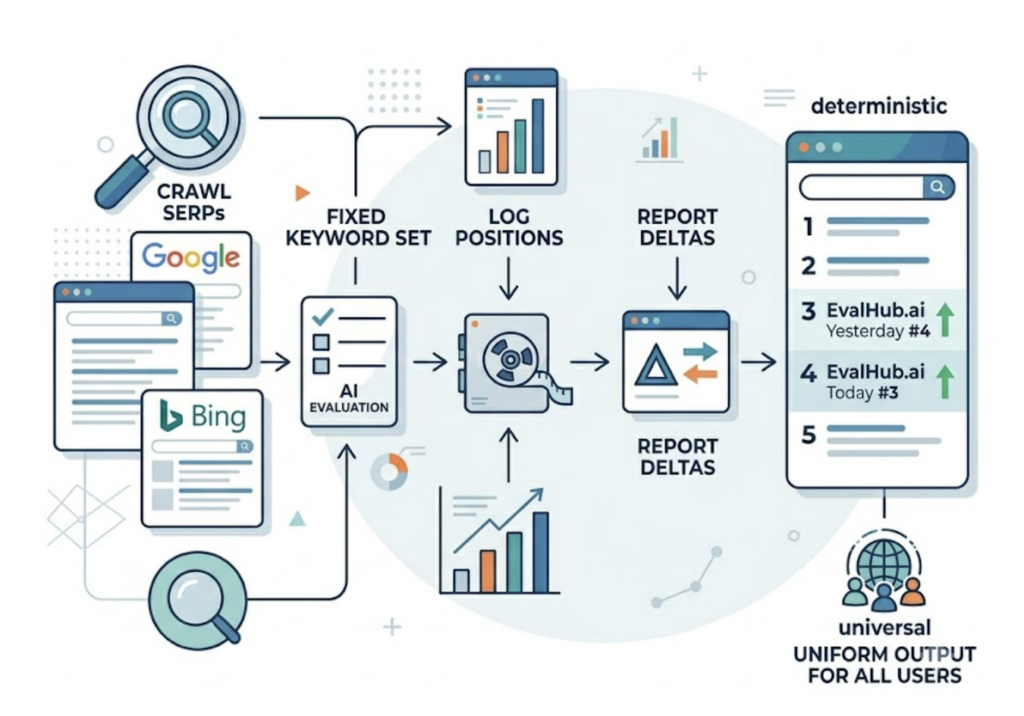
The model also shaped how monitoring works mechanically. Tools crawl SERPs on a schedule, log positions for a fixed keyword set, and report deltas. The output is deterministic: you ranked #4 yesterday, you rank #3 today, and anyone running the same query sees the same list.
None of that is wrong. It’s just incomplete. Traditional search monitoring tells you where your pages appear. It says nothing about what an AI answer actually said about your brand, or whether it said anything at all.
AI Search Monitoring Tracks Answers, Not Rankings
AI search monitoring starts from a different question: when someone asks ChatGPT, Perplexity, or Gemini about your category, does your brand show up in the answer, and how is it framed?
The unit of analysis shifts from keywords to prompts. People don’t type “best CRM small business” into an AI assistant. They ask, “What CRM should a 10-person agency use if we already run HubSpot for email?” Monitoring has to cover these conversational, multi-turn queries, which static keyword tracking can’t interpret.
The outputs shift too. There’s no rank in an AI answer. Responses are synthesized on the fly, and the same prompt can produce different brand lists across sessions. That makes AI search metrics probabilistic by design: instead of “position #3,” you measure how often your brand appears across thousands of sampled responses.
The core metrics that replace rankings:
- AI share of voice: how frequently your brand is mentioned relative to competitors across a defined prompt set
- Citation rate: how often AI answers link to your domain as a source
- Sentiment: whether the AI is recommending you, or mentioning you neutrally or negatively
- Position in answer: where you appear when multiple brands are listed
The collection method changes accordingly. Instead of scheduled SERP crawls, AI search monitoring runs active sampling: injecting a defined set of category prompts into each platform, capturing the generated answers, and extracting brand entities and citations from the output.
Side by Side: 7 Dimensions Where the Two Diverge
| Dimension | Traditional Search Monitoring | AI Search Monitoring |
|---|---|---|
| Primary goal | Driving click-through traffic to your domain | Building presence and trust within synthesized answers |
| Unit of analysis | Keywords and static SERP positions | Prompts and conversational sessions |
| Output type | Deterministic, rank 1 to 100 | Probabilistic, sampled mentions and citations |
| Core metrics | Rankings, backlinks, organic traffic | AI share of voice, citation rate, sentiment |
| Update logic | Scheduled crawling of SERPs | Active sampling of AI model responses |
| Optimization lever | On-page content, link building | Authority signals, brand entity consistency |
| Reporting unit | Position deltas per keyword | Visibility share per prompt, per platform |
The most counterintuitive row is output type. In traditional SEO, #1 is a fact. In AI search, there’s no equivalent fact to report, because each answer is generated fresh. A brand “ranking well” in AI search means it appears in, say, 62% of sampled answers for its core prompts this month, up from 54% last month.
This is why teams that try to force AI visibility data into a rank-tracking mental model get confused fast. The question isn’t “where do we rank.” It’s “how often do we appear, where in the answer, and in what tone.”
One more practical difference: volatility. AI citation patterns shift as models update and retrieval sources change, often within weeks. Monitoring cadence has to match that pace, which scheduled monthly rank reports were never designed for.
The Overlap Is Smaller Than You Think
The two systems do share a foundation. High-quality content, structured data, and topical authority feed both Google’s index and the retrieval pipelines behind AI answers. Investments there compound across both channels.
But shared inputs don’t mean interchangeable measurement. A site can pass every technical SEO audit and still go uncited, because the brand entity isn’t trusted or referenced in the sources LLMs retrieve from. Traditional tools have no metric that captures this. Domain authority doesn’t convert into citation rate at any fixed exchange rate.
The cleaner way to think about it: traditional search is your discovery layer, AI search is your authority and attribution layer. One tells users where to find you. The other tells them why to trust you.
And the second layer punches above its traffic weight. BrightEdge’s cross-industry research found that AI search visitors convert at roughly 23x the rate of traditional organic visitors, largely because users who click through from an AI answer arrive pre-qualified by the recommendation itself.
Bottom line: this isn’t an either/or decision. It’s a both/and architecture, with separate instrumentation for each layer.
Adding AI Search Monitoring Without Rebuilding Your Stack
The good news is that closing the gap doesn’t mean replacing anything. Your rank tracker keeps doing its job. AI search monitoring sits alongside it as a data overlay, and three capabilities determine whether that overlay is actually useful.
Cross-platform coverage. AI behavior varies by model. A brand can dominate Perplexity citations while being invisible to ChatGPT. Monitoring one platform and extrapolating is guesswork.
Prompt-level tracking. You need to know which specific questions trigger answers in your category, and whether your brand appears in them, not just whether your site “does well in AI” in the abstract.
Citation analysis. Citations are the new backlinks. That means tracking mention frequency, citation rate, and sentiment alignment together, because a brand that’s mentioned often but framed as the “budget option” has a different problem than one that’s not mentioned at all.
For teams evaluating how to add this layer, Topify covers all three in a single platform. It tracks brand presence across ChatGPT, Gemini, Perplexity, DeepSeek, and Google AI Overviews at the prompt level, scoring performance on seven metrics: visibility, sentiment, position, volume, mentions, intent, and CVR. In practice, that means you can watch your AI share of voice move week over week, then trace a drop back to a specific source that stopped citing you.
Its Source Analysis does for AI search what backlink analysis did for SEO: it reverse-engineers the exact domains and URLs each AI platform cites in your category, so content investment goes where citations actually come from. Plans start at $99/month, which keeps the entry cost below most single-seat rank trackers.
If you want a baseline before committing to anything, Topify’s free GEO score checker grades any URL on how well AI engines can crawl, parse, and cite it, no signup required. From there, you can start tracking your core prompts and build the AI layer of your reporting in an afternoon.
GEO Score Checker
Conclusion
The brands that get caught out in 2026 won’t be the ones with bad SEO. They’ll be the ones whose monitoring stopped at the SERP while their buyers moved to the answer.
Keep your traditional search monitoring running. It still measures a channel that drives real, high-intent traffic. Then add the layer it can’t see: pick your 20 to 50 highest-value category prompts, sample them across the major AI platforms, and establish a baseline for share of voice, citation rate, and sentiment. Once that baseline exists, the green dashboard stops being an illusion and starts being two honest dashboards instead.
FAQ
Q: What is the difference between traditional search monitoring and AI search monitoring? A: Traditional search monitoring tracks your position in a static list of ranked links, using keywords as the unit of analysis. AI search monitoring tracks your brand’s presence, citation frequency, and sentiment inside synthesized answers generated by LLMs, using prompts as the unit of analysis.
Q: Do I still need traditional search monitoring if I use AI search monitoring tools? A: Yes. Traditional search continues to drive significant bottom-of-funnel traffic, and its monitoring remains the right instrument for that channel. AI search monitoring covers brand authority and recommendation visibility, which rank trackers can’t measure. Most teams need both layers.
Q: How do you monitor brand mentions in ChatGPT and Perplexity? A: Through automated sampling: a monitoring system injects a defined set of category prompts into each platform on a recurring schedule, captures the generated answers, and uses entity recognition to identify brand mentions, citation links, and sentiment across the sampled responses.
Q: What search monitoring metrics matter most for AI visibility? A: AI share of voice, which measures how often your brand appears relative to competitors across sampled prompts; citation rate, which counts how often AI answers link to your domain; and brand sentiment, which captures whether the AI is actively recommending you or merely mentioning you.

