

Your search intelligence dashboard looks fine. Rankings are holding. Organic traffic is stable. The weekly report to your CMO is clean.
Meanwhile, someone asks ChatGPT which tools to use in your category. Your competitor gets recommended. You don’t. Nobody on your team knows it happened.
That’s the blind spot. And it’s growing.
The Data Your Search Intelligence Tool Was Built to Ignore
Traditional search intelligence tools were designed for a specific version of search: a user types a query, Google returns ten blue links, and the brand with the highest-ranking page wins the click.
Every major metric in your current stack reflects that model. Keyword rankings, backlink profiles, organic click volume, crawl health, SERP feature tracking. These are all measurements of how well you’re indexed and surfaced in a list-based retrieval system.
The problem is that AI search doesn’t work that way. ChatGPT, Perplexity, and Google AI Overviews don’t return lists. They synthesize answers. And the mechanics of how a brand gets included in a synthesized answer have almost nothing to do with the metrics your search intelligence platform is tracking.
Your tool wasn’t built to ignore AI-generated answers. It was built before they existed.
What “Search Intelligence” Actually Measures Today
Most search intelligence platforms track some combination of the following: keyword position, estimated traffic, domain authority, backlink acquisition, and on-page technical signals.
These dimensions are still worth tracking. They tell you how you’re performing in traditional search, which still drives the majority of navigational and transactional queries. Google’s traditional search still processes roughly 50 billion queries per week, and ranking well there matters.
But here’s what those seven metrics have in common: they all measure your relationship with an index. None of them measure your relationship with an AI model’s output.
When Perplexity generates a response to “best analytics tools for marketing teams,” it doesn’t check your domain authority. It synthesizes from sources it deems credible and relevant for that specific query context. Your search intelligence tool has no visibility into whether you appeared, where you appeared, or how you were described.
The Blind Spot: 3 Things AI Answers Do That Google Results Don’t
1. AI rankings and SERP rankings don’t correlate.
Ranking #1 on Google for a query doesn’t guarantee you appear in the AI summary for that same query. This isn’t a fringe edge case. It’s a structural feature of how generative search works. The model selects sources based on contextual credibility signals, not organic position. Your search intelligence platform provides no alert when a competitor displaces you in that AI answer.
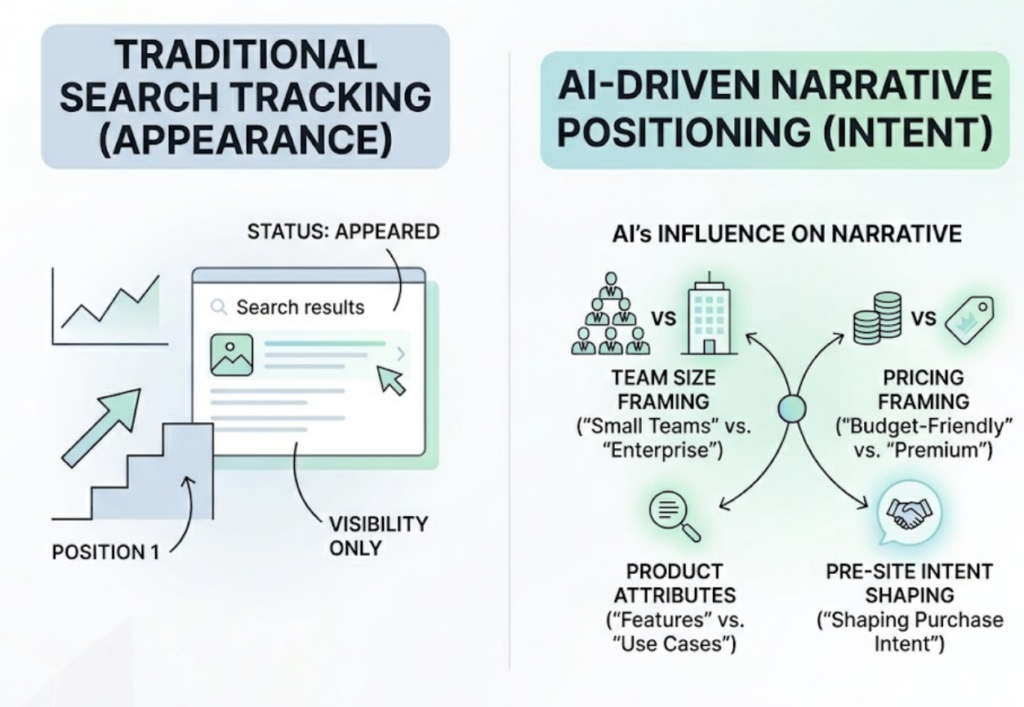
2. AI characterizes brands, not just lists them.
Traditional search tools measure whether you appear. AI search changes the stakes: it determines how you’re described. An AI might recommend your product as “ideal for small teams” when you’re trying to close enterprise deals. It might frame your pricing as “budget-friendly” while you’re positioning as premium. That narrative is shaping purchasing intent before users ever reach your site. No current SERP tracking tool captures this.
3. AI citation sources bear no resemblance to your backlink profile.
AI platforms frequently pull from secondary sources like industry review sites, Reddit threads, and niche blogs, rather than your official landing pages. The domains your SEO team has spent years building authority with may have zero influence over what an LLM chooses to cite. According to research, up to 88% of users interacting with AI summaries don’t click through to a source at all. Your backlink strategy and your AI citation footprint are operating in parallel universes.
Why This Blind Spot Costs More Than You Think
The stakes are higher than most teams realize. AI search has captured high-intent query volume at a scale that warrants attention: ChatGPT Search handles an estimated 250–500 million queries per week, with Google AI Overviews active for over 200 million users and Perplexity processing 50 million queries weekly.
Users on these platforms aren’t browsing. They’re making decisions. “Which tool should I use for X?” and “What’s the difference between A and B?” are exactly the queries where AI delivers synthesized answers instead of links.
Getting included in those answers is also significantly harder than ranking in traditional search. Research from Trustmary estimates that appearing in AI recommendations is 3x to 30x harder than achieving a top-10 Google ranking, since AI models act as gatekeepers based on brand authority, E-E-A-T signals, and review sentiment.
Your search intelligence dashboard doesn’t report on any of this. It shows no warning. No competitor alert. No visibility drop. It looks fine.
What a Complete Search Intelligence Stack Looks Like in 2026
The answer isn’t to replace your current tools. SEMrush and Ahrefs are still doing their jobs. The answer is to add the data layer they can’t see.
A complete search intelligence stack in 2026 has two components:
The traditional layer handles SERP rankings, backlink health, crawl diagnostics, and organic traffic attribution. You likely already have this.
The AI visibility layer handles everything your traditional tools miss: how often your brand appears in AI-generated answers (mention rate), how AI platforms characterize your brand (sentiment and narrative), which domains AI is actually citing when it discusses your category (citation sources), and where your brand ranks relative to competitors inside AI responses (position tracking).
These aren’t redundant metrics. They measure a completely different part of the search funnel. Zero-click search behavior is now pervasive, with data showing 69% of searches ending without a click, which means a significant portion of your market is forming impressions from AI-generated summaries that your dashboard never registers.
How Topify Fills the Gap Your Search Intelligence Tool Leaves Behind
Topify was built specifically for the data layer your current stack can’t access. It tracks brand performance across ChatGPT, Gemini, Perplexity, DeepSeek, Doubao, and Qwen, and translates that into seven structured metrics: visibility, sentiment, position, volume, mentions, intent, and CVR.
For teams already running traditional search intelligence workflows, the integration is additive. You keep your existing tools for SERP performance. Topify handles the AI answer layer.
Visibility Tracking monitors how often your brand appears in AI-generated answers across platforms and compares it against competitors. If your mention rate drops in ChatGPT while a rival’s climbs, you’ll see it.
Source Analysis tracks which domains AI platforms are actually citing when they reference your category. This often reveals a gap: the sites driving AI citations aren’t the same sites your SEO link-building targets. That mismatch is where content strategy adjustments start.
Sentiment Analysis captures how AI describes your brand, scored on a 0–100 scale. If Perplexity consistently frames you as an entry-level option when you’re targeting mid-market, that’s a positioning problem that requires a different fix than a ranking problem.
Competitor Monitoring shows who else appears in the AI responses where your brand is mentioned or should be mentioned. It surfaces competitors you may not be tracking in traditional search, including newer players that AI models have already started recommending.
Topify’s Basic plan starts at $99/month and covers 100 prompts across ChatGPT, Perplexity, and Google AI Overviews tracking. For teams managing multiple brands or deeper prompt coverage, Pro starts at $199/month. You can get started here.
Conclusion
Your search intelligence platform isn’t broken. It’s doing exactly what it was designed to do: track how you perform in a link-based retrieval system.
But search in 2026 has two operating layers. The traditional layer, where your tools have full visibility. And the AI synthesis layer, where you’re flying blind.
The brands that close this gap first will have a measurable advantage in high-intent AI queries while their competitors keep optimizing for a dashboard that can’t see the full picture. Adding AI visibility tracking to your stack is the most direct path to closing it.
FAQ
Q: Can my existing search intelligence tool be updated to track AI search visibility?
A: Most traditional SEO platforms have added some surface-level AI features, like tracking whether your site appears in Google AI Overviews. But they typically don’t measure brand mention rate across ChatGPT or Perplexity, AI-generated sentiment, or citation source analysis at the prompt level. These require a purpose-built AI visibility layer, not a bolt-on feature.
Q: How is AI visibility tracking different from brand monitoring tools?
A: Brand monitoring tools track mentions across social media, news sites, and web content. AI visibility tracking specifically measures what AI engines say about your brand in response to high-intent queries, including whether you appear, how you’re described, which sources are cited, and how you rank against competitors within the AI answer itself. The data structure and measurement methodology are fundamentally different.
Q: If I rank #1 on Google, why wouldn’t I automatically appear in AI answers?
A: AI models don’t retrieve from a ranking list. They synthesize from sources that appear credible and relevant for a specific query context, which can include forums, review aggregators, industry blogs, and news coverage rather than the top-ranked landing page. Strong SERP performance and strong AI mention rate require partially overlapping but distinct strategies.
Q: How many AI prompts should I be tracking to get meaningful data?
A: It depends on your category breadth and competitive landscape. For most B2B brands, tracking 50–100 prompts across two to three AI platforms covers the high-intent query surface that drives purchasing decisions. Topify’s Basic plan includes 100 prompts, which is sufficient for teams starting to build their AI visibility baseline.

