

Your SEO dashboard looks clean. Rankings are stable, traffic is steady, and your team’s monthly report shows nothing alarming. Meanwhile, someone just asked ChatGPT which vendor to use in your exact category, and your brand wasn’t in the answer.
That’s the gap search intelligence tools were built for. The question is whether yours actually closes it.
Your Search Intelligence Tool Probably Misses 80% of AI Search
Most tools marketed as “search intelligence” were built for a click-driven world. They track keyword positions, backlink profiles, and crawl data across Google and Bing. That coverage made sense five years ago.
It doesn’t anymore.
Around 55% of users now rely on AI chat as a primary or frequent research channel. That’s not a niche behavior; it’s how your buyers are doing product research before they ever touch a search bar. And the overlap between what ranks on Google and what gets cited in AI-generated answers is surprisingly small: domain overlap between AI search results and traditional Google organic results can be as low as 11–42%, depending on the industry.
That means a brand can hold the #1 Google ranking and still be completely invisible in the AI answer for the same query.
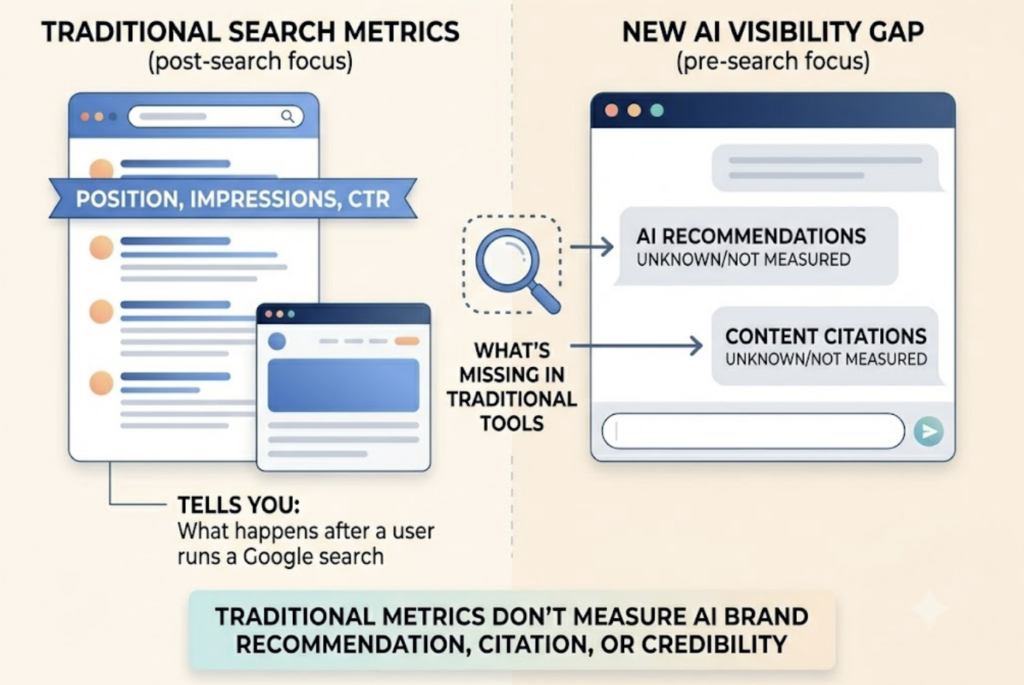
Traditional search intelligence tools don’t measure this. They weren’t designed to. The metrics they surface, such as position, impressions, and click-through rate, describe what happens after someone runs a Google search. They tell you nothing about whether an AI engine is recommending your brand, citing your content, or framing you as a credible solution.
The 6 AI Platforms a Search Intelligence Tool Should Cover
Not all AI platforms behave the same way. Each has its own citation logic, audience, and recommendation patterns. Tracking one doesn’t tell you how you’re doing on the others.
Here’s the landscape marketing teams need to cover in 2026:
| Platform | Search Style | Why It Matters |
|---|---|---|
| ChatGPT | Conversational synthesis | Highest volume; frames answers in natural language |
| Perplexity | Reference-first | Highly sensitive to citation credibility and source agreement |
| Google AI Mode | Hybrid ecosystem | 67–86% overlap with traditional SEO, but adds unique ranking signals |
| Claude (Anthropic) | Analytical depth | Prioritizes factual density; heavily used in professional research contexts |
| DeepSeek | Technical/developer-focused | Growing influence in developer-centric and technical search patterns |
| Doubao / Qwen | Asian market leaders | Essential for brands with significant footprint in East Asian markets |
The key insight from this table: being cited on Perplexity does not guarantee a mention on ChatGPT. Each platform indexes differently, weights sources differently, and reaches a different segment of your audience.
A search intelligence tool that only monitors one or two of these platforms is giving you a partial picture. And partial pictures lead to incomplete strategies.
Topify tracks brand visibility across all six of these platforms, including ChatGPT, Gemini, Perplexity, DeepSeek, Doubao, and Qwen, from a single dashboard. For brands with global audiences or diverse buyer personas, that coverage isn’t optional.
What Marketing Teams Actually Track With Search Intelligence Tools
The metrics that matter in AI search are different from the ones on your SEO dashboard. Marketing teams that have made the shift are tracking five core dimensions:
Visibility Rate measures the percentage of high-intent prompts where your brand gets mentioned. This is the foundational metric. If your brand doesn’t appear in the answers your buyers are reading, nothing else matters.
Citation Frequency tracks how often your owned content, such as blog posts, product pages, and documentation, gets selected as a primary source compared to competitors. High citation frequency typically signals that AI models consider your content authoritative.
Share of Model (SoM) is the AI equivalent of share of voice. It measures your brand’s percentage of total mentions within a defined prompt set across platforms. A drop here, before it shows up in traffic data, is often the first signal that a competitor is gaining ground.
Sentiment Alignment is where most teams are still catching up. AI responses don’t just list sources; they frame them. A model might mention your brand while describing it as “budget-friendly” when your positioning is premium, or “complex to implement” when you’ve invested heavily in onboarding. Monitoring that framing is now a brand safety issue.
Referral Conversion closes the loop by tracking the quality of traffic originating from AI-referred sources, specifically assisted conversions and pipeline acceleration.
Topify’s platform surfaces all of these through seven tracked metrics: visibility, sentiment, position, volume, mentions, intent, and CVR (Conversion Visibility Rate). The CVR metric in particular estimates how likely an AI-generated answer is to drive a user toward a brand interaction, which is something no traditional search intelligence tool measures.
How to Set Up Cross-Platform AI Visibility Tracking in 3 Steps
The implementation is more straightforward than most teams expect. Here’s how marketing teams are building this into their workflows.
Step 1: Identify high-intent prompts. Don’t try to track everything. Curate a focused list of buyer-stage questions: product comparisons, use-case queries, and decision-stage keywords. These are the prompts that actually influence purchase behavior. Topify’s High-Value Prompt Discovery feature surfaces these automatically, flagging queries with high AI search volume that are relevant to your category.
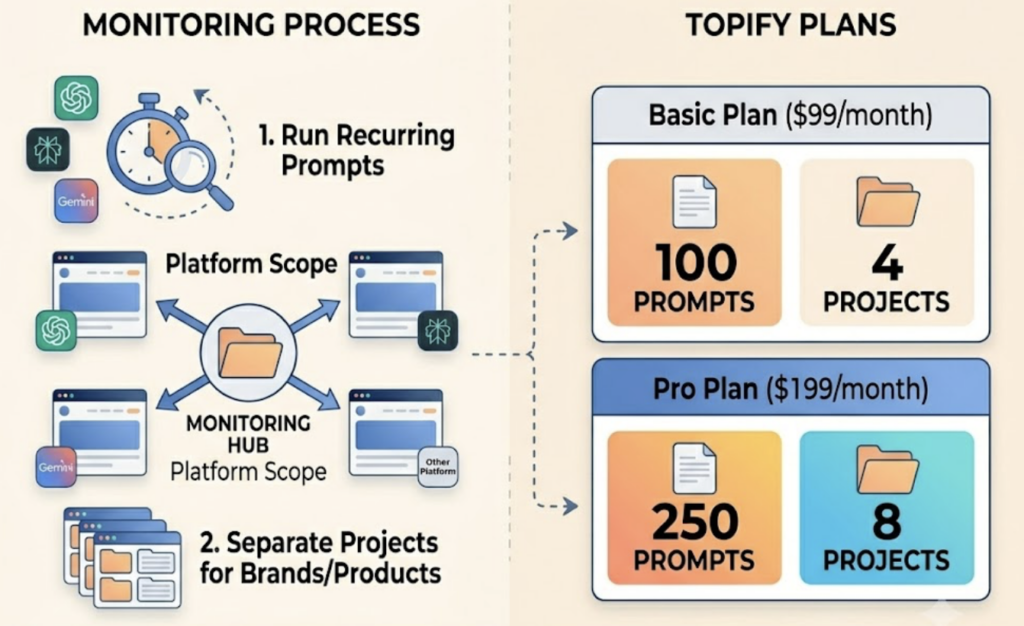
Step 2: Configure cross-platform monitoring. Run recurring prompts across ChatGPT, Perplexity, Gemini, and the other platforms in your scope. Set up separate projects for each brand or product line you’re tracking. Topify’s Basic plan supports up to 100 prompts across 4 projects at $99/month, with Pro expanding to 250 prompts across 8 projects at $199/month.
Step 3: Feed findings into content strategy. This is where the data becomes action. Use citation and source analysis to identify which content types AI models trust and which gaps your competitors are filling. Restructure content for extractability: clear answers up front, structured data, and objective technical specifications that AI models are more likely to cite.
Topify’s One-Click Execution feature lets you define your optimization goals in plain English and deploy the resulting strategy without building manual workflows. For teams running multiple brands or client accounts, that’s where the time savings compound.
When Search Intelligence Catches What Your SEO Dashboard Misses
Here’s a scenario that’s playing out across marketing teams right now.
A brand’s Google rankings are stable. Organic traffic looks normal. Nothing in the SEO dashboard suggests a problem. Then, a quarter later, traffic drops and nobody can explain why.
Source analysis in search intelligence tools often reveals shifts in AI citation patterns before they appear as ranking fluctuations in traditional data. If a competitor starts dominating Perplexity citations for a key “best X vs Y” query, that influence works its way through the buyer research funnel before it ever registers as a traffic decline on your end.
That’s the predictive advantage of AI-native search intelligence. It doesn’t just describe what’s happening in search. It surfaces what’s about to happen, because AI engines are shaping buyer intent earlier in the funnel than Google is.
Topify’s Source Analysis tracks exactly which domains and URLs AI platforms are citing, and whether your content is gaining or losing ground in that citation layer. When a competitor’s pricing page starts getting cited more frequently than yours for high-intent comparison queries, you see it in the data before you feel it in the pipeline.
That’s not a feature SEO tools have. It’s a different category of intelligence.
Conclusion
Search intelligence has always been about understanding why buyers choose one brand over another. That logic hasn’t changed. What’s changed is where that decision gets shaped.
Increasingly, it happens in AI-generated answers, before a user ever visits a website. A search intelligence tool that only monitors Google is watching the second half of the decision. If you want the full picture, you need coverage across the platforms where AI is synthesizing the answers your buyers are reading first.
Get started with Topify to track your brand visibility across ChatGPT, Gemini, Perplexity, DeepSeek, Doubao, and Qwen from a single platform.
FAQ
Q: What is a search intelligence tool?
A: A search intelligence tool tracks how and where your brand appears in search results, including AI-generated answers, citation patterns, and competitive positioning across search platforms. Modern tools extend beyond Google and Bing to cover AI engines like ChatGPT and Perplexity.
Q: How many AI platforms should a search intelligence tool cover?
A: At minimum, it should cover the platforms your target audience actively uses. For most marketing teams in 2026, that means ChatGPT, Perplexity, and Google AI Mode. For brands with global reach or technical audiences, adding DeepSeek, Doubao, and Qwen is worth the additional coverage.
Q: How often should marketing teams check their AI visibility data?
A: AI citation patterns can shift in days, not months. Teams tracking competitive categories typically review visibility and sentiment data weekly, with automated alerts set for significant position changes or sentiment shifts on high-value prompts.
Q: Can a search intelligence tool replace traditional SEO tracking?
A: Not entirely. Traditional SEO tools still provide essential data for Google-driven traffic. The stronger approach is to run both in parallel: SEO tools for click-driven channel performance, and AI-native search intelligence tools for citation-layer visibility. The two datasets tell different parts of the same story.

