

Your domain authority is strong. Your keyword rankings are solid. You’re in the top three for most of your target terms. Then someone on your team asks ChatGPT which solution to recommend in your category, and your brand isn’t mentioned once.
That’s not a content gap. That’s a tooling gap. The search intelligence tools most teams rely on weren’t built to see what AI chooses to say.
Search Intelligence Used to Mean Keyword Rankings. It Doesn’t Anymore.
For over a decade, search intelligence meant one thing: tracking where your pages ranked on Google, how much search volume a keyword had, and how your click-through rates compared to competitors. That framework was complete, because Google was search.
That assumption no longer holds.
AI search engines, including ChatGPT, Perplexity, Gemini, and Google’s own AI Mode, don’t return ten blue links. They synthesize answers. And according to 2026 data, roughly 83% of searches involving AI Overviews result in zero clicks, with that number rising to 93% for queries handled entirely in AI Mode. The content still exists. The traffic just doesn’t flow the way it used to.
Traditional search intelligence tools measure visibility in a world that’s getting smaller.
What a Search Intelligence Tool Actually Tracks in 2026
A complete search intelligence tool now needs to operate across three dimensions, not one.
The first is classic: keyword rankings, SERP positions, organic traffic. This layer still matters for technical SEO and legacy search. It’s not going away.
The second is new: AI answer visibility. Whether your brand appears in the synthesized response when a user asks an AI engine for a recommendation in your category. This is where most current tools go blind.
The third is newer still: citation source intelligence. AI engines don’t pull from everywhere equally. They have preferred sources, and they increasingly rely on content updated recently, with 76% of AI-cited content in 2026 refreshed within the last 30 days. Knowing which domains get cited, and whether yours is among them, is now a core measurement task.
Miss any of these three layers, and you’re operating on partial data.
The Gap Nobody Warned You About
Here’s the core problem with the old definition: ranking and being mentioned are no longer the same thing.
A brand can hold the top organic position for a category keyword while being completely absent from every AI-generated recommendation for that same query. The inverse is also true. Some brands with modest Google rankings show up consistently in ChatGPT and Perplexity answers because they’ve become trusted citation sources within a specific topic cluster.
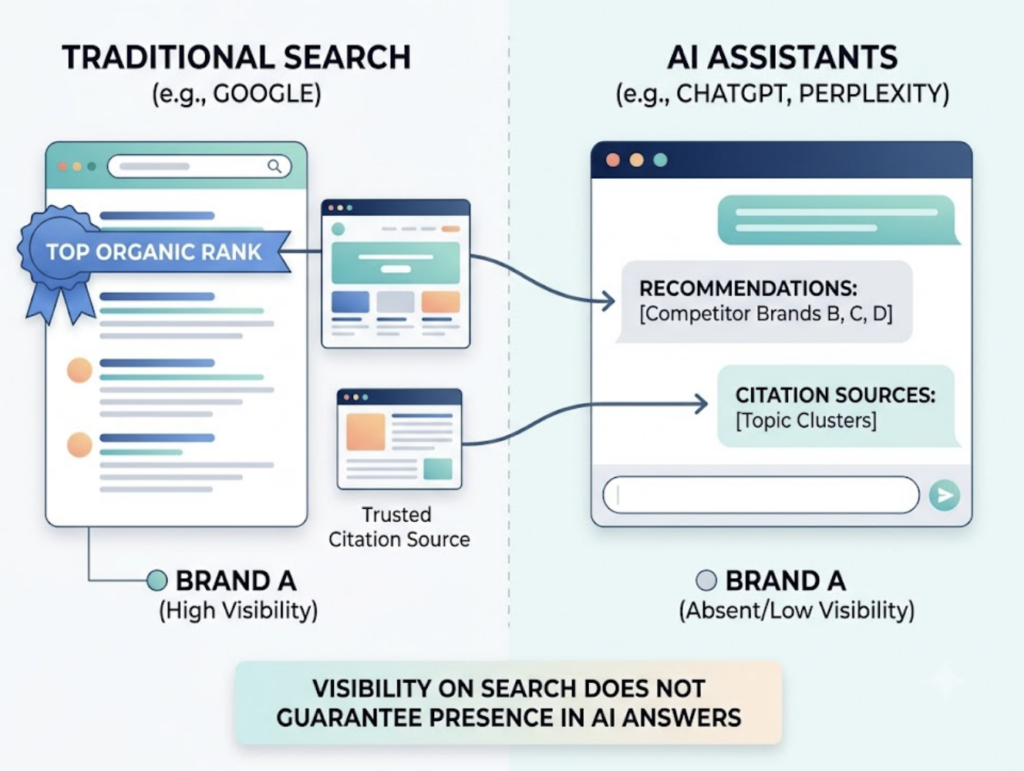
This is what researchers call “ranking-mention separation.” It’s not a bug in how AI search works. It’s a structural feature. AI engines use Retrieval-Augmented Generation (RAG) pipelines that retrieve, re-rank, and synthesize content differently from how PageRank worked. A brand’s Google ranking is now a secondary signal in that process, not the primary gate.
Traditional search intelligence tools can’t measure this gap. They weren’t built to.
What Search Intelligence Looks Like When It Actually Covers AI Search
A search intelligence tool built for 2026 needs specific capabilities that didn’t exist in the previous generation of platforms.
First, it needs to track brand mentions across AI platforms, not just Google. That means ChatGPT, Perplexity, Gemini, DeepSeek, and regional AI engines like Doubao and Qwen if you’re operating in multiple markets. Single-platform monitoring understates your actual exposure by a wide margin.
Second, it needs prompt-level granularity. Not just “is your brand visible in AI search generally,” but “for this specific high-value query, does the AI include your brand, and if not, what source is it citing instead?” That’s an actionable data point. A general visibility score isn’t.
Third, it needs sentiment and contextual framing analysis. AI engines don’t just mention brands; they characterize them. If Perplexity consistently describes your product as “a budget option” while your positioning is mid-market or premium, that’s a brand intelligence problem, and it’s invisible to any tool that only tracks whether you were mentioned.
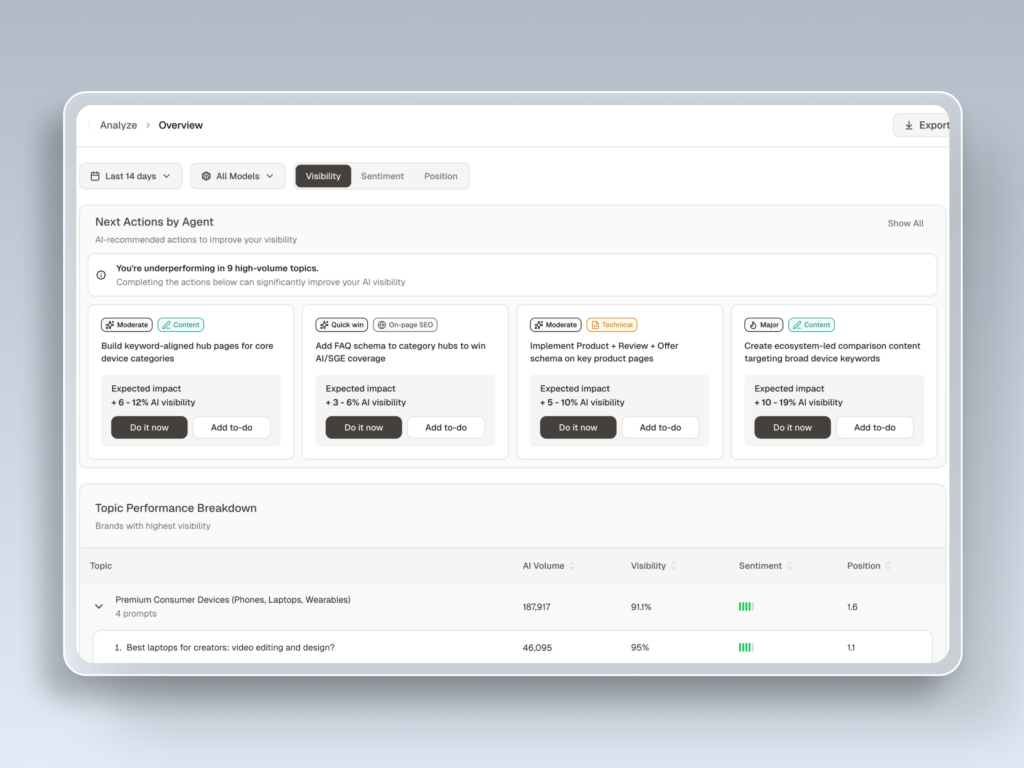
Topify is built around exactly this architecture. Its platform monitors seven metrics across AI platforms: visibility, sentiment, position, volume, mentions, intent, and CVR. The Source Analysis feature shows which domains the AI engines are actually citing in your category, and the High-Value Prompt Discovery layer surfaces specific queries where competitors are getting recommended and you’re not. That’s the gap most brands still can’t see.
Why Most Marketing Teams Haven’t Updated Their Toolstack Yet
The honest answer is inertia, compounded by a framing problem.
Teams that have used SEMrush or Ahrefs for years don’t feel the absence of AI visibility data because traditional dashboards look complete. They show rankings. They show traffic. Nothing is obviously missing, even when a competitor is being recommended in ChatGPT fifty times a day.
There’s also a technical barrier. Understanding why your brand doesn’t appear in AI answers requires knowing how RAG pipelines work, specifically that content fails not just at retrieval but at a secondary re-ranking stage. A cross-encoder re-ranking filter evaluates whether a page is directly relevant to the specific prompt before it reaches the LLM. If your content is structured for Google’s crawlers rather than for answer-ready synthesis, you’re getting filtered out before the AI even considers you.
The fix isn’t abandoning your SEO stack. It’s augmenting it with tooling that can see the AI layer.
How to Evaluate a Search Intelligence Tool Today
Three criteria separate tools that have genuinely adapted from those that are adding AI-flavored dashboards to legacy infrastructure.
Platform coverage. A tool that only tracks ChatGPT is covering roughly one slice of AI search. A complete picture requires monitoring across ChatGPT, Perplexity, Gemini, DeepSeek, and, if relevant to your market, Doubao and Qwen. Ask specifically: which AI engines are included, and how frequently are they queried?
Prompt-level granularity. Aggregate visibility scores are useful for trend-spotting. They’re not useful for action. What you need is the ability to identify specific high-value prompts where your brand should appear and doesn’t, and to understand which sources are filling that gap instead.
Actionability. Data without a clear path to optimization is reporting, not intelligence. The best tools close the loop, identifying what content change, schema update, or source-building action would improve visibility for a specific prompt. Topify’s One-Click Execution does this directly: define your goal, review the proposed action, deploy. No manual workflow required.
Pricing starts at $99/month for the Basic plan, which includes tracking across ChatGPT, Perplexity, and AI Overviews with 100 prompts and 9,000 AI answer analyses per month. That’s enough coverage for most mid-sized teams to start closing the visibility gap without a major budget commitment.
Conclusion
Search intelligence hasn’t disappeared. It’s expanded. The teams that treat it as “keywords plus AI mentions” will have a more complete picture than those still running on 2022-era tooling. The teams that add prompt-level granularity, citation source tracking, and AI sentiment monitoring will be the ones who can actually explain why their brand is or isn’t showing up when a potential customer asks an AI for a recommendation.
The definition changed in 2026 because search itself changed. The toolstack needs to catch up.
FAQ
Q: Is a search intelligence tool the same as an SEO tool?
A: Not anymore. Traditional SEO tools track keyword rankings, backlinks, and SERP performance on Google. A modern search intelligence tool also covers AI answer visibility, which means whether your brand appears in ChatGPT, Perplexity, or Gemini responses. The two overlap but don’t duplicate each other.
Q: What AI platforms should a search intelligence tool cover?
A: At minimum: ChatGPT, Perplexity, and Google’s AI Overviews. Comprehensive coverage also includes Gemini, DeepSeek, and regional platforms like Doubao and Qwen if your audience is in markets where those engines are dominant.
Q: How often should search intelligence data be updated?
A: For AI search, weekly updates are a floor, not a ceiling. AI citation patterns shift as models are updated and source authority changes. Since 76% of AI-cited content in 2026 was refreshed within the last 30 days, freshness monitoring needs to run continuously.
Q: Do small brands or startups need a search intelligence tool?
A: If your category sees any AI search activity, yes. Smaller brands often have the most to gain: you’re not fighting a legacy keyword ranking war, so if you can get your content into AI citation sources early, you can appear in recommendations ahead of incumbents who aren’t optimizing for this layer yet.

