

Your keyword rankings are solid. Your domain authority is strong. But last week, a potential customer asked ChatGPT for the best tool in your category, and your brand didn’t appear once. Not in position three. Not at the bottom. Just gone.
That’s not a content quality problem. That’s a measurement gap. The search intelligence tools your team relies on were built for a world where ranking meant visibility. In 2026, they’re flying blind on the channel that’s increasingly shaping buyer decisions before a single search result is clicked.
What Classic Search Intelligence Tools Don’t See Anymore
Traditional search intelligence was engineered for the link-and-rank era. SEMrush, Ahrefs, SimilarWeb — these platforms are exceptional at what they were designed to do: track keyword positions, monitor backlink profiles, and analyze Google SERP performance. The problem is that more search behavior is happening somewhere else.
As of Q2 2026, ChatGPT has surpassed 1 billion monthly active users, while Perplexity processes over 780 million queries per month. Roughly 10–15% of total search traffic has already migrated to AI-native interfaces. That number is growing.
AI engines don’t rank websites the way Google does. They synthesize content into a single conversational answer, drawing on sources based on factual density, technical precision, and semantic relevance. A strong backlink profile doesn’t guarantee a citation. A brand can hold the number one Google position for a query while being completely absent from the AI-generated answer to the exact same question. Traditional search intelligence tools have no mechanism to detect that gap.
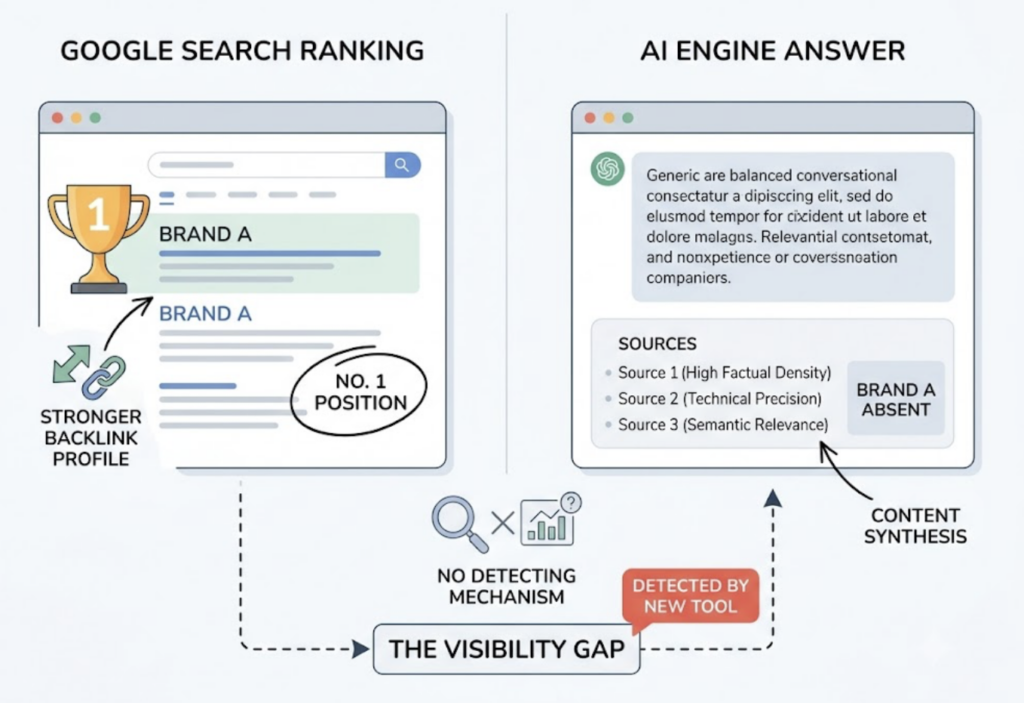
That’s the structural blind spot. And it’s not a feature request — it’s a category problem.
What a Modern Search Intelligence Tool Needs to Measure
If traditional search intelligence tracked where you ranked, AI-native search intelligence tracks whether you’re recommended. Those are fundamentally different questions, and they require fundamentally different data.
Effective AI search intelligence needs to operate across five dimensions:
| Dimension | What It Tracks | Why It Matters |
|---|---|---|
| Platform Breadth | Model-specific visibility across AI engines | Claude, Gemini, and ChatGPT weight sources differently based on their retrieval systems |
| Brand Mention Rate | Share of Model (SoM) vs. competitors | Measures how often your brand appears in answer sets relative to rivals |
| Sentiment Analysis | How AI frames your brand | “Industry leader” vs. “budget alternative” shapes buyer perception at the research stage |
| Citation Source Tracking | Which specific URLs AI platforms cite | Lets you reverse-engineer the content AI trusts and optimize toward it |
| Competitor Benchmarking | Real-time relative positioning | Shows who’s gaining Top-of-Answer dominance in your category |
The metric that has emerged as the standard for AI search performance is Share of Model (SoM), calculated as (Your Citations / Total Citations) × 100. It’s the closest equivalent to “market share” that exists for AI-generated answers.
A search intelligence tool that doesn’t measure at least three of these dimensions isn’t measuring AI search. It’s measuring something adjacent to it.
AI Search Intelligence Tools: What the Market Looks Like Now
The tools on the market split into two categories: traditional SEO suites that have added AI monitoring features as an afterthought, and platforms built natively for the AI search environment. The distinction matters more than most teams realize.
Here’s how the two categories compare across the dimensions that actually matter:
| Capability | Topify | Traditional SEO Suites (Semrush / Ahrefs) |
|---|---|---|
| AI Platform Coverage | Native (ChatGPT, Perplexity, Gemini, DeepSeek, Doubao, Qwen) | None — Google SERP only |
| Citation Tracking | URL-level Source Analysis | Backlink-level only |
| Sentiment Scoring | Automated AI-sentiment scoring, 0–100 | Not available |
| Actionability | One-Click Strategy Execution | SEO task management |
| Primary Metric | Share of Model / CVR | Keyword position / domain authority |
Traditional suites aren’t going away. For Google-focused measurement, they remain the standard. But if AI search is part of your audience’s research behavior — and at 1 billion ChatGPT users, it almost certainly is — relying on them alone leaves a measurable blind spot in your intelligence stack.
Why Topify Works as a Search Intelligence Tool for the AI Era
Topify was built around the premise that AI visibility requires a different measurement architecture, not a patch applied to an existing SEO product.
The platform tracks brand performance across seven indicators: Visibility, Sentiment, Position, Volume, Mentions, Intent, and CVR (Conversion Visibility Rate). Each maps to a specific layer of how AI engines discover, evaluate, and recommend brands.
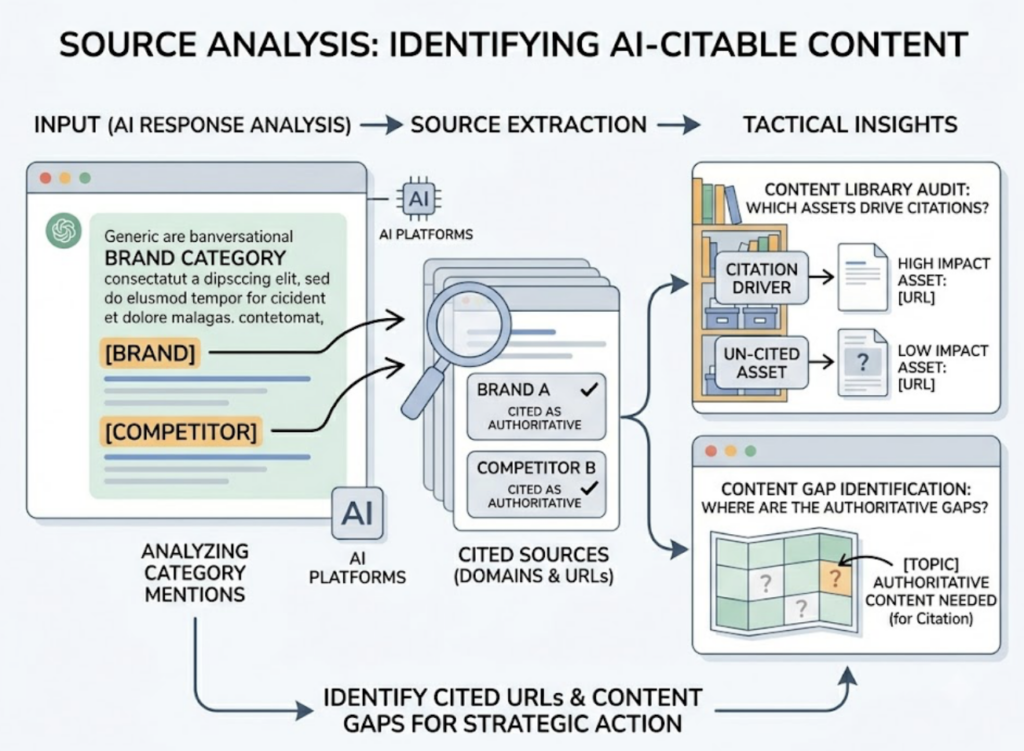
Source Analysis is one of the more tactically useful features. It identifies the exact domains and URLs that AI platforms are citing when they mention brands in your category. This lets content teams identify which assets are driving AI citations, which aren’t, and where the gaps are between your content library and what AI considers authoritative.
High-Value Prompt Discovery works differently from traditional keyword research. Instead of tracking search volume for a list of terms, it surfaces the specific questions that users are actively asking AI assistants during the buying research phase. These are the prompts where brand visibility translates most directly to pipeline.
Competitor Monitoring provides a real-time view of how rivals are performing across the same AI platforms. You can see which competitor is gaining Top-of-Answer positioning, track changes over time, and get a clear picture of where your brand stands relative to the field rather than just in absolute terms.
One-Click Execution is what separates a reporting tool from an optimization tool. State your goal in plain English, review the proposed strategy, and deploy it without manual workflows. Most search intelligence platforms stop at the data layer. Topify connects data to action.
Pricing is straightforward: $99/mo on the Basic plan for teams tracking up to 100 prompts across ChatGPT, Perplexity, and Google AI Overviews, and $199/mo on Pro for expanded coverage and competitor monitoring. Enterprise starts at $499/mo.
What AI Search Reveals That Google Analytics Never Could
Google Analytics measures clicks. AI search intelligence measures what happens before the click.
That distinction matters because AI platforms increasingly function as top-of-funnel gatekeepers. A user researching software options doesn’t always start with a Google search anymore. They ask ChatGPT for a comparison, get a synthesized answer with three or four recommended options, and then go to Google (or directly to a website) for one of those brands. If your brand wasn’t in the AI answer, you were never in consideration.
A team can watch stable or growing traffic in GA and miss the fact that their Share of Model is declining across AI platforms. That’s a leading indicator of pipeline pressure that traditional search intelligence has no way to surface. The AI answer layer influences buyer research at a stage that precedes any trackable click, which is exactly why GA’s measurement model can’t see it.
The brands that will have a structural advantage over the next two to three years are the ones building AI search intelligence into their analytics stack now, not as a reaction to visible traffic drops.
How to Pick the Right AI Search Intelligence Tool for Your Team
The right tool depends less on feature count and more on which measurement gap is most expensive for your team to leave unmonitored.
For marketing and SaaS teams, the priority is Brand Mention Rate and Sentiment. These tell you whether AI is framing your product correctly during the research phase, and they’re the levers most directly connected to how prospects perceive you before they ever land on your site. Topify’s Visibility Tracking and Sentiment Analysis are the entry points for this use case.
For SEO specialists, Source Analysis is the most actionable feature. It maps which content assets are driving AI citations, so you can audit your library and direct production resources toward formats and topics that AI systems actually trust. This is different from traditional link building — it’s building for citation.
For agencies managing multiple clients, Competitor Monitoring and Position Tracking make it possible to demonstrate AI search performance in client reporting. “Your brand appears in 34% of AI answers in this category, up from 22% last quarter” is a data point traditional SEO suites can’t produce.
The common thread across all three use cases: the tool needs to cover multiple AI platforms, not just one. A search intelligence platform that tracks only ChatGPT misses the citation behavior of Perplexity, Gemini, and the AI engines gaining traction in international markets. Get started with Topify to see how your brand performs across the full landscape.
Conclusion
The brands investing in search intelligence right now are largely investing in the wrong thing. Not because SEO is dead — it isn’t — but because the measurement architecture they’re relying on was designed for a search environment that no longer accounts for the full picture.
AI search engines now influence buyer decisions at a stage that Google Analytics can’t see and traditional search intelligence tools weren’t built to track. Share of Model, sentiment framing, citation source analysis: these are the metrics that map to how AI shapes your pipeline in 2026. The tools that measure them are a different category, not a feature upgrade.
Your Google rankings are worth protecting. But if your brand is invisible in the AI answer layer, you’re optimizing for visibility in a channel your buyer already moved past.
FAQ
Q: What’s the difference between traditional search intelligence and AI search intelligence?
A: Traditional search intelligence tracks keyword rankings, backlinks, and SERP positions on Google. AI search intelligence tracks whether and how your brand appears in AI-generated answers across platforms like ChatGPT, Perplexity, and Gemini. The core metrics are different: domain authority vs. Share of Model, keyword position vs. sentiment framing and citation rate.
Q: Do I need a separate tool if I already use SEMrush or Ahrefs?
A: For AI search visibility, yes. Existing SEO suites are built for Google SERP data and don’t have native coverage of AI platform behavior. They can’t track brand mention rates in ChatGPT, citation sources in Perplexity, or sentiment scoring across AI engines. An AI-native search intelligence tool covers the layer they don’t reach.
Q: Which AI platforms should my search intelligence tool cover?
A: At minimum, ChatGPT, Perplexity, and Google AI Overviews. For global coverage, look for platforms that also include Gemini, DeepSeek, Doubao, and Qwen, which are gaining significant share in Asian markets. A tool that covers only one or two platforms will give you an incomplete picture of your AI search presence.
Q: How often do AI search rankings change?
A: More frequently than Google rankings. AI citation patterns can shift within weeks as models update their retrieval logic, new content is indexed, or competitor activity changes. This is why real-time monitoring matters more for AI search intelligence than it traditionally has for SEO.

