

Your search intelligence stack was built for a world where Google owned discovery. That world no longer exists.
In 2026, a buyer researching your category might never open a browser tab. They ask ChatGPT. They query Perplexity. They get a synthesized answer — with specific brands named, compared, and recommended — and they act on it. The tool you use to monitor “search visibility” has no idea any of that happened.
This is not a gap at the edges of your measurement strategy. It is the center of it.
This article compares five leading search intelligence tools on a single question: do they actually cover AI search?
What a Search Intelligence Tool Is Supposed to Do
Search intelligence, as a category, emerged to answer one question: where does my brand stand in the places people go to discover things?
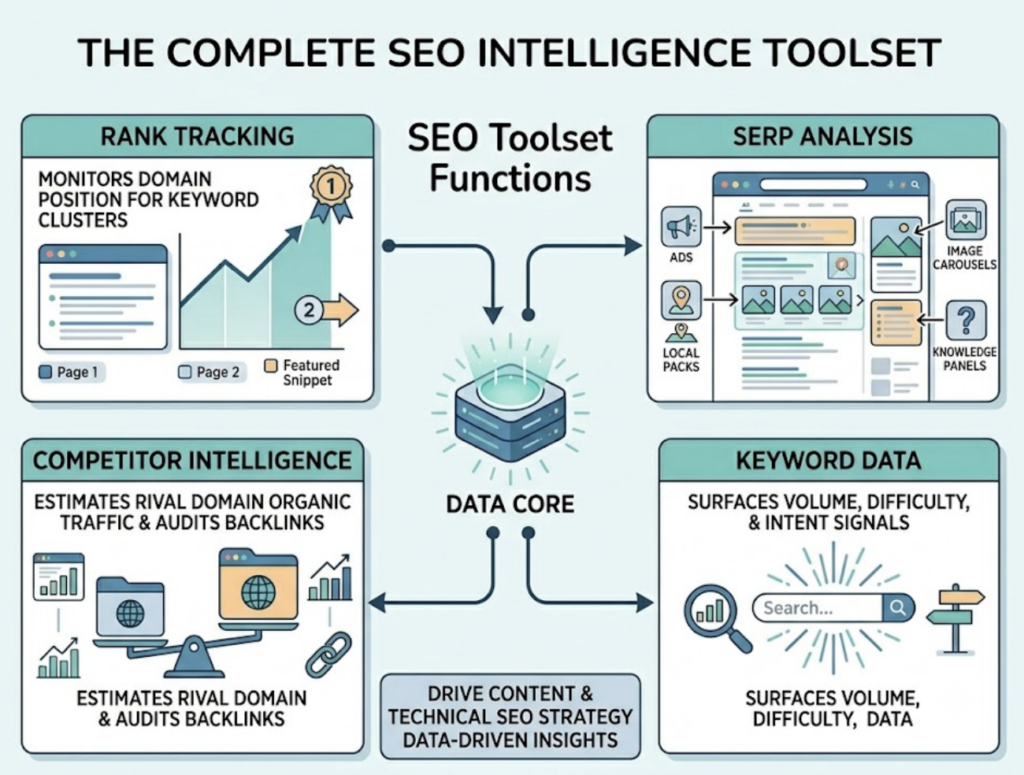
For most of its history, that meant Google. Traditional search intelligence tools built their core around four capabilities:
Rank tracking monitors where your domain appears for target keyword clusters — position 1, page 2, featured snippet, or nowhere. SERP analysis maps the full landscape of a results page: ads, local packs, image carousels, knowledge panels. Competitor intelligence estimates organic traffic to rival domains and audits their backlink profiles. Keyword data surfaces volume, difficulty, and intent signals to inform content investment.
These capabilities are real, mature, and still relevant — for Google. The problem is that the definition of “where people go to discover things” has fundamentally changed.
The AI Search Blind Spot Traditional Tools Cannot See
As of mid-2026, AI search engines — including ChatGPT, Perplexity, Gemini, DeepSeek, Doubao, and Qwen — collectively exceed 1.7 billion combined monthly active users. These platforms do not return a list of ten blue links. They return a synthesized answer, written in prose, with a small set of sources cited or brands named.
The mechanics are entirely different from traditional search. An LLM does not return results by crawling a live index. It synthesizes a response based on its training data, retrieval-augmented generation (RAG) layers, and real-time web citations — depending on the platform. There is no SERP to audit. There is no ranking position in the traditional sense. There is only: does your brand appear in the answer, and in what context?
Traditional search intelligence tools are structurally incapable of answering that question. They rely on crawling links and index snapshots. You cannot crawl the reasoning logic of a language model. You cannot scrape a keyword rank from a conversational response.
The result is what you might call a silent visibility loss. A brand can hold the number-one organic position on Google for its most important keyword while being completely absent from every AI-generated answer about its category. The traditional dashboard shows green. The market share erosion is invisible.
Five Search Intelligence Tools Compared on AI Search Coverage
Here is how the major players in the search intelligence space stack up when evaluated on AI search coverage specifically.
| Tool | Primary Focus | AI Search Coverage | Core Strength |
|---|---|---|---|
| SEMrush | Traditional SEO | Minimal / None | Keyword database, backlinks |
| Ahrefs | Traditional SEO | Minimal / None | Technical audit, backlink depth |
| SimilarWeb | Traffic analytics | Aggregated / High-level | Industry traffic trends |
| Brandwatch | Social listening | Primarily social | Brand reputation monitoring |
| Topify | AI-native GEO | Comprehensive | Actionable AI visibility data |
SEMrush remains the most widely deployed SEO platform in enterprise marketing stacks. Its keyword database is unmatched in depth, and its backlink tools cover the legacy web thoroughly. AI search coverage is not a current feature — the platform is fundamentally oriented around Google and Bing indexing logic.
Ahrefs is the preferred tool for technical SEO teams and link builders. Its crawl infrastructure and backlink analysis are industry-leading. Like SEMrush, it has no native capability for tracking brand visibility inside AI-generated answers.
SimilarWeb sits at the traffic analytics layer rather than the SERP layer. It provides aggregated views of where traffic comes from, including some categorization of AI referral traffic at a high level. But it cannot tell you whether your brand was named in a specific AI response, or whether a competitor was cited instead.
Brandwatch monitors brand mentions across social platforms, news, and online communities. Its sentiment analysis is sophisticated. It does not, however, monitor what AI engines say about your brand — that is a structurally different data source than the social web it was built to index.
Topify was built specifically for the AI search era. Its architecture is oriented around prompt-based engine simulation: triggering real-time queries across multiple AI platforms and capturing the answer state rather than a link position. The coverage spans ChatGPT, Perplexity, Gemini, DeepSeek, Doubao, and Qwen — the platforms where your buyers are actually asking questions about your category.
What Real AI Search Coverage Actually Requires
The gap between “says it covers AI search” and actually providing actionable AI visibility data comes down to architecture. Genuine coverage requires four things that traditional search intelligence tools were never designed to do.
Prompt-based engine simulation. Instead of crawling keyword rankings, the tool must fire real, high-intent prompts at live AI engines and capture the full response — including which brands were named, in what order, and in what context. This is the only way to see what buyers actually encounter when they ask AI assistants about your category.
Multi-engine parity. ChatGPT, Perplexity, and Gemini use fundamentally different retrieval and generation architectures. A brand cited consistently in ChatGPT answers may be largely absent from Perplexity responses. Coverage across all major AI engines is not optional — it is the minimum viable scope for AI search intelligence.
Source citation attribution. When an AI engine cites a source, that attribution is a signal about what content it treats as authoritative. Understanding which URLs were cited — and which of your competitors’ pages earned those citations — reveals the content gaps that determine AI visibility outcomes.
Sentiment and context scoring. A mention is not necessarily a positive signal. If an AI engine names your brand in a comparative context that frames it negatively, or in a category you are trying to exit, that matters. Effective AI search intelligence includes qualitative scoring of how the brand is characterized, not just whether it appears.
How Topify Addresses AI Search Intelligence
Topify’s product is organized around the specific data problems that AI search creates for marketing and growth teams.
Visibility Tracking measures the percentage of high-intent prompts in which your brand is cited — across all monitored AI engines. This is the AI-era equivalent of organic share of voice, and it is the metric that traditional tools cannot produce.
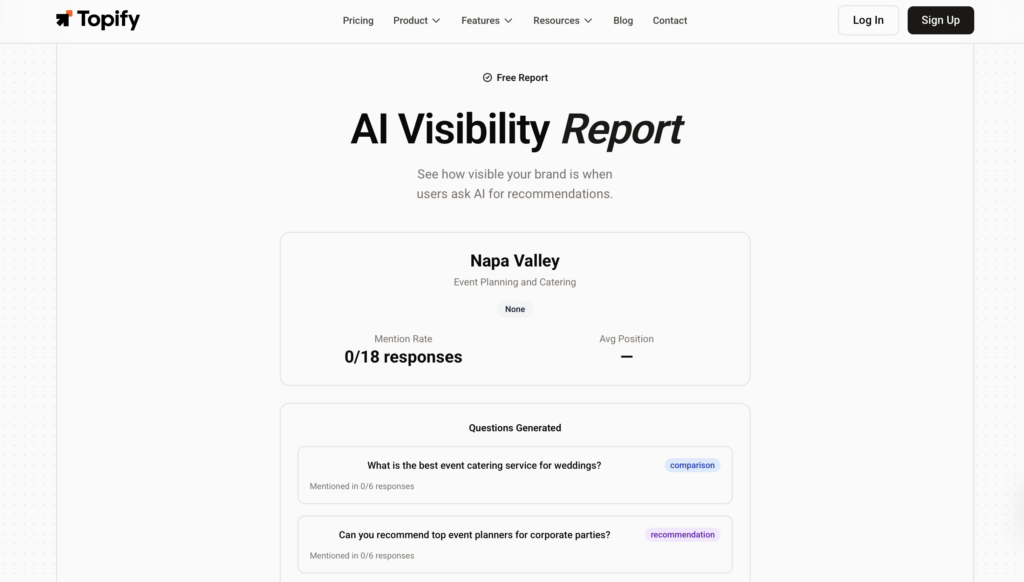
Source Analysis identifies which content pieces the AI engines chose to cite when generating answers about your category. This tells you not just whether you are visible, but why — and what your competitors are doing that earns citations you are not getting.
Competitor Monitoring provides side-by-side comparison of AI visibility share across your competitive set. If a competitor is gaining ground in AI-generated thought leadership for your core category, you will see it before it shows up in pipeline data.
High-Value Prompt Discovery uses machine learning to surface the specific questions that buyers are directing at AI assistants during the research and decision phase. These prompts are the new high-intent keywords — and they require a different content strategy than traditional keyword clusters.
Position Tracking maps AI visibility metrics to conversion data, connecting the gap between “brand was mentioned” and “deal was influenced.” This is the bridge between AI search intelligence and revenue attribution.
Topify’s pricing starts at $99/month for the Basic plan, with Pro at $199/month and Enterprise plans from $499/month for teams requiring broader prompt coverage and custom integrations.
Which Tool Should You Choose?
The right answer depends on where your customers are discovering your category.
Choose SEMrush or Ahrefs if your primary objective is maintaining and growing Google organic traffic — technical site health, backlink management, and keyword ranking for the legacy search web. These remain the best tools for that specific job.
Choose Topify if buyers in your category are using AI assistants — ChatGPT, Perplexity, Gemini — as their primary research interface. If your sales cycle involves any phase where a prospect says “I asked AI and it recommended X,” you have an AI visibility problem that traditional tools cannot measure, let alone solve.
Use both if you operate in a space where Google traffic and AI-referral traffic both matter — which, in 2026, describes most B2B SaaS, professional services, and high-consideration consumer categories. The most sophisticated marketing teams now run Topify for AI visibility strategy alongside traditional tools for Google performance, with no coverage gap in either channel.
The risk of not making this decision deliberately is asymmetric. Traditional search intelligence tools will tell you your Google presence is healthy while your AI search visibility erodes without a trace.
Start Measuring What Traditional Tools Miss
Search intelligence built for Google cannot tell you what AI engines say about your brand. The measurement gap is real, and it is widening as AI search adoption accelerates.
If you want to see where your brand stands in AI-generated answers right now, Topify’s free GEO Score Checker gives you an immediate read on your AI visibility without requiring a full platform commitment. It is the fastest way to find out whether the tools you are currently using are leaving a significant part of your search landscape unmeasured.
Frequently Asked Questions
What is a search intelligence tool?
A search intelligence tool monitors where your brand appears in the places people use to discover products, services, and information. Historically that meant Google — tracking keyword rankings, SERP features, and competitor backlinks. In 2026, genuine search intelligence also requires coverage of AI search engines like ChatGPT, Perplexity, and Gemini, where an increasing share of discovery happens outside the traditional link-based results page.
Why can’t SEMrush or Ahrefs track AI search?
SEMrush and Ahrefs are built around crawling index snapshots and monitoring link-based rankings. AI engines like ChatGPT and Perplexity do not return a list of ranked pages — they synthesize a conversational answer using large language models and retrieval-augmented generation (RAG). There is no SERP position to crawl. The only way to capture AI search visibility is to fire real prompts at live AI engines and analyze the responses directly, which is a fundamentally different technical architecture than what traditional SEO tools were designed to do.
What does “AI search coverage” mean for a search intelligence platform?
It means the tool can tell you whether your brand appeared in AI-generated answers to high-intent queries — and if so, where, in what context, and with what sentiment. Complete AI search coverage includes multi-engine monitoring (not just one AI platform), source citation attribution (which URLs the AI cited), competitor visibility comparisons, and prompt-level tracking rather than keyword-level tracking.
How is Topify different from traditional search intelligence tools?
Topify was built for the AI search era rather than retrofitted for it. Instead of crawling link rankings, it simulates real buyer prompts across ChatGPT, Perplexity, Gemini, DeepSeek, Doubao, and Qwen, then measures brand visibility, sentiment, source citations, and competitive position within the actual AI-generated answers. Traditional tools tell you where you rank on Google. Topify tells you whether you exist in the answers your buyers are actually reading.
Do I need to replace my existing SEO tools with Topify?
Not necessarily. Most sophisticated marketing teams run Topify alongside traditional tools rather than instead of them. SEMrush and Ahrefs remain strong for managing Google organic performance — backlinks, technical health, keyword rankings. Topify fills the AI search gap those tools cannot cover. The combination eliminates blind spots in both channels.
Is there a free way to check my AI search visibility?
Yes. Topify’s free GEO Score Checker gives you an immediate read on your brand’s AI visibility without a platform subscription. It is the fastest way to find out whether AI engines are citing you — or your competitors — in answers about your category.
Read More
- AI Search Visibility vs. Traditional SEO in 2026 — Why the overlap between Google’s top 10 and AI-cited sources has dropped from 70% to under 20%, and what that means for your measurement stack.
- AI Visibility Tracking: A 2026 Primer — A practical introduction to the metrics, platforms, and monitoring cadence marketers need to build an AI visibility baseline.
- 7 Best Tools to Track AI Search Visibility in 2026 — A detailed comparison of the leading AI visibility platforms, including how they differ on prompt coverage, source attribution, and competitive intelligence.

