

Your domain authority is solid. Your keyword rankings are moving up. But then your SEO lead pulls up ChatGPT and searches for a tool recommendation in your category, and your brand isn’t in the answer.
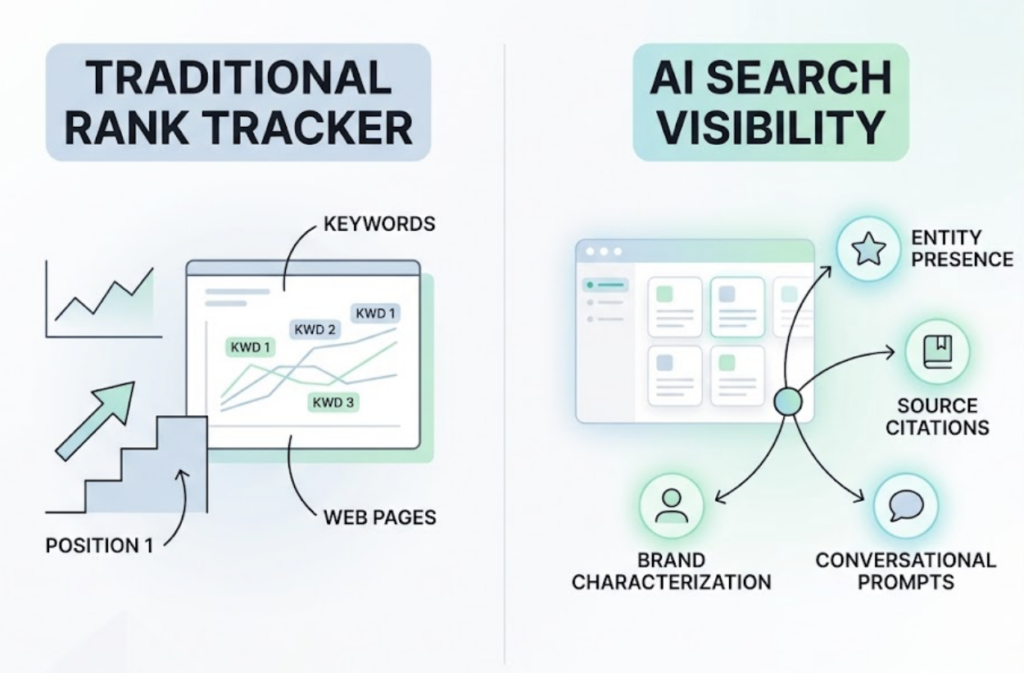
This is the gap that traditional rank trackers can’t explain. They were built to measure position in a list of links. AI search doesn’t work that way. It synthesizes, characterizes, and cites, and none of those actions produce a rank position between 1 and 100.
Here’s what a search intelligence tool actually does that your current stack doesn’t.
#1: Search Intelligence Tools Track Whether AI Mentions Your Brand at All
A rank tracker gives you a number. Position 4. Position 11. Position 1.
A search intelligence tool asks a different question entirely: did AI mention your brand in its answer?
That distinction matters more than it sounds. AI engines like ChatGPT and Perplexity don’t return a ranked list of links. They generate a synthesized response and, in many cases, your brand either appears in that response or it doesn’t. There’s no “page two” to fall back on.
Research confirms that AI models prioritize what analysts call “entity authority”: the degree to which a brand is embedded in the topical context surrounding a category. A brand can hold a top-10 Google ranking for a competitive keyword and still be entirely absent from the AI-generated answer to that same query.
Topify‘s Visibility Tracking monitors brand mentions across ChatGPT, Perplexity, Gemini, DeepSeek, and other major AI platforms. In practice, it means you know whether AI is including your brand in the conversation, not just whether your page ranks somewhere on Google.
#2: They Show You Which Sources AI Is Actually Citing
Rank trackers surface which of your pages hold positions for target keywords. That’s useful for Google traffic. It tells you almost nothing about AI.
AI models don’t necessarily cite the #1 Google result. Studies show that AI engines frequently favor highly readable, structured content and specific authoritative domains, regardless of SERP position. A competitor’s thought leadership piece on a niche industry publication may carry more weight in AI citations than a well-optimized pillar page ranking #2 in Google.
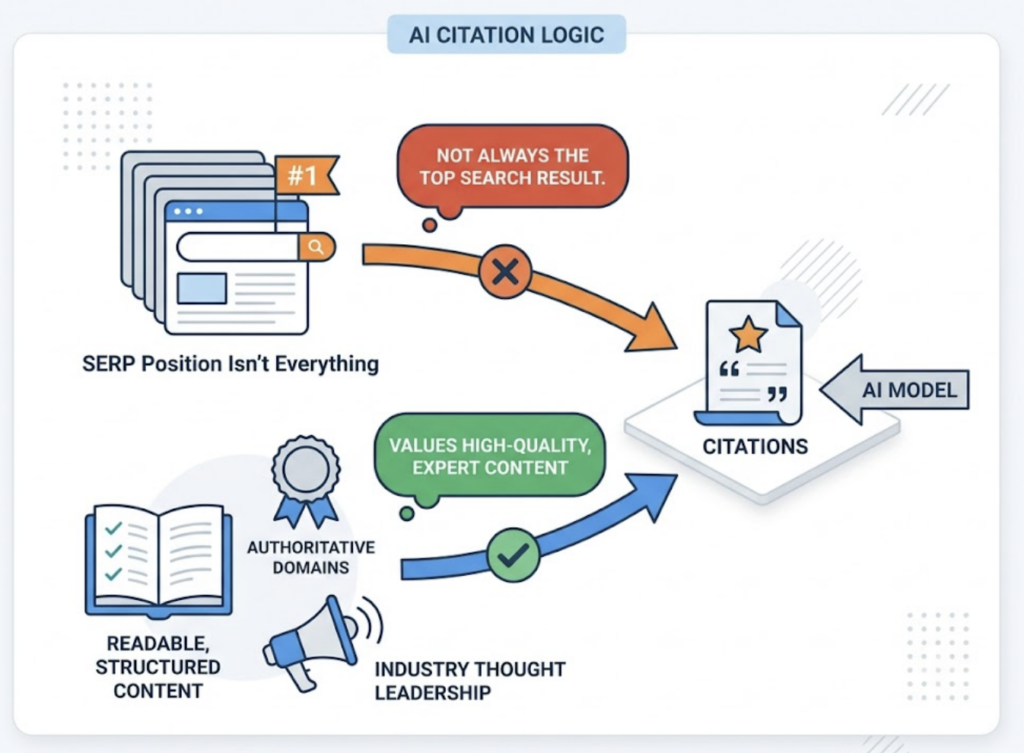
Search intelligence tools expose this layer through source analysis: which domains AI platforms are actually pulling from when they generate answers about your category.
That’s actionable in a way rank data isn’t. If you can see that AI answers about your category consistently cite three specific publications that you haven’t appeared in, that’s a PR and content placement target list. No rank tracker surfaces that insight.
Topify’s Source Analysis tracks the exact domains and URLs AI platforms cite, showing whether your brand or your competitors dominate these references. The gap between where you rank and where AI cites is often where the real content strategy work lives.
#3: They Tell You How AI Characterizes Your Brand, Not Just Whether It Mentions You
This is the dimension traditional SEO tools don’t have at all.
A rank tracker tells you that your page is at position 3 for “best enterprise project management software.” It doesn’t tell you that Perplexity describes your product as “a solid option for small teams on a budget” when users ask for enterprise solutions.
That misalignment between your brand positioning and AI characterization is a real problem, and it’s invisible to any tool measuring only position or traffic.
Search intelligence tools use NLP-based sentiment analysis to categorize how AI discusses your brand: positive, neutral, or negative, and with what framing. The practical output isn’t just a sentiment score. It’s the specific language patterns AI is associating with your brand across platforms.
Topify’s Sentiment Analysis assigns a 0-100 score to brand characterization across AI engines. For a marketing team managing brand positioning, this is the difference between knowing your rankings and knowing your reputation in the channel that’s increasingly shaping purchase decisions before a user ever visits your site.
#4: They Map the Competitive Landscape as AI Sees It
On a Google SERP, your competitor is whoever ranks at position #2. In AI search, the competitive picture is completely different.
AI answers often recommend brands based on entity associations, topical authority, and citation patterns. The result is that your actual AI competitors may have little overlap with your Google SERP rivals. A company ranking #15 for your core keyword might be the brand AI recommends first when users ask for a solution like yours.
Basic rank trackers have no way to show you this. They compare your keyword positions against domains that rank similarly in Google. That’s a reasonable competitive frame for traditional SEO. It’s the wrong frame entirely for AI search.
Search intelligence tools map AI’s competitive landscape in real time, revealing which brands appear alongside yours in AI-generated answers, and in what order. Topify’s Competitor Monitoring and Position Tracking do exactly this: they surface which entities AI engines are recommending, how those recommendations shift over time, and what the citation pattern differences look like.
That data gives teams something concrete to act on. If a competitor consistently appears before your brand in AI answers for a specific category of prompts, you can trace back what sources AI is relying on to form that preference, and build a strategy to close the gap.
#5: They Surface the Prompts Driving AI Visibility Before You Think to Track Them
Every rank tracker starts with the same requirement: give us your keyword list.
That workflow made sense when SEO was about matching keyword intent. It creates a structural blind spot in AI search, where the actual queries users run are conversational, long-tail, and constantly shifting. The prompts that drive AI answers don’t map neatly onto your historical keyword lists.
Search intelligence tools flip the model. Instead of reporting how you’re performing for the keywords you already know, they surface the high-volume AI prompts actively generating brand-relevant answers, including ones you never would have thought to track.
This matters because AI search is evolving fast. Citation patterns shift. New query clusters emerge. A prompt that triggered no brand mentions six weeks ago might be a high-volume opportunity today. Passive keyword tracking doesn’t catch that. Active prompt discovery does.
Topify’s High-Value Prompt Discovery continuously surfaces AI queries that are relevant to your category, flagging new opportunities as AI recommendation patterns evolve. It’s the difference between monitoring a static list and running an always-on intelligence operation.
What This Means If You’re Still Using Only a Rank Tracker
None of this is an argument to abandon rank tracking. Google’s organic channel still drives substantial traffic, and SERP position still matters for that channel.
But AI search is a separate channel with separate logic, and it’s one that’s growing. Zero-click AI answers are increasingly where brand consideration begins, particularly for high-intent queries. A user who asks Perplexity “what’s the best tool for X” and gets a confident recommendation may never run a Google search for that category at all.
Rank trackers aren’t built for this environment. They weren’t designed to monitor entity presence, source citations, brand characterization, or conversational prompt discovery. Expecting them to cover AI search visibility is asking the wrong tool to do the wrong job.
Topify combines all five of these capabilities into a single platform: Visibility Tracking, Source Analysis, Sentiment Analysis, Competitor Monitoring, and High-Value Prompt Discovery, across ChatGPT, Gemini, Perplexity, DeepSeek, Doubao, and Qwen. Plans start at $99/month for teams ready to treat AI search as a measurable growth channel.
The question isn’t whether AI search visibility matters for your brand. The question is whether you have the right tool to see it. Get started with Topify.
Conclusion
Rank trackers measure what AI search doesn’t produce: a list of positions. Search intelligence tools measure what AI search actually does: synthesize, cite, characterize, and recommend. For brands serious about visibility across the full search landscape, those are two different data layers that require two different types of tools.
If your reporting shows strong Google rankings but you have no visibility into what AI is saying about your brand, you’re not missing a metric. You’re missing a channel.
FAQ
Q: What is a search intelligence tool?
A: A search intelligence tool is a platform that monitors how your brand appears in AI-generated search responses across engines like ChatGPT, Perplexity, and Google AI Overviews. Unlike traditional rank trackers, which measure SERP position, search intelligence tools track brand mentions, source citations, sentiment, competitive positioning, and high-value AI prompts.
Q: How is a search intelligence tool different from a rank tracker?
A: A rank tracker reports your URL’s position in Google’s list of links for a given keyword. A search intelligence tool reports whether AI mentioned your brand in a synthesized answer, how it characterized you, which sources it cited, and which competitors it recommended instead. The underlying data models, metrics, and use cases are fundamentally different.
Q: Can I use a rank tracker and a search intelligence tool together?
A: Yes, and for most brands that’s the right approach. Google organic search and AI-generated search are distinct channels, each with their own optimization logic. Rank trackers remain relevant for Google traffic strategy. Search intelligence tools cover the AI visibility layer that rank trackers can’t see.
Q: How do I know if my brand has visibility in AI search?
A: The quickest way is to run a few representative prompts in ChatGPT, Perplexity, or Gemini and check whether your brand appears in the answers. For systematic monitoring at scale, a dedicated search intelligence tool like Topify tracks brand visibility across multiple AI platforms simultaneously, across hundreds of prompts, so you’re not relying on manual spot-checks.

