

Your team spent six months building SEO authority. Domain Authority climbed, keyword rankings held steady, organic impressions trended up. Then your CEO typed your product category into ChatGPT and got a list of five recommendations. Your brand wasn’t on it.
Traditional SEO dashboards can’t explain why. They weren’t built to measure what AI chooses to say, or who it chooses to recommend. That gap between ranking well on Google and being invisible to AI is where most marketing teams are operating right now, whether they realize it or not.
Your SEO Dashboard Says You’re Winning. AI Search Says Otherwise.
The disconnect isn’t a bug. It’s a structural shift in how information gets discovered.
Traditional SEO was built on a “rank and click” model: secure a top position on a search engine results page, earn a click, drive traffic to your site. The AI-driven discovery model works differently. It synthesizes a direct answer for the user, often bypassing the need for any outbound click at all. A website can rank first on Google for a specific keyword but fail to appear when an AI model summarizes the same topic.
The data backs this up. Only approximately 17% of citations in Google’s AI Overviews come from pages that rank in the top ten organic results for the same query. That means the AI’s criteria for “source-worthiness” are fundamentally different from traditional ranking algorithms.
Here’s the practical gap this creates: while traditional SEO rewards domain age, backlink volume, and keyword density, generative engines prioritize semantic clarity, factual density, and extractive readiness. Tracking AI visibility isn’t an optional add-on to your SEO stack. It’s the primary diagnostic for whether your brand exists in the generative discovery layer.
| Metric | Traditional SEO | AI Visibility Tracking |
|---|---|---|
| Primary Objective | SERP Position (Top 10) | Citation Inclusion and Recommendation |
| Value Exchange | User Clicks to Website | Inclusion in Synthesized Answer |
| Key Authority Signal | Backlinks and Domain Authority | Factual Density and Entity Confidence |
| Tracking Unit | Keywords | Natural Language Prompts |
| Performance Goal | Traffic Volume | Share of Model and Sentiment |
Without dedicated AI visibility tracking, your team can’t answer why a competitor is consistently recommended by Perplexity for a high-intent query while your brand is ignored. That blind spot compounds over time.
What AI Visibility Tracking Actually Measures
AI visibility tracking is the systematic monitoring of how a brand is mentioned, characterized, and cited within the outputs of generative AI platforms and answer engines. It’s not a binary “yes or no” check. It’s multidimensional, accounting for frequency of mentions, sentiment of characterization, relative position in recommendation lists, and quality of the citations used to support the AI’s claims.
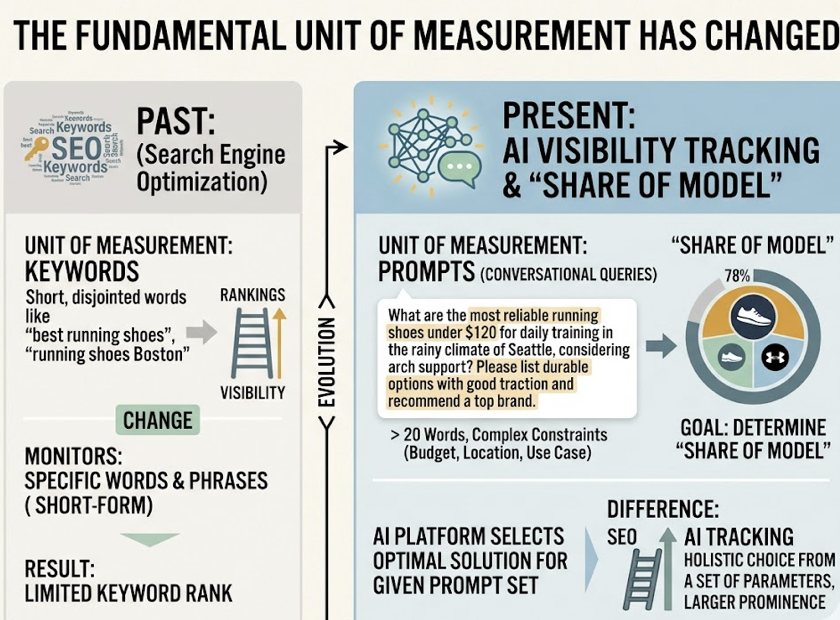
The fundamental unit of measurement has changed. SEO monitors keywords. AI visibility tracking monitors prompts: full-sentence, conversational queries that often exceed twenty words and include complex constraints like budget, location, and specific use cases. The goal is to determine your “Share of Model,” the frequency with which an AI platform selects your brand as the optimal solution for a given prompt set.
Professional tracking frameworks in 2026, like the system built by Topify, use a seven-dimension metric system to provide a holistic view of brand presence across AI platforms:
| Metric | What It Measures | Why It Matters |
|---|---|---|
| Visibility Score | % of target prompts where the brand appears | Overall reach in AI discovery |
| Sentiment Score | Tone of AI’s characterization (positive/neutral/negative) | Brand reputation and narrative framing |
| Position Rank | Numerical order in recommendation lists | User trust and recall |
| Mention Frequency | Total brand name appearances in responses | Entity strength |
| Citation Share | % of outbound links pointing to your domain | Content authority as a “source of truth” |
| Intent Alignment | How well presence matches user journey stage | Visibility for high-value commercial queries |
| CVR | Estimated conversion probability based on mention context | Direct revenue impact |
One critical detail that catches most teams off guard: AI visibility is highly volatile and platform-dependent. A brand’s citation volume can vary by as much as 615x between different platforms. A single-platform approach leaves enormous blind spots.
Why Marketers Can’t Afford to Skip AI Visibility Tracking in 2026
The numbers tell the story.
By early 2026, the AI search engine market has expanded past USD 20 billion, with 900 million weekly active users on ChatGPT alone. Gartner predicted in 2024 that traditional search volume would drop 25% by 2026 as users shifted to AI assistants. Real-world data from mid-2026 suggests this trend has accelerated, especially for informational queries where AI Overviews satisfy user intent directly on the results page.
Zero-click searches now account for roughly 64.82% of all Google searches. AI Overviews trigger on 25.11% of Google searches, up from about 13% in early 2025. When an AI summary appears, only 8% of users click on a traditional organic result, compared to 15% when no summary is present.
That’s the volume side. The value side is even more striking.
AI search visitors convert at an average rate of 14.2%, compared to 2.8% for traditional Google organic search. That’s a 5x conversion advantage. Ahrefs research from June 2025 found that AI search visitors, while representing only 0.5% of total traffic for some domains, can drive up to 12.1% of all sign-ups. A 23x conversion premium.
These users arrive pre-qualified. They’ve already done their research and comparison inside the AI interface. When they finally click through, they’re moving from research to decision. Being the cited brand in an AI response isn’t just a visibility play. It’s a direct pipeline to high-intent conversions.
The 5 Metrics That Define Your AI Visibility
A professional AI visibility tracking strategy focuses on five core metrics. Each one addresses a specific stage of the AI discovery funnel and informs a different optimization lever.
Visibility Score: does the AI know you exist?
This measures the frequency of your brand’s appearance across a defined prompt universe. In 2026, a Visibility Score below 30% in your core category signals a significant discovery gap. Above 80% indicates market leadership.
A SaaS company might score 45% for “best PM tools” but only 12% for “PM tools with built-in time tracking.” That gap reveals a semantic hole in how AI models perceive their feature set.
Sentiment: what is the AI actually saying about you?
Being mentioned is only half the equation. An AI platform could reference your brand consistently while adding caveats like “users often report slow delivery times.” Tracking sentiment lets your team catch and counter these narratives before they calcify.
Position: where do you rank in the AI’s recommendation list?
AI platforms typically recommend three to five brands per query. The brand listed first carries an implicit endorsement. If you’re consistently placed third or fourth, your influence on the user’s decision is minimal compared to the first-position brand.
Source Citations: what’s feeding the AI’s opinion?
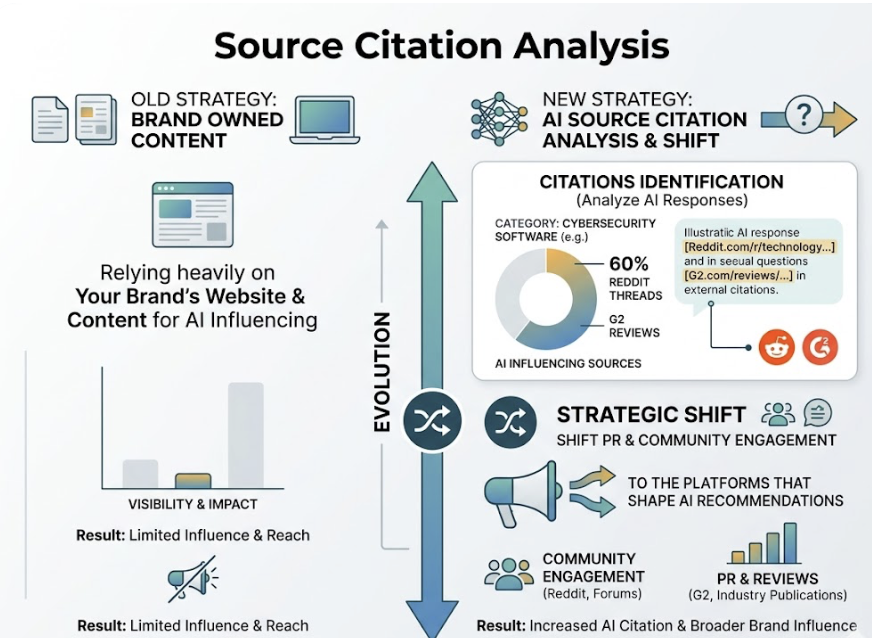
AI models rely on specific web sources. Source citation analysis identifies which external URLs are influencing the response. If 60% of Perplexity’s citations for your category come from Reddit threads and G2 reviews rather than your own content, that’s a clear signal to shift your PR and community engagement strategy toward the platforms that actually shape AI recommendations.
CVR (Conversion Visibility Rate): what’s the revenue impact?
CVR estimates the economic value of an AI mention by analyzing the recommendation context and prompt intent. A fintech brand might have fewer total mentions than a competitor, but if those mentions appear in higher-converting contexts like “secure tools for high-net-worth individuals,” the projected ROI is higher.
| Metric | Target Goal |
|---|---|
| Visibility Score | > 60% for core categories |
| Sentiment Score | > 85/100 (weighted positive) |
| Position Rank | < 2.0 (Top 2 placement) |
| Source Citations | Dominating top-3 citation sources |
| CVR | Outperforming traditional organic CPC value |
How to Start Tracking Your Brand’s AI Visibility
The implementation path follows three steps, from manual baseline to automated monitoring.
Step 1: Platform selection and baseline audit.
Identify where your audience asks AI for recommendations. In 2026, that typically means ChatGPT (creative and reasoning tasks), Perplexity (research-oriented queries), Gemini (Google ecosystem users), and Google AI Overviews. Run a representative sample of queries across each and record current visibility, sentiment, and citations.
Step 2: High-value prompt discovery.
Tracking the right questions matters more than tracking many questions. Unlike keyword research, prompt discovery focuses on intent and conversational context. The average conversational query in 2026 runs about 23 words long, packed with qualifiers that push an AI from “explanation mode” into “recommendation mode.”
The methodology: pull language from sales transcripts, support tickets, and community forums. Map those prompts to the buyer journey (awareness, consideration, purchase) to ensure your brand is visible at every decision point.
Step 3: Move from manual checks to automated monitoring.
Manual tracking is fundamentally unscalable. AI responses are non-deterministic: the same prompt can yield different results across multiple sessions. Automated systems resolve this by running real-time monitoring across thousands of prompts simultaneously, calculating a statistical baseline that accounts for model volatility.
Topify’s platform handles this by combining High-Value Prompt Discovery with continuous visibility tracking across all major AI platforms. The difference in accuracy is measurable: automated systems detect visibility regressions with 92% sensitivity, compared to 64% for manual monitoring, with an average detection lead time of 4.2 hours.
For marketing teams, automation is the only way to catch “drift,” the gradual change in AI outputs as models retrain on new data, before it hits your bottom line.
| Monitoring Approach | Sensitivity | Lead Time | Scalability |
|---|---|---|---|
| Manual Tracking | 64% | Immediate but spotty | Very Low |
| Automated (Topify) | 92% | 4.2 hours (early detection) | Unlimited |
3 AI Visibility Tracking Mistakes That Waste Your Budget
As marketing teams rush to adapt, several recurring errors undermine the accuracy of their visibility data.
Mistake 1: Treating ChatGPT as the entire AI search landscape.
ChatGPT holds roughly 77-87% of AI referral traffic. But Perplexity, Gemini, and Google’s AI Overviews use different retrieval mechanisms and citation sources. A brand well-represented in ChatGPT’s training data can be entirely absent from Perplexity’s real-time web search results. Multi-platform tracking across at least three major models is the baseline for a representative view.
Mistake 2: Counting mentions without measuring sentiment or position.
A 100% mention rate means nothing if the AI characterizes your brand negatively in every instance. And being listed at the end of a five-brand recommendation carries far less weight than a first-position mention. Your tracking system needs a weighted scoring approach that prioritizes prominence and positive framing, not just raw frequency.
Mistake 3: Benchmarking in isolation, without competitor context.
AI visibility is a zero-sum game within the synthesized answer box. If you track your own visibility without monitoring competitors, you’ll miss that a rival’s citation share is growing twice as fast, or that the AI has started pairing your brand with a new, disruptive competitor. Continuous dynamic competitor benchmarking is non-negotiable.
Conclusion
The old playbook of backlinks and keyword density is no longer sufficient to guarantee that your brand shows up where your audience is looking. In 2026, the marketing team’s defining question has shifted from “how do we rank higher?” to “does the AI know we exist, and does it recommend us correctly?”
AI visibility tracking gives you the answer. It turns an opaque, unmanaged channel into something measurable and actionable: which platforms mention you, how they describe you, where you rank against competitors, and what sources are shaping the AI’s opinion.
The path forward starts with a baseline. Topify’s free GEO score check gives your team an immediate snapshot of where your brand stands across AI platforms, so you know exactly which gaps to close first.
FAQ
What’s the difference between SEO and AI visibility tracking?
SEO optimizes for page rankings to earn clicks. AI visibility tracking optimizes for inclusion in synthesized answers to earn citations and recommendations. SEO is a volume-based traffic play. AI visibility tracking is an authority-based brand influence play. They measure fundamentally different things, and strong performance in one doesn’t guarantee performance in the other.
Which AI platforms should I track my brand on?
Most brands should monitor ChatGPT, Perplexity, and Google Gemini, as these represent the majority of user queries and referral traffic in 2026. Google AI Overviews are also critical because they appear directly on the primary search results page and significantly impact traditional click-through rates.
How often should I check my AI visibility metrics?
Weekly monitoring is the recommended cadence for most brands. AI models are volatile and retrain frequently, so weekly checks let you catch drift and competitive shifts early. Daily tracking is appropriate for high-competition sectors like SaaS or finance where recommendation positions change rapidly.
Can I track AI visibility manually without a tool?
Manual tracking works for a very small set of prompts, maybe 10-20. But it’s statistically unreliable due to model variance and completely unscalable for professional operations. A single prompt can return different results across different sessions. Automated tools provide the statistical rigor needed for enterprise-level decisions.

