

Your domain authority is solid. Your keyword rankings look healthy. But none of that tells you whether Perplexity is recommending your competitor instead of you. Traditional SEO metrics weren’t built to measure what AI engines choose to say, and the gap between where you rank on Google and where you appear in AI-generated answers is often wider than most marketing teams expect.
That gap has a name: AI search visibility. And tracking it requires a different kind of monitoring entirely.
Your Brand Is Being Evaluated by AI. You’re Not in the Room.
When a potential customer types a question into ChatGPT or Perplexity, they’re not seeing a list of blue links. They’re reading a synthesized answer. That answer includes brand names, product recommendations, and competitive context, assembled by a model that may or may not have encountered your content.
44% of AI search users now cite AI as their primary source for product discovery. Brands that don’t appear in those synthesized answers are effectively invisible at the top of the buyer funnel, before a user ever visits your website or sees an ad.
That’s the problem an AI search monitoring service is built to solve. It’s not about tracking rankings in a traditional sense. It’s about understanding how AI engines represent your brand, which prompts trigger a mention, and whether the representation is accurate and favorable.
What an AI Search Monitoring Service Actually Tracks
An AI search monitoring service measures your brand’s performance across AI-generated responses. The specific metrics differ from traditional SEO, and understanding what’s actually being tracked is the first step to using it effectively.
Visibility Rate measures what percentage of high-intent prompts result in your brand being mentioned at all. A brand might have a 60% visibility rate across 100 tracked prompts, meaning it appears in 60 of the AI-generated answers. The other 40 go to competitors.
Position captures where your brand appears within an AI response. Being named third in a list of five recommendations yields a very different trust signal than being named first. Research consistently shows higher positions generate significantly more user consideration.
Sentiment tracks how an AI describes your brand. Not whether you’re mentioned, but how. A monitoring platform that scores sentiment on a 0-100 scale can reveal if a model is describing your product as “budget-friendly” when your positioning is premium, or “suitable for small teams” when you’re selling to enterprise clients.
Source Attribution (also called citation tracking) identifies which external domains the AI is using to build its opinion of your brand. If a review site with outdated information is being cited, that’s a content gap you can close.
Competitor Benchmarking shows where rivals appear relative to you, across the same prompt set. This is where the practical value of monitoring becomes clearest: you can see, prompt by prompt, who’s winning the AI recommendation slot you’re not.
Topify tracks all seven of these dimensions, including AI Volume (how much search intent exists around your prompt set) and CVR (how likely an AI mention is to drive downstream user action), across ChatGPT, Gemini, Perplexity, and other major platforms.
How to Track Your Brand in Perplexity AI (and Why It’s Different)
Perplexity AI operates differently from ChatGPT, and that difference matters for Perplexity AI keywords tracking.
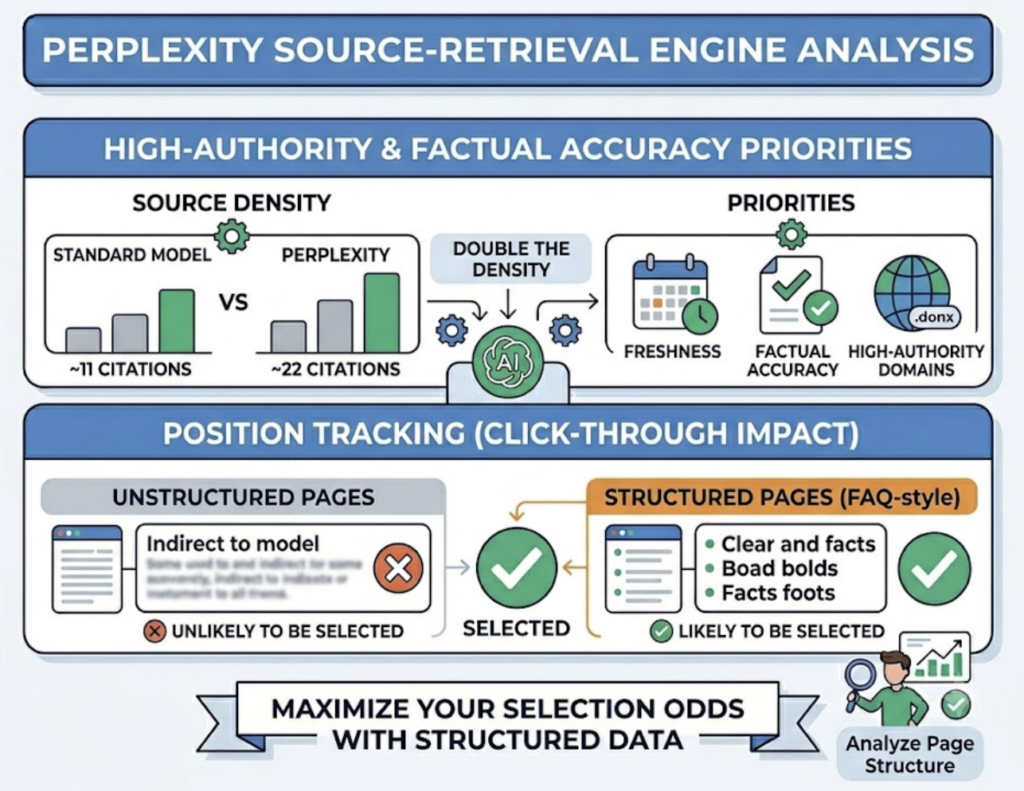
Perplexity averages roughly 22 citations per response, approximately double the density of most other models. It functions primarily as a source-retrieval engine, prioritizing freshness, factual accuracy, and high-authority domains. If a page isn’t structured to answer questions directly, with clear facts and attributable data, it’s unlikely to be selected.
ChatGPT, by contrast, is synthesis-first. It tends to pull from aggregate platforms like G2, Wikipedia, and editorial sites to build its recommendation list, and relies more heavily on brand entity consistency across the web.
This divergence has a measurable consequence: 28% of ChatGPT’s most-cited pages have no significant Google organic visibility. The two platforms are drawing from parallel information pipelines. A brand that tracks brand in Perplexity AI separately from ChatGPT will almost always find different results.
In practice, this means you need platform-specific data. A brand appearing prominently in ChatGPT answers may be nearly absent from Perplexity if its pages lack the citation-ready structure Perplexity favors. Topify’s Source Analysis feature identifies exactly which domains are being cited per platform, so you can see where the gap is and what type of content is closing it.
How to Measure Whether Your AI Search Monitoring Is Working
Monitoring without measurement is just data collection. These four indicators tell you whether your AI search monitoring service is producing actionable signal.
Mention Rate change over time. Establish a baseline across your target prompt set, then track weekly movement. A 10-point increase in visibility rate over 60 days is a concrete outcome, not a vanity metric.
Sentiment Score trend. If your brand is getting mentioned more frequently but the sentiment score is declining, something is wrong with how source content is framing you. That’s a different problem than low visibility, and it requires a different fix.
Source Attribution growth. Track how many of your owned or earned domains are appearing in AI citations. This metric connects your content strategy directly to AI recommendation behavior.
Position movement. Monitor whether your brand is moving from third or fourth mention to first or second across high-intent prompts. Position shifts often precede traffic changes.
Weekly automated execution is the minimum threshold for this data to be statistically meaningful. AI engines are probabilistic and crawl-dependent. Monthly monitoring treats AI answers as static when they aren’t, and the result is a dataset that always lags the current reality by weeks.
5 Common Mistakes That Make AI Monitoring Useless
Most early-stage AI monitoring programs produce data that doesn’t drive decisions. Here’s why.
Relying on Google rankings as a proxy for AI visibility. The two platforms read and prioritize content differently. A #1 organic ranking doesn’t guarantee an AI mention, and there are brands with weak Google presence that appear consistently in AI answers. Treating one as a substitute for the other produces a false sense of security.
Monitoring only branded queries. Tracking “Your Brand Name” prompts misses where most AI-driven discovery actually happens: category comparisons, problem-aware queries, and “best [product type] for [use case]” prompts. Those are the searches where you’re being evaluated against competitors, and they’re the ones that matter most at the top of the funnel.
Low monitoring cadence. Running reports once a month and expecting to catch meaningful shifts is like checking your website traffic quarterly and wondering why conversions dropped. Weekly execution is the floor.
Ignoring which external sources the AI trusts. If a low-authority blog or an outdated review is influencing how an AI describes your brand, you won’t find it without source-level auditing. Most teams skip this entirely.
Treating all platforms as equivalent. A monitoring setup that only queries ChatGPT misses Perplexity’s citation-heavy behavior, Gemini’s integration with Google’s knowledge graph, and platform-specific ranking logic entirely. Coverage matters.
How to Build a Simple AI Search Monitoring Workflow
A functional monitoring workflow doesn’t require a large team or a complex tech stack. It requires three things done consistently.
Step 1: Define your prompt matrix. Identify 50 to 100 high-intent customer prompts your target audience is likely asking AI engines. Include category comparison prompts (“best [product category] for [industry]”), problem-aware prompts (“how do I solve [specific problem]”), and a smaller set of branded prompts. This is your monitoring universe.
Step 2: Establish a baseline. Run your prompt matrix across your target AI platforms, capture visibility rate, position, sentiment, and source data, and store it as your Week 0 benchmark. Without a baseline, every subsequent data point is context-free.
Step 3: Set a response cadence. Weekly automated execution, with a defined review process. The review should answer three questions: Did visibility change? Did sentiment shift? Are competitors gaining position on specific prompts? Anything that can’t be answered in under 20 minutes is too complex to sustain.
Topify‘s One-Click Execution automates the query simulation step across platforms, so your team isn’t manually prompting AI engines and trying to record consistent results. The platform’s Competitor Monitoring feature surfaces position changes automatically, flagging prompts where rivals are gaining ground before the shift becomes a trend.
For teams starting from scratch, Topify’s Basic plan starts at $99/month and covers 100 prompts across ChatGPT, Perplexity, and AI Overviews, enough to build a meaningful baseline for most brands.
AI Search Monitoring Service Pricing: What to Expect
The pricing market for AI search monitoring has matured considerably in 2026. Here’s how the tiers generally break down.
Free and manual options exist (running prompts yourself, logging results in a spreadsheet) but they don’t scale past 10-15 prompts and introduce human bias into query execution. They’re useful for initial exploration, not operational monitoring.
Specialized platforms are the standard for teams that need consistent, comparable data over time.
| Plan | Price | Best For |
|---|---|---|
| Topify Basic | $99/mo | Small teams, 100 prompts, 4 platforms, baseline monitoring |
| Topify Pro | $199/mo | Growing teams, 250 prompts, 8 projects, deeper analytics |
| Topify Enterprise | from $499/mo | Large brands, custom prompt sets, dedicated account support |
Service-layer GEO programs (where a team executes the strategy, not just the monitoring) operate at a different price point. Topify’s managed service tiers start at $3,999/month for full-cycle execution including content production, distribution, and monthly reporting.
The right entry point depends on whether you need data or execution. For teams that already have a content strategy and need to measure its AI impact, the platform tiers are the starting point. For teams that need both the strategy and the execution, a service tier makes more sense.
Conclusion
The core problem with AI search monitoring isn’t that the tools don’t exist. It’s that most brands are still measuring the wrong things, checking Google rankings while AI engines build recommendations from a different data set entirely.
An effective AI search monitoring service tracks visibility, position, sentiment, source attribution, and competitive positioning across the platforms your audience is actually using. It runs consistently, at a cadence that matches how frequently AI answers change. And it produces data specific enough to drive content decisions, not just reports.
Get started with Topify to establish your brand’s AI visibility baseline and see exactly where you stand across ChatGPT, Perplexity, and Gemini.
FAQ
Q: What is an AI search monitoring service?
A: An AI search monitoring service tracks how your brand appears in AI-generated answers across platforms like ChatGPT, Perplexity, and Gemini. It measures whether you’re being mentioned, where in the answer you appear, how the AI describes you, and which external sources the AI is using to form that description. It’s distinct from traditional SEO monitoring, which tracks position in search engine result pages.
Q: How does an AI search monitoring service work?
A: The service programmatically queries AI engines using a defined set of high-intent prompts, captures the responses, and extracts structured data: visibility rate, position, sentiment score, and cited sources. This is repeated on a regular cadence (typically weekly) to build a time-series dataset that shows how your brand’s AI presence changes over time and in response to content changes.
Q: What are the best tools for AI search monitoring?
A: Specialized platforms built specifically for AI visibility monitoring outperform generic SEO tools for this use case. Topify covers seven metrics across ChatGPT, Perplexity, Gemini, and other platforms, with automated query execution and competitor benchmarking. The key criteria to evaluate any tool on: multi-platform coverage, prompt-level data (not just averages), source attribution tracking, and sentiment analysis.
Q: How do I improve my AI search monitoring results?
A: Improvement comes from acting on what the data reveals. If source attribution shows the AI is citing low-authority pages about your brand, publishing higher-quality content on authoritative domains is the fix. If sentiment is declining, audit the external sources being cited and address the framing issues there. If visibility is low on specific prompts, structure content to answer those questions directly, with clear facts and entity-consistent information across your web presence.

