

Your competitor didn’t outrank you. They out-cited you.
That distinction sounds small. It isn’t. Search rankings and AI citations run on different logic, and most SaaS marketing teams are still measuring the wrong one.
Here’s what’s actually happening. A buyer opens ChatGPT or Perplexity and asks something like “best project management software for a distributed team.” The AI doesn’t return ten blue links. It returns three to five vendors, already filtered, already reasoned about. Forrester’s 2026 Buyers’ Journey Survey found that 94% of B2B buyers used AI tools during their most recent purchase process, and AI assistants are now the single most influential source across discovery and comparison. By the time your sales team hears about the account, the shortlist is already set.
That’s the gap most SaaS teams still can’t see.
Why SaaS Competitor Analysis Breaks in AI Search
Traditional competitor analysis tools track keyword rankings and backlink profiles. Those metrics built the last two decades of SEO strategy, and they’re weak predictors of who gets cited in an AI answer.
An Ahrefs study across 75,000 brands found that branded web mentions correlate with AI visibility at 0.664, while backlinks land at just 0.218. Domain rating tells a similar story: one analysis found it explains roughly 3% of the variation in whether a brand gets cited at all. The signals that used to guarantee a Google ranking are now tiebreakers, not foundations.
SaaS makes this worse. Products in the same category tend to look alike on paper, so AI models lean harder on third-party review sites, community threads, and structured comparison content to decide who’s worth recommending. A competitor with a thinner backlink profile than yours can still dominate the prompts that matter, because AI isn’t counting links. It’s counting mentions, context, and consistency across platforms.
If your competitor tracking still runs through a rank tracker built for Google, you’re watching the wrong scoreboard.
The Market Share You’re Losing Without Knowing It
Here’s where it gets expensive. G2’s 2026 survey of 1,076 B2B decision-makers found that 51% of software buyers now start their research inside an AI chatbot rather than a search engine, up from 29% just twelve months earlier. Sixty-nine percent said the chatbot led them to pick a different vendor than they’d originally planned. One in three bought from a brand they’d never heard of before the AI surfaced it.
You don’t lose that deal in a competitive evaluation. You never make the shortlist.
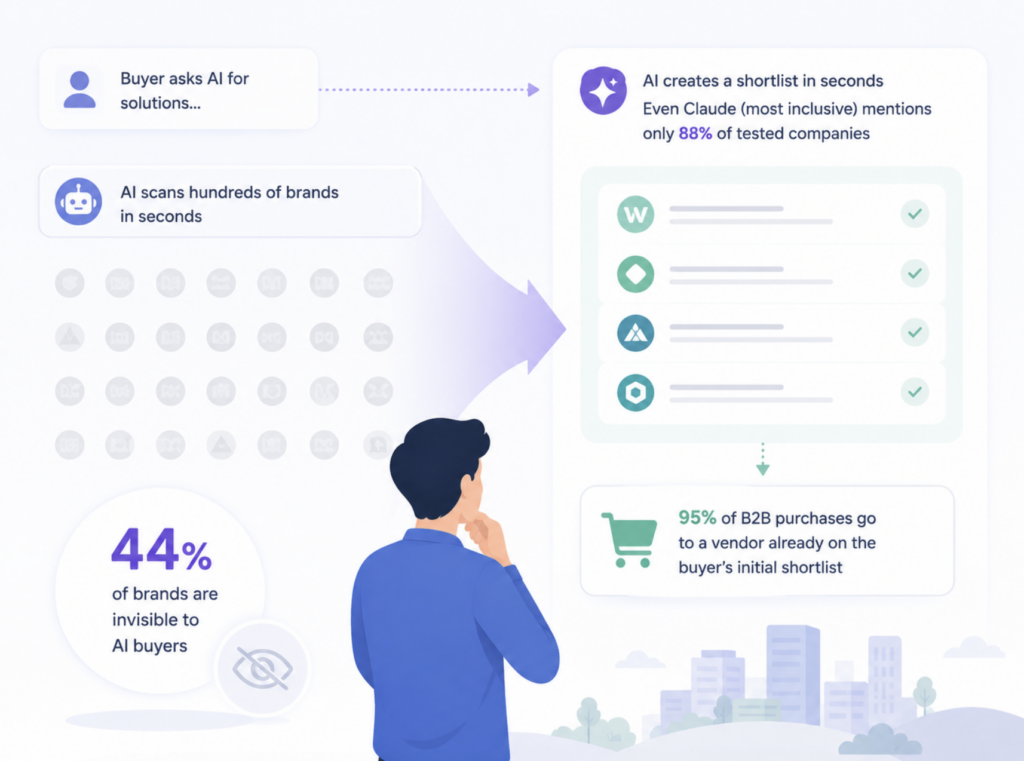
One 2026 benchmark of 50 B2B SaaS companies across 1,400 buyer-intent prompts found that 44% of tested brands were functionally invisible to AI buyers, with even Claude, the most inclusive platform in the study, mentioning only 88% of the companies tested. That invisibility compounds. Research from Bain shows 95% of B2B purchases go to a vendor already on the buyer’s initial shortlist. If AI builds that shortlist in seconds and your name isn’t in it, no amount of downstream sales effort recovers the deal.
None of this shows up in a traffic dashboard. There’s no bounce rate spike, no ranking drop to flag. The prospect simply never hears your name.
What AI Competitor Monitoring Actually Measures
Traditional competitor analysis compares two things: rank position and traffic estimates. AI competitor monitoring has to answer a different set of questions.
| Dimension | Traditional SEO Tools | AI Competitor Monitoring |
|---|---|---|
| What it tracks | Keyword rank, backlinks, organic traffic | Mention frequency, position in AI answers, sentiment |
| Data source | Search engine index | Live prompts run across ChatGPT, Perplexity, Gemini, and more |
| Update cadence | Weekly or monthly crawl | Near real-time, prompt by prompt |
| What it tells you | Where you rank on a results page | Whether you get recommended, and how you’re described |
The dimension most teams skip is sentiment. Two competitors can both get mentioned in an AI answer, but one gets described as the reliable enterprise option and the other as a budget alternative. That framing shapes a buyer’s decision before they’ve clicked anything. Static rank reports have no way to capture it, because it’s not a position, it’s a judgment the model is making on the fly.
Add prompt-level nuance and the picture gets more complicated. The same competitor can dominate one buyer-intent prompt and disappear from another, depending on who’s asking and what they’re comparing against. A single snapshot report can’t hold that much variance. Monitoring has to run continuously, across a defined set of high-value prompts, not as a one-time audit.
How SaaS Teams Rebuild Visibility Through Competitor Benchmarking
Winning back market share starts with a narrower question than most teams ask. Not “how do we rank higher,” but “which prompts is our category being decided on, and who’s winning them right now.”
The workable sequence looks like this. First, map the high-intent prompts your buyers actually type, not the keywords your old SEO tool tracked. Second, track how often you and your named competitors show up across those prompts, and in what order. Third, trace the sources the AI is pulling from when it favors a competitor. Fourth, close the specific content gap that’s costing you the mention.
That third step is usually where teams get stuck manually. Finding out which domain, review, or forum thread an AI model leaned on to recommend a competitor takes running the same prompts repeatedly and comparing outputs by hand. Topify’s competitor analysis tool automates that detection, surfacing which competitors are showing up across your tracked prompts and how your visibility, sentiment, and position compare to theirs.
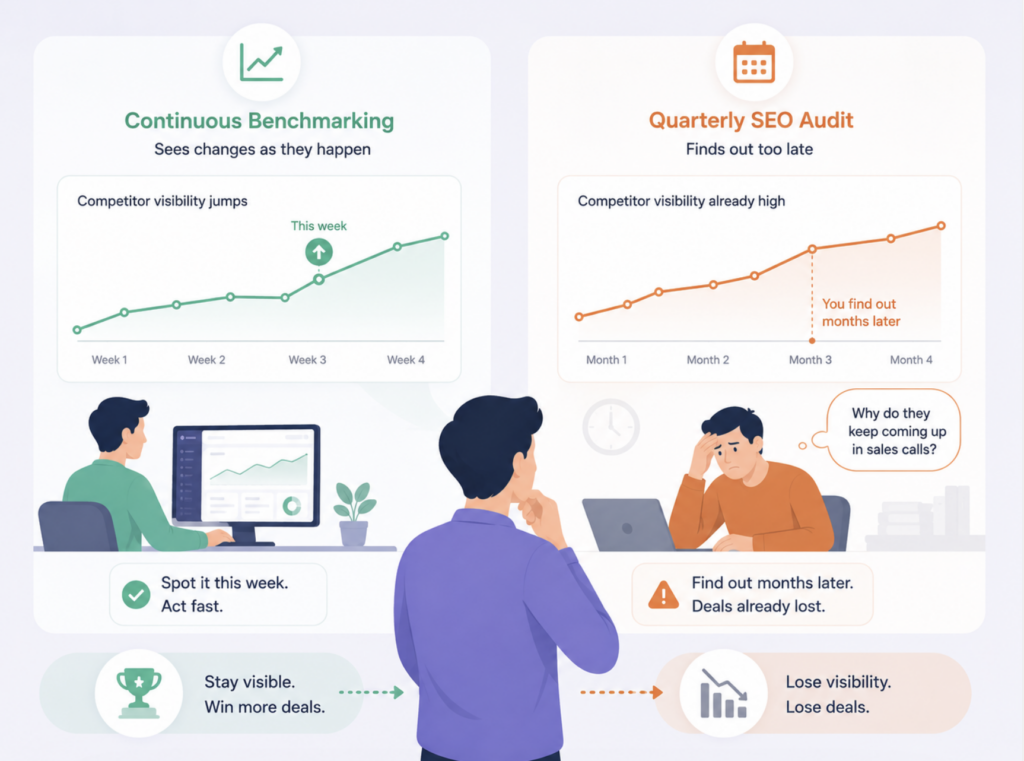
The practical difference shows up in timing. When a competitor’s visibility jumps in a specific prompt cluster, a team using continuous benchmarking sees it that week. A team relying on a quarterly SEO audit finds out months later, usually after a few lost deals prompt someone to ask why a rival keeps coming up in sales calls.
From Watching Competitors to Winning Prompts
Monitoring is the diagnostic step, not the fix. Seeing that a competitor dominates a prompt tells you where the gap is. Closing it takes the same content and structural work that earns citations in the first place: clearer comparison pages, more third-party mentions, content that answers the specific question the AI is fielding.
That’s the loop Topify’s broader GEO analytics is built around. Monitor where competitors are winning, understand why through source and sentiment data, then act on the content gap before the next buying cycle starts. Treated as a one-time check, competitor monitoring is trivia. Treated as a recurring input into content and PR planning, it’s a mechanism that compounds every quarter you run it.
FAQ
What is AI competitor monitoring for SaaS brands?
It’s the practice of tracking how often your brand and named competitors get mentioned, ranked, and described across AI platforms like ChatGPT, Perplexity, and Gemini, for the specific prompts your buyers actually use during evaluation.
How is AI visibility competitor analysis different from traditional SEO competitor tools?
Traditional tools compare keyword rankings and backlink counts. AI competitor monitoring tracks mention frequency, position within generated answers, and sentiment, none of which a rank tracker built for search engines can see.
How often should SaaS teams check competitor visibility in AI search?
Continuously, not quarterly. AI answers shift as models update and as competitors publish new content, so a snapshot from three months ago often no longer reflects who’s winning a given prompt today.
Can small SaaS teams do AI competitor monitoring without an agency?
Yes. Running the same set of buyer-intent prompts on a regular schedule and logging who gets mentioned is a starting point any team can do manually, and tools built for this task remove the manual repetition as the prompt set grows.

