

A SaaS brand we looked at sat at position two on Google for its main category keyword. Solid rankings, solid backlink profile, years of SEO work behind it. When we ran the same query set through ChatGPT, that brand didn’t show up once. Its closest competitor, ranked seven spots lower on Google, got mentioned in nearly a third of the AI responses.
That’s the kind of gap you only find by actually testing it. So we did, using Topify’s competitor analysis tool to track how a set of brands performed across roughly 200 AI prompts, and the results didn’t match what most SEO playbooks would predict.
Why We Ran This Analysis
Competitor analysis used to be simple. Check rankings, check backlinks, check who shows up on page one. That framework worked when search meant a list of blue links.
It doesn’t work the same way anymore. AI engines don’t return ten ranked results. They synthesize an answer and decide, on their own logic, which two or three brands are worth naming. That’s a different kind of competition, and most brands are still analyzing it with the wrong toolkit.
We wanted to know: if you actually run an AI visibility competitor analysis instead of a traditional SEO audit, what shows up that a Google-first view would completely miss?
How We Set Up the Test
We picked a set of brands across a few categories, built a prompt list that mirrored real buyer questions, and tracked mentions across ChatGPT, Perplexity, and Google AI Overviews. For each brand, we logged whether it got mentioned, where it landed in the response, and how that compared to its Google ranking for the same query.
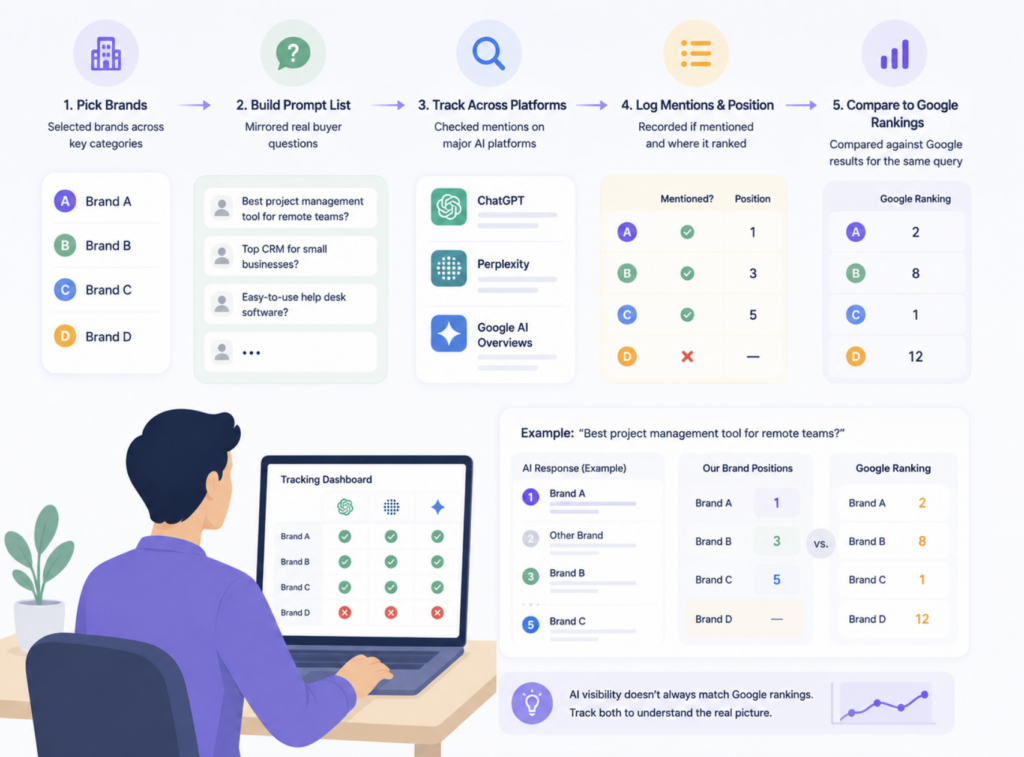
This is close to what Topify’s Dynamic Competitor Benchmarking does automatically. Instead of a one-time snapshot, it keeps running the comparison so you catch shifts as AI engines update their answers, not months after the fact.
The goal wasn’t to prove a point. It was to see what the data actually showed.
Finding #1: Ranking #1 on Google Buys You Less Than You’d Think
This is the finding that should worry anyone treating SEO rank as a proxy for AI visibility. A large-scale study of 150 SaaS companies across 120 keywords found that <cite index=”3-1″>ChatGPT cited study brands 686 times across all keywords, and only 128 of those mentions overlapped with a brand’s Google top-10 ranking</cite>. Put differently, roughly 44% of the brands with strong Google positions were nowhere to be found in ChatGPT’s answers.
Separate research looking at the reverse angle found something just as stark. Among brands that ChatGPT actively recommended, <cite index=”1-1″>81% didn’t rank in Google’s top 10 for the matching query</cite>.
That’s not a small discrepancy. It’s two different visibility systems running in parallel, and most brands are only measuring one of them.
Finding #2: The Gap Isn’t Even Across Categories
Here’s where it gets more useful. The size of that citation gap depends heavily on the category you’re in.
| Category | Google-to-ChatGPT Citation Gap | Likely Driver |
|---|---|---|
| Marketing Automation | 53% | Heavy reliance on paid placement and brand SEO over third-party discussion |
| Dev Tools | 18% | Strong documentation and community content, exactly what AI models train on |
| SaaS (overall average) | 44% | Mixed content ecosystems, inconsistent third-party coverage |
The pattern researchers pointed to lines up with what we saw in our own sample. <cite index=”3-1″>Categories with better documentation and more community discussion tend to have narrower citation gaps</cite>, because that’s the type of content generative engines actually pull from.
If your category leans on brand-controlled marketing content rather than independent reviews, forums, and comparison articles, expect your gap to run wider than average.
Finding #3: Bing Might Matter More Than Your SEO Team Realizes
This is the finding that surprised us the most. A separate case study tracking hotel brand mentions across ChatGPT responses found that <cite index=”4-1″>Bing rank strongly predicts ChatGPT citations, with 87% alignment to Bing’s top results</cite>.
Not Google. Bing.
The same case study illustrated how sharp this effect can get. One boutique hotel appeared in <cite index=”4-1″>just 1.5% of trials</cite>, while a similarly positioned competitor showed up far more often and got cited in a meaningfully higher share of responses.
That’s a hard thing to catch with a traditional SEO audit. Nobody’s checking their Bing rankings in 2026. But if ChatGPT is quietly leaning on Bing’s index to decide who gets named, ignoring it means missing a real lever.
What Correlates and What Doesn’t
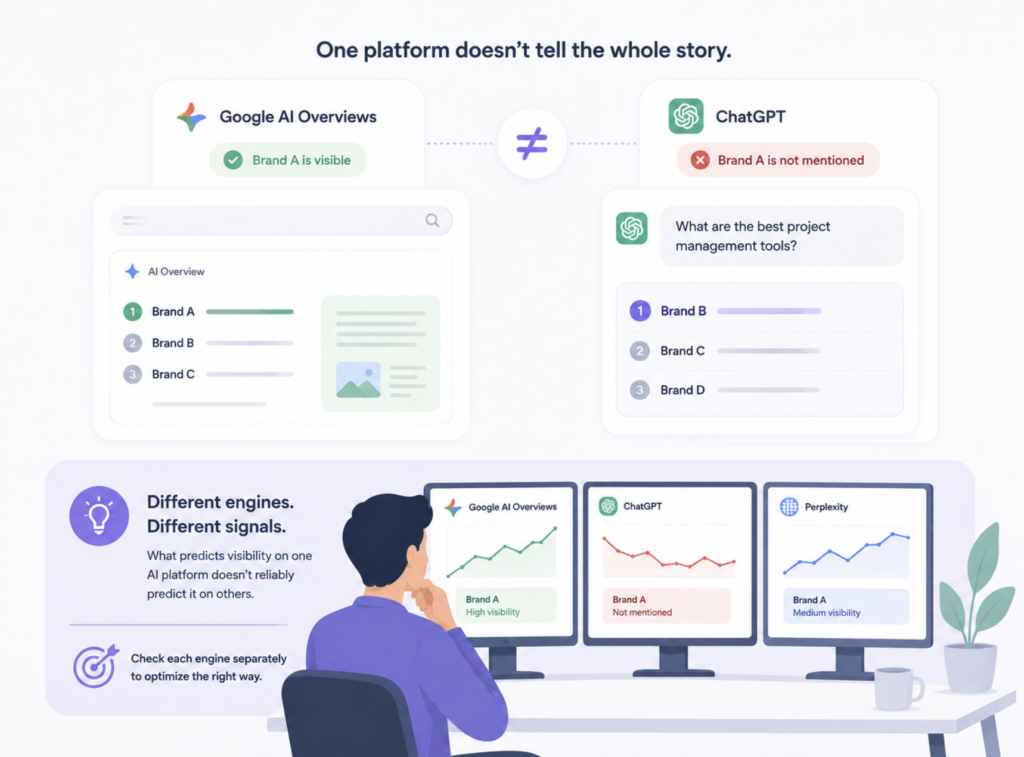
Not every AI platform plays by the same rules, which is part of why a single-platform check gives you an incomplete picture. Analysis of branded web mentions across roughly 75,000 websites found a clear pattern: <cite index=”6-1″>branded web mentions were the strongest correlating factor for Google AI Overview visibility</cite>. But that same signal barely moved the needle elsewhere. <cite index=”6-1″>Perplexity showed a weak correlation with branded mentions, and ChatGPT an even weaker one</cite>.
That’s the core problem with running a competitor analysis on just one AI platform. What predicts visibility on Google AI Overviews doesn’t reliably predict visibility on ChatGPT. You need to check each engine separately, or you’re optimizing for the wrong signal.
What This Means If You’re Running Your Own Competitor Analysis
A few things worth acting on if you’re setting this up for your own brand:
Don’t stop at Google rankings. They tell you almost nothing about whether ChatGPT or Perplexity will mention you. Pull actual AI responses and check for yourself.
Segment by category before you panic. A 50% citation gap in marketing automation isn’t the same red flag as a 50% gap in dev tools. Know your category’s baseline first.
Check Bing, even if you’ve ignored it for years. It’s quietly become a bigger input into ChatGPT’s answers than most teams assume.
Track this continuously, not once. AI answers shift as models update and as competitors publish new content. A one-time competitor snapshot goes stale fast. This is exactly what Topify’s Competitor Monitoring is built for: it keeps checking your position against competitors across platforms so you’re not rerunning a manual audit every quarter.
The trade-off is time. Manually running 200 prompts across three AI platforms, logging every mention, and cross-referencing Google rank takes days if you’re doing it by hand. Automating that comparison is less about convenience and more about being able to catch a shift before a competitor quietly takes your spot in AI answers.
Conclusion
The brand we mentioned at the start wasn’t losing to a competitor with better content or a bigger budget. It was losing to a competitor that happened to align better with the signals AI engines actually weigh, consensus across sources, Bing visibility, and category-specific content patterns that have nothing to do with traditional rank.
Running an AI visibility competitor analysis isn’t about replacing your SEO process. It’s about seeing the part of the competitive landscape that SEO tools were never built to measure.
FAQ
What is a competitor analysis for AI visibility?
It’s the process of tracking how your brand and your competitors show up across AI platforms like ChatGPT, Perplexity, and Google AI Overviews, measuring mention rate, position, and sentiment rather than traditional search rank.
How many prompts do you need for a reliable analysis?
It depends on your category, but most reliable studies use somewhere between 100 and 250 prompts spread across a range of buyer intents. Fewer than that and you risk drawing conclusions from noise.
Do I need to check every AI platform, or is one enough?
Check more than one. Correlation between traditional SEO signals and AI visibility varies significantly by platform, so a competitor analysis limited to one engine will miss how you’re performing elsewhere.
Does ranking well on Google still matter for AI visibility?
It helps, but it’s not sufficient on its own. It’s the foundation, not the ceiling.

