

A SaaS brand ranks first on Google for its category. Ask ChatGPT the same question, and a competitor two spots below them on Google gets named first, described favorably, and linked as the recommended pick. The brand isn’t losing on Google. It’s losing somewhere Google metrics can’t see.
That’s the gap most teams still can’t measure. Traditional competitor analysis tracks backlinks, keyword rankings, and organic traffic share. None of that tells you who ChatGPT recommends when a buyer asks for options in your category.
Your Google Rank Doesn’t Tell You Who’s Winning in AI Search
AI platforms don’t return a list you can scroll through. They generate a single answer, and that answer either includes your brand or it doesn’t. There’s no page two to fall back on.
This changes what “competitor analysis” even means. You’re not comparing domain authority anymore. You’re comparing whether a model chooses to mention you at all, and if it does, how it talks about you next to everyone else in the answer.
That’s a fundamentally different discipline than link building or keyword gap analysis.
Mention Frequency: Are They Even in the Conversation
Mention frequency is the starting point. It’s the percentage of relevant prompts where a competitor shows up at all, and it functions as the AI equivalent of share of voice. Comparing how often your brand is mentioned against competitors for the same query category is the clearest competitive benchmark available in AI search.
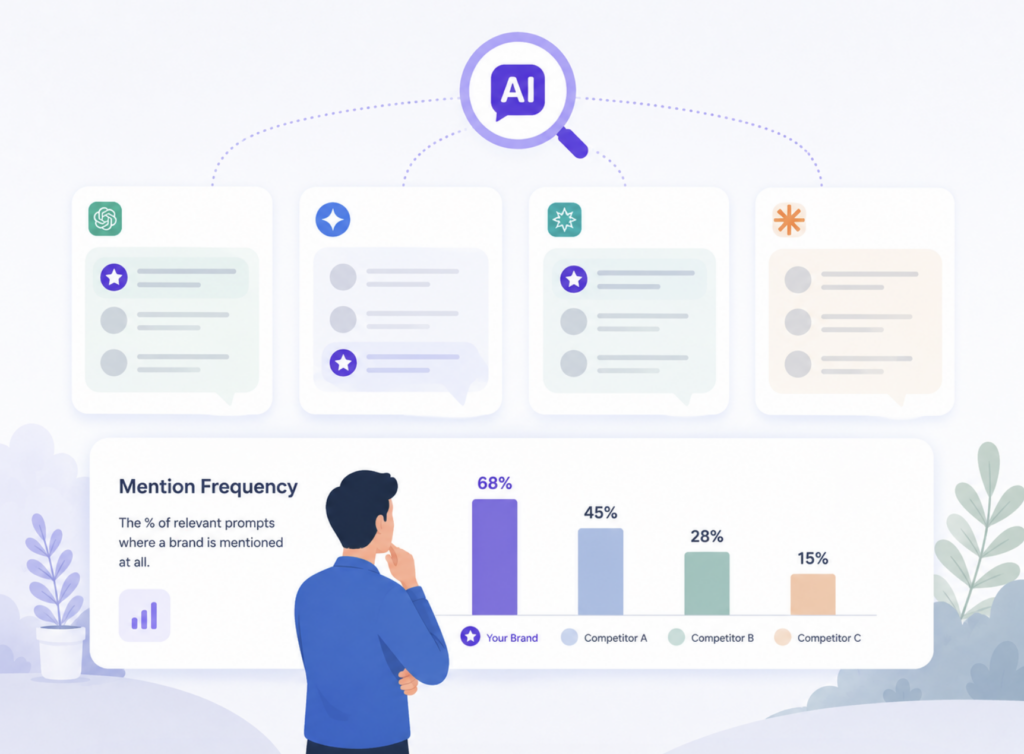
Manually checking this doesn’t scale. A handful of prompts run by hand once a month tells you almost nothing, because AI answers drift on a weekly basis, and one-off snapshots make a benchmark look productive while actually measuring nothing.
You need a fixed prompt set run repeatedly across platforms, not a spot check. That’s the baseline layer. Everything else builds on top of it.
Sentiment: How AI Talks About Them, Not Just Whether It Does
Getting mentioned isn’t the same as getting recommended. A competitor can show up in an answer and still come across poorly, and the reverse is just as common. A positive recommendation carries more weight than a neutral listing, which is why sentiment and positioning both need tracking inside the response itself.
This matters more than most teams assume. A brand mentioned only in the context of problems or complaints technically has visibility, but not the right kind. If a competitor’s mentions skew negative while yours skew neutral, that’s a real advantage, even if their raw mention count is higher.
Sentiment turns a mention count into something you can actually act on.
Position: Who Gets Named First When AI Compares Options
Order matters inside an AI answer the same way it matters on a results page. First-mentioned brands tend to receive disproportionate user attention, similar to position-one bias in traditional search.
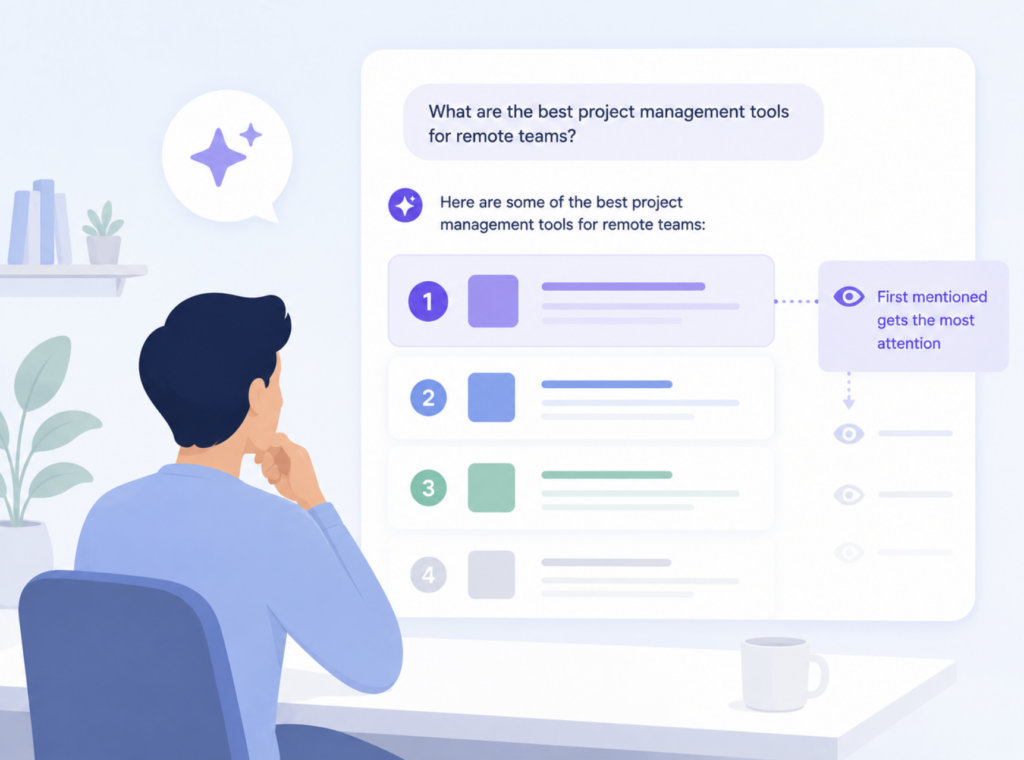
That means two brands can have identical mention frequency and still be in very different competitive positions. One gets named first in “best tools for X” answers. The other gets tacked on at the end, or buried inside a longer list.
Position shifts often before mention frequency does. Watching it lets you catch a competitor gaining ground before they overtake you outright.
Source Overlap: Where Competitors Are Getting Cited From
Every AI answer pulls from somewhere. When a competitor gets cited consistently, there’s usually a specific set of pages the model keeps pulling from, and that’s the most actionable data point in the whole framework.
Surfacing the citation gap, meaning which sources are feeding a competitor’s mentions that are absent from your own footprint, tells teams exactly what to fix to get recommended more often. That’s not a guess. It’s a direct map from a specific competitor advantage to a specific content gap.
Here’s the thing: platforms don’t all pull from the same kind of sources. Perplexity tends to respond fastest because of its recency bias, while ChatGPT and Google’s AI systems take longer to shift because they weight established authority signals that build over months. A source overlap that closes your gap on Perplexity this week might take months to move the needle on ChatGPT.
Putting It Together: A Simple Competitor Tracking Workflow
A workable process looks like this. Fix a prompt set that mirrors how your buyers actually phrase questions. Run it across ChatGPT, Gemini, and Perplexity on a set schedule, not once. Score mention frequency, sentiment, and position for you and named competitors on every run. Then pull source overlap on whichever prompts show the widest gap.
Doing that by hand across three or more platforms, on a recurring basis, with consistent scoring, isn’t realistic for most teams. Prompts drift, model versions update mid-quarter, and a spreadsheet built in January is stale by March. That’s less about effort and more about the format. A tracker needs to run automatically to be worth trusting.
This is exactly the gap Topify‘s competitor analysis tool is built to close. It runs your prompt set across major AI platforms on a schedule, scores mention frequency, sentiment, and position for each named competitor, and surfaces the citation sources feeding their mentions, so the benchmark updates itself instead of going stale between manual checks.
Conclusion
AI visibility competitor analysis comes down to four things: how often a competitor gets mentioned, how AI talks about them when they do, where they land in the answer, and which sources keep feeding their citations. None of that shows up in a Google rank tracker. Building a recurring process around all four, instead of an occasional manual check, is what separates teams that catch competitive shifts early from teams that find out after a rival has already taken the top spot.
FAQ
How often should I track AI visibility competitors?
Weekly at minimum. Model updates and content changes shift AI answers often enough that a monthly check will miss most of the movement.
Is AI visibility competitor analysis different from SEO competitor research?
Yes. SEO competitor research compares rankings, backlinks, and keywords. AI visibility competitor analysis compares whether and how a model mentions each brand inside a generated answer, which follows a different logic entirely.
Does ChatGPT show the same answer to everyone?
Not reliably. Answers can vary by phrasing, account history, and model version, which is why tracking needs a fixed, repeated prompt set rather than a single spot check.
Which AI platforms matter most for competitor tracking?
ChatGPT and Perplexity typically come first, since they’re most often used for direct comparison questions. Gemini matters more if your traffic already leans on Google organic search.

