

Your team has been optimizing for “best CRM software” for months. Rankings are solid. Traffic is steady. Then a potential buyer opens ChatGPT and types, “Which CRM works best for a 50-person SaaS company that already uses HubSpot for email but needs better pipeline reporting?” That prompt triggers multiple internal searches, pulls from dozens of sources, and returns a synthesized answer naming three to five brands. Yours isn’t one of them.
The gap between what keyword search rewards and what prompt search surfaces is widening fast. According to a January 2026 study, 37% of consumers now start their searches with AI instead of Google. And the queries they’re typing into ChatGPT, Perplexity, and Gemini look nothing like the two-to-four-word keyword fragments that traditional SEO was built to capture.
What Prompt Search Actually Does (and Why It’s Not Just Longer Keywords)
The difference between prompt search and keyword search isn’t just word count. It’s architecture.
In keyword search, a user types a fragment like “best project management tool.” Google matches that fragment against an index of pages, ranks them by signals like backlinks and domain authority, and returns a list of ten blue links. The user clicks, scans, and decides.
In prompt search, the user types something closer to a full thought: “What project management tool works best for remote teams of 15 to 20 people who need Slack integration and Gantt charts?” The AI doesn’t match against an index. It reasons across sources, synthesizes information, and delivers a single narrative answer, often naming specific brands and explaining why each fits.
The numbers confirm this behavioral shift. A Semrush study found that the average ChatGPT prompt is 23 words long, compared to just 4.2 words for a typical Google search. Google’s own AI Mode sits in between at 7.22 words per query. Users aren’t just asking longer questions. They’re providing context, constraints, and intent that traditional keyword research never captures.
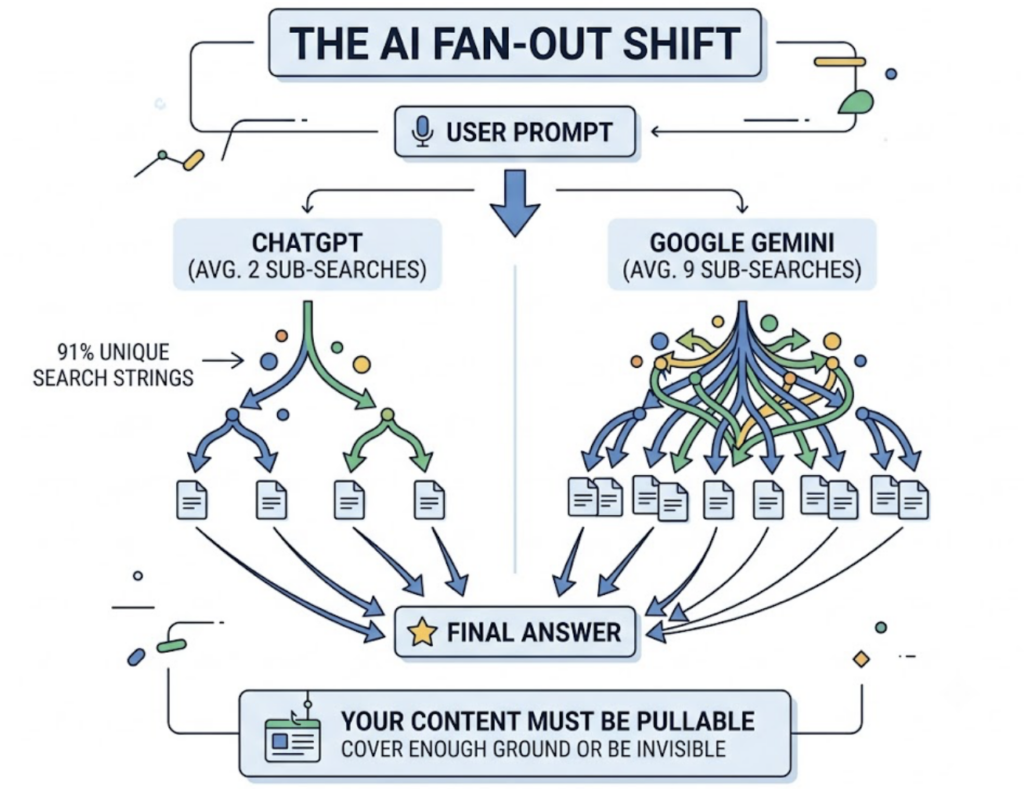
That shift matters because AI platforms don’t just read the prompt literally. ChatGPT, for example, averages about two fan-out queries per prompt, breaking a single user question into multiple sub-searches before assembling a response. Google’s Gemini averages nine. And here’s the kicker: 91% of ChatGPT’s fan-out queries are unique, meaning the AI almost never fires the same search string twice for the same prompt. Your content either covers enough ground to get pulled into those sub-queries, or it doesn’t exist in the answer.
Five Gaps Between Keyword Search and Prompt Search That Marketers Can’t Ignore
The structural differences go deeper than query length. Here’s where keyword search and prompt search diverge in ways that directly affect marketing strategy.
| Dimension | Keyword Search | Prompt Search |
|---|---|---|
| Query structure | 2-5 word fragments (“best CRM software”) | Full sentences with context, constraints, and intent |
| Ranking logic | PageRank, backlinks, domain authority | AI reasoning, source authority, entity clarity, content structure |
| Result format | 10 blue links the user must evaluate | Synthesized paragraph naming 3-5 brands with explanations |
| Intent signal | Single keyword-level intent | Multi-layered intent embedded in one prompt (use case + budget + tech stack + team size) |
| Optimization lever | Keyword density, link building, meta tags | Topical coverage, structured claims, third-party validation, citation-worthy content |
The result format gap is particularly consequential. In keyword search, ranking on page one means you’re one of ten options a user sees. In prompt search, the AI typically mentions three to five brands per answer. If you’re not in that short list, you’re not on page two. You’re nowhere.
A Semrush study of 50,000 brands across 1,094 categories in ChatGPT found that only 15% of categories have a clear brand “owner,” a single brand that shows up consistently across related prompts. In the other 85%, no brand dominates. That’s both a risk and an opportunity: the race for prompt search visibility is still wide open in most categories.
The Invisible Cost of Ignoring Prompt Search
Marketers who treat prompt search as a future trend are already losing ground.
ChatGPT crossed 900 million weekly active users as of February 2026. Perplexity surpassed 100 million monthly active users by April 2026. These aren’t niche platforms. They’re mass-market search tools processing billions of queries daily.
The zero-click problem makes this worse. On traditional Google, 68% of searches already end without a click in 2026. On Google’s AI Mode, that number jumps to 93%. Only 1% of users click on links inside an AI Overview. Prompt search doesn’t just change how brands get discovered. It compresses the entire discovery-to-decision funnel into a single AI-generated answer.
Here’s what that means in practice. A marketer investing solely in keyword SEO might still rank well on Google. But when 43% of U.S. online shoppers are using AI assistants for product research, and 74% of users choose the top-mentioned brand in an AI answer, ranking on Google alone doesn’t guarantee that the brand shows up where buying decisions are actually forming.
The traffic won’t come back through a different door. It simply never reaches your site.
How to Shift from Keyword Thinking to Prompt Thinking
Adapting to prompt search doesn’t mean abandoning keyword SEO. It means layering a new set of practices on top of it. Here are four concrete shifts.
Move from keyword research to prompt research
Traditional keyword tools show you what people type into Google. They don’t show you the full-sentence prompts users are asking ChatGPT or Perplexity.
The fix: start with the questions your customers actually ask. Sales calls, support tickets, Reddit threads, and community forums are rich sources of real prompts. The vocabulary people use when they “talk” to an AI is closer to how they’d ask a colleague than how they’d type a Google search.
Topify‘s High-Value Prompt Discovery surfaces the actual prompts driving AI answers in your category, across ChatGPT, Perplexity, Gemini, and Google AI Overviews. Instead of guessing which keywords matter, you see which prompts are generating brand mentions and recommendations right now.
Build content that answers sub-queries, not just head terms
Because AI search engines decompose prompts into multiple fan-out queries, a single page optimized for one head keyword often misses the retrieval net entirely. ChatGPT’s fan-out queries share only 13% word overlap with the original prompt, meaning the AI is searching for related concepts your keyword-focused content may never mention.
The practical response: build topic clusters, not keyword pages. Cover the definition, the comparison, the use case, the objections, and the alternatives. Each distinct angle becomes a potential entry point for AI retrieval.
Strengthen third-party signals
AI systems tend to pull brand mentions from third-party sources rather than brand-owned content. An analysis of over 23,000 AI citations found that 91% came from third-party sources, not brand websites. Reddit alone accounts for roughly 40% of AI citations across major platforms.
That means PR mentions, industry roundups, expert reviews, and community discussions carry more weight in prompt search than they ever did in keyword search. If the only place your brand is discussed in depth is your own blog, AI systems have less reason to recommend you.
Track visibility where it actually matters
This is where most teams hit a wall. Google Analytics, Search Console, and rank trackers can’t tell you whether your brand appears in an AI-generated answer. They were built for keyword search, not prompt search.
Topify’s Visibility Tracking monitors how often your brand gets mentioned across ChatGPT, Perplexity, Gemini, and Google AI Overviews. Its Source Analysis shows which domains AI platforms are citing when they recommend brands in your category, so you can identify exactly where to build presence. And its Competitor Monitoring lets you see which rivals are being recommended in prompts where your brand should be.
The shift isn’t theoretical. It’s measurable, if you have the right instruments.
Why Traditional SEO Dashboards Can’t Track Prompt Search
Most marketing teams still rely on dashboards built for keyword search: rankings, click-through rates, organic sessions, and conversion paths that start with a Google query.
None of these metrics capture what happens in prompt search.
When a user asks ChatGPT for a recommendation and gets a direct answer, there’s no click to track. No session to attribute. No landing page to measure. The brand either showed up in the answer or it didn’t, and the user either followed up or moved on. Traditional SEO tools are blind to this entire layer.
The gap is especially wide for competitive intelligence. In keyword search, you can check where your competitors rank for target keywords. In prompt search, you need to know which competitors are being named in AI responses to prompts your buyers actually ask, across multiple platforms, with enough frequency to be statistically meaningful.
Topify was built for this exact problem. It combines Visibility, Sentiment, Position, and Source data across AI platforms into a single view. In practice, that means you can spot a drop in ChatGPT mentions, trace it back to a competitor gaining ground on a specific prompt cluster, and see which sources the AI started citing instead of yours, all from one dashboard. If you’re ready to see where your brand stands in AI search, you can get started here.
Conclusion
The shift from keyword search to prompt search isn’t coming. It’s here. Over 900 million people use ChatGPT weekly. Almost 40% of consumers start searches with AI. And the prompts they type bear little resemblance to the keywords marketers have been optimizing for.
The brands that win in this new environment aren’t the ones with the highest domain authority or the most backlinks. They’re the ones AI systems choose to name when a user asks a specific, nuanced question. Building that kind of visibility starts with understanding which prompts matter in your category, tracking how AI engines currently answer them, and creating the kind of content that earns a mention in a synthesized, three-to-five-brand response.
Keyword search isn’t going away. But if it’s the only layer in your strategy, you’re optimizing for a channel that’s handling a shrinking share of how people find, evaluate, and choose brands.
FAQ
Q: What is prompt search?
A: Prompt search refers to the way users query AI-powered platforms like ChatGPT, Perplexity, and Google Gemini using natural-language sentences or questions instead of short keyword fragments. Unlike traditional search, prompt search involves full context (use case, constraints, preferences) and returns a synthesized answer rather than a list of links.
Q: Is prompt search replacing keyword search?
A: Not entirely, but the two are diverging fast. Google still processes billions of keyword searches daily, and traditional SEO remains valuable. However, a growing share of product research and discovery is shifting to AI platforms where prompt-based queries dominate. The smartest approach is optimizing for both.
Q: How do I find what prompts users are asking about my brand?
A: Start with real customer language from sales calls, support tickets, and community forums. Then use tools like Topify’s High-Value Prompt Discovery, which surfaces the actual AI prompts driving brand mentions and recommendations in your category across ChatGPT, Perplexity, Gemini, and Google AI Overviews.
Q: Can I optimize for prompt search and keyword search at the same time?
A: Yes, and you should. The foundation is similar: create high-quality, authoritative content that clearly answers real questions. The difference is scope. Keyword SEO focuses on matching specific terms. Prompt search optimization requires broader topical coverage, structured claims, third-party validation, and cross-platform visibility tracking to ensure AI systems include your brand in synthesized answers.

