


Your marketing dashboard tracks domain authority, keyword rankings, backlinks, and organic traffic. Not one of those numbers tells you whether ChatGPT recommends your brand when a buyer asks for options in your category. Most marketers assume that presence in AI answers can’t be quantified, that it’s too fluid to pin down. It isn’t. An AI visibility score turns your brand’s presence across generative engines into a single trackable number, the same way domain authority once made link equity legible. Once you can see the number, you can move it.
Your Dashboard Has 20 Metrics. None of Them Measure AI
An AI visibility score is a composite metric, typically on a 0 to 100 scale, that measures how frequently, how prominently, and in what context your brand appears in AI-generated answers across platforms like ChatGPT, Gemini, and Perplexity.
The comparison to domain authority is useful but imperfect. Domain authority estimates how likely a page is to rank based on link equity. An AI visibility score measures something different: whether an AI system considers your brand worth mentioning at all. One measures position in a list. The other measures selection into an answer.
That distinction matters more than it sounds. Research compiled by seoClarity and Conductor in 2026 found that roughly 88% of URLs cited by AI engines don’t appear in Google’s top 10 organic results for the same query. Rankings and AI citations have decoupled. A brand can dominate page one and still be absent from the answer layer where a growing share of buyers now start their research.
This is the scoreboard problem that generative search optimisation exists to solve. GSO, often called GEO, is the practice of earning presence in AI answers. The visibility score is how you know whether that practice is working.
How Does an AI Visibility Score Actually Work
There’s no industry-standard formula yet, which is worth knowing before you compare scores across tools. That said, most professional methodologies share the same four-step architecture.
Step 1: Prompt sampling. The system defines a representative set of 20 to 50 high-intent queries that real buyers ask, such as “best expense management software for startups.” These prompts, not head keywords, are the unit of measurement.
Step 2: Answer collection. Each prompt runs against multiple AI platforms on a recurring schedule, capturing the full generated response rather than a link list.
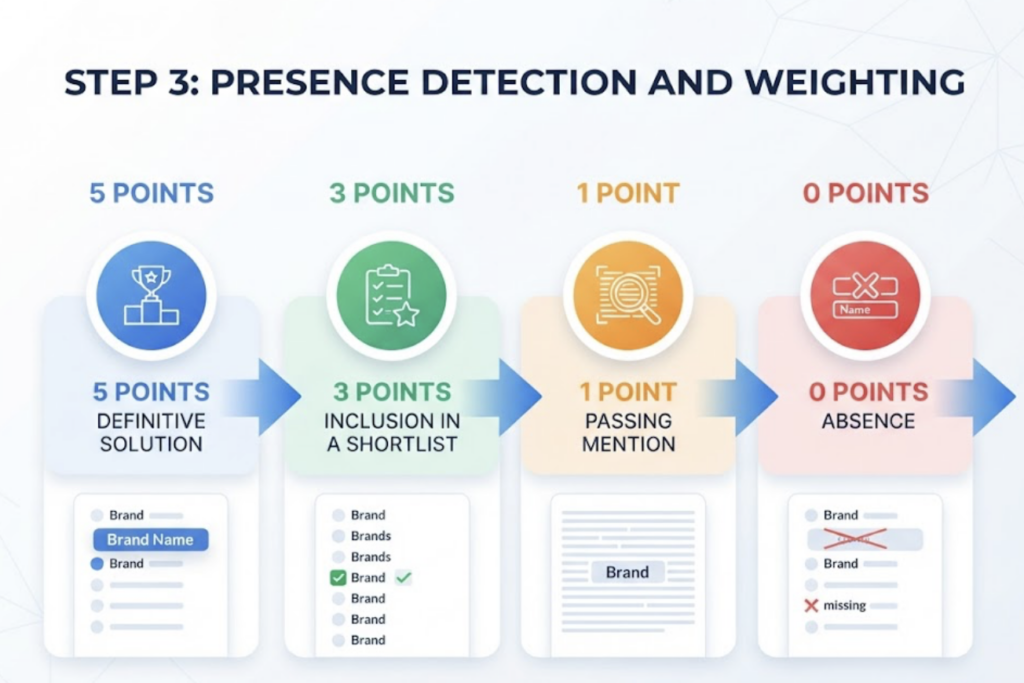
Step 3: Presence detection and weighting. Methodologies like the one documented by Campaign Creators score each appearance on a tiered scale: a brand named as the definitive solution earns 5 points, inclusion in a shortlist earns 3, a passing mention earns 1, and absence earns 0.
Step 4: Normalization. Raw points are converted to a percentage of the maximum possible score, averaged across platforms to smooth out model-specific biases.
The output is one number. Behind it sit dozens of prompt-level observations you can drill into.
One caveat: because vendors weight these steps differently, a 42 in one tool isn’t comparable to a 42 in another. Pick one methodology and track your trend within it.
How to Measure AI Visibility Score Without Guesswork
The tempting shortcut is manual spot-checking. Ask ChatGPT ten questions about your category, count your mentions, note the result in a spreadsheet.
That approach fails for a specific, measurable reason. seoClarity’s 2026 citation volatility research found that platform-level citation rates on ChatGPT can swing by up to 40% within a single month, driven by model updates rather than anything you did. A Tuesday spot-check might show you in 80% of answers; the following Tuesday, 20%. Neither snapshot means much on its own.
Reliable measurement needs four things: a fixed prompt set, multi-platform coverage, time-series data instead of snapshots, and a competitor baseline so you can tell platform noise from genuine share shifts.
That’s a systems problem, not a spreadsheet problem. This is where a platform like Topify fits. Its GEO analytics engine tracks brand presence across ChatGPT, Gemini, Perplexity, DeepSeek, and other major engines through seven metrics: visibility, sentiment, position, volume, mentions, intent, and CVR. In practice, that structure answers the question a single score can’t: not just “what’s my number” but “which component moved, on which platform, and why.”
If you want a baseline before committing to anything, a free GEO score check takes a few minutes and gives you a defensible starting number to report against.
How to Improve Your AI Visibility Score: 5 Moves That Compound
Raising the score isn’t traditional SEO with new vocabulary. The drivers are different, and the research is starting to quantify them.
1. Publish original data. Academic work on generative engine optimisation out of Princeton found that content containing unique statistics, benchmarks, and citable frameworks is 30 to 40% more likely to be cited by LLMs. AI systems synthesizing an answer need concrete facts to anchor on. Generic advice gives them nothing to quote.
2. Structure for retrieval. AI engines pull “chunkable” passages, not whole pages. Content that answers the question directly within the first 60 words of a section, under a clear heading, consistently outperforms narrative copy that builds to a conclusion.
3. Build third-party consensus. Citations are heavily shaped by what AI models see beyond your own site. Brands consistently discussed on Reddit, G2, and industry publications get prioritized in synthesis because independent repetition reads as consensus. Your owned content alone can’t manufacture that signal.
4. Keep entity signals consistent. Same brand name, same category framing, same core claims across every surface. Conflicting descriptions fragment the entity model AI systems build about you, and fragmented entities get skipped.
5. Monitor and iterate on a cadence. There’s a compounding effect worth knowing about: 2026 research points to a “circular authority” loop in which strong AI visibility strengthens the entity signals feeding Google’s own systems. Improving your score in Perplexity isn’t a side quest from SEO. Increasingly, it feeds back into it.
None of these moves requires a big budget to start. A number of free utilities cover the basics, and this GEO free tools reference is a practical starting list.
Common Mistakes That Quietly Tank Your Score
Four patterns show up repeatedly in teams whose scores stall or mislead them.
Platform siloing. Measuring only ChatGPT, or only Google AI Overviews, and treating that as your AI visibility. Cross-platform consensus is the actual signal; single-platform data mostly captures one model’s quirks.
Ranking proxy bias. Assuming strong Google rankings will carry over. The 88% decoupling figure says otherwise, and teams that lean on this assumption tend to discover the gap only when a competitor starts owning the answers.
Counting mentions, ignoring context. A rising mention rate looks like progress until you read the answers and find the AI describing you as “a budget option with limited support.” Frequency without sentiment tracking is a vanity metric.
Static keyword sets. Porting your high-volume SEO keywords into prompt tracking. AI users ask long, specific, high-intent questions. If your prompt set doesn’t reflect that language, your score measures the wrong conversation.
The common thread: each mistake produces a number that looks fine while the underlying position erodes.
What an AI Visibility Score Looks Like in Practice
Abstract scores become useful when you know what the ranges mean. The tiering used in current AVS methodologies breaks down like this:
| Stage | Score range | What it means in practice |
|---|---|---|
| Pre-visibility | 0 to 8 | AI effectively doesn’t know your brand exists; entity signals are missing |
| Early traction | 8 to 25 | Sporadic mentions, often on one platform or in passing context |
| Category presence | 25+ | Your brand recurs as a recognized option in category-level answers |
Here’s how that plays out. A B2B SaaS brand starts at 14: decent Perplexity presence, near-zero on ChatGPT, sentiment neutral. Citation analysis shows ChatGPT’s answers in their category lean on two comparison sites where the brand has no profile. Three months after fixing those third-party gaps and restructuring their product pages for retrieval, the score sits at 31, with primary-mention appearances replacing passing ones.
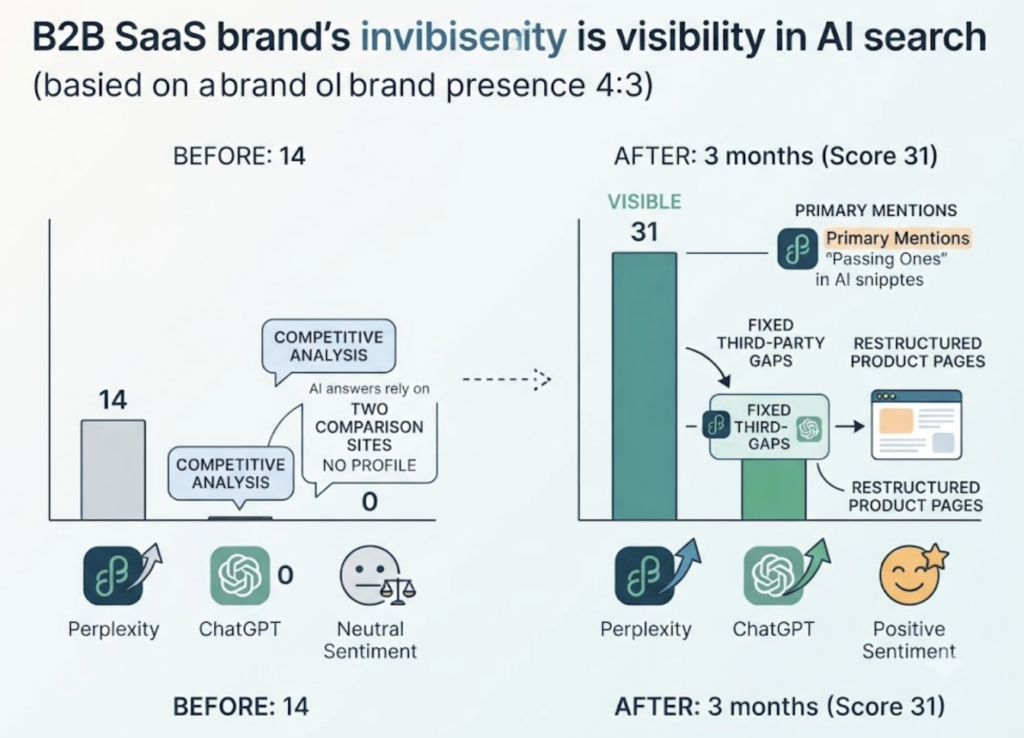
The score didn’t cause that improvement. It made the gap findable and the progress reportable. Competitor benchmarking sharpens this further, because a score of 31 means one thing when your closest rival sits at 18 and something else entirely when they’re at 55.
Conclusion
The metrics on your current dashboard were built for a discovery model where users clicked through lists. AI answers skip the list. An AI visibility score closes that measurement gap: it tells you whether generative engines select your brand, how prominently, and in what tone, and it turns generative search optimisation from guesswork into a trackable practice.
The practical first step is cheap. Establish a baseline score this week, even with free tooling, and start tracking against a fixed prompt set. You can’t raise a number you’ve never measured.
FAQ
Q: What are the best tools for AI visibility score tracking?
A: Look for four capabilities: multi-platform coverage, time-series tracking, sentiment and position data alongside raw mentions, and competitor benchmarking. Topify covers all four through its seven-metric GEO analytics, with a free GEO score checker for baseline measurement. Several point solutions handle single platforms, which works for early experiments but hits the platform-siloing problem at scale.
Q: How much does AI visibility score tracking cost?
A: Free checkers give you a one-time baseline at no cost. Continuous monitoring platforms typically start around $99 per month for tracking roughly 100 prompts across major engines, scaling up with prompt volume, platform coverage, and seats. Managed GEO services that combine tracking with content execution run considerably higher.
Q: Is there a standard checklist for an AI visibility score audit?
A: A workable six-point audit: define 20 to 50 high-intent prompts, run them across at least three AI platforms, score each appearance by prominence tier, log sentiment for every mention, benchmark two or three competitors on the same prompts, and repeat monthly to build a trend line.
Q: How is an AI visibility score different from generative search optimisation?
A: The score is the measurement; GSO is the practice. Generative search optimisation covers everything you do to earn presence in AI answers, from content structure to third-party consensus building. The AI visibility score tells you whether that work is moving the needle.

