

Every Monday, someone on your team asks ChatGPT the same five questions about your category, screenshots the answers, and drops them into a Slack channel. Two weeks in, the answers have changed, nobody remembers the original wording, and the screenshots can’t be compared or reported. Recent research suggests that more than 50% of the sources cited in AI answers can shift within a single month. Against that kind of volatility, spot-checking isn’t measurement. It’s noise collection. What you need is a repeatable system: defined queries, a fixed cadence, consistent metrics, and a feedback loop that turns data into action.
Manual Spot Checks Aren’t an AI Query Tracking Strategy
An AI query tracking strategy is a documented system for monitoring how AI platforms answer the questions that matter to your business. It has four pillars: a defined prompt universe, a tracking cadence, a unified metric system, and an iterative optimization loop. Miss any one of them, and you’re back to screenshots.
The reason this needs to be systematic, not casual, is that LLM outputs are non-deterministic. The same prompt can surface your brand today and omit it tomorrow, because answers are synthesized on the fly rather than pulled from a stable index. Tracking AI-driven search requires a fundamentally different approach than watching a rankings column.
Here’s the part most teams underestimate: AI visibility and Google rankings are actively decoupling. Industry data from 2026 indicates that only about 12% of URLs cited by AI appear in Google’s top 10 organic results for the same query. Pages ranking in Google’s top 10 accounted for roughly 76% of AI citations in mid-2025. By 2026, that figure had dropped to around 38%.
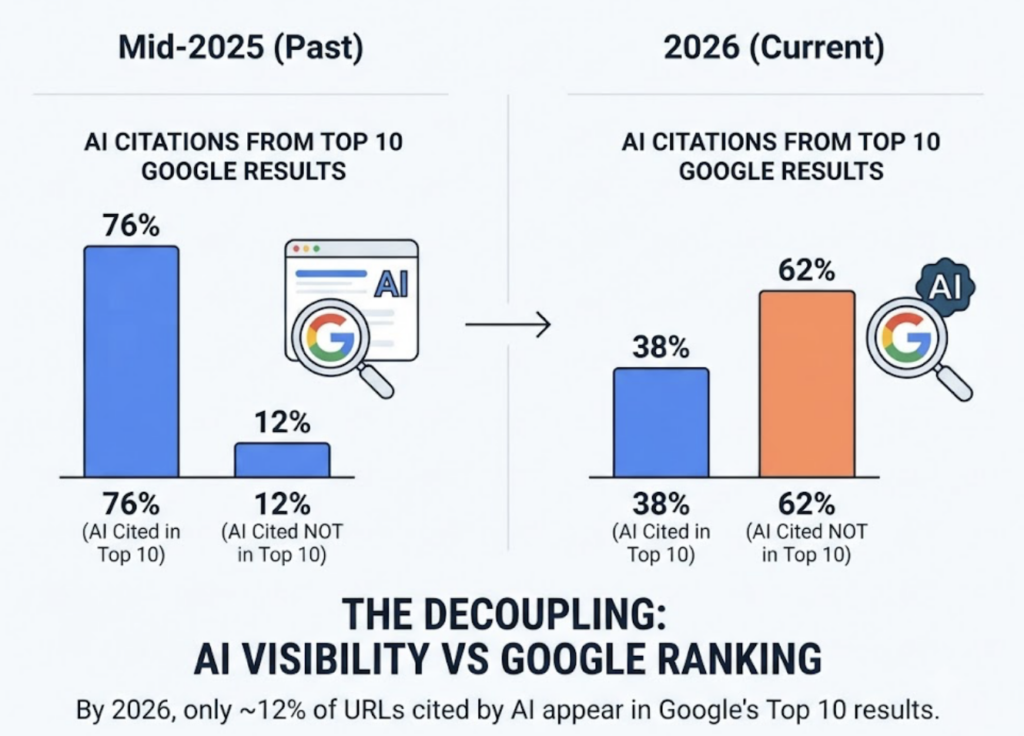
Your SEO dashboard can’t see this shift. A tracking strategy can.
Step 1: Choose the Queries That Actually Drive Revenue
Query selection is where most programs quietly fail before they start. Teams either track too few prompts to be statistically useful, or they copy their SEO keyword list and call it done. Neither reflects how people actually talk to AI.
A working prompt universe maps to the customer journey, typically in three layers. Informational queries capture early research (“how does X category work”). Comparative queries capture evaluation (“best AI query tracking tool for agencies”). Transactional queries capture decision moments (“is [brand] worth it”). High-value prompts mirror buying intent, not raw search volume.
There’s a second reason journey coverage matters. Users increasingly follow a hybrid path: they discover options through AI, then verify through Google. If your brand is absent at the discovery stage, the odds of being searched at the verification stage drop sharply. The queries you track should cover the discovery moments where that filtering happens.
If you’re not sure which prompts carry weight in your category, this is one place tooling helps early. Topify includes a prompt discovery function that surfaces high-volume AI queries relevant to your brand, which tends to be faster than brainstorming a list and hoping it matches real user behavior.
Start with 20 to 50 core queries. You can expand later. You can’t retroactively build a baseline.
Step 2: Set a Tracking Cadence That Matches AI Volatility
A single snapshot of an AI answer is statistically meaningless. With half of cited sources potentially rotating within a month, the value is in the trend line, not the data point.
The practical cadence is tiered. High-value queries, the comparative and transactional prompts closest to revenue, deserve daily or weekly runs. Long-tail informational queries can run monthly, enough to catch model drift without drowning your team in data. And before you react to anything, establish a 30-day baseline. A brand dropping out of one Tuesday’s answer is noise. A brand trending downward across four weeks is signal.
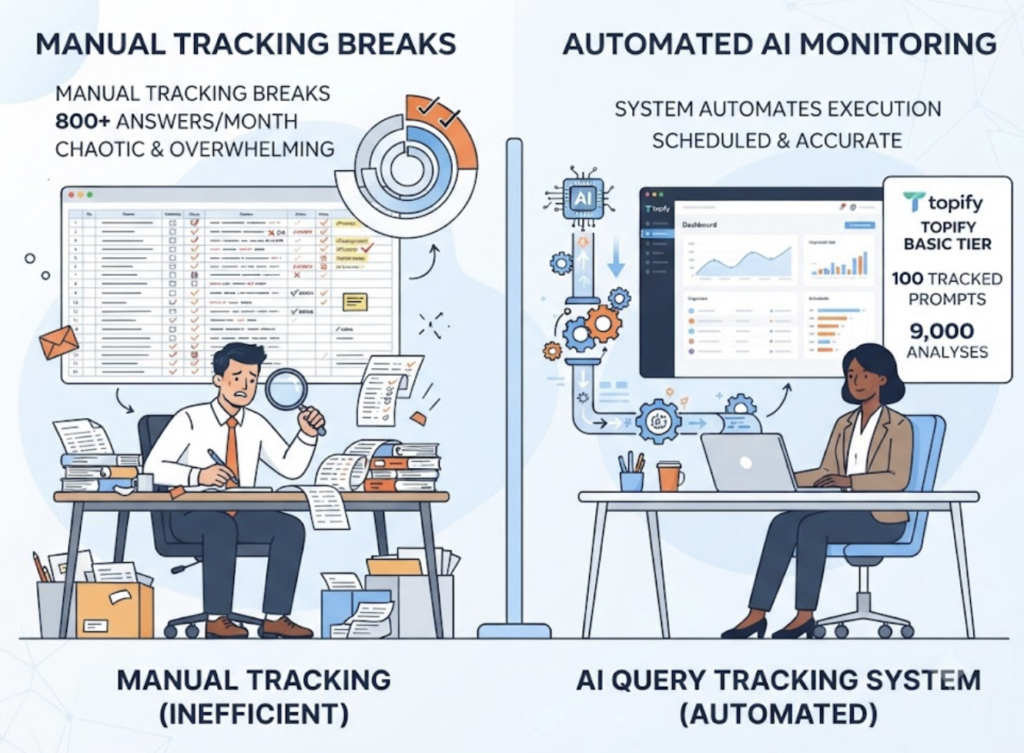
This is also where manual tracking mathematically breaks. Running 50 queries weekly across four AI platforms means 800+ answer checks a month, each needing consistent capture and scoring. An AI query tracking system worth the name automates this batch execution on schedule. For reference, an entry-level plan like Topify’s Basic tier covers 100 tracked prompts and 9,000 AI answer analyses per month, which gives a sense of the volume a serious program actually processes.
Step 3: Measure What Matters in an AI Query Tracking Dashboard
Counting brand mentions is the shallow end of measurement. A mention in position seven of a lukewarm list is not the same as being the first recommendation with a positive framing. A useful AI query tracking dashboard separates four distinct signals.
| Metric | What It Tells You | Why Mentions Alone Miss It |
|---|---|---|
| Visibility score | How often you appear across tracked prompts | Frequency without context |
| Positioning | Where you fall in the answer’s recommendation order | First pick vs. footnote |
| Sentiment | How the AI describes you: positive, neutral, or competitive framing | A mention can be a warning |
| Citation source | Which pages the AI attributes to your brand | Reveals which assets earn AI trust |
These four interact in ways a single number hides. You can hold steady visibility while your position slips from first to fourth, which usually precedes disappearing entirely. You can gain mentions while sentiment shifts toward “budget alternative,” which is a positioning problem, not a visibility win. And citation source is the diagnostic layer underneath everything: when your visibility moves, the citation data tells you which page started or stopped carrying you. That’s why platforms like Topify consolidate visibility, sentiment, position, and citation data into a single analytics view rather than reporting mentions in isolation.
One more metric deserves a seat: zero-click rate, the share of queries resolved entirely inside the AI interface. As that number climbs, your strategy’s goal shifts from earning clicks to shaping the answer itself.
Step 4: Turn Tracking Data into GEO Actions
Tracking without action is an expensive hobby. The optimization loop starts with citation gap analysis: for each query where a competitor appears and you don’t, identify which sources the AI cited for them. Those sources are the map of what you’re missing.
The fixes usually fall into two buckets. The first is content structure. AI models favor extractive content, and pages that deliver a direct, concise answer within the first 60 words tend to get cited more. Front-load the answer, then elaborate.
The second is entity authority. AI systems weigh co-occurrence: whether your brand shows up alongside the problems you solve in authoritative third-party contexts, not just on your own domain. Review sites, industry publications, and community discussions carry citation weight your homepage can’t replicate.
Then close the loop. Ship the fix, keep tracking, and confirm the change moved the metric. Tools with source analysis shorten this cycle considerably. Topify’s citation reverse-engineering shows the exact domains and URLs AI platforms cite for any tracked query, so the gap analysis takes minutes instead of a manual afternoon, and its agent can deploy the resulting strategy without hand-built workflows.
Common Mistakes That Quietly Break Your Tracking Program
Most failed programs die from a handful of predictable errors.
Relying on Google Search Console as a proxy. GSC doesn’t capture LLM behavior, and with only around 12% of AI-cited URLs overlapping Google’s top 10, it’s measuring a different game.
Assuming rank one on Google equals AI visibility. The 76%-to-38% citation drop is the clearest evidence yet that these channels have split.
Tracking a single AI platform. ChatGPT, Perplexity, Google AI Overviews, and DeepSeek cite different sources and describe brands differently. One platform’s data generalizes poorly.
Counting mentions without position or sentiment. You’ll report growth while your actual standing erodes.
Freezing the query set. Buying language evolves, and last quarter’s prompt universe slowly stops representing your market.
Ignoring off-site presence. Reddit threads, review platforms, and trusted media often outweigh your own pages in citation decisions.
None of these mistakes announces itself. That’s what makes them expensive.
The Tool Stack: What AI Query Tracking Software Should Cover
The category has grown crowded, and most AI query tracking software looks similar in screenshots. The differences show up in five capabilities.
| Capability | What to Verify |
|---|---|
| Multi-platform coverage | ChatGPT, Perplexity, AI Overviews at minimum; ideally Gemini, DeepSeek, and regional engines |
| Prompt-level tracking | Scheduled batch runs against your defined query set, not ad hoc lookups |
| Competitor benchmarking | Side-by-side visibility, position, and sentiment against named rivals |
| Citation analysis | Source-level data explaining why answers cite what they cite |
| Execution layer | A path from insight to action, not just another report |
Topify covers all five in one AI query tracking platform. Its visibility tracking runs your prompt universe across ChatGPT, Gemini, Perplexity, DeepSeek, and other major engines on schedule, scoring each answer across seven metrics including visibility, sentiment, position, and CVR. Competitor monitoring auto-detects rivals and benchmarks your standing in real time, and the citation analysis maps every source domain behind the answers. What separates it from report-only tools is the execution end: you state a goal in plain English, review the proposed strategy, and deploy it in one click. Pricing starts at $99/month for 100 tracked prompts, which puts a systematic program within reach of a single marketer, not just enterprise teams.
If budget is zero for now, there’s still no excuse for guessing. This reference list of free GEO tools covers no-cost options for baseline checks while you build the case for a full AI query tracking solution.
A 10-Point Checklist Before You Call It a Strategy
- Prompt universe documented, 20 to 50 core queries minimum
- Queries layered by intent: informational, comparative, transactional
- Every stage of the customer journey covered by at least one query
- Tracking cadence assigned per tier: daily or weekly for high-value, monthly for long-tail
- At least three AI platforms monitored
- 30-day baseline captured before any optimization decision
- Dashboard tracks visibility, position, sentiment, and citation source separately
- Named competitor set benchmarked on the same queries
- Citation gap review scheduled monthly
- Every optimization shipped gets a follow-up measurement window
If you can’t check all ten, you have a monitoring habit, not a strategy.
Conclusion
The screenshot-in-Slack era of AI monitoring is ending for the same reason gut-feel SEO ended: the channel got too volatile and too valuable to manage by intuition. With AI citations rotating monthly and the overlap with Google rankings shrinking fast, the brands that win are the ones measuring systematically while competitors spot-check.
Start small and start now. Define 20 to 50 revenue-relevant queries, capture a 30-day baseline, and let the trend lines tell you where to act. If you’d rather not build the pipeline by hand, you can get started with Topify and have your first tracked prompts running the same day.
FAQ
Q: What is an AI query tracking strategy?
A: It’s a documented system for monitoring how AI platforms like ChatGPT and Perplexity answer questions relevant to your brand. It combines four elements: a defined set of tracked queries, a fixed monitoring cadence, a unified metric system covering visibility, position, sentiment, and citations, and an optimization loop that acts on the data.
Q: How does an AI query tracking strategy work in practice?
A: You define 20 to 50 high-intent queries, run them on schedule across multiple AI platforms, and score each answer for brand presence, position, and framing. After a 30-day baseline, you use citation gap analysis to find where competitors get cited instead of you, fix the underlying content or authority gaps, and confirm the change in the next tracking cycle.
Q: How much does AI query tracking cost?
A: Dedicated platforms typically run from around $99 to $500+ per month depending on prompt volume and platform coverage. Topify’s entry plan starts at $99/month with 100 tracked prompts, while free tools can handle basic one-off checks before you commit to a paid AI query tracking solution.
Q: What are examples of an AI query tracking strategy?
A: A SaaS team might track “best [category] software” weekly across four platforms and use citation data to prioritize review-site coverage. An agency might run per-client prompt sets monthly and report visibility trends alongside SEO metrics. An ecommerce brand might track product recommendation queries daily during peak season to catch positioning drops before they cost revenue.

