

Your quarterly review has a slide for rankings, a slide for traffic, and a slide for conversions. Then someone asks how the brand is performing in AI search, and the deck goes quiet. You’ve asked ChatGPT about your category a few times, taken screenshots, and noticed the answers change week to week. That’s not a metric. That’s anecdote collection.
The uncomfortable part: your brand already has a measurable presence in AI answers, whether you’re tracking it or not. Perplexity, Gemini, and ChatGPT are recommending someone in your category every day. An AI visibility score tool turns those scattered, non-deterministic answers into a single number you can report, benchmark, and improve. Here’s what that number actually contains, and how to move it.
Your Brand Has an AI Visibility Score. You Just Can’t See It Yet.
An AI visibility score tool is software that measures how often, where, and in what context your brand appears in AI-generated answers, then compresses that data into a composite benchmark, typically on a 0 to 100 scale. Think of it as the AI-era equivalent of a keyword rank tracker, with one core difference: rankings measure position on a page, while a visibility score measures the probability and quality of being mentioned at all.
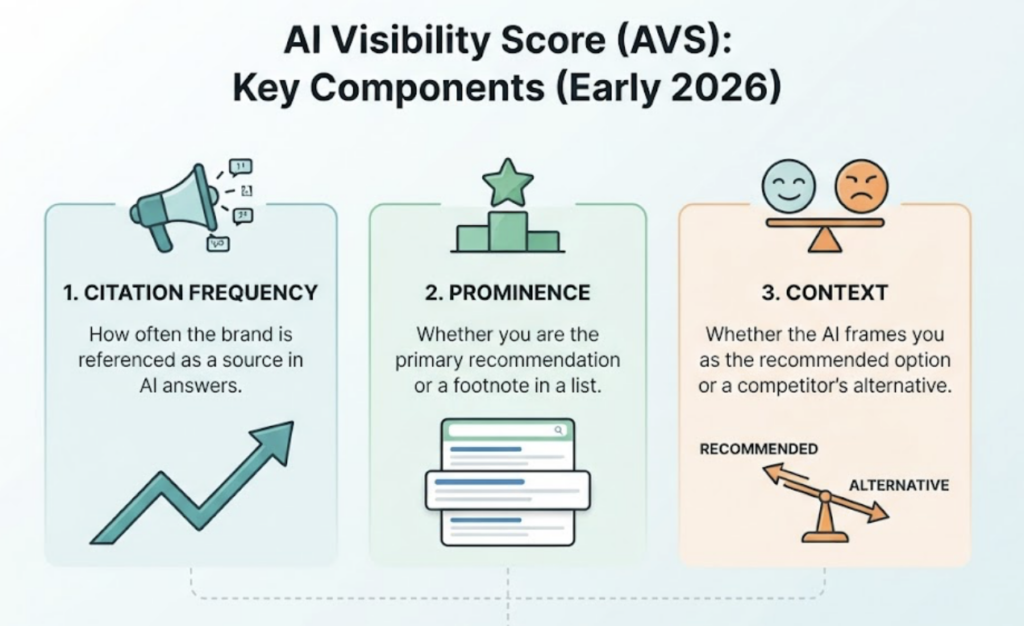
According to industry research from early 2026, an AI Visibility Score (AVS) synthesizes three things: citation frequency (how often the brand is referenced as a source), prominence (whether you’re the primary recommendation or a footnote in a list), and context (whether the AI frames you as the recommended option or a competitor’s alternative).
Examples of AI visibility score tools range from free single-scan checkers, which grade one domain against GEO readiness criteria, to full monitoring platforms that run hundreds of prompts across multiple AI engines daily. The free checkers answer “where do I stand today.” The platforms answer “what changed, why, and what do I do about it.”
That distinction matters more than most buyers realize.
How Does an AI Visibility Score Tool Work
Manual spot-checking fails for a structural reason: AI answers are non-deterministic. Ask the same question twice and you can get different brand lists. Citation patterns shift with model updates, training data refreshes, and even minor changes in prompt phrasing. One screenshot tells you what one model said one time. It can’t tell you your baseline.
Professional tools solve this with scale. The typical pipeline runs in three steps:
- Prompt universe sampling. The tool builds a set of high-intent queries that mirror your customer journey, things like “best enterprise software for X” or “alternatives to Y for small teams.” A meaningful sample usually starts around 100 tracked prompts. For scale reference, entry-level plans on platforms like Topify analyze roughly 9,000 AI answers per month against 100 prompts.
- Platform aggregation. The tool queries ChatGPT, Perplexity, Gemini, Google AI Overviews, and increasingly DeepSeek and other regional engines simultaneously, then parses each response for brand mentions, citations, and positioning.
- Metrics synthesis. Raw mentions get converted into structured scores: visibility rate, sentiment, competitive share of voice, and position within answers, tracked over time so you can separate signal from model noise.
Repetition is the whole point. A score built from thousands of sampled answers is stable enough to benchmark. A score built from five manual chats is a coin flip.
How to Measure an AI Visibility Score: 7 Metrics That Matter
If you’re evaluating what a score should contain, the 2026 research consensus points to four core dashboard metrics: citation rate (the percentage of relevant AI queries that cite your brand), share of model (your voice versus top competitors in AI synthesis), response position (how prominent your mention is within the answer), and entity signal consistency (whether the AI correctly identifies what your products actually do).
In practice, the more complete measurement frameworks expand this into seven dimensions. Topify’s Comprehensive GEO Analytics, for instance, scores brands across visibility, mentions, position, sentiment, volume, intent, and CVR (Conversion Visibility Rate, an estimate of how likely an AI answer is to drive users toward your brand).
Why seven instead of one raw mention count? Because mentions without context mislead. A brand can be mentioned frequently but framed as “the budget option” in a premium category. Another can appear rarely but always as the first recommendation for high-intent buying prompts. Sentiment and position separate those two situations. Volume and intent tell you whether the prompts you’re winning actually matter commercially.
This is also where brand optimization for AI answers starts to become concrete rather than abstract. Once you can see that your sentiment score dropped on Perplexity while your citation rate held steady, you’re no longer guessing what to fix. You’re diagnosing.
One number to report upward. Seven dimensions to act on.
How to Improve Your AI Visibility Score
Improving the score requires shifting from “rank-ready” content to answer-ready content. The strategies with the strongest evidence behind them in 2026:
Structure for extraction. AI models favor content they can lift cleanly: 40 to 60 word answer blocks, FAQ sections, and comparison tables. If your key claims are buried in 300-word paragraphs, models tend to cite whoever chunked the same information better.
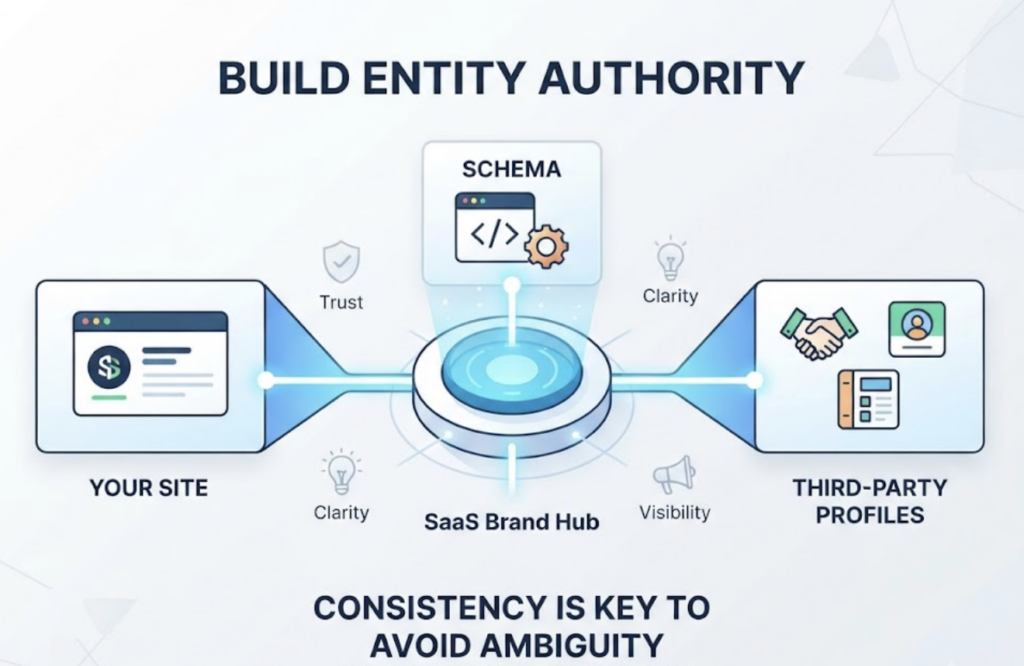
Build entity authority. Keep brand, product, and service descriptions consistent across your site, schema markup, and third-party profiles. Entity signal consistency is a scored metric precisely because AI engines penalize ambiguity: if the model isn’t sure what you do, it won’t recommend you for it.
Earn third-party consensus. AI engines triangulate trust signals across sources. Research indicates that mentions on Reddit, review platforms like G2 and Capterra, and authoritative industry publications now move AI citations more effectively than traditional backlink building. This is the biggest single mindset shift for teams coming from classic SEO.
Don’t ignore technical foundations. Core Web Vitals still gate crawling. Pages with poor performance (LCP above 2.5 seconds) are reported to be 72% less likely to be cited by AI engines.
Close the loop with citation analysis. Improvement compounds when you can see which domains and URLs the AI actually cites for your target prompts. Tools that reverse-engineer AI citations show you whether your content, or your competitor’s, dominates those source lists, which turns “publish more content” into “publish the specific asset that fills this citation gap.” A good starting point for building this workflow on a budget is this reference list of free GEO tools, which maps free checkers to each stage of the process.
Common Mistakes That Keep Your Score Flat
Four patterns show up repeatedly in teams whose scores don’t move:
Platform siloing. Measuring only ChatGPT and assuming the result generalizes. Each engine has different citation behavior and different source preferences. A brand can score 60 on ChatGPT and 15 on Perplexity for identical prompts.
Ranking proxy bias. Assuming strong Google rankings imply AI visibility. The data says otherwise: roughly 88% of URLs cited by AI engines don’t appear in Google’s top 10 organic results for the same query. SEO and AI visibility have decoupled. Treating one as a proxy for the other is the fastest way to be surprised in a quarterly review.
Sentiment blindness. Celebrating mention counts while the AI consistently positions you as “a cheaper alternative to [competitor].” Volume without favorable framing can actively reinforce the wrong narrative.
Static auditing. Running one audit, fixing the findings, and moving on. Citation patterns are volatile by design; models retrain and platforms update. Scores need continuous monitoring, not annual checkups.
Each of these mistakes shares a root cause: treating AI visibility like a snapshot instead of a stream.
Best Tools for Tracking Your AI Visibility Score
Before comparing platforms, it’s worth being clear on why the investment case exists at all. Brands cited in AI-generated answers earn a 35% higher organic CTR and a 91% higher paid CTR than uncited competitors, and Ahrefs data from 2025 to 2026 shows AI-sourced visitors converting at up to 23x the rate of traditional organic traffic. Visibility in AI answers isn’t a vanity metric. It’s a channel.
When evaluating tools, four criteria matter most: platform coverage (how many AI engines are tracked), metric depth (mentions only, or the full sentiment/position/intent picture), competitive benchmarking (a score without competitor context is hard to interpret), and execution support (whether the tool stops at dashboards or helps you act).
For teams that want measurement and execution in one place, Topify covers ChatGPT, Gemini, Perplexity, DeepSeek, and other major engines, scores brands across the seven-metric framework described above, and pairs the analytics with one-click strategy execution: you define the goal in plain English, review the proposed GEO strategy, and deploy it without manual workflows. Competitor benchmarking is built in, so your score always reads relative to who AI engines are actually recommending in your category.
On pricing, plans start at $99 per month for 100 tracked prompts and 9,000 monthly AI answer analyses, with a 30-day trial, which puts a full baseline within reach before any long-term commitment. Full plan details are on the Topify pricing page.
Other platforms in the category tend to specialize: some focus narrowly on citation monitoring, others on single-engine tracking. They’re workable choices if your needs are narrow, though most teams outgrow single-platform data quickly.
If you just want a baseline number today, running a first scan takes a few minutes and gives you something concrete to bring to the next review.
Conclusion
The question that opened this article, “how are we doing in AI search,” has an answerable form now. An AI visibility score tool converts non-deterministic AI answers into a stable, benchmarkable number, and the seven metrics underneath it tell you exactly where the gaps are: citation frequency, position, sentiment, or entity clarity.
The practical sequence is short. Establish a baseline score across at least three AI platforms. Identify which prompts and which engines you’re losing. Fix the highest-impact gaps first, usually citation sources and answer-ready structure. Then keep measuring, because in a channel this volatile, the score you don’t monitor is the score that quietly drops.
FAQ
Q: What is an AI visibility score tool?
A: It’s software that measures how often and how favorably your brand appears in AI-generated answers across platforms like ChatGPT, Perplexity, and Gemini, then converts that data into a composite 0 to 100 score. Unlike rank trackers, it measures whether AI systems mention and recommend you at all, not where a page sits in a list of links.
Q: What should be on your checklist before choosing an AI visibility score tool?
A: Four items: coverage of at least three major AI platforms, metrics beyond raw mentions (sentiment, position, and intent at minimum), built-in competitor benchmarking so the score has context, and some path from insight to action, whether that’s citation-gap reports or automated execution. If a tool only shows mention counts on one engine, it’s a spot-checker, not a scoring system.
Q: How much does an AI visibility score tool cost?
A: Free single-scan checkers exist for establishing a rough baseline. Continuous monitoring platforms typically start around $99 to $199 per month depending on prompt volume and seats, with enterprise tiers from roughly $499 per month. Managed GEO services that combine tracking with content execution run significantly higher, generally $4,000 or more per month.
Q: What’s the best strategy for using an AI visibility score tool?
A: Treat it as a loop, not a report. Baseline your score, benchmark against your top three competitors, diagnose whether gaps come from citation sources, content structure, or entity inconsistency, ship targeted fixes, and re-measure monthly. Teams that fold the score into their existing marketing dashboard, next to rankings and traffic, tend to sustain improvement; teams that audit once tend to plateau.

