


Your domain authority is solid. Your keywords rank on page one. But when a prospect asks Google AI Mode for a recommendation in your category, your brand isn’t part of the answer. Only 38% of URLs cited in AI Overviews now rank in Google’s Top 10 for the same query, down from roughly 76% a year earlier. The disconnect between organic rankings and AI citations has a technical explanation: query fan-out. Most content strategies still aren’t built for it.
What Happens When AI Fans Out Your Query
Query fan-out is the retrieval mechanism behind AI search platforms like Google AI Mode, ChatGPT, and Perplexity. Instead of matching a user’s prompt to a single keyword, the AI decomposes the query into 8 to 12 parallel sub-queries, each targeting a different angle of the user’s intent. It then retrieves passages from multiple sources, synthesizes the results, and delivers one answer.
Here’s what that looks like in practice. A user types “best project management tools for remote teams.” A traditional search engine looks for pages optimized around that exact phrase. An AI system fans the query out into sub-queries like “top project management software 2026,” “remote team collaboration features,” “project management pricing comparison,” and “enterprise vs small team PM tools.”
The user never sees these sub-queries. They only see the final answer.
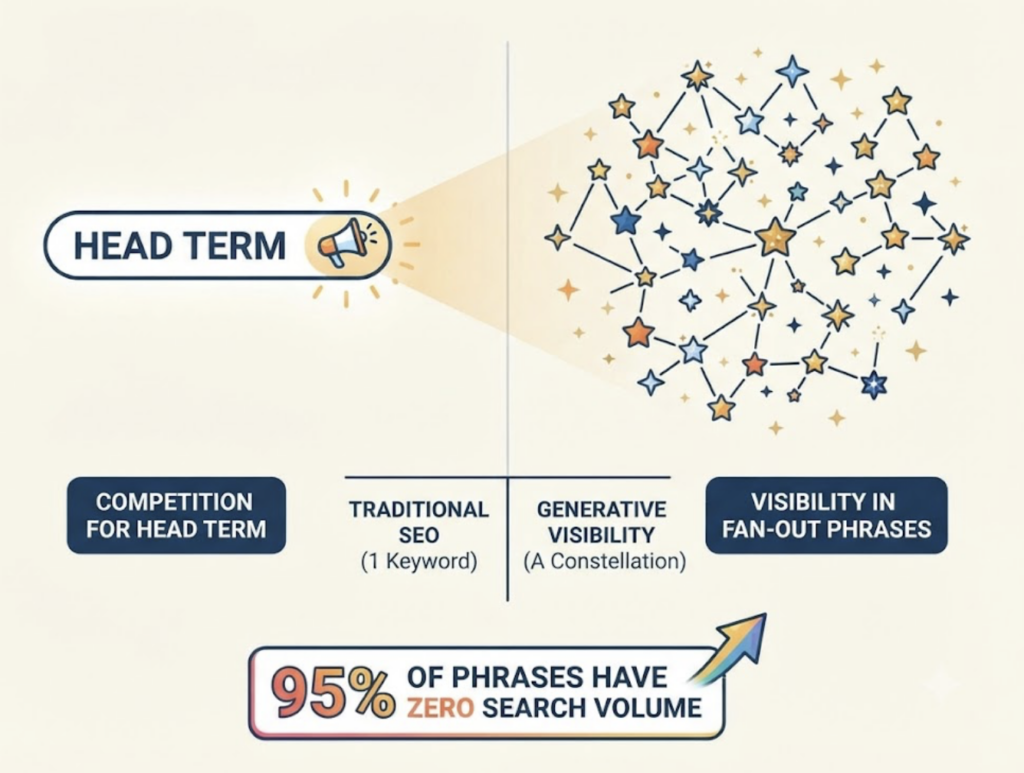
But the brands that get cited are the ones whose content matched the hidden sub-queries, not just the head term. Your content isn’t competing for one keyword anymore. It’s competing for a constellation of related questions you can’t find in any keyword tool. 95% of fan-out phrases show zero monthly search volume in traditional keyword research platforms, yet they’re the gatekeepers of generative visibility.
Why Traditional Rankings Don’t Predict AI Citations
A decoupling has occurred between where you rank in Google and whether AI systems cite you. The data is clear.
An Ahrefs analysis of 863,000 keyword SERPs and 4 million AI Overview URLs found that the overlap between top-10 organic results and AI citations dropped from 76% to about 38% in one year. Put another way: roughly 62% of AI Overview citations now come from pages that don’t rank in Google’s Top 10 at all.
Why? Because AI systems don’t evaluate pages. They evaluate passages. Research from Ziptie.dev indicates that self-contained answer units of roughly 134 to 167 words are significantly more likely to be selected as citation sources. A 3,000-word article with no clear passage boundaries loses to a shorter, well-structured piece that directly answers one of the fanned-out sub-queries.
This creates a real opening for smaller brands. You don’t need a domain authority of 80 to get cited. You need a passage that answers a specific sub-query better than anyone else’s.
Ranking and citation are now separate games.
Five Sub-Query Types AI Generates During Fan-Out
Not all fan-out sub-queries work the same way. Understanding the types helps you build content that covers more of them.
Intent Diversity Queries
When a user asks a broad question, AI generates sub-queries spanning different intents: comparing, exploring, purchasing. A single prompt like “best CRM for startups” triggers sub-queries about pricing, features, integrations, and user reviews simultaneously. Google’s own patent documentation describes this as the LLM generating queries across multiple user intents from a single input.
Temporal Variants
AI systems frequently add freshness qualifiers to sub-queries. Freshness signals lift citation probability by 25.7%according to aggregated industry research. Sub-queries like “latest CRM updates 2026” or “recently launched features” target content refreshed within the past 30 to 90 days. Re-dating a post without updating its facts produces no measurable lift.
Entity-Based Expansion
AI models fan out into specific entities: brand names, tools, techniques, people, statistics. Entity-rich passages that name specific products, cite concrete numbers, or reference known frameworks score higher in passage-level retrieval than generic descriptions. Content that says “one leading platform” instead of naming it gets treated as lower-value by retrieval systems.
Context and Profile Alignment
Two users asking the same query can see different citations. AI adjusts sub-queries based on contextual signals: location, device, search history, language. Your content needs to address multiple contextual interpretations of the same topic, or you’ll only match one slice of the fan-out.
Comparative Queries
Fan-out routinely generates “vs” and “comparison” sub-queries, even when the user didn’t explicitly ask for a comparison. Research shows that ranking for fan-out queries only, without ranking for the main keyword, makes you 49% more likely to earn citations than ranking exclusively for the head term. If your content doesn’t include comparative elements, you’re invisible to an entire branch of sub-queries.
How to Optimize Content for Query Fan-Out
The query fan-out optimization playbook overlaps with good GEO practice, but a few priorities change.
Simulate the Fan-Out First
Before writing or restructuring a page, run your target query through ChatGPT, Perplexity, and Google AI Mode. Note what follow-up questions appear, which entities surface, and which sources get cited. These patterns reveal how the model interprets your topic and which content formats it prefers. AI Mode queries tend to be 2x longer than traditional searches, so test with conversational, multi-part prompts too.
Cover Multiple Angles on a Single Page
Traditional SEO splits sub-topics across separate pages and links them together in a hub-and-spoke model. Query fan-out optimization takes a different approach: make a single page resilient to query expansion by addressing the main query plus 3 to 5 sub-query directions within the same piece of content.
That doesn’t mean writing a 10,000-word mega-post. It means structuring your page so each major section directly answers a likely sub-query with a clear, self-contained passage.
Optimize at the Passage Level
AI systems extract passages, not pages. Keep answer-ready sections between 134 and 167 words. Lead each section with a direct answer in the first sentence, then support it with data or context. Clear headings, short factual summaries, and definition-style answers make it easier for AI systems to parse and extract your content.
Build Entity Density
AI models favor content with high entity density: roughly 15 or more Knowledge Graph entities per 1,000 words. That means naming specific tools, citing concrete statistics, referencing known frameworks, and mentioning relevant brands rather than writing in vague generalities. “A popular CRM platform” is invisible to retrieval. “HubSpot’s free tier with contact management for up to 1,000 contacts” is extractable.
Maintain Freshness
Content refreshed within the past 30 to 90 days with substantive data updates holds a 25.7% citation probability advantage over stale pages. References to 2024 data are increasingly treated as outdated by AI citation models. Regular content refreshes with real updated figures aren’t optional anymore.
Add Structured Data
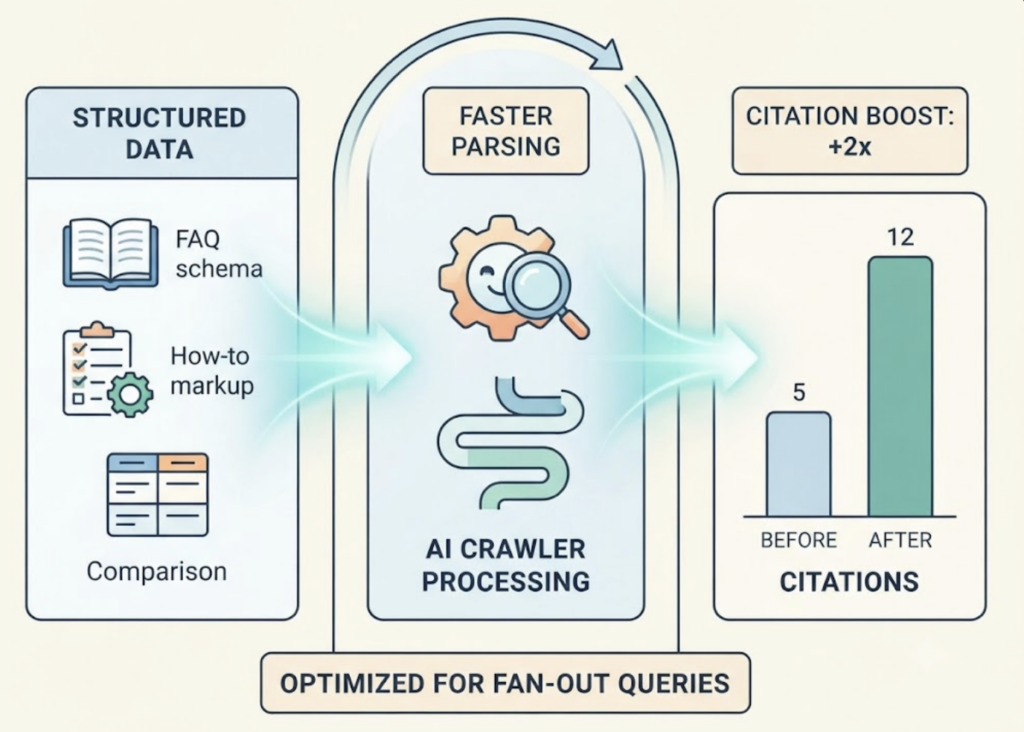
FAQ schema, how-to markup, and comparison tables help AI crawlers parse entity relationships faster. In a controlled experiment by Semrush, content optimized specifically for fan-out queries saw citations more than double. Structured data played a measurable role in that result.
How to Track Whether Your Content Covers Fan-Out Queries
Here’s the problem with query fan-out: it’s invisible. AI Mode doesn’t reveal which sub-queries it used. You can’t see in Google Search Console which fan-out queries your content matched or missed.
The manual approach is to run your target queries across multiple AI platforms regularly and check whether your brand or pages get cited. That works for a handful of queries. It doesn’t scale.
For teams managing dozens or hundreds of target topics, Topify offers a more systematic approach. Its Visibility Tracking monitors brand presence across ChatGPT, Gemini, Perplexity, and other major AI platforms at the prompt level, not just the keyword level. Source Analysis shows which domains and URLs AI systems actually cite, helping you identify exactly where your content gets pulled in and where it doesn’t.
In practice, the workflow looks like this: you optimize a page to cover fan-out sub-queries using the strategies above, then track whether AI platforms start citing that page across related prompts. If citations increase, the coverage is working. If they don’t, Topify’s Competitor Monitoring shows which competing pages are winning those sub-queries, giving you a specific target to improve against.
The combination of High-Value Prompt Discovery and fan-out awareness also helps teams move beyond reactive optimization. Instead of waiting to see which prompts mention your brand, you can proactively identify high-volume AI prompts in your category and check whether your content structure matches the sub-queries those prompts generate.
Query Fan-Out vs. Traditional Keyword Optimization
The shift from keyword optimization to query fan-out optimization changes several fundamentals at once.
| Dimension | Traditional SEO | Query Fan-Out Optimization |
|---|---|---|
| Optimization target | Single keyword per page | Multiple sub-queries per page |
| Content model | Hub-and-spoke, separate pages linked | Container page, comprehensive and structured |
| Success metric | Rank position | AI citation presence |
| Authority signal | Backlinks and domain authority | Passage relevance and entity density |
| Results format | Ranked list of links | Single synthesized answer |
| Query visibility | Keyword tools show search volume | 95% of fan-out queries show zero volume |
| Ideal passage length | Full page optimized for keyword | Extractable passages of 134 to 167 words |
This isn’t a replacement. SEO still feeds the retrieval pipeline that AI systems depend on. But it’s no longer sufficient on its own. Teams that track fan-out coverage as a separate metric alongside traditional rankings will have a clearer, more accurate picture of their actual search visibility.
Conclusion
Query fan-out explains why strong organic performance no longer translates directly into AI visibility. When every prompt triggers 8 to 12 hidden sub-queries, content that only answers the head term becomes easy to skip.
The practical shift is straightforward: structure each page to cover multiple angles, optimize at the passage level, maintain entity density and freshness, and track citation presence across AI platforms rather than relying on rank position alone. Platforms like Topify make that tracking systematic instead of manual, so you can measure whether your fan-out coverage is actually working.
The brands that adapt to query fan-out now will own the citation layer that defines AI search visibility in 2026 and beyond. The ones that don’t will keep ranking without being seen.
FAQ
Q: What is query fan-out in AI search?
A: Query fan-out is a retrieval technique where AI search systems break a single user query into 8 to 12 parallel sub-queries, each targeting a different angle of intent. The AI retrieves passages for each sub-query, then synthesizes everything into one answer. Your content needs to cover not just the original query, but the sub-queries generated behind the scenes.
Q: How many sub-queries does AI generate per search?
A: Google AI Mode typically generates 8 to 12 sub-queries for standard prompts, while Gemini averages about 10.7 fan-out queries per prompt. Complex “Deep Search” scenarios can trigger hundreds. The exact count varies by query complexity and platform.
Q: Does ranking #1 on Google guarantee an AI citation?
A: No. Only 38% of AI Overview citations come from pages that also rank in Google’s Top 10, down from 76% in July 2025. AI systems evaluate passage-level relevance, not page-level rankings. A page ranked #7 can earn citations while #1 gets skipped if it provides better passage-level answers to fan-out sub-queries.
Q: How do I check if my content covers fan-out queries?
A: Start by running your target queries through ChatGPT, Perplexity, and Google AI Mode to see which sources get cited. For systematic tracking at scale, AI visibility platforms like Topify monitor citation presence across multiple AI search engines and show exactly which prompts and sub-queries your content is or isn’t matching.

