

Your domain authority is 72. Your primary keyword sits at position three. Your content team published 40 articles last quarter targeting every variation of your core terms. Then someone asks Perplexity, “What’s the best [your category] tool for growing teams?” and your brand doesn’t appear anywhere in the response.
The disconnect isn’t about effort. It’s about a mechanism most SEO teams have never directly observed: query fan-out. When an AI search engine receives a prompt, it doesn’t match your content against that single query. It silently generates 8 to 15 sub-queries, retrieves information for each one in parallel, and synthesizes everything into one answer. If your content doesn’t cover the specific sub-intents the AI decided to explore, you’re filtered out before the response is even assembled.
That’s the gap between traditional search visibility and AI visibility. And right now, most brands can’t see it.
What Happens Between a Prompt and an AI Answer
Traditional search was straightforward. A user typed a query, Google returned a ranked list of pages, and the user clicked. One query in, ten links out.
Query fan-out works differently. When a user enters a prompt into ChatGPT, Perplexity, Gemini, or Google’s AI Mode, the system doesn’t treat that prompt as a single retrieval task. It decomposes the prompt into multiple sub-queries, each targeting a different facet of the user’s intent.
Here’s what that looks like in practice. A prompt like “best CRM for small business” might fan out into sub-queries covering pricing for startups, ease of onboarding, integration ecosystems, mobile app quality, and customer support reviews. The AI runs all of these searches simultaneously, pulls the most relevant passages from across the web, and stitches them into one synthesized response.
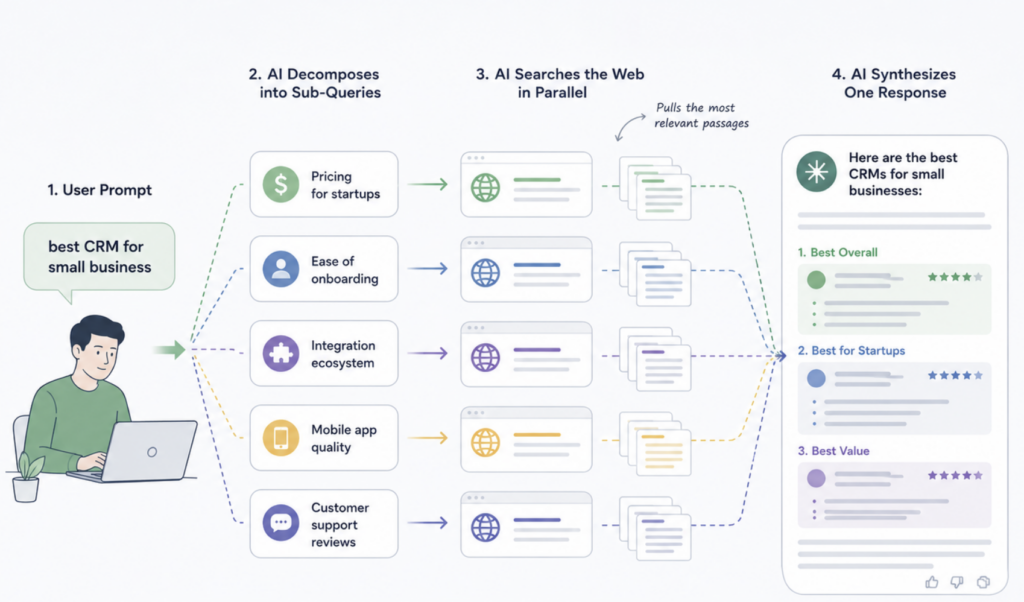
Google popularized the term “query fan-out” when introducing AI Mode, but the technique underpins every major answer engine. Perplexity, ChatGPT with browsing, and Gemini all employ variations of the same decomposition-retrieval-synthesis pipeline.
One question in, a dozen hidden questions out.
Why Your Brand Can Rank on Google and Still Be Invisible to AI
This mechanism creates a structural disconnect between traditional SEO performance and AI search visibility. Your Google rankings reflect how well your content matches a primary query. AI search engines evaluate your content against a dynamically generated cluster of sub-queries you never see.
The result is a new category of visibility blind spots. You might hold a top-10 position for “project management software,” but if your content doesn’t address the sub-intents the AI generates, like “project management for remote teams under 20 people” or “Gantt chart alternatives for agile workflows,” your page gets passed over. The AI pulls that specific passage from a competitor who covered it.
Domain authority, backlink profiles, keyword density: none of these metrics tell you whether your content answers the questions the AI is actually asking. They measure performance in a retrieval system that operates on a fundamentally different model.
The shift goes deeper than retrieval. AI synthesis creates zero-click interactions where users get what they need inside the AI interface without visiting your site. Visibility in this environment isn’t about earning a click. It’s about earning inclusion in the answer.
The Sub-Queries You Never See: How Query Fan-Out Creates Blind Spots
The core challenge with query fan-out isn’t just that sub-queries exist. It’s that they’re invisible, dynamic, and personalized.
You can’t predict them. A single prompt generates different sub-queries depending on the AI platform, the user’s conversation history, their location, and the model’s own reasoning chain. The sub-queries Perplexity generates for “best HR software” today might not match what it generates tomorrow, and they almost certainly won’t match what ChatGPT generates for the same prompt.
You also can’t manually track them. As practitioners have noted, traditional SEO tools struggle with the dynamic nature of query fan-out because there’s no static index of sub-queries to monitor. The variations are effectively infinite and often personalized.
This creates a compounding problem. Even if your content thoroughly covers the primary topic, a single uncovered sub-intent can knock you out of the AI’s synthesized response. The AI doesn’t partially cite you. If another source covers both the primary query and the sub-query the AI is exploring, that source wins the citation. You get nothing.
“Comprehensive content” in the fan-out era doesn’t mean long content. It means content that anticipates the specific facets an AI model might explore when deconstructing a user’s question.
What Query Fan-Out Means for Content Strategy
The strategic shift is clear: optimizing for a primary keyword alone is no longer sufficient. Content needs to cover the full spectrum of sub-queries that AI might generate around your core topics.
That requires a few structural changes in how content gets built.
Lead with direct answers. AI models scan for easy-to-extract information. Content that buries its core point beneath three paragraphs of context gets skipped. The first 75 to 150 words should contain a concise, factual answer to the primary question.
Align headings with natural language questions. H2s and H3s should mirror the kinds of questions users actually ask. Not “CRM Features Overview,” but “How much does a CRM cost for a 10-person team?” Each heading becomes a potential match for a sub-query the AI generates.
Design atomic sections. Every section of your content should be able to stand alone as a citation source. If an AI pulls a single passage to answer a sub-query, that passage needs to make sense without the surrounding context. Specific facts, concrete numbers, and named entities make sections more extractable.
Build explicit topical relationships. AI models assess whether a brand has authority across a broader topic cluster, not just a single page. Internal linking, consistent terminology across articles, and comprehensive coverage of related sub-topics all signal topical depth to the retrieval system.
None of this is about writing more. It’s about writing with the right architecture.
How to Track Query Fan-Out When You Can’t See the Queries
Here’s the operational problem: Google Search Console won’t tell you whether ChatGPT cited your page for a sub-query you never targeted. Traditional rank trackers measure your position on a results page that AI users are increasingly skipping.
Tracking query fan-out coverage requires a different kind of tool, one that simulates buyer-intent prompts across multiple AI platforms, monitors whether your brand appears in the responses, and identifies which sub-queries you’re winning or losing.
Topify approaches this through a layered workflow. Its High-Value Prompt Discovery feature continuously surfaces the AI prompts that matter most in your category, including the sub-queries that fan out from them. Visibility Tracking then monitors your brand’s presence across ChatGPT, Gemini, Perplexity, and other platforms at the prompt level, covering seven key metrics: visibility, sentiment, position, volume, mentions, intent, and CVR.

The Source Analysis layer adds depth. It shows which domains and URLs the AI is actually citing when it answers prompts in your space. If a competitor’s blog post keeps getting cited for a sub-query you haven’t covered, that gap surfaces in the data before it shows up in your traffic numbers.
Competitor Monitoring closes the loop. You can see not just where you appear, but where your competitors appear on the sub-queries you’re missing. That turns a black box into a visible map of content gaps.
The practical workflow: set up your target prompts, track visibility and sentiment scores over time, identify fan-out gaps where competitors outperform you, and build content specifically designed to fill those gaps. It’s measurable, repeatable, and tied to actual AI search behavior rather than keyword proxies.
For teams ready to start, Topify’s platform offers plans starting at $99/month with coverage across major AI search engines and up to 100 tracked prompts.
Brands That Ignore Query Fan-Out Will Lose the AI Search Funnel
AI search isn’t just changing how users find information. It’s compressing the entire purchase funnel into a single interaction. A user who asks “best project management tool for marketing agencies” can get awareness, consideration, and a recommendation in one response.
Query fan-out determines where in that compressed funnel your brand appears, or whether it appears at all. If the AI’s sub-queries about pricing, integrations, and use-case fit all point to competitors, you’ve lost the user before they ever visit your site.
The trend is accelerating. Uberall estimates that $750 billion in commerce will flow through AI-driven search by 2028. As AI agents become more autonomous in making purchasing decisions on behalf of users, the fan-out mechanism will only grow more influential in determining which brands get recommended.
Waiting to see how this plays out is itself a strategic choice. And it’s one that compounds: every month your content doesn’t cover the sub-queries AI is generating, you’re building a deeper visibility gap that competitors are filling.
Conclusion
The queries that shape your AI visibility aren’t the ones users type. They’re the ones the AI generates behind the scenes, and traditional search tools can’t show them to you.
Query fan-out is the mechanism that turns a single prompt into a research process spanning a dozen sub-intents. If your content covers those intents, you get cited. If it doesn’t, you’re invisible, regardless of your Google rankings.
The path forward starts with acknowledging that this hidden layer exists, then building the content architecture and tracking infrastructure to address it. Brands that make this shift now will own the AI search funnel. The rest will keep optimizing for a system that’s already moving on without them.
FAQ
What is query fan-out in AI search?
Query fan-out is the process where AI search engines decompose a single user prompt into multiple sub-queries. Each sub-query targets a different facet of the user’s intent, and the AI retrieves information for all of them simultaneously before synthesizing a unified answer. Your content needs to address not just the primary question, but the related sub-intents the AI explores.
How many sub-queries does AI generate from one prompt?
The number varies by prompt complexity and platform, but research indicates that a typical complex prompt generates 8 to 15 distinct sub-queries. Simple, factual queries may produce fewer, while multi-faceted questions about products, comparisons, or recommendations tend to trigger more extensive fan-out.
Can traditional SEO tools track query fan-out?
No. Tools like Google Search Console and traditional rank trackers measure your position on search engine results pages, but they don’t capture whether your content was cited in AI-generated responses or which sub-queries the AI explored. Tracking fan-out coverage requires AI-native monitoring platforms that simulate prompts across multiple AI search engines.
How do I optimize my content for query fan-out?
Focus on four areas: lead with direct answers in the first 75 to 150 words, structure headings around natural language questions that mirror potential sub-queries, design each section as an atomic unit that can stand alone as a citation, and build topical authority across related sub-topics through internal linking and consistent coverage.

