

You spent months optimizing a page for “best CRM for small teams.” It ranks third on Google. Organic traffic is steady. Then a prospect asks ChatGPT the same question, and the AI pulls together an answer from six different sources. Yours isn’t one of them.
The reason is a retrieval mechanism called query fan-out. Instead of matching your page to a single search phrase, AI systems break that one prompt into a cluster of sub-queries, retrieve passages for each, and synthesize a response from whatever content best answers each piece. Your page answered the main question. It didn’t answer the ten related ones the AI generated behind the scenes.
That gap between keyword rankings and AI citations is where most content strategies are now failing.
Your Page Ranks First on Google. AI Search Didn’t Even Pull It.
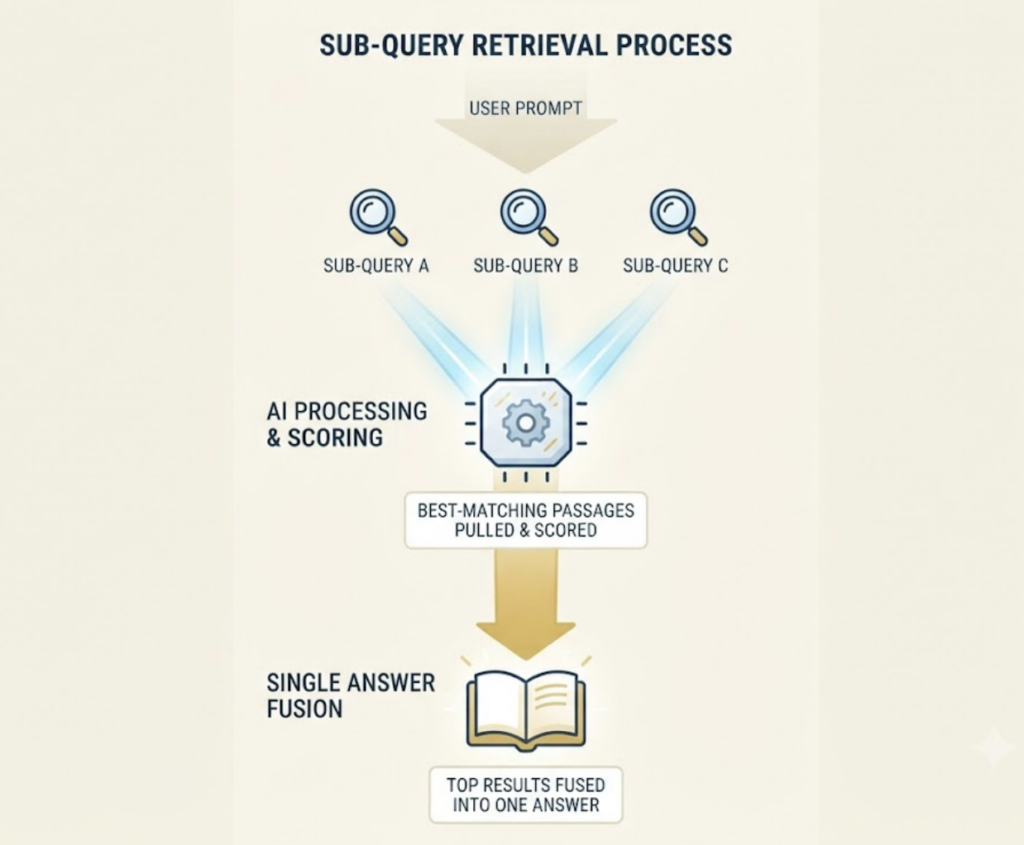
When someone types a question into Google AI Mode, ChatGPT, or Perplexity, the system doesn’t search for that exact phrase. It generates a fan of synthetic sub-queries, each targeting a different facet of the user’s intent, then runs them all in parallel.
The scale varies by platform. Google’s AI Mode typically triggers 8 to 15 sub-queries per prompt. ChatGPT and Perplexity tend to generate a tighter fan of 3 to 10. Complex reasoning tasks can push that number even higher.
Here’s the thing: each sub-query runs its own retrieval process. The AI pulls the best-matching passages from across the web, scores them, and fuses the top results into a single answer. Your content doesn’t need to rank first for the original prompt. It needs to contain passages that satisfy at least some of those sub-queries.
That’s a fundamentally different selection process than the ranked-list model SEO teams have spent years optimizing for.
Why Single-Keyword Content Loses in a Query Fan-Out World
Traditional SEO is built around separation. One page targets one primary keyword. Related topics get their own pages. Internal links connect them. This architecture works well for Google’s ranked results, where each page competes independently.
AI search doesn’t work that way. When a model fans out a query, it’s looking for sources that can cover multiple related sub-questions within the same topic area. A page that only answers one narrow angle might still get retrieved, but it’s easily replaced as the fan-out expands.
The math tells the story. A page ranking #14 for a head term can appear in an AI answer because it contains one highly relevant paragraph for a specific sub-query. Meanwhile, the #1 result gets skipped because its content is broad but shallow, covering the topic in general terms without the specific, extractable passages the AI needs.
This is what makes the shift so disorienting for SEO teams. Nearly 30% of marketers already report declining search traffic as users move toward AI tools. And an estimated 15% of daily searches in 2026 are brand-new queries with zero historical data. You can’t target a keyword that didn’t exist yesterday.
Keyword Research Isn’t Dead. But It’s No Longer the Whole Job.
The “is keyword research dead” debate has been running for years. In 2026, the answer is clear: it’s not dead, but its role has changed.
Keywords still validate demand. They tell you what people care about, what language they use, and how much interest exists around a topic. That function hasn’t gone away. What’s changed is what you do with that information.
In a query fan-out world, a keyword is a starting signal, not the destination. The real work begins after you’ve identified your target phrase: mapping the full intent landscape around it, identifying the entities and relationships that define the topic, and building content that covers the sub-questions AI systems will inevitably generate.
Think of it as a shift from “keyword to page” to “keyword to topic authority to entity alignment to fan-out coverage.” Keywords validate demand. Entities build authority. Authority drives AI visibility.
The teams still treating keyword research as the endpoint of their content strategy are optimizing for a search architecture that’s no longer the only one that matters.
How to Build Content That Survives Query Fan-Out
Adapting for query fan-out doesn’t require abandoning everything you know about SEO. It means adding a layer on top of it.
Start with the fan-out, not the keyword. Before writing, take your target keyword and map the full cluster of sub-questions AI might generate. Tools like People Also Ask, AlsoAsked, and AI query simulators can help. The goal is to see your keyword the way an AI system sees it: not as a phrase, but as an entry point into a web of related information needs.
Design for extractability. AI systems retrieve passages, not pages. Structure your content so each section can stand alone as a direct answer to a specific sub-query. Clear headings, concise topic-level chunks, and FAQ blocks all help the model find and pull the right piece.
Cover multiple intent types in one asset. AI search often surfaces informational, evaluative, and contextual questions together during fan-out. A page that only handles the informational angle misses the evaluative sub-queries. Build content that addresses “what is it,” “how does it compare,” and “when should I use it” within a single, well-organized resource.
Reinforce semantic clarity. Query fan-out optimization relies on making entities, relationships, and key concepts explicit. When meaning is clear, AI systems can interpret how ideas connect and apply your content more consistentlyacross related queries. Don’t assume the reader, or the model, can infer relationships you haven’t stated.
The Visibility Gap Most SEO Teams Still Can’t Measure
Here’s the problem that ties everything together. You can’t optimize for query fan-out if you can’t see what AI systems are actually doing with your topic.
Google Analytics tells you who visited. Search Console tells you which queries drove impressions. Neither tells you whether ChatGPT cited your competitor for a sub-query you didn’t even know existed.
That measurement gap is exactly what Topify was built to close. Its High-Value Prompt Discovery feature surfaces the specific prompts and sub-queries AI systems generate around your target topics, giving you the fan-out map your content strategy needs. Source Analysis then tracks which domains AI platforms are citing for those prompts, so you can see exactly where competitors are winning and where content gaps exist.
In practice, that looks like tracking 200+ prompts across ChatGPT, Gemini, Perplexity, and DeepSeek over 30 days, then watching how citation patterns shift as your content changes. It’s the difference between guessing which sub-queries matter and knowing.
For teams already investing in GEO, Topify’s Visibility Tracking and Competitor Monitoring add the layer traditional tools miss: not just whether you rank, but whether AI systems trust your content enough to cite it.
From Keywords to Query Ecosystems: A Practical Shift
The shift query fan-out demands isn’t a revolution. It’s an expansion.
You still do keyword research. You still build pages. You still earn links and optimize technical SEO. What changes is the frame: instead of thinking “this page targets this keyword,” you start thinking “this page anchors a cluster of sub-queries that AI will generate around this topic.”
Early adopters are already seeing results. Brands that build comprehensive topic coverage with well-structured, entity-rich content are outperforming competitors in AI citations, even when those competitors have higher domain authority.
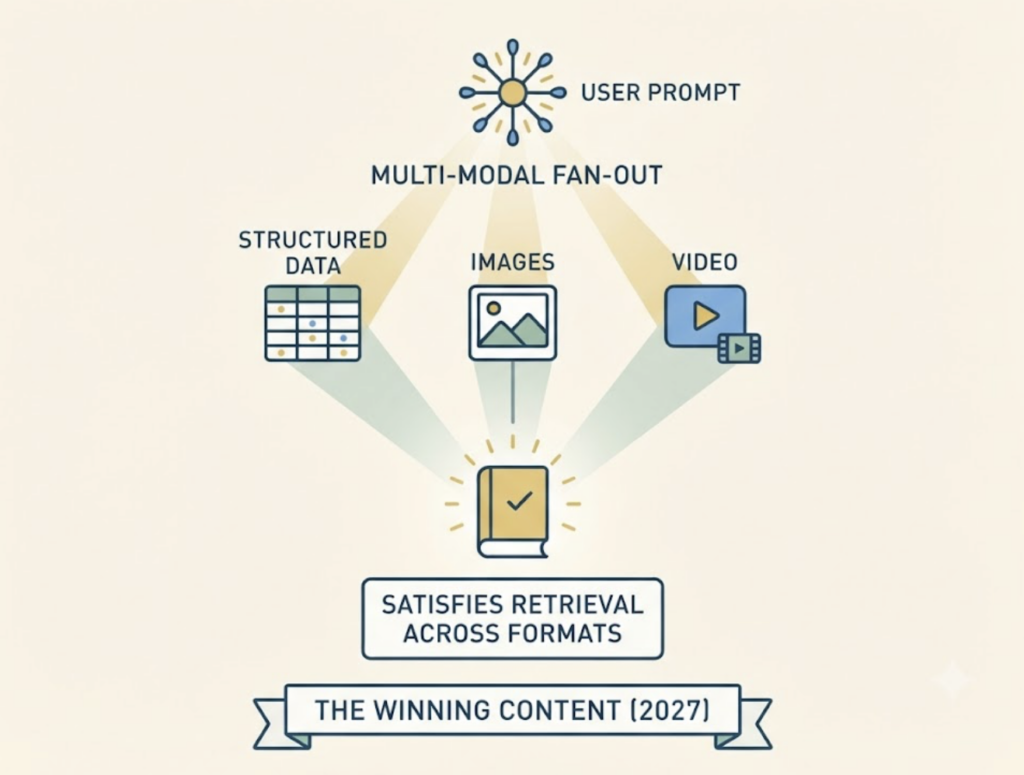
The trend is accelerating. Multi-modal query fan-out, where AI systems incorporate images, video, and structured data into the fan-out process, is already emerging. The content that wins in 2027 won’t just answer text-based sub-queries. It’ll need to satisfy retrieval across formats.
The starting point is practical. Pick your ten highest-traffic pages. Map the likely fan-out sub-queries for each. Audit whether your content actually answers them, or whether it only covers the main keyword. Then start tracking how AI systems are handling those topics today.
Conclusion
Keyword research isn’t dead. What’s dead is the assumption that ranking for a single phrase means AI search will find and cite you.
Query fan-out changed the retrieval architecture. AI systems now decompose every prompt into a cluster of sub-queries, and your content either answers enough of them to earn a citation, or it doesn’t. The brands that adapt, building for topic coverage, passage-level extractability, and measurable AI visibility, are the ones showing up in the answers that matter.
Start with the pages you already have. Map the fan-out. Fill the gaps. Measure what changes.
FAQ
Q: What is query fan-out in AI search?
A: Query fan-out is a retrieval technique where AI search systems break a single user prompt into multiple sub-queries. Each sub-query targets a different facet of the user’s intent. The AI retrieves passages for each, then synthesizes the results into one unified answer. Google popularized the term when launching AI Mode at Google I/O 2025.
Q: Is keyword research still relevant in 2026?
A: Yes, but its role has shifted. Keywords still validate demand and reveal what audiences care about. The difference is that keywords are now a starting signal, not the full strategy. Teams need to map the broader intent landscape, entity relationships, and sub-queries that AI systems generate around a keyword, not just optimize a page for that single phrase.
Q: How many sub-queries does a single AI search generate?
A: It depends on the platform and prompt complexity. Google’s AI Mode typically generates 8 to 15 sub-queries per prompt. ChatGPT and Perplexity tend to generate 3 to 10. Simple prompts might trigger only 2 to 4, while complex reasoning tasks can produce dozens.
Q: How can I optimize my content for query fan-out?
A: Focus on four areas: map the full cluster of sub-queries around your target keyword before writing, structure content so each section can be independently retrieved, cover multiple intent types in a single asset, and reinforce semantic clarity by explicitly stating entity relationships. Use AI visibility tools to track which sub-queries your content is being cited for and where gaps exist.

