

You built topic clusters. You covered sub-intents. You structured every page so AI engines could pull clean, citable answers. Then you checked your brand across three AI platforms and got three completely different results: visible on Perplexity, mentioned once in ChatGPT, absent from Google AI Mode.
That gap isn’t random. Each AI engine runs its own version of query fan-out, the retrieval process that decomposes a single user prompt into multiple parallel sub-queries. And a cross-platform citation analysis found that only 12% of cited sources overlap between engines for the same query. One optimization strategy can’t cover all three.
What Query Fan-Out Does Behind Every AI Search
Query fan-out is the mechanism that decides which content gets into an AI answer and which doesn’t.
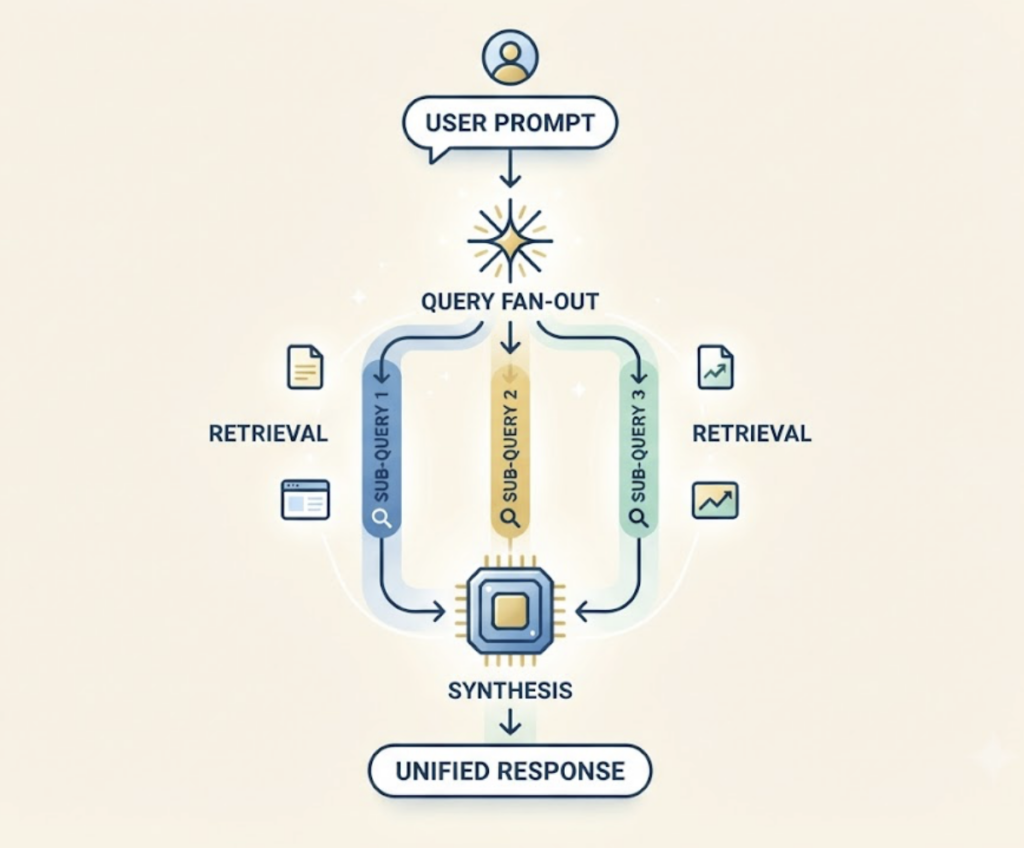
When someone types a prompt into Google AI Mode, ChatGPT, or Perplexity, the engine doesn’t run a single keyword lookup. It breaks the prompt into a cluster of related sub-queries, executes them simultaneously, retrieves passages from each result set, and synthesizes one unified response. Google coined the term when it launched AI Mode, describing a system that “issues multiple related searches concurrently across subtopics and multiple data sources.”
The stakes are measurable. Pages that rank for these fan-out sub-queries are 161% more likely to be cited in AI-generated answers, according to an analysis of 10,000 keywords. And with 92 to 95% of AI-powered searches producing zero clicks, the citation is the only visibility that matters.
Here’s the thing: each engine fans out differently. The depth, the consistency, the source preferences, and the ranking logic all vary. That means the content architecture that wins on one platform can miss entirely on another.
Google AI Mode Runs the Widest Query Fan-Out
Google AI Mode, powered by a custom Gemini 2.5 model built specifically for query decomposition, runs the most aggressive fan-out of any AI engine.
Standard prompts typically trigger 8 to 12 parallel sub-queries. Complex reasoning tasks or Deep Search scenarios can push that number into the hundreds. Research from Ekamoira found that 59% of prompts generate between 5 and 11 simultaneous sub-queries.
The ranking logic is distinct too. Google uses Reciprocal Rank Fusion, where documents that appear consistently across multiple sub-query result sets accumulate higher scores than documents that rank first in only one. In practice, broad topical coverage beats narrow keyword dominance.
Fan-out depth also varies by industry. Nectiv’s analysis of 60,000 queries showed software-related prompts averaging 11.7 fan-outs, travel at 10.8, careers at 9.8, and local queries at just 3.79. If you’re in SaaS or travel, your content competes across far more hidden sub-queries than a local business does.
One more pattern worth noting: Google searches content from the current year and the previous year. That gives older content a grace period before the engine treats it as stale.
The correlation between fan-out coverage and citation likelihood is strong. An ALM Corp longitudinal study covering 173,000 URLs found a Spearman correlation of 0.77 between sub-query coverage and AI Overview citations. In the same study, the AI Overview citation rate for top-10 ranked pages dropped from 76% to 38% in a single year. Ranking alone no longer guarantees a citation.
ChatGPT Searches Less Often, but Each Sub-Query Cuts Deeper
ChatGPT takes a different approach. It doesn’t fan out on every prompt. It fans out when it needs to.
On average, ChatGPT issues roughly 3.5 sub-queries per prompt when it does search. Semrush data from February 2026 showed search activation on just 34.5% of queries, down from 46% in late 2024. The model’s training data already covers a lot of ground, so it searches only when it needs current or specialized information.
But when ChatGPT does search, those queries are precise. Sub-query word count has doubled from 6 to 12 words since October 2025, meaning each search is narrower and more targeted.
The biggest difference from Google is volatility. An analysis of 102,018 queries by Qwairy found that 91% of ChatGPT’s search strings are unique. It rarely issues the same sub-query twice for the same prompt. That makes optimization unpredictable. You can’t reverse-engineer a fixed set of sub-queries the way you might for Google.
ChatGPT also treats content freshness differently. It searches only the current year. If your page references 2024 data without a 2026 update, ChatGPT is less likely to pull it. Google, by comparison, gives last year’s content a grace period.
The strategic implication is clear. For ChatGPT, coverage across query variations matters more than winning any single keyword. A brand appearing in all 6 of ChatGPT’s sub-queries for a given prompt gets 6x the visibility of a brand appearing in just one.
Perplexity Keeps Query Fan-Out Tight: Fewer Searches, Higher Precision
Perplexity sits at the opposite end of the spectrum.
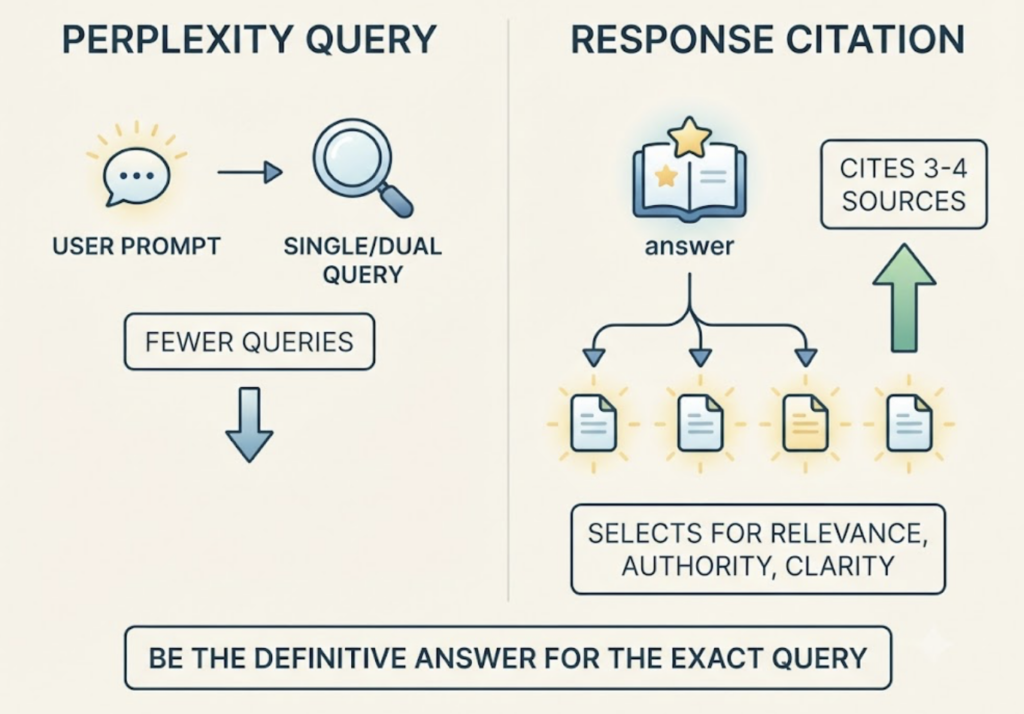
Qwairy’s dataset showed that 70.5% of Perplexity prompts generate exactly one query. It only fans out when a topic is genuinely ambiguous or multi-faceted, typically producing 3 to 5 sub-queries for complex questions. The engine was built around a single-pass retrieval model from day one.
What Perplexity loses in breadth, it gains in consistency. About 92.8% of its search patterns stay stable across repeated runs. Run the same prompt three times, and you’ll get the same sources cited in the same order. That predictability is rare in AI search.
Perplexity’s citation behavior is also more concentrated. Each response typically cites 3 to 4 sources, selected based on direct relevance, authority, and structural clarity. For brands, the math is straightforward: if Perplexity only runs one or two queries, you need to be the definitive answer for that exact query. Broad topical coverage matters less here. Depth and authority on the specific question matter more.
Its Pro Search and Deep Research tiers do expand the fan-out significantly, sometimes issuing 10 to 30 sub-queries and reading full pages rather than snippets. But the majority of Perplexity’s organic traffic runs through standard single-pass queries.
Three Engines, One Prompt, Three Query Fan-Out Paths
The differences become obvious when you put them side by side.
| Dimension | Google AI Mode | ChatGPT | Perplexity |
|---|---|---|---|
| Avg. sub-queries per prompt | 8 to 12+ | ~3.5 | 1 to 3 |
| Search activation rate | High (nearly every prompt) | Moderate (34.5%) | High (single-pass default) |
| Result stability | Moderate | Very low (91% unique strings) | Very high (92.8% consistent) |
| Freshness window | Current + previous year | Current year only | Real-time web |
| Ranking mechanism | Reciprocal Rank Fusion | Broad semantic matching | Authority-first precision |
| Winning strategy | Hub-and-spoke coverage | Broad entity and variation coverage | #1 authoritative positioning |
The pairwise citation overlap between engines ranges from just 16% to 59%. That means a page cited by Google AI Mode has, at best, a coin-flip chance of being cited by ChatGPT for the same prompt. Treating these engines as interchangeable is the fastest way to miss two-thirds of your AI visibility.
One Query Fan-Out Strategy Won’t Cover All Three Engines
The platform-level differences in fan-out behavior translate directly into different content requirements.
For Google AI Mode, the play is topical coverage. You need a hub-and-spoke content architecture where a pillar page covers the broad topic and supporting pages address individual sub-query variants. Research shows that pages covering 26 to 50% of sub-queries actually get cited more often than pages trying to cover 100%. A focused cluster beats a single mega-article.
For ChatGPT, the priority shifts to semantic breadth and recency. Because its sub-queries are highly variable and search strings rarely repeat, your content needs to align with the entity and intent space around your topic, not just specific keyword phrasing. And everything needs to reference current-year data.
For Perplexity, the game is precision authority. Win the primary query. Structure your content in clean, extractable 50 to 150-word blocks that a RAG system can pull without distortion. Adding 3 or more data points per section can improve citation probability by 15 to 40%.
That’s three different playbooks for three different engines. And without cross-platform tracking, you’re guessing which one is working.
Topify addresses this by tracking brand visibility across ChatGPT, Perplexity, Google AI Overviews, and other major AI engines through a single dashboard. Its Comprehensive GEO Analytics layer monitors seven metrics, including visibility, sentiment, position, and source citations, broken down by platform. You can see where your brand is being cited, where it’s missing, and trace the gap back to specific fan-out patterns that your content doesn’t cover.
The Source Analysis feature is particularly relevant here. It shows which domains and URLs are being cited by each AI engine, so you can identify whether your hub-and-spoke architecture is working on Google while your ChatGPT visibility lags because of stale data or missing entity coverage.
How to Adapt Your Content for Platform-Specific Fan-Out
Knowing the differences is step one. Acting on them requires a systematic approach.
Start by simulating query fan-out for your top keywords. Tools like Qforia (from iPullRank) can show you which sub-queries fire for a given prompt. Map those sub-queries against your existing content to find coverage gaps.
Then prioritize by platform. If your audience skews toward Perplexity (researchers, B2B professionals, early adopters), focus on authoritative depth for primary queries. If they’re on ChatGPT, invest in semantic breadth and make sure every key page references current-year data. If Google AI Mode is the priority, build out your topic cluster with dedicated spoke pages for the sub-query variants you’re missing.
Cross-platform monitoring turns this from a one-time audit into an ongoing feedback loop. Topify’s Competitor Monitoring feature lets you see not just your own visibility, but which brands the engines are recommending instead. When ChatGPT starts citing a competitor you’ve never tracked, that’s a signal about a sub-query variant you haven’t covered.
The brands gaining ground in AI search aren’t the ones with the most content. They’re the ones matching their content architecture to how each engine actually retrieves information.
Conclusion
Query fan-out is the hidden layer that determines AI search visibility. But it doesn’t work the same way everywhere. Google AI Mode fans out aggressively across 8 to 12 sub-queries and rewards topical breadth. ChatGPT searches less often but with high variability, making coverage and freshness the priority. Perplexity runs tight, single-pass retrievals where precision and authority on the primary query decide everything.
The 12% citation overlap across platforms confirms that a single optimization strategy leaves most of your AI visibility to chance. Map the fan-out behavior for each engine your audience uses, build content that matches each platform’s retrieval logic, and track the results across all of them. That’s the only way to close the gap.
FAQ
Q: What is query fan-out in AI search?
A: Query fan-out is the process where an AI search engine breaks a single user prompt into multiple parallel sub-queries, retrieves results for each one, and synthesizes a unified answer. Google AI Mode coined the term, but ChatGPT and Perplexity use the same general pattern with different depths and behaviors.
Q: How many sub-queries does Google AI Mode generate per prompt?
A: Google AI Mode typically generates 8 to 12 sub-queries for standard prompts. Complex queries or Deep Search scenarios can trigger significantly more. The exact number varies by industry: software-related prompts average 11.7 fan-outs, while local queries average around 3.8.
Q: Does ChatGPT use query fan-out the same way Google does?
A: No. ChatGPT averages about 3.5 sub-queries per prompt and only activates web search on roughly 34.5% of queries. Its fan-out is narrower but more precise, with each sub-query averaging 12 words. The biggest difference is volatility: 91% of ChatGPT’s search strings are unique, making it less predictable than Google.
Q: How can I track my brand’s visibility across different AI search fan-out behaviors?
A: You need cross-platform AI visibility monitoring that breaks down citations, mentions, and source analysis by engine. Topify offers this through its Comprehensive GEO Analytics, covering ChatGPT, Perplexity, Google AI Overviews, and other major platforms with per-engine metrics for visibility, sentiment, position, and source citations.

