

Your page ranks in the top three for its target keyword. Traffic from that term looks steady. Then a user opens Google AI Mode, types the same question, and Google quietly runs eight to twelve searches you never see, pulling answers from pages that aren’t always yours. Your ranking didn’t drop. It just stopped being the whole game. The query that used to send you traffic now gets split into a dozen smaller ones, and most SEO reports have no way to tell you which of those you actually showed up in. That gap is what AI Mode SEO has to close.
One Query In, a Dozen Searches Out: What Fan-Out Really Does
Query fan-out is the mechanism behind that split. At Google I/O 2025, Head of Search Elizabeth Reid described it plainly: AI Mode calls on a custom version of Gemini to break a question into subtopics and issue a multitude of queriesat once. One question goes in. Many related searches come out. The system runs them in parallel, then synthesizes a single answer from the combined results.
The scale is bigger than most people assume. Google AI Mode typically fires 8 to 12 sub-queries for a standard prompt, and for complex research it can trigger a Deep Search mode that issues dozens or even hundreds of background queries before it responds.
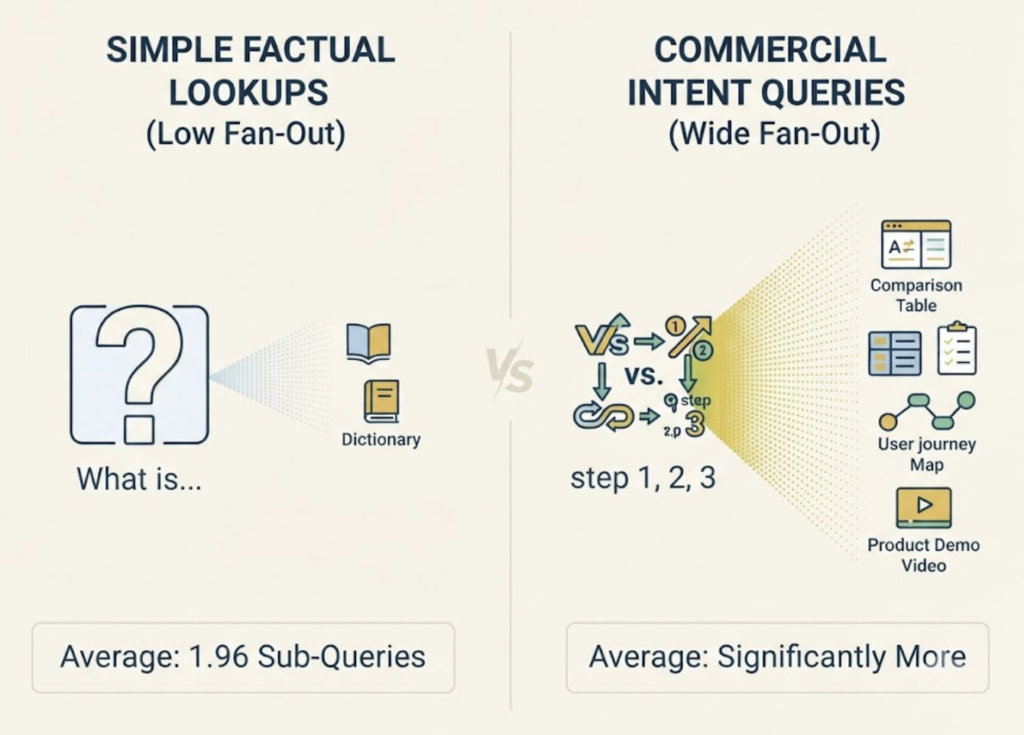
Not every query fans out the same way. Simple factual lookups barely trigger it. Analysis found that prompts starting with “what is” generate only 1.96 sub-queries on average, because the model often answers definitions from its own training data. Comparative and multi-step questions, the kind with real commercial intent, fan out the widest.
Fan-out also reaches past the open web. AI Mode pulls from Google’s Knowledge Graph, its web index, and specialized sources like the Shopping Graph, then looks for agreement across them rather than trusting any single page.
That’s the shift in one line: you’re no longer optimizing for a query. You’re optimizing for a query’s entire family tree.
Why AI Mode SEO Isn’t the Same as Ranking Page One
Traditional SEO optimizes one page for one keyword and measures success by rank position. AI Mode SEO works on a different unit. Because fan-out evaluates your content against a spread of sub-queries, the thing being judged isn’t your page’s rank. It’s whether specific passages answer specific sub-intents well enough to get cited.
This has a direct consequence. Your content can be pulled into an AI answer even when it doesn’t rank first, since AI systems weigh passage relevance over raw page authority. In one dataset, only about half of cited sources sat in the top 10 organic results. Ranking still helps. It just no longer decides the outcome on its own.
Here’s how the two approaches compare in practice:
| Dimension | Traditional SEO | AI Mode SEO |
|---|---|---|
| Unit of optimization | One page per keyword | Topic cluster across sub-queries |
| Success metric | Rank position | Passage citation and mention rate |
| Retrieval model | One query, one result set | One query, 8 to 12 parallel sub-queries |
| Authority signal | Page-level backlinks, domain authority | Passage relevance plus entity consistency |
| Visibility outcome | Click-through from the SERP | Inclusion in the synthesized answer |
The measurement gap is real too. Roughly 92 to 94% of AI Mode sessions end without a click to an external site, per Semrush data. When AI Mode has already passed a billion monthly users, being cited rather than clicked becomes the thing worth tracking.
The Sub-Queries Google Never Shows You
Here’s the hard part. Google doesn’t publish the sub-queries fan-out generates. You can see the answer it produces, but not the dozen searches behind it, which means you can’t easily tell which sub-queries cited you and which handed the spot to a competitor.
It gets harder. Only 27% of fan-out sub-queries stay stable across repeated searches, based on a December 2025 study. The other 73% shift each time, so chasing individual sub-queries is a losing game. Broad topical coverage holds up where single-query optimization doesn’t.
The cost of ignoring this shows up in the citation data. One analysis across 173,902 URLs found that 88% of brands miss AI citations entirely, mostly because they optimize for head terms instead of the full fan-out cluster.
If you’re optimizing for the original question alone, you’re visible to one retrieval path out of a dozen.
For now, most teams reverse-engineer the gap by hand, scraping People Also Ask boxes and running seed prompts through AI Mode to log the follow-up questions, a workaround documented by Digiday. It works, but it doesn’t scale, and it goes stale within weeks.
How to Show Up in Every Sub-Query AI Mode Generates
You can’t control which sub-queries Google generates. You can control how much of that sub-query space your content covers. Three moves do most of the work.
Cover the Subtopics, Not Just the Head Keyword
Fan-out breaks one question into many, so a single thin page rarely satisfies the full set. Map the sub-intents around your topic: features, pricing, comparisons, use cases, and common objections, then build content that answers each. Comparison pages, product reviews, and “best of” formats tend to get retrieved far more often than basic definitional pages, which the model usually answers from memory.
Think in clusters, not keywords. A topic with strong sub-query coverage keeps far more AI visibility than a page tuned for one term, even as the underlying sub-queries churn week to week.
Structure Content So AI Can Extract It
Google’s fan-out does passage-level retrieval. It evaluates specific sections, not just the page as a whole, and in AI Mode it may pull up to five chunks before and after a relevant passage for context.
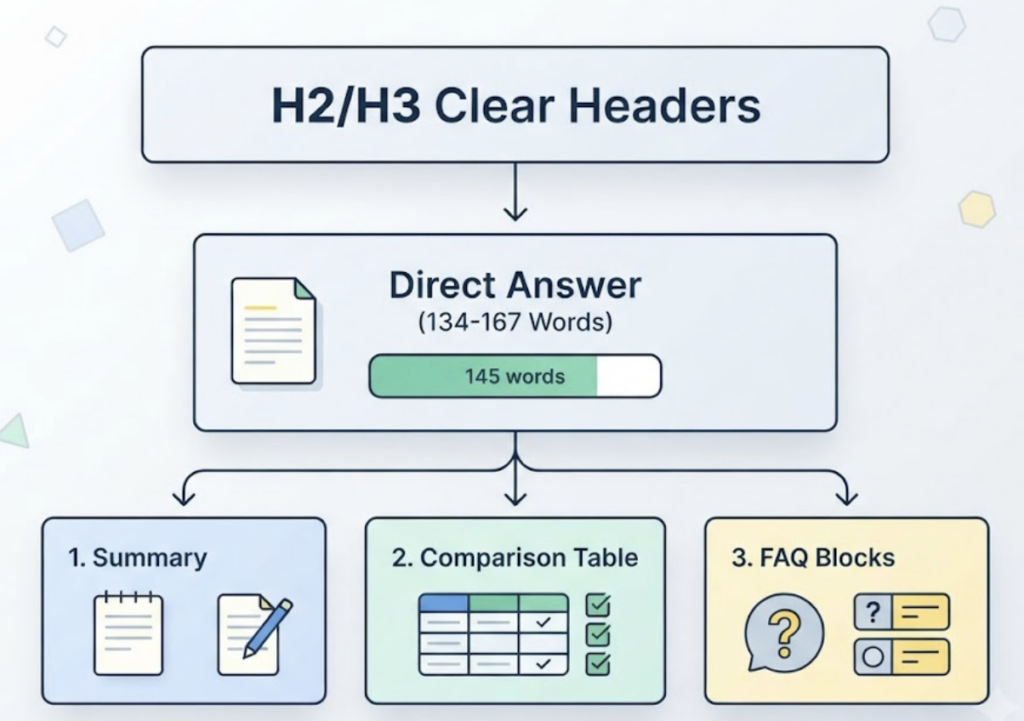
Structure for that. Use clear H2 and H3 headers phrased as the questions users actually ask, and put a direct answer in the first sentence of each section. Research on AI Overview citations found passages of 134 to 167 words get cited most, so keep answer blocks tight. Add short summaries, comparison tables, and FAQ blocks that each map to a distinct sub-intent.
Freshness helps as well. AI tools tend to cite content that’s meaningfully fresher than what traditional search rewards, so update high-value pages on a schedule instead of letting them sit.
Build Entity Authority Across Sources
Fan-out retrieves across the live web, the Knowledge Graph, and third-party sources, then favors information that several sources agree on. A brand mentioned consistently across multiple credible places is easier to ground an answer in than one that only describes itself on its own domain.
Keep your entity facts consistent everywhere: your site, review platforms, industry directories, and structured data that matches your visible content. When the sources line up, fan-out has an easier time attributing part of its answer to you.
Turning Hidden Sub-Queries into a Measurable AI Mode SEO Channel
Coverage and structure get you into more sub-queries. The open question is whether you can see the results. Since Google hides the fan-out set, the practical challenge is turning an invisible process into something you can track and act on.
That’s where a dedicated AI search platform earns its place. Topify approaches the problem from the sub-query side rather than the keyword side. Its High-Value Prompt Discovery surfaces the high-volume AI prompts that matter for your brand and keeps surfacing new ones as AI recommendations shift, which maps directly to the churn that breaks manual fan-out tracking.
From there, its Comprehensive GEO Analytics tracks how you appear across ChatGPT, Gemini, Perplexity, and other engines on seven metrics: visibility, sentiment, position, volume, mentions, intent, and conversion visibility. In practice, that means you can catch a drop in mentions on one platform and trace it back to a specific source that stopped citing your brand, inside a single view.
The citation layer matters most for fan-out. Topify’s citation analysis reverse-engineers the exact domains and URLs AI engines pull from, so you can see whether your pages or a competitor’s are winning the sub-queries you care about. You can get started with one project and expand coverage as the picture sharpens.
Conclusion
Your rankings aren’t obsolete. They’re one input into a process that now runs a dozen searches for every question a user asks. AI Mode SEO is less about owning a keyword and more about covering the full family of sub-queries that fan-out generates, then structuring content so specific passages get cited. Start by mapping the sub-intents around your top topics and building coverage across them. Then find a way to measure which sub-queries you actually appear in, because in a search experience where most sessions end without a click, being cited is the metric that counts.
FAQ
Q: What is query fan-out in Google AI Mode?
A: It’s the technique where AI Mode uses a custom version of Gemini to break a single question into multiple sub-queries, run them in parallel across Google’s web index and Knowledge Graph, then synthesize one answer. A standard prompt typically triggers 8 to 12 sub-queries.
Q: Does traditional SEO still work for AI Mode?
A: Yes, but not on its own. Ranking well still helps your pages get retrieved, yet AI Mode weighs passage relevance over page authority, so content can be cited without ranking first. The real shift is optimizing for a cluster of sub-queries instead of a single keyword.
Q: How can I tell which sub-queries my brand appears in?
A: Google doesn’t publish the fan-out set, so it won’t show up in Search Console. Teams either reverse-engineer it by hand through People Also Ask and seed prompts, or use an AI visibility platform that discovers the relevant prompts and tracks citations across engines.
Q: Which queries trigger the most fan-out?
A: Comparative, multi-step, and commercial-intent questions fan out the widest. Simple definitional queries like “what is X” generate the least, often under two sub-queries, because the model answers them straight from training data.

