


You rebuilt your content strategy around pillar pages. Long-form guides, topic clusters, internal links pointing every direction. Then you checked whether AI search engines were actually citing any of it.
They weren’t. Not because the content was thin, but because AI systems don’t retrieve pages the way Google ranks them. When someone asks ChatGPT or Perplexity a question, the model doesn’t pull up your 4,000-word guide and scan for the answer. It breaks that question into 12 to 15 sub-queries, runs them in parallel, and assembles a response from the best passage it finds for each one. That process is called query fan-out. And it turns the “one big guide vs. many small articles” debate into a question of architecture, not word count.
What Query Fan-Out Actually Changes About Content Strategy
Traditional SEO rewarded depth on a single page. The more thoroughly you covered a topic, the better your chances of ranking for it. Query fan-out breaks that logic.
A user types a question. The AI system decomposes it into a dozen or more sub-queries, each targeting a different facet of the original intent. A prompt like “best project management tool for remote teams” might trigger sub-queries about pricing, integrations, security, team size, user reviews, and onboarding difficulty. Each sub-query runs its own retrieval cycle, pulling passages from different sources.
Your content doesn’t compete as a whole page. It competes passage by passage, sub-query by sub-query.
That’s a structural shift. Pages optimized to address a higher percentage of fanned-out sub-queries are 161% more likely to be cited in AI-generated answers. But a single page can’t realistically provide the best passage for every sub-query. Not when each sub-query has a different intent, a different expected format, and a different depth requirement.
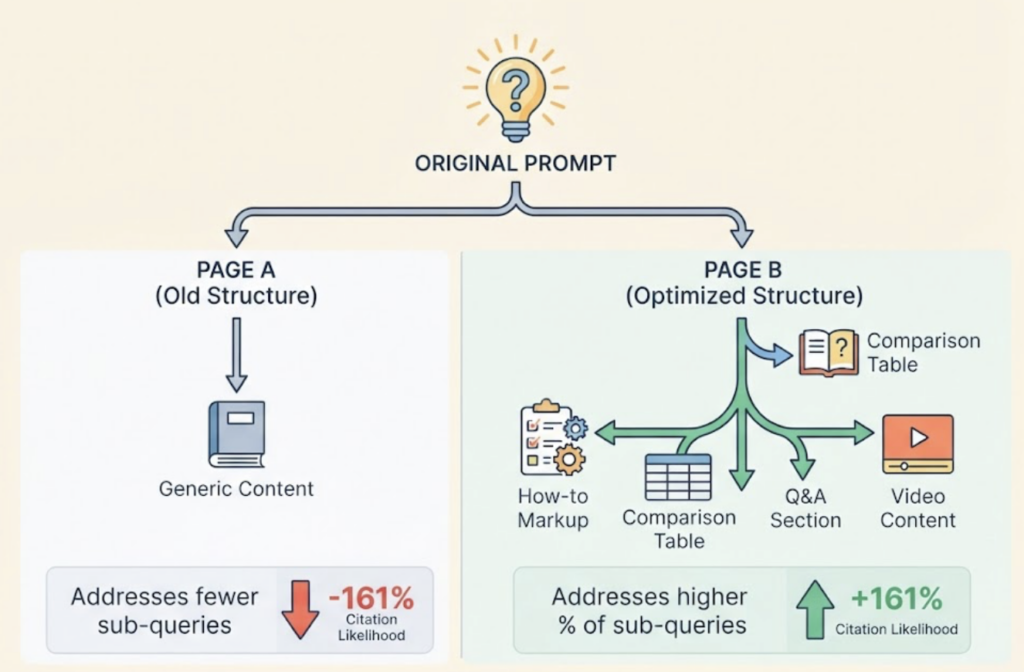
Content architecture, not content volume, becomes the variable that determines AI visibility.
The Pillar Page Trap
The pillar page model isn’t dead. But relying on it as your primary AI citation strategy is a losing bet.
A typical pillar page runs 2,000 to 5,000 words. It covers a broad topic, links to cluster articles, and consolidates topical authority in one URL. For traditional organic rankings, that still works. For AI retrieval, it creates a problem: semantic dilution.
AI models seek concise, extractable answers. A 5,000-word guide buries specific answers inside layers of context, subheadings, transitions, and supporting points. When the model runs a sub-query about pricing, and the answer sits 3,000 words deep between two unrelated sections, the model often skips it for a competitor’s 600-word article that leads with a pricing table.
Here’s the math that matters. If an AI system generates 12 sub-queries for a single prompt, a monolithic pillar page might effectively address two or three of them. That leaves nine or ten sub-queries open for competitors to capture. You’re not losing to better content. You’re losing to better architecture.
One data point tells the story: 62% of content cited by AI systems doesn’t even appear in Google’s traditional top 10 results. The AI isn’t prioritizing page authority. It’s prioritizing passage relevance.
When Ten Focused Articles Beat One Comprehensive Guide
There’s a reason the “ten focused articles” approach keeps gaining traction in GEO circles. It aligns with how AI retrieval actually works.
Each focused article targets a specific sub-query intent. Instead of one page trying to cover “What is GEO, how does it work, who needs it, what tools exist, how to get started,” you produce five articles, each answering one of those questions in depth. The AI model now has a dedicated, structurally clean passage to extract for each sub-query, instead of hunting through a wall of text.
The concept is what Similarweb’s GEO research calls “node architecture”: every significant section of content is a self-contained, extractable unit. When applied at the article level, each piece becomes a citeable node.
The data backs this up. Topify’s internal analytics show that 92% of AI citations come from domains that maintain atomic content structures: short, fact-dense segments rather than long-form, loosely structured essays. The Princeton GEO study found that adding quantitative data to content improved AI citation rates by up to 41%. Keyword stuffing, by contrast, performed below the unoptimized baseline.
Focused articles also offer practical advantages. They’re faster to publish, easier to A/B test, and simpler to update when AI citation patterns shift. If a specific sub-query gains traction, you can spin up a dedicated spoke article in days, not weeks.
Hub-and-Spoke: The Content Architecture Query Fan-Out Rewards
The “one guide or ten articles” framing is a false binary. The most effective content architecture for query fan-out combines both.
The hub page serves as your entity center. It defines the core topic, provides high-level summaries, and links out to every spoke article. Think of it as a table of contents with enough substance to establish topical authority, but not so much detail that it competes with its own spokes.
Each spoke article focuses on one or two sub-query intents. One spoke handles the “how to” intent. Another tackles “pricing comparison.” A third covers “common mistakes.” Each spoke contains what the research calls “best-answer blocks”: 130 to 170 words of structurally clean, fact-dense content that AI crawlers can extract without parsing through irrelevant context.
The linking structure matters as much as the content itself. Hub links to every spoke. Every spoke links back to the hub. Related spokes cross-link to each other. This bidirectional linking pattern signals to both traditional search engines and AI retrieval systems that your content cluster owns the topic.
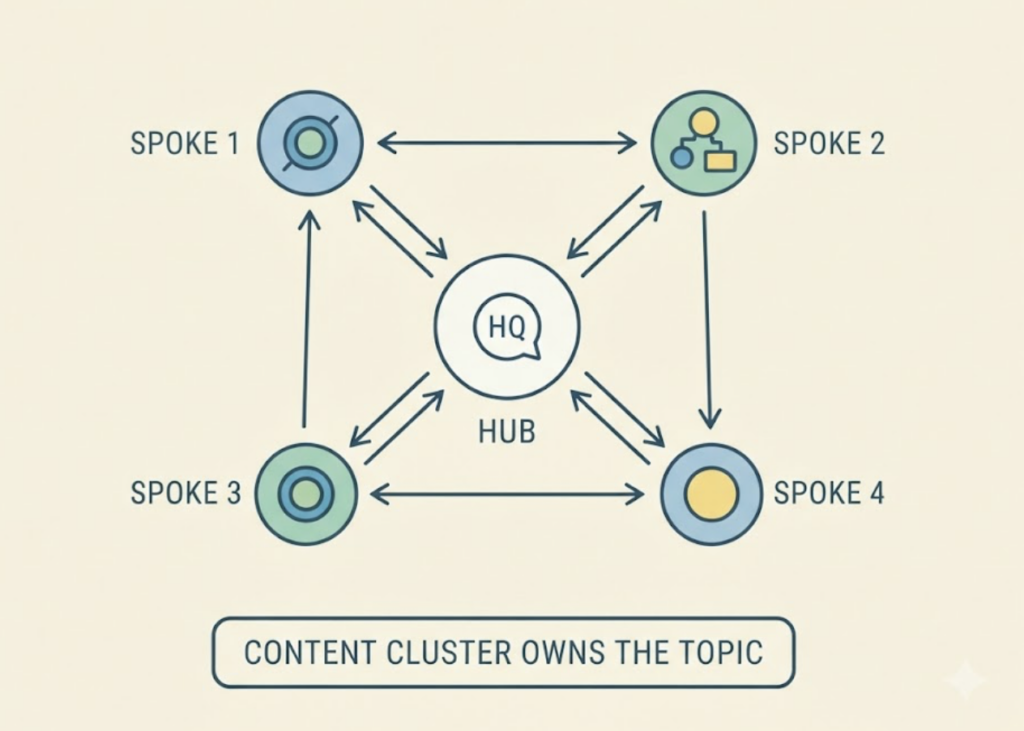
Websites using this structured node architecture see a 41% increase in AI visibility compared to sites with flat, unstructured content hierarchies.
The sweet spot for most teams? One hub page plus 8 to 15 spoke articles per core topic, expanding based on performance data and content gaps.
How to Map Your Query Fan-Out Before Writing a Single Word
Content architecture decisions shouldn’t start with a content calendar. They should start with a fan-out map.
Step 1: Identify the fan. Take your core topic and run it through Perplexity, Gemini, or ChatGPT. Ask the same question three different ways. Document every sub-question, follow-up, and tangent the AI explores in its response. That’s your raw fan-out data.
Step 2: Classify intent. Group each sub-query by type:
| Intent Type | Example Sub-Query | Content Format |
|---|---|---|
| Informational | “What is query fan-out?” | Explainer article |
| Comparative | “Pillar page vs. cluster content” | Comparison table |
| Commercial | “Best tools for AI visibility” | Review or feature matrix |
| Procedural | “How to optimize for fan-out” | Step-by-step guide |
Step 3: Assign content. Map each sub-query cluster to either a dedicated spoke article or a specific section within your hub. High-volume, high-competition sub-queries get their own spoke. Narrower or lower-intent sub-queries can be folded into the hub or an existing spoke.
Step 4: Validate with data. This is where guesswork turns into strategy. Tools like Topify surface the specific prompts AI engines are actually generating around your brand and category through its High-Value Prompt Discovery feature. Instead of guessing which sub-queries matter, you see the actual prompts AI models produce, including ones you’d never find in traditional keyword research.
Topify’s Source Analysis also reveals which domains AI platforms currently cite for each sub-query. If a competitor owns the “comparison” intent while your content only covers “informational,” you know exactly which spoke to build next.
Measuring Content Architecture Performance in AI Search
You can’t optimize an architecture you can’t measure. And traditional SEO dashboards don’t measure what matters for query fan-out performance.
Organic traffic, keyword rankings, and domain authority tell you how Google sees your pages. They don’t tell you whether ChatGPT is extracting passages from your spoke articles, whether Perplexity is citing your hub page, or whether a competitor just captured three sub-query intents you left uncovered.
Effective measurement requires three layers.
Citation presence. Track how often your domain appears in AI-generated answers for your target sub-query sets. This is the GEO equivalent of ranking position.
Source gap analysis. Identify which sub-query intents your competitors own in AI responses and which ones you’re missing. Topify’s Competitor Monitoring and Source Analysis features map this automatically across ChatGPT, Gemini, Perplexity, and other major AI platforms.
Architecture impact tracking. Monitor how changes to your hub-and-spoke structure affect AI visibility over time. Adding a new spoke article, updating your hub’s internal links, or restructuring a section should produce measurable shifts in citation patterns within weeks.
The brands that win in AI search aren’t the ones producing the most content. They’re the ones building architectures that give AI systems exactly what they need, one clean passage at a time.
Conclusion
Query fan-out doesn’t reward longer guides or more articles. It rewards smarter architecture.
Start with one core topic. Map its fan-out. Build a hub that establishes authority and spokes that deliver extractable answers for every sub-query intent. Link them together. Then track which passages AI systems are actually citing, and iterate from there.
The brands that figure this out first won’t just rank in traditional search. They’ll become the default source AI turns to when it needs to answer a question in your category.
FAQ
What is query fan-out in AI search?
Query fan-out is the process where AI search systems break a single user query into 12 to 15 sub-queries, run them in parallel, and synthesize the best passages from multiple sources into one answer. It means your content competes at the passage level, not the page level.
Should I create one pillar page or multiple articles for GEO?
Neither approach works perfectly on its own. The most effective strategy is a hub-and-spoke architecture: one hub page that defines the core topic, plus 8 to 15 focused spoke articles that each target a specific sub-query intent. This gives AI systems clean, extractable passages while maintaining topical authority.
How many cluster articles do I need per topic hub?
Most teams see strong results with 8 to 15 spoke articles per hub, expanding based on performance data. The goal isn’t a fixed number. It’s covering the full range of sub-queries AI systems generate for your core topic.
How do I know which sub-queries AI systems are generating from my topic?
You can manually test by running your topic through Perplexity, Gemini, or ChatGPT and documenting the sub-questions explored. For systematic tracking, tools like Topify’s High-Value Prompt Discovery surface the specific prompts AI engines generate around your category, showing you the actual fan-out picture rather than guesses based on traditional keyword data.

