

Your Google sessions are down a quarter from last year, and the rankings in your SEO report haven’t moved. Same positions, same keywords, fewer visits. Now finance wants to know if paid search can plug the hole, because that’s what the largest publishers are doing.
Run the numbers before you sign off. The clicks you’d be buying cost more every year. The audience you lost didn’t disappear, either. It read the answer on the results page and never came to your site. That’s zero click search traffic in practice, and buying it back is a harder trade than it looks.
$113 Million a Month to Rent Back Traffic Google Used to Send Free
Here’s the number that started this conversation. The hundred largest media publishers spent an estimated $113 million on paid search in July 2026, according to Similarweb data reported by Adweek. That’s up 41% from a year earlier and 274% from three years ago.
The spending is heavily concentrated. Forbes alone accounted for $72.2 million, roughly two thirds of the total, and the New York Times more than doubled its spend to $11.3 million.
The motive is just as clear. Organic search traffic fell 26.7% year over year at Forbes, 28.9% at CNN, and 24.1% at USA Today. Similarweb’s David Carr said the pay-per-click surge has been building since about April.
They aren’t buying growth. They’re buying back a baseline.
The Zero Click Search Traffic Math Nobody Puts in the Deck
The headline figures hide a more useful number: what each purchased visit actually costs. The July budgets bought 23.7 million visits, up 39% year over year and 148% over three years. Working backward from those growth rates gives you a cost-per-visit trend:
| Period | Est. Paid Search Spend | Est. Paid Visits | Est. Cost per Visit |
|---|---|---|---|
| July 2023 | ~$30.2M | ~9.6M | ~$3.16 |
| July 2025 | ~$80.1M | ~17.1M | ~$4.70 |
| July 2026 | $113M | 23.7M | ~$4.77 |
The 2023 and 2025 figures are derived from the reported growth percentages, so treat them as directional.
Two things stand out. First, a bought visit costs about 51% more than it did three years ago. That’s what a crowded auction looks like: every publisher replacing lost organic traffic bids into the same inventory, so the clearing price rises for all of them.
Second, the year-over-year cost per visit is nearly flat. This year’s pain isn’t mainly price. It’s volume. Publishers are buying far more visits at roughly the same rate, which means the bill scales directly with how much organic traffic keeps leaking.
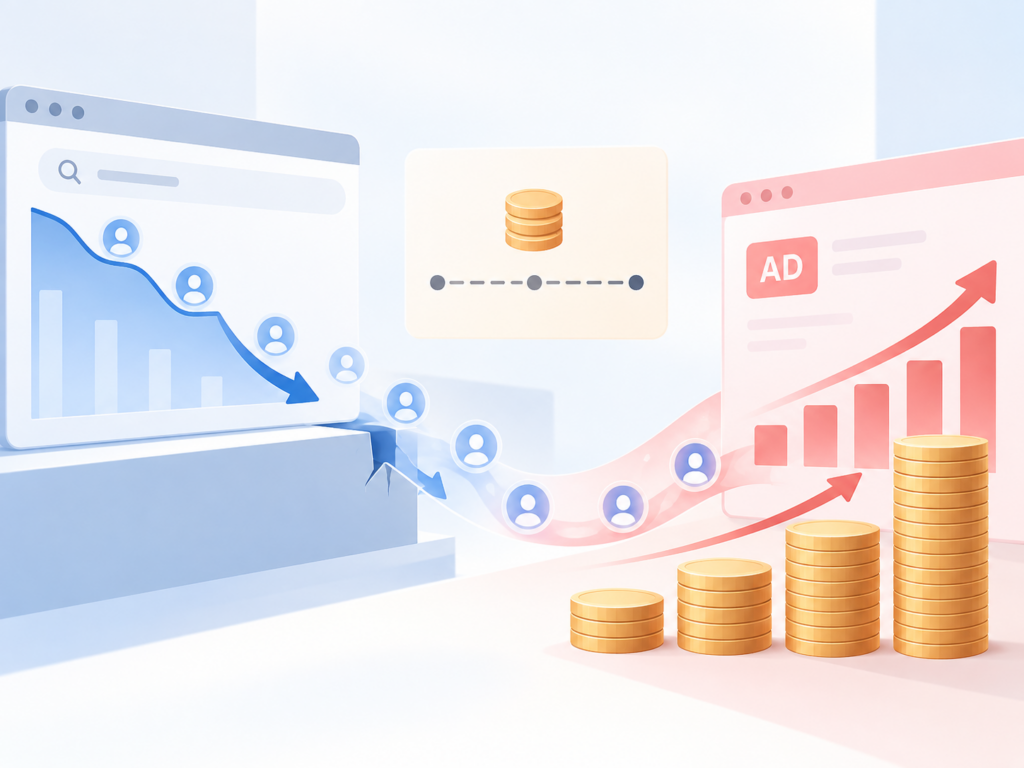
Now test whether a single visit can pay for itself. Say a paid visitor only monetizes through display ads. At an illustrative $30 RPM, earning back $4.77 takes about 160 pageviews from that one visitor. Almost nobody reads that much.
That’s why the arbitrage only works on certain queries. Media consultant Scott Messer pointed out that publishers are targeting high-yield commerce keywords where the math holds up. U of Digital’s Shiv Gupta took the opposite view: the ad money flows straight back into the system that’s cutting publisher referrals. Both can be true at once.
The Organic Units That Used to Pay Out Are Closing
Paid search is becoming the default because the free click supply keeps shrinking.
People Also Ask is a good example. It was one of the last large organic units still sending clicks to third-party sites. AlsoAsked’s Mark Williams-Cook analyzed roughly 19.2 million English queries and found AI-generated PAA answers rose to 86% in August and 97% by early September. Allintitle recorded 100%. Fourteen months earlier, the share was about 12%. Search Engine Roundtable covered the shift in detail.
The click behavior follows. Pew Research found that users clicked a traditional result in 8% of visits when an AI summary appeared, versus 15% when none did. Clicks on links inside the summary itself happened in just 1% of visits. Sessions also ended outright more often after an AI summary: 26% compared with 16%.
Zoom out and the pattern holds. In the Similarweb clickstream panel analyzed by SparkToro, 68.01% of Google searches in the first four months of 2026 ended without a click. Smaller sites have been hit harder, with one analysis finding small publishers lost 60% of their search traffic.
The organic unit that once handed out clicks now answers the question in place. The ad auction on that same page is the only place left to buy the visit back.
Forbes Can Fund This. Most Brands Can’t.
Take Forbes out of the July total and the other 99 publishers split roughly $41 million. The New York Times accounts for $11.3 million of that. Everyone else is working with a much thinner budget.
If you’re a SaaS company, a B2B brand, or an ecommerce team that built its funnel on informational content, you’re exposed to the same click loss without the same buying power. Your how-to guides and comparison posts are exactly the queries AI answers resolve on the page.
The publishers with the most at stake are already changing how they’re organized. Digiday reported that USA Today Co. is building an audience and digital production team of 23 to 30 people. The New York Times moved an executive into a role overseeing AI and off-platform discovery, and the Washington Post created its first head of SEO and AI discovery.
That’s the signal worth copying. The response isn’t only a bigger ad budget. It’s someone who owns how your brand shows up in answers.
What Zero Click Search Traffic Is Still Worth When Nobody Clicks
A search that ends without a click isn’t worthless. A brand can still shape consideration by appearing in an AI Overview, a generative answer, or a cited source, even if the user never lands on its site.
The problem is that your analytics can’t see any of it. Google Analytics records sessions. Search Console records clicks and impressions for blue links. Neither tells you whether ChatGPT named you when someone asked for a recommendation, or whether Perplexity cited your research or a competitor’s. So a team can lose half its organic traffic, keep a strong presence in AI answers, and still report the quarter as a pure loss.
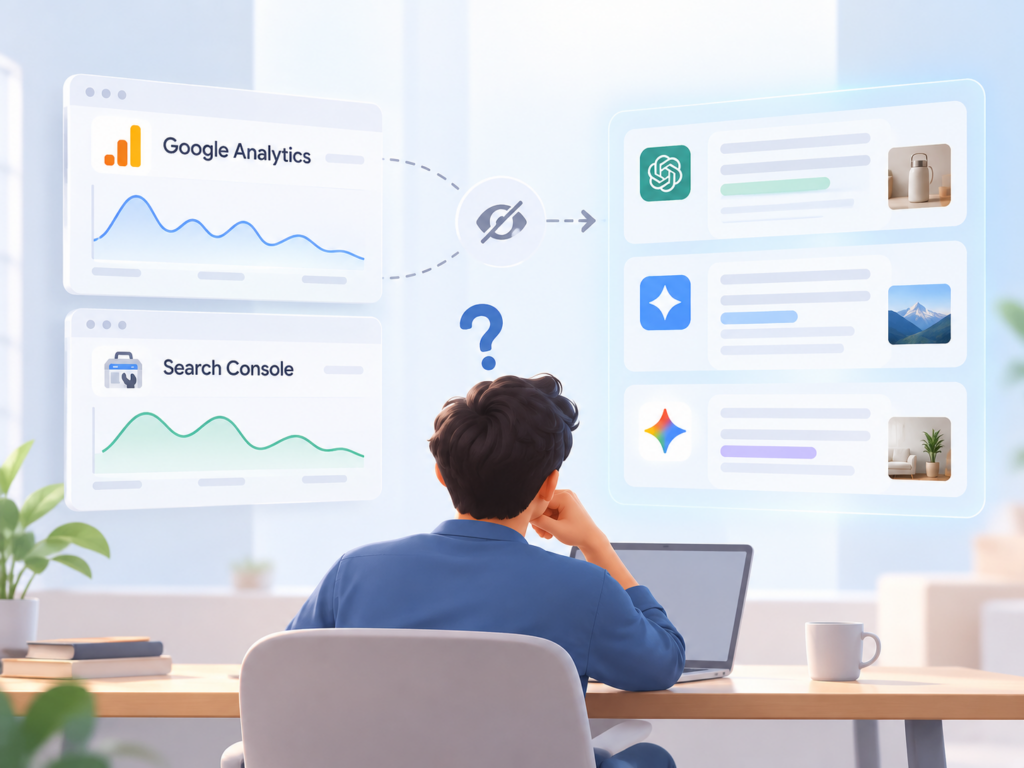
You need a different set of metrics:
- Mention rate. How often your brand appears across a fixed set of prompts.
- Citation share. Which domains AI platforms cite for your topics, and how often yours is one of them.
- Position. Where you land in a recommendation list relative to competitors.
- Sentiment. Whether the answer describes you the way you’d want.
Bottom line: if you’re going to pay $4.77 for a click, you should first know what you’re already getting for free in the answer.
Tracking the Visibility That Never Shows Up in Analytics
This is the gap AI visibility platforms are built to close. Topify is one option worth evaluating if your team is seeing a gap between stable rankings and falling sessions.
Topify tracks brand performance across ChatGPT, Gemini, Perplexity, Google AI Overviews, DeepSeek, and other major AI engines. It uses seven metrics: visibility, sentiment, position, volume, mentions, intent, and CVR. In practice, that turns “our traffic dropped” into a more useful question: did we lose the click, or did we lose the answer too?
Source Analysis is the most relevant feature for a buy-back decision. It shows which domains and URLs AI platforms cite for your prompts, so you can see whether your content, a competitor’s page, or a Reddit thread is shaping the answer. If you’re already cited, paying for the click may be optional. If you’re absent, the fix is earning the citation, and ads won’t do that for you.
Prompt discovery and AI Volume Analytics help you decide where money should go at all. Some prompts carry real commercial intent and justify paid spend. Others are informational, and there you’re better off earning presence in the answer. CVR adds an estimate of how likely an answer is to lead the user toward engaging with your brand.
For scale, the Basic plan runs $99 a month with 100 tracked prompts and a 30-day trial. That’s about the cost of 21 paid visits at July’s publisher rate. The Pro plan covers 250 prompts at $199 a month.
Before You Buy Back a Single Click, Answer These Four Questions
Does the query still convert after the click?
Commerce and subscription queries can support a $4-plus visit. Ad-funded informational pages usually can’t. Map spend to queries with a real downstream conversion.
Is your content already cited in the answer?
If AI Overviews and chat assistants cite you, part of the value is already reaching the user. Measure that before you pay to reach them again.
Who owns the answer right now?
If a competitor or a third-party review site dominates the citations, bidding on the click won’t change what the user reads first. Earning those citations will.
What’s your cost ceiling per visit?
Set it before the auction sets it for you. Price per visit rose about 51% in three years, and nothing on the supply side suggests that trend reverses.
Conclusion
Publishers didn’t choose paid search because it’s efficient. They chose it because the organic clicks stopped coming and the auction was the fastest way to fill the gap. Spend is growing faster than visits, and each visit costs noticeably more than it did in 2023.
For most brands, copying that playbook at scale isn’t realistic. The better first move is to measure where the value went: into AI answers, citations, and recommendations that never show up as a session. Once you can see that layer, you can decide which clicks are worth buying and which answers are worth earning. You can start tracking your AI visibility here.
FAQ
Q: What is zero click search traffic?
A: It refers to searches that end without a visit to any website, usually because the answer appears directly on the results page through AI Overviews, featured snippets, or People Also Ask. One Similarweb panel put the zero-click share at 68.01% of Google searches in early 2026.
Q: Why are publishers spending more on paid search?
A: They’re replacing organic traffic lost to AI answers. The top 100 publishers spent about $113 million on paid search in July 2026, while organic traffic at Forbes, CNN, and USA Today fell by roughly 24% to 29% year over year.
Q: Is buying back search traffic profitable?
A: It depends on the query. At an estimated $4.77 per visit, the math tends to work only when the visitor converts through commerce or a subscription. Display-ad-funded visits rarely generate enough revenue to cover the cost.
Q: How can brands measure visibility that doesn’t generate clicks?
A: Track mention rate, citation share, position, and sentiment across a fixed set of prompts on major AI platforms. Traditional analytics only capture sessions, so you’ll need a dedicated AI visibility tool to see presence inside answers.

