


Your engineering lead wants a decision by end of quarter: which agentic commerce protocol do you build for first? The vendor decks don’t agree. One says the Google-backed standard is the only one that matters. Another warns you’re leaving chatbot revenue on the table. A third wants you to sign off on cryptographic payment mandates that nobody on the finance team can explain.
Meanwhile, nobody on the call can answer a simpler question. When a shopper asks an AI assistant for the top pick in your category, does your brand show up at all?
Picking a protocol decides how the money moves. It doesn’t decide who gets named.
The Agentic Commerce Protocol Question Most Brands Get Backwards
Most coverage treats UCP, ACP, and AP2 as rivals in a standards war. They aren’t, at least not in the way the headlines suggest. UCP, backed by Google and Shopify, covers discovery and the cart. ACP, from OpenAI and Stripe, handles checkout execution, and AP2 proves who actually authorized the payment. One purchase can run through all three.
The only real overlap is between two of them. UCP and ACP are the one pair actually competing for the same ground, and ACP shifted its focus to discovery in March 2026. AP2 sits a floor below both, and its governance has already moved out of vendor hands. On April 28, 2026, Google handed AP2 to the FIDO Alliance, together with Mastercard’s Verifiable Intent framework.
So “which protocol wins” is the wrong frame. The better question is which AI surface your buyers use, and what that surface reads before it recommends anything.
UCP vs ACP vs AP2: What Each Layer Actually Controls
Here’s the side-by-side, focused on the part most comparison posts skip: whether each protocol has a place where your brand can be cited.
| Protocol | Backers | Layer | Where shoppers meet it | Who owns checkout | Citation surface |
|---|---|---|---|---|---|
| UCP | Google, Shopify, Walmart, Target, Etsy, Wayfair | Discovery, cart, checkout session | AI Mode, Gemini, YouTube | Merchant of record, via Google Pay or cart transfer | Yes, AI Mode and Gemini answers |
| ACP | OpenAI, Stripe, PayPal | Product feeds and checkout API, discovery-first since March 2026 | ChatGPT | Merchant site or merchant app inside ChatGPT | Yes, ChatGPT product cards |
| AP2 | Google-initiated, now FIDO Alliance | Payment authorization and mandates | Invisible to shoppers | Not applicable | None |
A few details matter. UCP launched January 11, 2026 at NRF, was co-developed with Shopify, Etsy, Wayfair, Target and Walmart, and has more than twenty endorsers including Visa, Mastercard, Stripe, and Best Buy. Under UCP, the retailer stays the merchant of record and keeps control of pricing rules, customer relationships, and fulfillment. ACP has broadened too, with PayPal joining Stripe behind the architecture.
A useful mental model: UCP runs the shopping session, ACP is the purchase interface, and AP2 is the signed proof that a human said yes.
Every Protocol Is Heading Toward the Same Checkout
The biggest story of 2026 isn’t a protocol launch. It’s a retreat.
OpenAI launched Instant Checkout inside ChatGPT on September 29, 2025, with “over a million” Shopify merchants promised. By February 2026, Forrester’s Emily Pfeiffer counted roughly 30 Shopify merchants actually live. In March, OpenAI ended the feature. It said merchants would use their own checkout experiences while it focused on product discovery.
The conversion data explains why. At Shoptalk 2026, Walmart said ChatGPT’s Instant Checkout converted three times worse than its own website. Under the new model, shoppers find products in ChatGPT and then go to the retailer’s site to buy.
Google is moving the same direction from the other side. Its latest UCP update adds cart transfer, which sends customers straight to the merchant’s checkout page with their cart already filled. Shoppers seem to want it that way. Gartner’s May 2026 consumer survey found that people want AI help with shopping but prefer to make the final purchase decision themselves.
The result is that the checkout is converging on the merchant’s own checkout, or a single wallet tap on top of it. Whichever agentic commerce protocol carries the session, the last step looks increasingly the same.
The checkout is becoming a commodity. The shortlist isn’t.
Where Your Brand Actually Gets Cited in the Agentic Commerce Protocol Stack
If checkout is converging, the competitive fight moves upstream to the AI answer that names three or four products before any protocol is involved.
The stakes are real. By March 2026, AI-referred traffic converted 42% better than non-AI sources such as paid search and email. A year earlier, it had converted 38% worse.
In the ACP ecosystem: ChatGPT reads feeds, then reviews
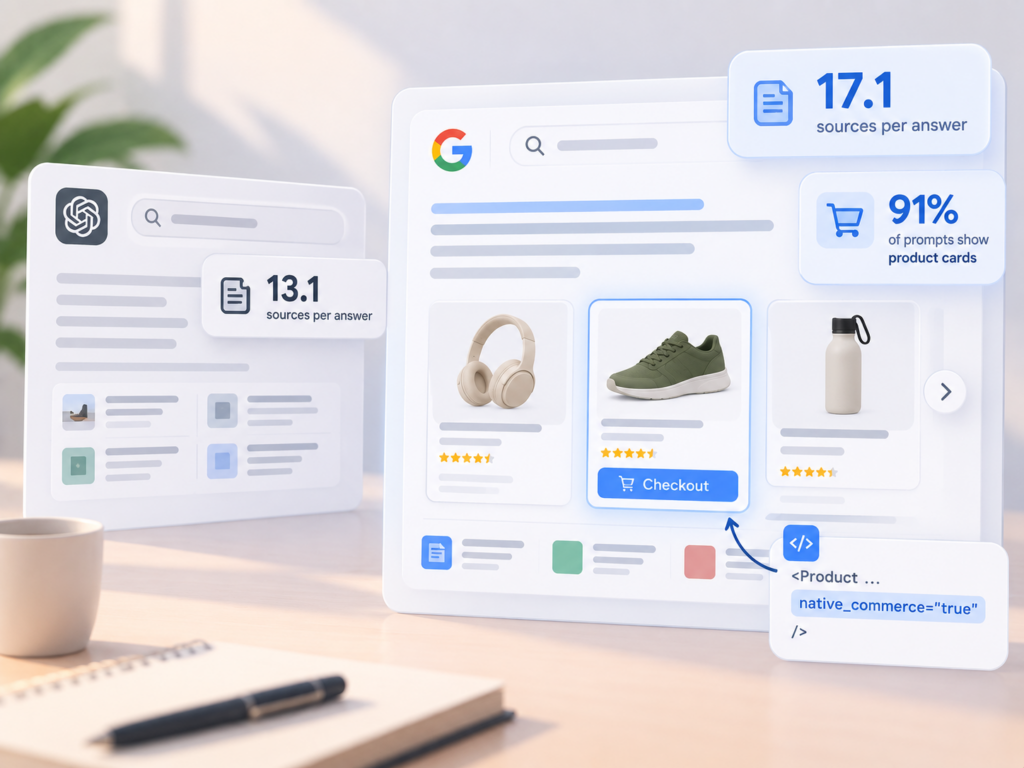
In one 3,312-prompt study across six AI engines, ChatGPT returned a structured product card on 87% of shopping prompts. Your ACP product feed gets you into the pool, but the ranking comes from somewhere else. Nectiv found that commercial-intent prompts trigger a ChatGPT web search 53.5% of the time, compared with 18.7% for informational prompts. That means the pages ChatGPT reads at query time often decide the pick.
In the UCP ecosystem: Merchant Center plus a deeper source list
Google AI Mode showed product cards on 91% of prompts in the same study and cited an average of 17.1 sources per answer, compared with 13.1 for ChatGPT. Products tagged with the native_commerce attribute get a checkout button in AI Mode and the Gemini app. That button only matters if you’re in the answer first.
AP2: no shelf, no citation
AP2 never faces the shopper, so there’s nothing to be cited in. It matters for fraud and trust, but it has no effect on visibility.
The sources behind every recommendation
This is the pattern that should reshape your budget. In the study above, the most-cited domains were YouTube and Reddit at 19% each, followed by RTINGS at 16%. Brand-owned sites barely showed up. A separate signal regression from Hexagon found that third-party editorial citations were the strongest single signal linked to how often a product got recommended. They outweighed brand website quality, review volume, and price competitiveness.
The field is also fragmented. The engines named 3,481 distinct products, and even the most-mentioned product appeared in only about 2% of answers. There’s no “rank #1” to lock in. You win by showing up consistently in the sources each engine reads.
The Measurement Gap All Three Protocols Share
Here’s the part no protocol spec solves. When a purchase completes inside Google AI Mode, the shopper never visits your site, so pageviews, cart events, and retargeting pixels never fire.
Google offers partial visibility. Its AI performance insights report shows share of voice and which products appear, while the UCP analytics dashboard only starts counting at the Buy button click. Both cover Google surfaces only. There’s no equivalent view of ChatGPT, Perplexity, or Copilot, and none of these tools shows which third-party source earned you the mention.
Consistency is the other blind spot. Only 30% of brands keep consistent visibility across back-to-back AI answers. A single manual check tells you almost nothing.
In practice, the brands making good protocol decisions measure the recommendation layer directly, across engines, before they spend engineering time on integrations.
Tracking Agentic Commerce Visibility Across Every Protocol Surface
This is where a dedicated GEO platform earns its place in the stack. Topify tracks how AI systems recommend brands across ChatGPT, Gemini, Perplexity, and Google AI Overviews. Those are the surfaces where both the ACP and UCP ecosystems actually show up in front of shoppers.
For e-commerce teams, three features map directly to the gaps above. Visibility Tracking and Position Tracking show how often your products appear in AI answers for shopping prompts, and where they rank against competitors. Source Analysis reverse-engineers the specific domains and URLs each engine cites, so you can see whether a Reddit thread, a YouTube review, or an editorial roundup put a competitor on the shortlist instead of you. Dynamic Competitor Benchmarking then flags new rivals as they start showing up in answers, which matters in a market where no product holds more than a few percent of mentions.
Here’s how that plays out. Say your air purifier appears in ChatGPT answers but not in AI Mode. Source Analysis might show that AI Mode’s longer source lists lean on two review sites that never covered your product. That’s a PR brief, not a protocol integration.
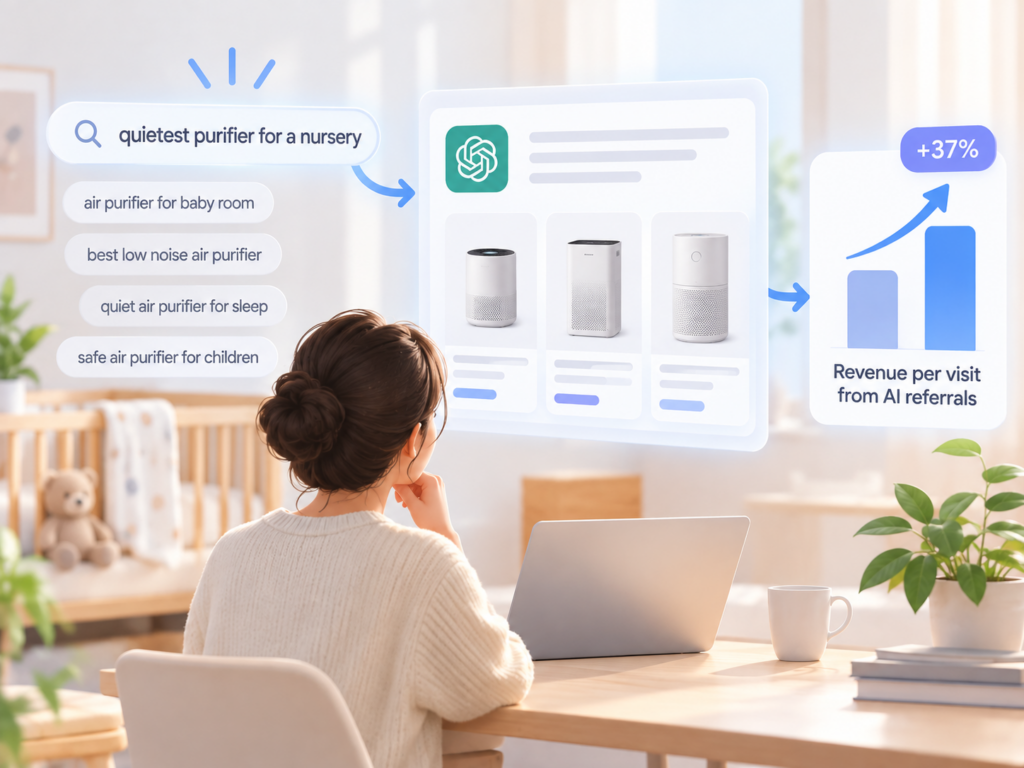
High-Value Prompt Discovery covers the input side by surfacing the real shopping prompts people use, such as “quietest purifier for a nursery,” which keyword tools tend to miss. Adobe’s data shows revenue per visit from AI referrals running 37% above non-AI traffic, so knowing which prompts drive those visits directly affects revenue.
Plans start at $99/month on Topify Pricing. The Basic plan covers 100 prompts across ChatGPT, Perplexity, and AI Overviews, with a 30-day trial. You can get started with Topify and run a baseline before your next protocol planning meeting.
Which Agentic Commerce Protocol to Prioritize for Your Brand
With the citation layer in view, the protocol decision gets simpler. UCP has strong supply-side momentum: one directory tracks 6,540 live UCP domains, and Google’s Universal Cart lets shoppers save items across retailers and pay with Google Pay or the retailer’s own checkout. ACP still connects you to the largest single AI referral source. The right mix depends on where you sell.
| Brand type | Protocol priority | Why | Citation priority |
|---|---|---|---|
| Shopify DTC brand | Let the platform handle it | Shopify merchants get access to both protocols automatically through platform-level integrations | Reddit, YouTube, niche reviewers |
| Large multi-category retailer | UCP and ACP together | Walmart already supports both ChatGPT and Gemini | Editorial roundups and review labs |
| Merchant Center-heavy seller | UCP first | Onboarding runs through existing feeds and the native_commerce attribute | AI Mode’s longer source lists |
| Brand on Salesforce or Stripe | Wait for the platform | Salesforce and Stripe are adding UCP support, so their merchants won’t need to implement it directly | Category comparison content |
| Non-US brand on local payments | Discovery layer first | For a Dutch merchant paying via iDEAL, checkout returns the buyer to your own site anyway | Regional review and community sites |
Notice the right column. It doesn’t change with the protocol you choose, because every protocol path starts with an AI answer built from the same kinds of third-party sources.
Conclusion
UCP, ACP, and AP2 are settling into distinct layers, and the checkout at the end is converging on something close to your own. That makes the agentic commerce protocol decision more of an integration question than a strategy question. Your platform will handle much of it.
What no protocol handles is whether your product makes the AI shortlist. That’s decided by YouTube reviews, Reddit threads, and editorial roundups that engines read before any checkout call happens.
Start by measuring where you’re cited today, across ChatGPT and Google’s AI surfaces, and which sources drive those citations. Then build the protocol integration your platform doesn’t already cover.
FAQ
Q: What is an agentic commerce protocol?
A: It’s an open standard that lets AI agents discover products, build carts, and complete purchases on a shopper’s behalf. The three main ones in 2026 are Google’s UCP, OpenAI and Stripe’s ACP, and AP2, which handles payment authorization.
Q: Should my brand support UCP or ACP?
A: Most mid-size and large brands will end up supporting both, usually through their commerce platform rather than building each one directly. Prioritize based on where your shoppers are: ACP for ChatGPT, UCP for AI Mode and Gemini.
Q: Does implementing a protocol get my products recommended by AI?
A: No. A protocol makes your catalog transactable and easier for engines to read, but recommendations lean heavily on third-party sources like reviews, Reddit, and editorial coverage. Product feed quality gets you into the pool; citations get you picked.
Q: How do I track whether AI agents recommend my products?
A: Run your real shopping prompts across ChatGPT, Gemini, Perplexity, and Google AI surfaces repeatedly, and log both mentions and cited sources. A GEO platform like Topify automates this with visibility, position, and source tracking across engines.

