

You’ve been optimizing for “best project management software” for months. Rankings are solid. Traffic is steady. Then a potential buyer opens ChatGPT and types: “I manage a 12-person remote engineering team and we’re constantly missing sprint deadlines. What should I change about our weekly standups?” Your page doesn’t surface. Neither does your brand.
That question isn’t a keyword. It’s a prompt. And it represents a fundamental shift in how people search for solutions online. According to Semrush’s analysis of 17 months of ChatGPT data, between 65% and 85% of prompts in ChatGPT couldn’t be matched to any traditional search keyword in a database of over 27 billion keywords. The queries people type into AI platforms simply don’t exist in the keyword universe most marketers still rely on.
When “Best CRM” Became a Full Paragraph
Prompt search is what happens when users interact with AI platforms using natural language instead of keyword shorthand. Rather than typing two or three compressed words into a search bar, they write full sentences, add personal context, specify constraints, and describe the outcome they want.
A traditional keyword search looks like this: “best CRM small business.” A prompt search looks like this: “What CRM should a 10-person sales team use if we’re migrating from spreadsheets and need something under $50 per user per month?”
The difference isn’t just length. It’s structure. Keywords compress intent into fragments that a matching algorithm can index. Prompts expand intent into context-rich instructions that a reasoning system interprets.
The data confirms this behavioral shift is accelerating. Google reported at I/O 2026 that the average AI Mode search is now three times longer than a traditional query. AI Mode has surpassed 1 billion monthly active users globally, with query volume more than doubling every quarter. Independent clickstream data from Semrush puts the average AI Mode query at 7.22 words, compared to about 3.5 words for standard Google searches.
That’s not a cosmetic shift. It’s a structural one.
Why Prompt Search Doesn’t Play by Keyword Rules
The core difference between prompt search and keyword search isn’t vocabulary. It’s how the system processes the input.
Traditional search engines match keywords against indexed pages. The relationship is mechanical: keyword presence, backlinks, and page authority determine what ranks. Prompt search works differently. AI platforms interpret intent, weigh context, evaluate constraints, and synthesize an answer from multiple sources. Google calls this underlying mechanism query fan-out: the AI breaks a single prompt into multiple sub-queries, retrieves sources for each, and merges them into one response.
Here’s how the two models compare in practice:
| Dimension | Keyword Search | Prompt Search |
|---|---|---|
| Query structure | 2-4 word fragments | 10-25 word natural language sentences |
| System behavior | Index matching | Intent reasoning + multi-source synthesis |
| Result format | Ranked list of links | Single generated answer with citations |
| Brand exposure | Position on a results page | Inclusion (or exclusion) from the answer |
| Optimization unit | Individual keyword | Cluster of implied sub-questions |
One detail from Google’s own data stands out. The top opening words in AI Mode queries are: what, how, “I”, is, can. The third most common word is “I”, which signals that users aren’t just asking questions. They’re narrating their situation into the search bar and expecting the AI to reason on their behalf.
The Visibility Gap Prompt Search Creates
Here’s the problem most brands haven’t caught up to: you can rank #1 on Google for a keyword and still be completely invisible in prompt search results.
Traditional SEO tools track keywords, rankings, and clicks. None of them natively track what happens inside ChatGPT, Perplexity, or Google AI Mode when a user types a multi-sentence prompt about your category. Topify’s own research into keyword tools found that the average AI prompt is 7.22 words long, while the average keyword these tools are built to track is 2-3 words.
The AirOps 2026 State of AI Search report puts the instability in stark terms: only 30% of brands stay visible from one AI answer to the next, and just 20% remain present across five consecutive runs of the same prompt. The same report found that roughly 60% of AI Overview citations come from URLs not ranking in the top 20 organic results. In other words, your SEO position and your prompt search visibility operate on different logic entirely.
This gap has real commercial consequences. A Similarweb study published in June 2026 found that users who received a brand recommendation from ChatGPT were 2.5x more likely to visit that brand’s website within seven days. And 55.9% of that downstream traffic arrived through branded search, meaning users took the brand name from an AI answer and Googled it. If your brand isn’t in the AI answer, that traffic goes to whoever is.
How AI Decides What Shows Up in a Prompt Search Answer
When someone types a prompt into ChatGPT, Perplexity, or Google AI Mode, the system doesn’t just look for pages that contain the right keywords. It breaks the prompt into sub-queries, retrieves evidence for each, and assembles a synthesized response. This is where query fan-out changes the game.
A prompt like “What CRM should a 10-person sales team use under $50 per user?” might trigger sub-queries like “CRM pricing comparison small teams,” “CRM migration from spreadsheets,” and “CRM user reviews for startups.” Each sub-query pulls from different sources. The final answer combines passages from multiple pages, and none of them need to rank #1 for the original prompt.
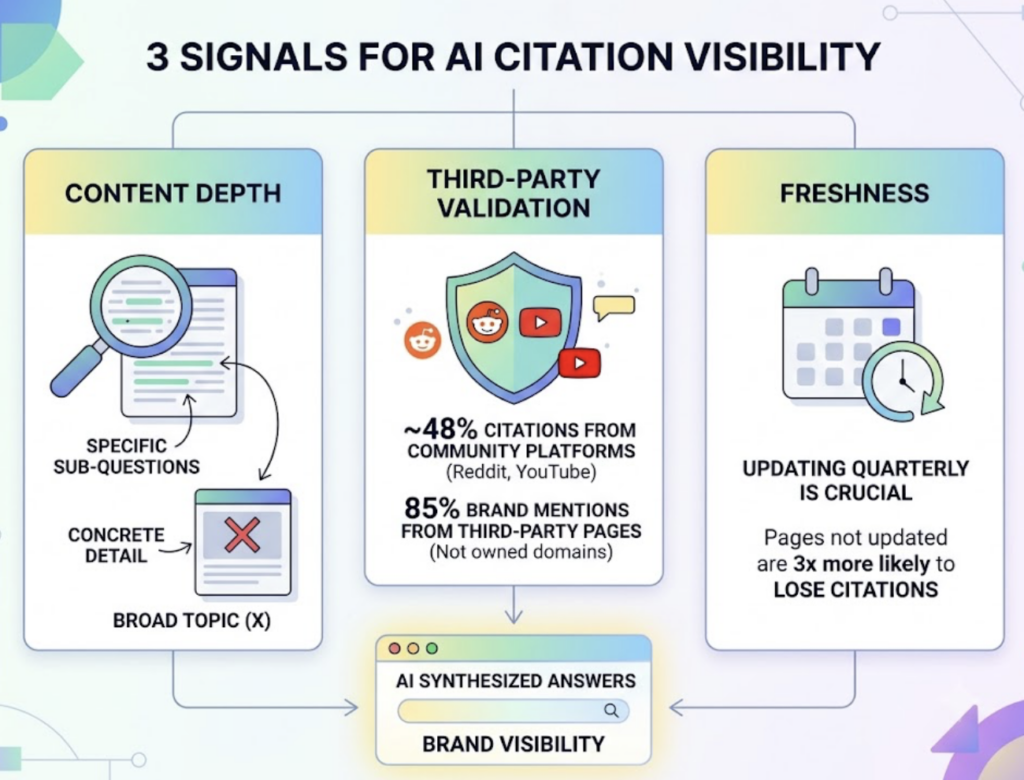
Three signals tend to influence whether your brand appears in these synthesized answers. First, content depth: AI platforms favor pages that answer specific sub-questions with concrete detail, not pages that cover a topic broadly. Second, third-party validation: the AirOps report found that about 48% of citations come from community platforms like Reddit and YouTube, and 85% of brand mentions originate from third-party pages rather than owned domains. Third, freshness: pages not updated quarterly are 3x more likely to lose citations.
That’s a fundamentally different optimization playbook than targeting one keyword and building backlinks.
How to Track and Optimize for Prompt Search
Tracking prompt search performance requires a different toolkit than tracking keyword rankings. You need to know which prompts matter in your category, whether your brand appears in the answers, and what sources the AI is citing.
Start by identifying the high-value prompts in your space. This isn’t something traditional keyword tools can do, because the prompts don’t exist in their databases. Topify’s High-Value Prompt Discovery surfaces the specific natural-language prompts where AI platforms are actively recommending brands in your category. It continuously identifies new prompt opportunities as AI recommendations evolve.
Next, monitor your brand’s presence across those prompts. Topify’s Visibility Tracking measures how often your brand appears in AI-generated answers across ChatGPT, Gemini, Perplexity, and Google AI Overviews. In a landscape where only 30% of brands stay visible from one answer to the next, continuous monitoring is the difference between catching a drop early and discovering it in a quarterly review.
Then, understand why AI is (or isn’t) citing you. Topify’s Source Analysis identifies the exact domains and URLs that AI platforms reference when constructing answers. If a competitor consistently gets cited because of a third-party review or a Reddit thread you’re absent from, that’s a specific, actionable gap.
What Prompt Search Optimization Looks Like in 2026
Prompt search optimization isn’t a replacement for SEO. It’s a parallel track with its own rules.
On the content side, the shift is from keyword-targeted pages to context-rich, question-answering content. Your pages need to address specific sub-questions with concrete data, not just cover a topic at a surface level. Think less “ultimate guide” and more “the precise answer to the question the AI is actually asking.”
On the technical side, structured data, clear heading hierarchies, and entity-level consistency across the web all increase the likelihood that AI systems can parse and cite your content. BrightEdge data shows that sequential headings and rich schema correlate with 2.8x higher citation rates in AI answers.
On the monitoring side, the metric that matters is prompt-level visibility, not keyword ranking. You need to know, for every commercially important prompt in your category, whether AI recommends your brand, how your sentiment compares to competitors, and which sources are feeding the AI’s answer.
That last piece is what separates brands that react to prompt search from brands that get ahead of it.
Conclusion
Search behavior has shifted from keyword fragments to full conversational prompts, and the systems processing those prompts operate on entirely different logic than traditional search engines. The brands that adapt are the ones building prompt-level visibility: discovering which prompts matter, tracking whether they appear in AI answers, and optimizing the sources AI platforms actually cite.
The starting point is knowing where you stand. Run a prompt-level audit across ChatGPT, Perplexity, and Google AI Mode for your core category prompts. If your brand isn’t showing up, traditional SEO metrics won’t tell you why. A platform like Topify will.
FAQ
Q: What is the difference between prompt search and keyword search?
A: Keyword search uses short, fragmented phrases (2-4 words) that search engines match against indexed pages. Prompt search uses natural-language sentences (often 10-25 words) with personal context and constraints that AI platforms interpret through reasoning. The average Google AI Mode query is 3x longer than a traditional search query, and 65-85% of ChatGPT prompts can’t be matched to any traditional keyword.
Q: How do AI platforms decide which brands to mention in prompt search results?
A: AI platforms use query fan-out to break prompts into sub-queries, then retrieve and synthesize information from multiple sources. Key factors include content depth and specificity, third-party validation (reviews, community mentions, expert citations), content freshness, and entity-level consistency. About 85% of brand mentions in AI answers originate from third-party sources, not a brand’s own website.
Q: Can traditional SEO tools track prompt search performance?
A: No. Traditional tools like Ahrefs and Semrush track keyword rankings using search engine index data. They don’t natively monitor what happens inside ChatGPT, Perplexity, or Google AI Mode. Prompt-level visibility requires dedicated AI search monitoring tools that track brand mentions, sentiment, and citation sources across AI platforms.
Q: What is prompt search optimization?
A: Prompt search optimization is the practice of making your brand visible and recommended within AI-generated answers. It involves creating context-rich content that addresses specific sub-questions, building third-party citations across community and review platforms, maintaining content freshness, and using AI visibility tools to monitor prompt-level brand performance across multiple AI platforms.

