

Your keyword rankings are stable. Your domain authority is climbing. Your content calendar is running on schedule. Then a prospect types a 23-word question into ChatGPT, gets a direct recommendation for your competitor, and never visits Google at all. Nothing in your SEO dashboard flagged it. Nothing in your analytics even registered the lost opportunity.
That’s the gap prompt search has opened. And for most marketing teams, it’s completely invisible.
From Keywords to Prompts: What Actually Changed in Search
For two decades, search worked on a simple contract: users compressed their intent into short keyword phrases, and search engines matched those fragments against indexed pages. Type “best CRM small business,” get a ranked list of links. The system rewarded brevity because the algorithm needed it.
Prompt search flips that contract. Instead of trimming context to fit a search box, users now write full questions with constraints, preferences, and background information baked in. A Semrush study found that the average ChatGPT prompt runs about 23 words, compared to roughly 4 words for a typical Google query. Some analyses put the ChatGPT average even higher, around 60 words, once you include detailed research and multi-step requests.
The difference isn’t just length. It’s structure. A keyword query like “project management tool” carries almost no context. A prompt like “What project management tool should I use for a remote team of 15 people with a tight budget and Slack integration?” tells the AI who’s asking, what they need, and what constraints matter. The AI doesn’t match keywords to pages. It interprets intent, weighs context, and synthesizes an answer from multiple sources.
That shift has a direct consequence for brands: if your content was built to match keyword fragments, it may not surface when an AI system processes a context-rich prompt.
Why Prompt Search Breaks Traditional Keyword Research
The mechanical reason is a process called query fan-out. When a user submits a prompt to ChatGPT, Perplexity, or Google’s AI Mode, the system doesn’t search for the exact phrase. It breaks the prompt into multiple sub-queries, runs them in parallel, retrieves pages for each, and synthesizes the results into a single answer.
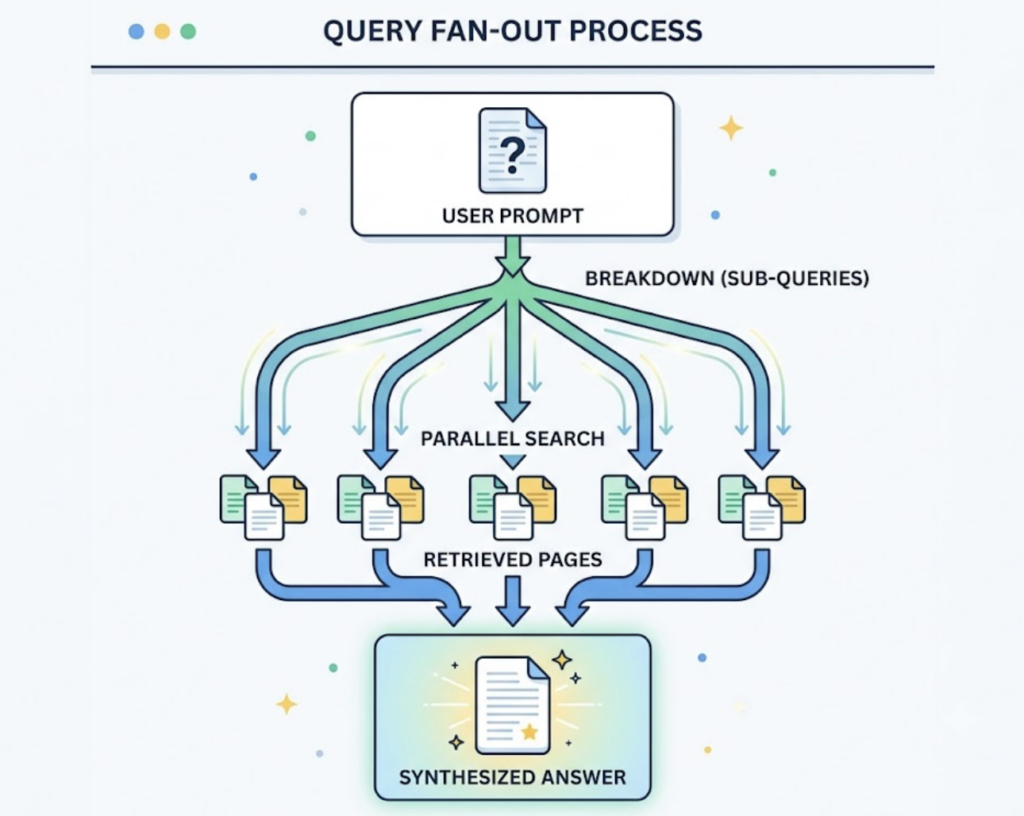
A Nectiv study analyzing 8,500+ ChatGPT prompts found that 31% triggered at least one web search, with an average of 2.17 searches per prompt. NoGood’s testing showed that a single prompt can generate 8 to 15 sub-queries behind the scenes, each pulling from different sources.
Here’s what that looks like in practice. A user asks: “How do I reduce customer acquisition costs?” ChatGPT might fan out into sub-queries like “CAC reduction strategies for SaaS,” “customer acquisition cost benchmarks by industry,” and “CAC vs LTV optimization.” The final answer combines passages from six different websites, none of which necessarily ranked first for the original query.
Traditional keyword research can’t capture this. Your keyword tool shows volume for “reduce customer acquisition costs.” It doesn’t show you the five hidden sub-queries that actually determine which brands get cited. And those sub-queries change depending on the phrasing, context, and constraints the user includes in their prompt.
That’s the core problem. Keyword research tells you what humans type into Google. Query fan-out tells you what the AI types into Google after it reads what the human asked. Different layer, different leverage.
The Numbers Behind the Shift to Prompt Search
The scale of this shift is no longer speculative. It’s measurable across every major platform.
ChatGPT reached over 1 billion monthly active users in early 2026, processing roughly 2.5 billion prompts per day. Perplexity scaled to 1.2 to 1.5 billion monthly queries. Google’s AI Overviews now appear on roughly 15% of all Google searches, with higher rates for informational and research queries.
The behavioral data is equally clear. Bain & Company’s 2025 research found that 80% of consumers rely on AI-written results for at least 40% of their searches, reducing organic web traffic by 15% to 25%. Gartner predicted that traditional search volume would drop 25% by 2026 as users shifted to AI chatbots. About 37% of consumers now start searches with AI tools, and that figure is higher among younger demographics.
The commercial impact is where it gets interesting. The Opollo AI Search Benchmark Report, analyzing 312 B2B technology companies, found that AI-referred traffic converts at 14.2%, compared to Google organic’s 2.8%. That’s a 5x gap. Fewer visitors, but dramatically more valuable ones.
Yet only 23% of marketers currently invest in measuring AI visibility, even though 54% plan to implement GEO within the next 3 to 6 months. The gap between awareness and action is wide.
What Prompt Search Means for Your Content Strategy
The strategic shift is straightforward, even if the execution isn’t. Content built for keyword matching needs to evolve into content built for intent coverage.
Here’s what that looks like in practice:
| Dimension | Keyword-Optimized Content | Prompt-Ready Content |
|---|---|---|
| Query it targets | Short phrase (“best CRM”) | Full question with context and constraints |
| Optimization goal | Rank for one keyword | Cover multiple sub-queries an AI might generate |
| Content structure | Single topic, keyword density | Multi-angle coverage with clear, extractable answers |
| Success metric | Google ranking position | Whether AI cites the content in generated answers |
| Update cadence | Quarterly refresh | Continuous, since AI favors pages updated within 30 days |
The practical starting point is prompt mapping. Rather than building a keyword list, you build a prompt set that mirrors how real users ask questions in AI search. SurfacedBy’s research breaks this into four categories:
Discovery prompts: Broad category questions where no brand is named. (“What’s the best way to track my brand’s visibility in AI search?”)
Constraint prompts: Questions that add budget, company size, use case, or technical requirements. (“What AI visibility tool works for a 10-person marketing team under $200/month?”)
Comparison prompts: Questions that force tradeoffs between named options. (“How does X compare to Y for AI search monitoring?”)
Follow-up prompts: Second and third questions in a conversation that narrow the recommendation. (“Does it also track Perplexity and Google AI Overviews?”)
Your content needs to address all four types, not just the head term. That means structuring articles so that each sub-section answers a distinct question an AI might fan out into. If your page answers the most relevant sub-queries with clear, direct passages at the top of each section, you’re more likely to get cited.
How to Track Prompt Search Visibility Before Competitors Do
Here’s the thing: you can’t optimize what you can’t measure. And traditional SEO tools weren’t built to measure prompt-level visibility. They’ll tell you where you rank on Google for “best CRM.” They won’t tell you whether ChatGPT mentions your brand when a user asks, “Which CRM should a 15-person remote team use if we need Slack integration and spend under $50/seat?”
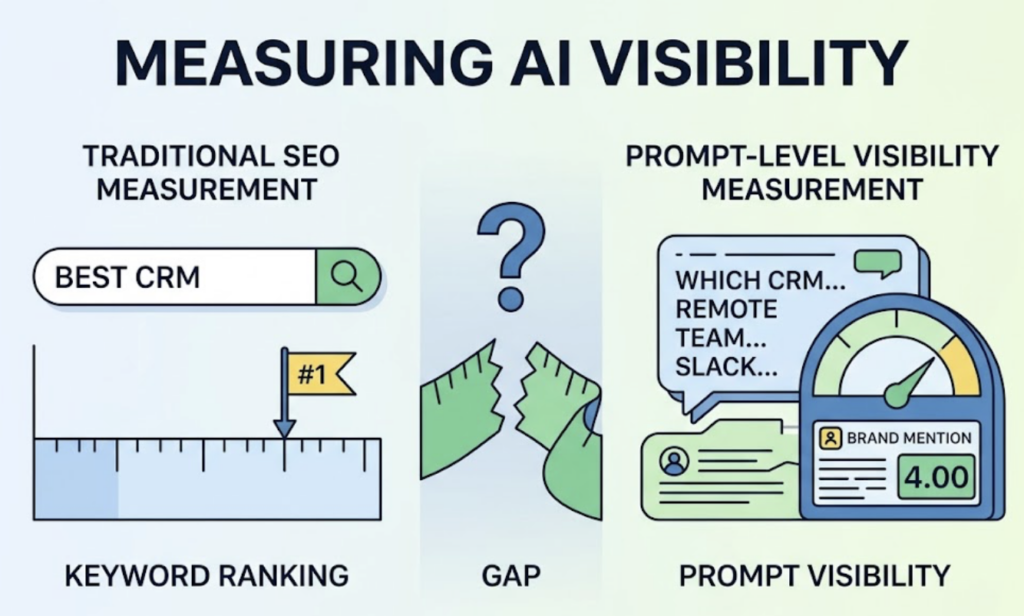
That’s a fundamentally different measurement problem. It requires tracking real prompts across multiple AI platforms, monitoring which brands get cited, and understanding the sentiment and position of those citations.
Topify was built for exactly this shift. Its High-Value Prompt Discovery feature surfaces the specific prompts your audience is asking across ChatGPT, Perplexity, and Google AI Overviews, so you’re optimizing for the questions that actually drive AI recommendations, not just the keywords that drive Google rankings.
The platform’s Visibility Tracking monitors whether your brand appears in AI-generated answers at the prompt level. You can see which prompts trigger a mention, which don’t, and how your citation rate compares to competitors. Source Analysis then shows which domains and URLs the AI platforms are actually citing, so you can identify exactly where your content gaps are.
In practice, this means a marketing team can go from “we think we’re doing well in AI search” to “we know we’re cited in 34% of high-intent prompts in our category, up from 18% last quarter, and competitor X just passed us on Perplexity.” That’s the difference between guessing and operating.
For teams just getting started, the first step is simple: take your top 10 keywords and rewrite them as the prompts your buyers would actually type into ChatGPT. Then check whether you show up. If the answer is no, or you don’t know, that’s where Topify’s prompt-level tracking fills the gap.
Conclusion
Search didn’t die. It evolved. The search bar trained users to think in fragments. AI search is training them to think in full sentences, with context, constraints, and follow-ups. That’s prompt search, and it’s already reshaping which brands get discovered, recommended, and chosen.
The marketers who’ll win this transition aren’t the ones with the best keyword rankings. They’re the ones who understand which prompts matter, track their visibility at the prompt level, and build content that answers the sub-queries AI actually runs behind the scenes. The data is clear, the shift is measurable, and the tools to act on it exist today.
FAQ
Q: What is prompt search?
A: Prompt search refers to the way users interact with AI platforms like ChatGPT, Perplexity, and Google AI Mode by typing full, natural-language questions instead of short keyword fragments. These prompts typically include context, constraints, and specific intent, and the AI interprets them to generate synthesized answers rather than a list of links.
Q: Does prompt search mean keywords are dead?
A: No. Keywords still indicate where demand exists. But keywords alone no longer capture how AI search engines process and respond to user queries. The shift is from optimizing for a keyword to covering the full set of sub-queries an AI might generate from a single prompt. The two approaches work together, not as replacements.
Q: How does query fan-out work in AI search?
A: When you submit a prompt to an AI search platform, the system breaks it into multiple narrower sub-queries, searches the web for each one in parallel, and then synthesizes the results into a single answer. This process, called query fan-out, means that the pages cited in an AI answer often weren’t optimized for the original prompt at all. They were pulled in because they answered one of the hidden sub-queries.
Q: How can I track my brand’s visibility in prompt search results?
A: You need a platform that monitors AI-generated answers at the prompt level across multiple AI engines. Topify, for example, tracks which prompts mention your brand in ChatGPT, Perplexity, and Google AI Overviews, and shows how your visibility compares to competitors. The key is moving beyond keyword rankings to prompt-level citation tracking.

