
Your product page ranks third for its main category term. The feed is clean, reviews are strong, and paid shopping sends steady traffic every week. Then someone opens ChatGPT and types “durable carry-on under $200 that actually fits budget airline sizers,” and gets five specific recommendations. Yours isn’t one of them.
Nothing broke. The shopper just asked a question your keyword strategy was never built to answer. That’s prompt search, and in a growing number of categories it’s where product discovery now starts.
Prompt Search Isn’t Keyword Search With More Words
Keyword search asks the shopper to translate a need into terms a machine already indexes. “Running shoes men.” “Carry-on luggage.” The engine returns a list, and the shopper does the filtering.
Prompt search flips who does the work. The shopper states a goal with constraints attached, and the system does the sorting before anything reaches the screen.
Google’s own framing is that people now interact using conversational language, not keywords, and expect the system to read intent rather than match strings. Google’s search leadership has described seeing two, three, or four-sentence querieswhere people explain a problem instead of naming a product.
The gap this creates is measurable. Semrush found that 65% to 85% of ChatGPT prompts have no matching keyword in its keyword database at all.
That’s not a long-tail problem. It’s a coverage problem, and most keyword tools can’t see it.
| Dimension | Keyword search | Prompt search |
|---|---|---|
| Input | 2 to 4 terms | Goal plus constraints, often a full sentence |
| Who filters | The shopper | The model |
| Output | 10 links plus ads | 3 to 8 products, one synthesized recommendation |
| What wins | Ranking position | Being selected as evidence |
| Measurable by | Rank trackers | Prompt-level monitoring |
Shoppers Bring Constraints and Feelings, Not Keywords
Here’s the thing about how people actually write shopping prompts: they’re shorter than most marketers assume, and more personal.
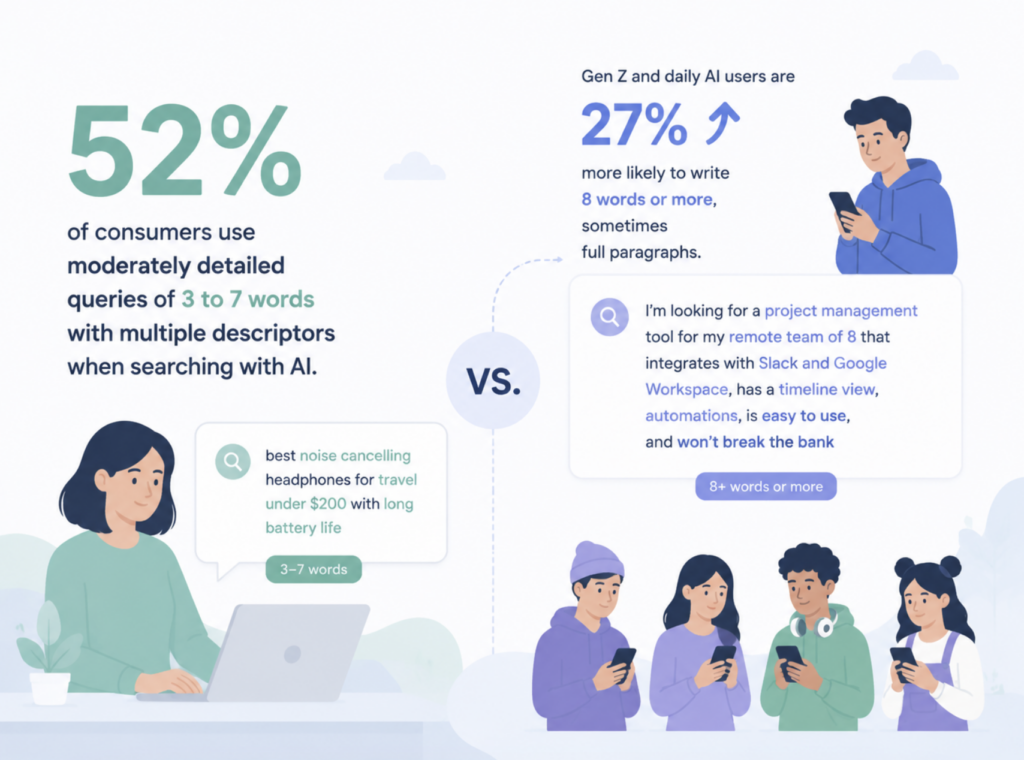
Klaviyo’s consumer research found that 52% of consumers use moderately detailed queries of 3 to 7 words with multiple descriptors when searching with AI. Gen Z and daily AI users are 27% more likely to write 8 words or more, sometimes full paragraphs.
The bigger shift is context. Klaviyo found 78% of people include emotional or personal context at least some of the time, asking for “something to cheer me up” or “a gift that feels thoughtful” rather than naming a product category.
That’s goal-based shopping. The shopper describes the outcome and lets the model reverse-engineer the product.
There’s a counterintuitive wrinkle worth knowing. A 2026 study covered by Search Engine Journal found that concise, keyword-style prompts produced more brand mentions than persona-heavy conversational ones, and that adding budget or feature constraints reduced the number of brands shown in ChatGPT and Perplexity while increasing it in Gemini and AI Overviews. Filler words changed nothing.
So the constraint is the moment of truth. “Under $200” and “fits budget airline sizers” are exactly where products get screened out, and they’re the attributes most product pages state vaguely or not at all.
One Prompt, a Dozen Hidden Searches
A shopping prompt rarely triggers one retrieval. It triggers query fan-out: the model decomposes the request into sub-queries, retrieves separately for each, then synthesizes.
The carry-on prompt above probably becomes something like: budget airline sizer dimensions by carrier, best carry-on under $200, spinner wheel durability complaints, warranty comparison across luggage brands, plus a few review-aggregation queries.
Your brand isn’t competing for the prompt. It’s competing for the sub-queries.
This is why single-page thinking fails in AI product discovery. Most ecommerce teams have one PDP built to win the parent phrase, and nothing that answers the definitional sub-query or the objection sub-query. The model needed four answers and found yours useful for zero of them.
Fan-out also explains why results feel unstable. Run the same prompt twice and citations shift, because retrieval is sampled rather than fixed. Checking your brand in ChatGPT once and feeling relieved is an anecdote, not a measurement.
AI Sends Less Traffic. It Sends Much Better Traffic.
The volume argument against prompt search is getting weaker every quarter.
Adobe Analytics, working from more than a trillion visits to U.S. retail sites, found AI-referred traffic to retail grew 138% year over year in May 2026 and 1,324% since October 2024, when it started tracking the category. Retail led every vertical in AI visit share growth in Q1 2026.
The quality signal is stronger than the volume signal. Adobe reported shoppers arriving from AI referrals spend 53% more time on site and browse 23% more pages per visit. By March 2026, AI traffic converted 42% better than non-AI traffic, with revenue per visit running 37% above other sources. A year earlier, that comparison ran the other way.
Scale is already there on the query side. Roughly 2% of ChatGPT queries involve shopping, which works out to about 50 million shopping queries per day against a base of 900 million weekly users. A Semrush survey found half of U.S. shoppers have bought something after researching it with AI.
Bottom line: prompt search is a small channel producing pre-qualified buyers, which is the profile every acquisition team says it wants.
Why AI Picks Three Products Out of Three Hundred
Where a Google results page gives ten links and a wall of shopping ads, an AI assistant returns three to eight products. Selection is the whole game.
Products surface based on structured merchant feeds, crawled web content, and third-party trust signals rather than paid placement. OpenAI’s shopping research model was trained to read trusted sites and cite reliable sources, synthesizing across many of them and refining as the shopper adds constraints.
The industry settled into a clear division of labor in 2026. OpenAI stepped back from running checkout and refocused on product discovery, with merchants keeping their own checkout under the Agentic Commerce Protocol. Google moved the same direction, letting shoppers refine a query through conversation in AI Mode with agentic checkout handled on the merchant side.
Discovery is the layer that got automated. That’s the layer to optimize.
Three things tend to decide selection. First, machine readability: Adobe’s content visibility scoring flags pages where a large share of the content simply can’t be parsed by a model, and a page scoring 50% has half its content invisible. Second, attribute coverage, meaning the specific constraints shoppers name are stated explicitly in your product data rather than implied by a photo. Third, corroboration, since models weight independent reviews, editorial roundups, and community discussion more heavily than your own copy.
Turning Prompt Search Into a Channel You Can Measure
Most ecommerce teams find out they’re invisible in AI answers by accident, usually when a founder types the category into ChatGPT and sees three competitors. The problem with that discovery method is obvious: it’s one prompt, one run, one platform, no baseline.
Measuring prompt search properly means treating prompts the way you once treated keywords. You need a defined set, repeated sampling over time, competitor comparison in the same runs, and visibility into which sources fed the answer.
Topify is built around that workflow. Its High-Value Prompt Discovery surfaces the prompts that actually carry volume in your category and keeps surfacing new ones as recommendations shift, which matters more in retail than in most verticals because seasonality rewrites the prompt set every quarter. Comprehensive GEO Analytics then tracks seven metrics across ChatGPT, Gemini, Perplexity, and other major engines: visibility, sentiment, position, volume, mentions, intent, and CVR.
The citation layer is where merchandising decisions come from. Topify reverse-engineers the exact domains and URLs AI platforms cite for your tracked prompts, so when a competitor takes over a “best under $200” prompt, you can see whether it won on its own PDP, a retailer listing, or a review site you’ve never pitched.
Dynamic Competitor Benchmarking runs alongside it, flagging emerging rivals in real time rather than at quarter end.
Pricing starts at $99 per month on the Basic plan with 100 tracked prompts, which is roughly the size of a serious starting prompt set for a single-category store. You can get started without rebuilding anything on your side.
Where to Start If You Sell Products Online
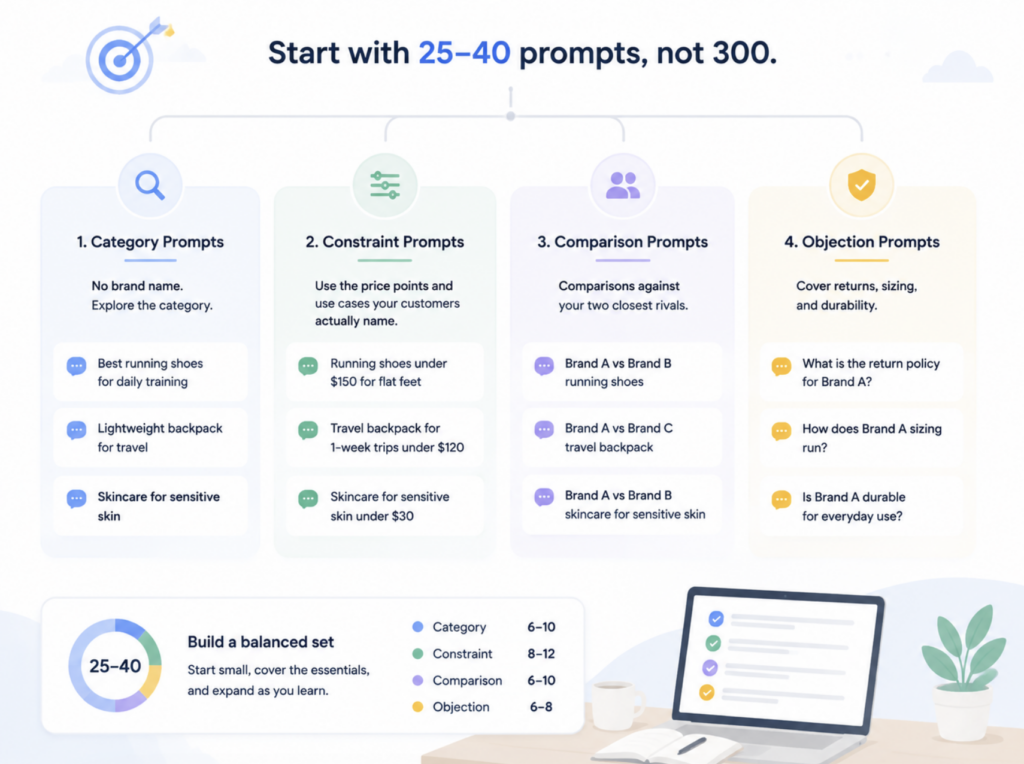
Start with 25 to 40 prompts, not 300. Split them into category prompts with no brand name, constraint prompts using the price points and use cases your customers actually name, comparison prompts against your two closest rivals, and objection prompts covering returns, sizing, and durability.
Run them weekly and record which brands appear, in what order, and which sources get cited.
Then fix the readability gaps the citation data exposes. Put constraint answers in text on the page, not in images. Make sure your feed carries the attributes that show up in prompts. Get corroboration where the model already looks.
Only 16% of brands currently track their AI search performance in any systematic way, which means the competitive bar in most categories is still low. That won’t hold for long.
Conclusion
The shopper who couldn’t find your carry-on didn’t reject your product. Your product never entered the consideration set, because the constraints in the prompt never matched anything readable in your data.
Prompt search rewards a different kind of work than keyword search did. Less about ranking for terms, more about being the clearest, best-corroborated answer to a specific goal with specific limits attached. The channel is still small enough that a focused prompt set and a few weeks of citation data can move you from invisible to recommended.
Pick 25 prompts your customers would actually type. Run them. See who’s there instead of you.
FAQ
Q: What is prompt search?
A: Prompt search is product discovery through conversational prompts in AI assistants like ChatGPT, Gemini, and Perplexity, where a shopper describes a goal with constraints and the system returns a short recommendation set instead of a page of links.
Q: How is prompt search different from keyword search for e-commerce?
A: Keyword search matches terms and leaves filtering to the shopper. Prompt search interprets intent, expands the request into sub-queries through query fan-out, and returns three to eight products. Visibility depends on selection, not ranking position.
Q: Which prompts should an ecommerce brand track?
A: Track four types: unbranded category prompts, constraint prompts built around real price points and use cases, comparison prompts naming your closest competitors, and objection prompts about returns, sizing, or durability. Keep branded prompts in a separate group so they don’t inflate your overall visibility numbers.
Q: Does AI search traffic actually convert for retail?
A: Adobe’s 2026 data shows AI-referred retail traffic converting 42% better than non-AI traffic, with 37% higher revenue per visit and 53% more time on site. Volume stays modest relative to paid search and email, but intent runs higher.