

Your keyword rankings are holding. Your traffic report looks clean. Then someone on your team opens ChatGPT, types a category question your brand should own, and gets back five competitor names. Yours isn’t one of them.
That’s not an SEO failure. It’s a measurement failure. Your tools were built to track Google, and Google no longer controls the full discovery journey.
Your Keyword Rankings Are Fine. Your AI Search Visibility Isn’t.
Traditional keyword research was built on one assumption: users type a short phrase into Google, click a link, and land on your site. That model worked for two decades.
It’s breaking down now. Google’s global search market share fell below 90% for the first time in a decade during late 2024, coinciding with a 721% increase in traffic to AI-powered platforms. That’s not a trend. That’s a structural shift.
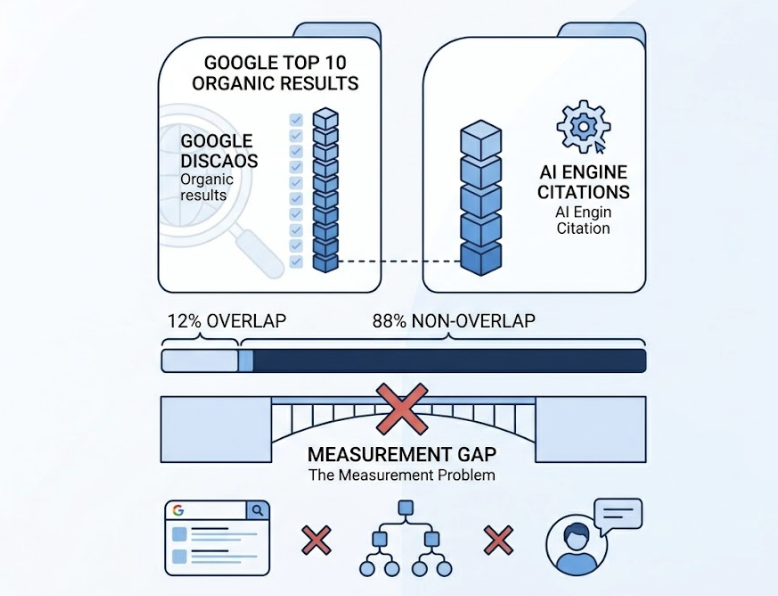
Here’s what makes it a measurement problem: only 12% of AI citations overlap with Google’s top 10 organic results. Being number one on Google does not mean an AI engine knows you exist. The two systems are drawing from different sources, applying different logic, and delivering different answers to the same user intent.
And that gap is widening every month.
What AI Keyword Research Actually Means
AI keyword research is the systematic study of the prompts users input into generative engines, and the analysis of which prompts trigger specific brand recommendations or citations.
The fundamental unit has changed. Traditional keyword research tracks “search volume” for short phrases. AI keyword research tracks “prompt volume” for long-form, conversational questions.
The scale of that difference is worth understanding concretely. The average Google query is 3.4 words. The average ChatGPT prompt is 60 words. A traditional search query like “best CRM for startups” is a broad intent signal. An AI prompt like “I’m a founder of a 10-person SaaS company with a $500 monthly budget; suggest a CRM that integrates with Slack and provides automated lead scoring” is a fully articulated scenario with trade-offs baked in.
That’s a different research discipline entirely, not just a longer version of what you already do.
How AI Engines Decide Who Gets Recommended
AI engines don’t rank pages. They synthesize answers.
When a user submits a prompt, the engine retrieves relevant content, extracts useful passages, and generates a response. At no point does it check your meta description or your domain authority score.
What it does evaluate: semantic density, information gain, and token efficiency. Content that leads with specific statistics, uses structured headings, and delivers direct answers gets cited. Generic marketing copy gets skipped.
One data point worth sitting with: AI models are 6.5 times more likely to cite a brand through a third-party source than through the brand’s own website. Your homepage is not your AI visibility strategy. Earned media and authoritative third-party coverage are.
Also worth knowing: only 12% of AI citations overlap with Google’s top 10 organic results. The AI actively digs past your highest-ranked pages to find content it considers more “machine-readable.” Your competitors may be winning AI citations from page-two blog posts you’ve never bothered to track.
GEO and AEO: The Two Frameworks Behind AI Keyword Strategy
AI keyword research doesn’t stand alone. It feeds into two optimization frameworks that most SEO teams are still treating as optional.
GEO (Generative Engine Optimization) focuses on influencing the synthesis process. The goal is to increase the probability that your brand is included in the narrative an AI platform generates. It’s less about driving clicks and more about shaping how an AI understands your category, so your brand becomes part of the synthesized answer.
AEO (Answer Engine Optimization) is more targeted. It’s about becoming the definitive single-source answer for specific factual questions, optimized for featured snippets, voice assistants, and scenarios where only one response is returned.
AI keyword research is the data layer that makes both of these work. Without it, GEO is guesswork: you’re optimizing content without knowing which prompts actually matter. Without it, how to do AEO becomes a structural exercise with no real prompt targeting. The research identifies which questions to win before you invest in winning them.
How to Do AI Keyword Research: A Practical Framework
Step 1: Map the Prompts Your Audience Actually Uses
Start by shifting from keywords to scenarios. 10-word queries trigger AI Overviews five times more often than single-word searches, which means the value in AI search concentrates in the long tail.
Instead of researching “project management software,” map prompts like “What’s the best project management tool for a remote team of 15 that already uses Google Workspace?” That level of specificity is where AI search volume lives, and it’s where traditional keyword tools stop giving you useful data.
Step 2: Identify Which Prompts Trigger Brand Recommendations
Run your mapped prompts across ChatGPT, Perplexity, and Gemini. Note which brands appear, how often, and in what context. This gives you a visibility baseline and surfaces the “recommendation triggers” your competitors have already secured.
Sentiment matters alongside frequency. Being mentioned isn’t enough if the AI describes your product in terms that contradict your positioning. Tracking both gives you a clearer picture of where you stand.
Step 3: Analyze Why Competitors Get Cited and You Don’t
When a competitor shows up and you don’t, dig into the source layer. Identify the specific URLs the AI cited to support that recommendation. Look for patterns: are those sources Reddit threads, industry journals, or structured comparison pages?
Perplexity, for example, draws heavily from community content and real-time sources. If your competitor owns category conversations in relevant forums and you don’t, that’s a citation gap with a clear fix. The AI is following a trail of trusted third-party endorsements, and right now that trail doesn’t always lead to you.
Step 4: Prioritize by AI Search Volume, Not Google Volume
Here’s the conversion math that changes how you should prioritize.
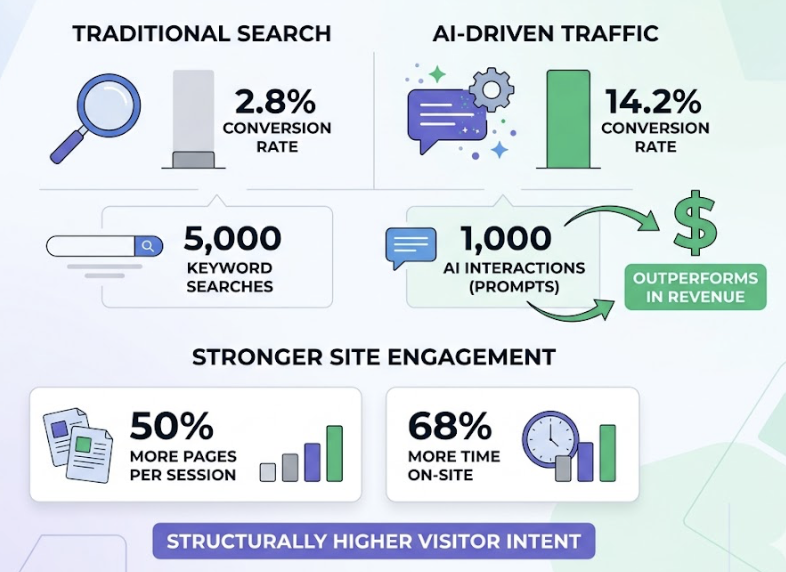
AI traffic converts at 14.2%, compared to 2.8% for traditional Google search. A prompt with 1,000 monthly AI interactions can outperform a keyword with 5,000 Google searches in revenue terms. On top of that, AI-referred visitors view 50% more pages per session and spend 68% more time on-site than visitors from traditional search. The intent quality is structurally higher.
That math should affect where your content budget goes.
GEO Tools and AEO Tools That Make This Scalable
Manual prompt testing across four AI platforms, tracked monthly, analyzed for source patterns, is not a workflow any team can sustain past the first quarter.
That’s the problem a new category of GEO tools and AEO tools is built to solve.
Topify is designed specifically for this use case. Its High-Value Prompt Discovery feature continuously scans for high-volume questions relevant to a specific brand or category, so you’re always optimizing for current conversational trends rather than last quarter’s data. Its AI Volume Analytics provides the modern equivalent of Google’s monthly search volume, measured against actual AI search behavior across ChatGPT, Gemini, Perplexity, and DeepSeek.
The Source Analysis feature addresses the citation gap problem directly. It identifies which domains and URLs AI platforms are citing in your category, so you can see exactly where your content is missing from the conversation and where a competitor has locked in a citation advantage. Adding statistics to content guided by that prompt research can boost AI visibility by 30–40% in affected categories.
For teams starting out, Topify’s Basic plan covers 100 prompts at $99 per month, which is enough to establish a meaningful visibility baseline across platforms. As your GEO program matures, the Pro plan at $199 per month scales to 250 prompts across eight projects.
Worth noting: this category of tooling is still maturing. Topify’s advantage lies in combining prompt discovery, AI volume data, and multi-platform coverage in a single platform rather than requiring you to stitch together separate tools for each step of the research process.
What “Machine-Friendly” Content Actually Looks Like
Identifying the right prompts is half the equation. The content itself needs to be structured to satisfy the extraction logic of large language models.
Research consistently points to a few formatting signals that increase citation probability. Leading each piece with a concise 40–60 word summary that directly answers the target prompt improves pickup in platforms like Perplexity that favor “answer-first” blocks. Using tables with descriptive headers, breaking content into modular sections of 120–180 words between headings, and grounding each claim in specific statistics all make content easier for an LLM to extract and cite.
The most counterintuitive finding: because AI models prioritize third-party mentions, GEO is as much about PR strategy as content strategy. Earning coverage on high-authority domains can double citation rates for a given category. Your content needs to exist in the right places, not just on your own site.
Conclusion
The gap between Google rankings and AI visibility isn’t a temporary anomaly. The tipping point, where AI begins to drive the same conversion volume as traditional search, is projected to arrive between late 2027 and early 2028. Brands that build their AI search presence now will have a compound advantage by the time that window closes.
The shift isn’t about abandoning SEO. It’s about extending your research methodology to include the actual prompts your audience is using in AI tools, and building content that satisfies those prompts with the structure and specificity that language models prefer. Prompt volume, citation sources, sentiment, and share of answer are the metrics that matter in this layer.
Get started with Topify to map your brand’s current AI visibility and identify the high-value prompts your competitors are already winning.
FAQ
Q: What is the difference between AI keyword research and traditional SEO keyword research?
A: Traditional SEO keyword research focuses on search volume for short phrases to rank in Google’s results. AI keyword research focuses on prompt volume for long-form, conversational questions to earn citations in AI-generated answers across platforms like ChatGPT and Perplexity. The average AI prompt is 60 words; the average Google query is 3.4 words. The research discipline, the metrics, and the content strategy that follows are fundamentally different.
Q: How do I start doing keyword research for AI search engines like ChatGPT or Perplexity?
A: Start by mapping the full-sentence scenarios your audience uses, not short keywords. Run those prompts across multiple AI platforms to identify which brands get recommended and why. Then use GEO tools like Topify to automate prompt discovery, track visibility changes over time, and analyze which domains the AI is citing as its primary sources in your category.
Q: What are GEO tools and how do they help with AI keyword research?
A: GEO tools automate the process of tracking brand mentions in AI-generated responses and discovering which prompts drive those mentions. They help identify citation gaps, measure AI share of voice, and surface high-value prompts that competitors are currently winning. Topify tracks prompt volume across ChatGPT, Gemini, Perplexity, and DeepSeek from a single dashboard, covering both prompt discovery and source analysis.
Q: How to do AEO and what tools support it?
A: AEO (Answer Engine Optimization) involves structuring content as direct answers to specific factual questions, using clear headings, concise 40–60 word summaries, and FAQ schema. The goal is to become the single-source answer for high-value questions in your category. Topify supports AEO by surfacing high-volume question-based prompts and identifying which content structures and source domains the AI platforms currently prefer to cite.

