

A fleet manager opens ChatGPT and types: “Best Toyota dealer near Dallas with a reliable service department.” Three names come back. Yours isn’t one of them. A DIY mechanic asks Perplexity: “Top-rated aftermarket brake pads for a 2024 F-150.” The answer lists two brands. Neither is yours.
This isn’t a reputation problem. It’s a technical visibility gap that most dealerships and auto parts brands don’t know they have.
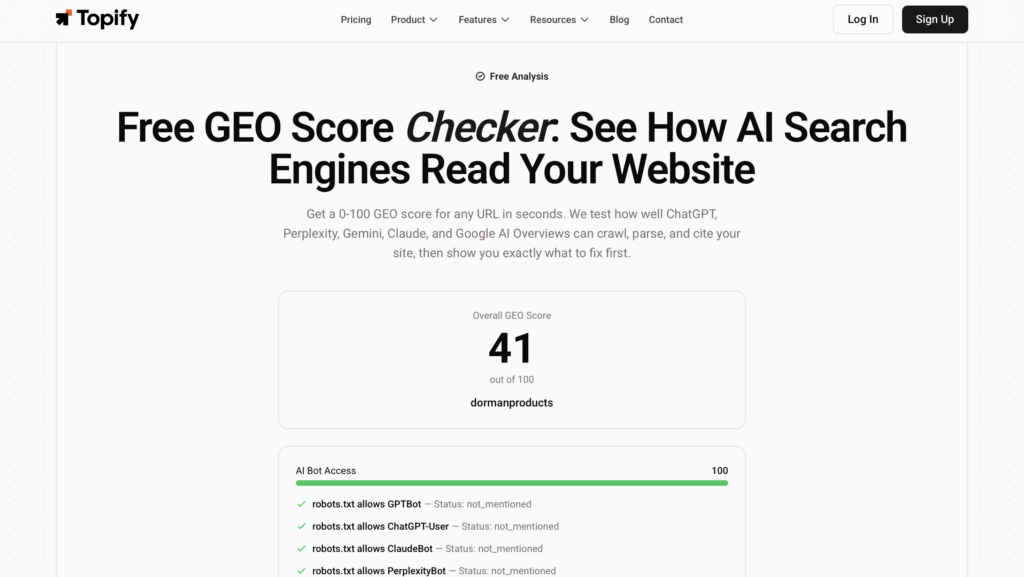
The GEO Score Checker measures exactly where that gap lives. It scores your website across four dimensions that determine whether AI platforms can find, understand, trust, and recommend your brand. No signup, no cost, results in 60 seconds.
✅ Free ⚡ Results in 60 seconds 🔒 No signup required
GEO Score Checker
The Four Numbers That Decide Whether AI Sends Shoppers Your Way
AI doesn’t browse your lot. It reads your website’s technical signals, decides whether your content is trustworthy, and either includes you in its recommendation or skips you entirely. The GEO Score Checker breaks that decision into four measurable dimensions.
| Score Dimension | What It Measures | Automotive Impact |
|---|---|---|
| Bot Access | Whether AI crawlers (GPTBot, ClaudeBot, PerplexityBot) can reach your pages | A blocked robots.txt means your entire inventory is invisible to the fastest-growing discovery channel |
| Structured Data | Whether schema markup helps AI parse your content | Without AutomotiveBusiness or Vehicle schema, AI can’t distinguish your dealership from a dry cleaner |
| Content Signals | Whether AI considers your content authoritative | Thin VDP descriptions and missing buying guides signal low expertise to AI models |
| Visibility Score | How often your brand appears in AI-generated answers | Measures actual presence across ChatGPT, Perplexity, Gemini, and Google AI Overviews |
Here’s how each dimension plays out on the ground.
Your Lot Has 200 Cars. AI Can’t See a Single One.
Most dealership website platforms ship with a default robots.txt that blocks GPTBot and PerplexityBot. The IT team never changed it. The marketing team doesn’t know it exists. The result: a Bot Access score below 20, and zero chance of appearing in any AI-generated answer, regardless of how strong your inventory or reviews are.
One line in a configuration file is erasing your dealership from the buying journey of nearly one in three shoppers who now use AI tools to research vehicles.
A Parts Brand with Five-Star Reviews but Zero AI Mentions
An aftermarket brake pad manufacturer ranks on page one of Google for dozens of product keywords. Customer reviews average 4.8 stars. But their Content Signals score sits at 35. Why? The site has product spec sheets but no installation guides, no comparison content, no technical articles that AI can cite as authoritative sources.
AI models don’t pull from product listings. Research shows 76.6% of AI citations in automotive come from informational content like buying guides and comparisons, not inventory or catalog pages.
Visible on Google AI Overviews, Invisible on ChatGPT
A multi-location dealer group checks their Visibility Score and finds a 62 on Google AI Overviews but a 14 on ChatGPT. That split matters. ChatGPT holds 68.4% of AI-assisted car shopping activity, according to Ekho’s 2026 study. Being visible on one platform and absent from the dominant one means you’re missing the majority of AI-driven buyer traffic.
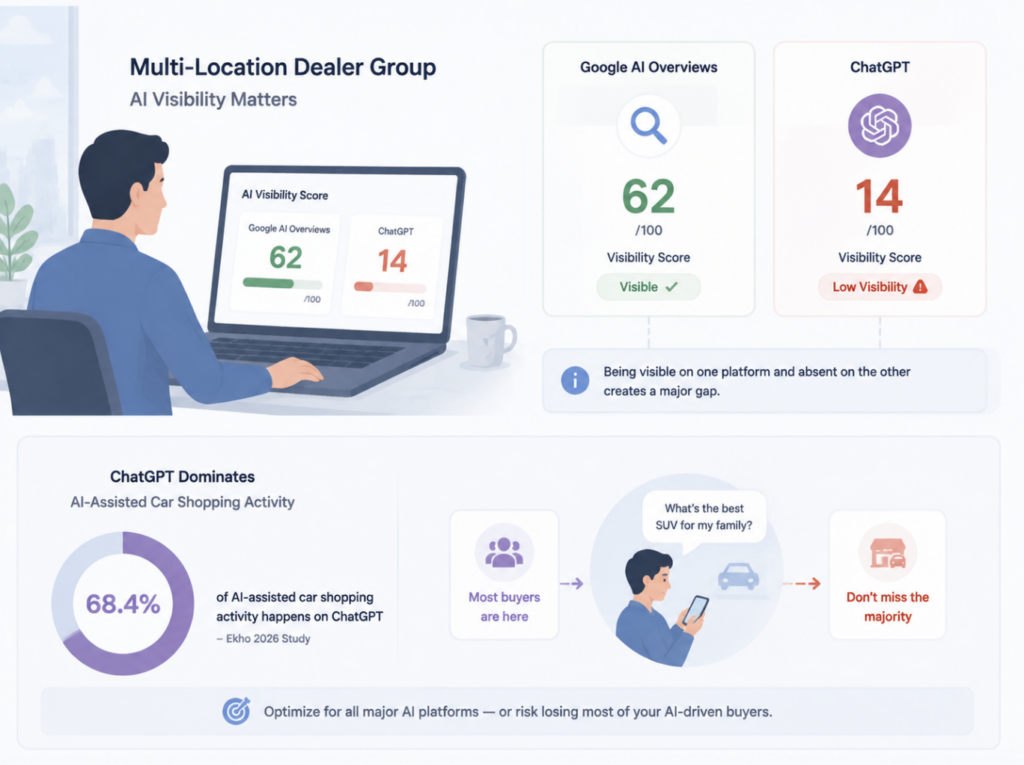
Cross-platform data confirms this pattern broadly: only 11% of domains are cited by both ChatGPT and Perplexity, meaning most automotive brands are visible on one AI platform and invisible on another.
How to Run Your Score
- Go to the GEO Score Checker
- Enter your dealership domain or parts brand URL
- Get your four-dimension breakdown in under 60 seconds
- Identify your weakest dimension and prioritize from there
What Car Buyers and Fleet Managers Are Asking AI Right Now
The shift isn’t coming. It’s already here. Cox Automotive’s 2025 Car Buyer Journey Study found that 19% of all vehicle buyers and 25% of new-vehicle buyers used AI websites or AI-generated overviews during their purchase process. Those buyers reported higher satisfaction, greater trust in dealers, and a faster process.
Here’s what those AI conversations actually look like:
| AI Prompt Example | Platform | Search Intent | What It Reveals |
|---|---|---|---|
| “Best Honda dealers near me with transparent pricing” | ChatGPT | Local dealer selection | Only dealers with strong Content Signals and entity consistency get named |
| “OEM vs aftermarket catalytic converter for 2023 Camry, pros and cons” | Perplexity | Parts purchase decision | Parts brands without comparison content are excluded from the answer |
| “Which dealerships in Phoenix have the best service department ratings” | Gemini | Service trust evaluation | AI pulls from review aggregators and structured business data, not your homepage |
| “Best all-season tires for a Subaru Outback under $150 each” | ChatGPT | Product recommendation | Tire and parts brands need structured product data and authoritative guides to appear |
| “Reliable used car dealers in Atlanta that offer certified pre-owned” | Perplexity | High-intent local query | Dealers without CPO schema and detailed program pages are invisible to this query |
| “What aftermarket exhaust brand has the best fitment for Jeep Wrangler JL” | ChatGPT | Brand-specific parts query | AI favors brands with technical installation content and community mentions |
The buyers asking these questions are high-intent. AI referral traffic in automotive converts at roughly 14-16%, compared to about 2-3% for traditional organic search. If your brand isn’t in the AI answer, you’re not losing impressions. You’re losing ready-to-buy customers.
Three GEO Blind Spots That Keep Automotive Brands Out of AI Answers
Automotive has industry-specific technical barriers that make GEO optimization harder than in most verticals. These aren’t content quality issues. They’re structural problems that sit between your brand and AI’s ability to process it.
The Robots.txt Lockout No One Audits
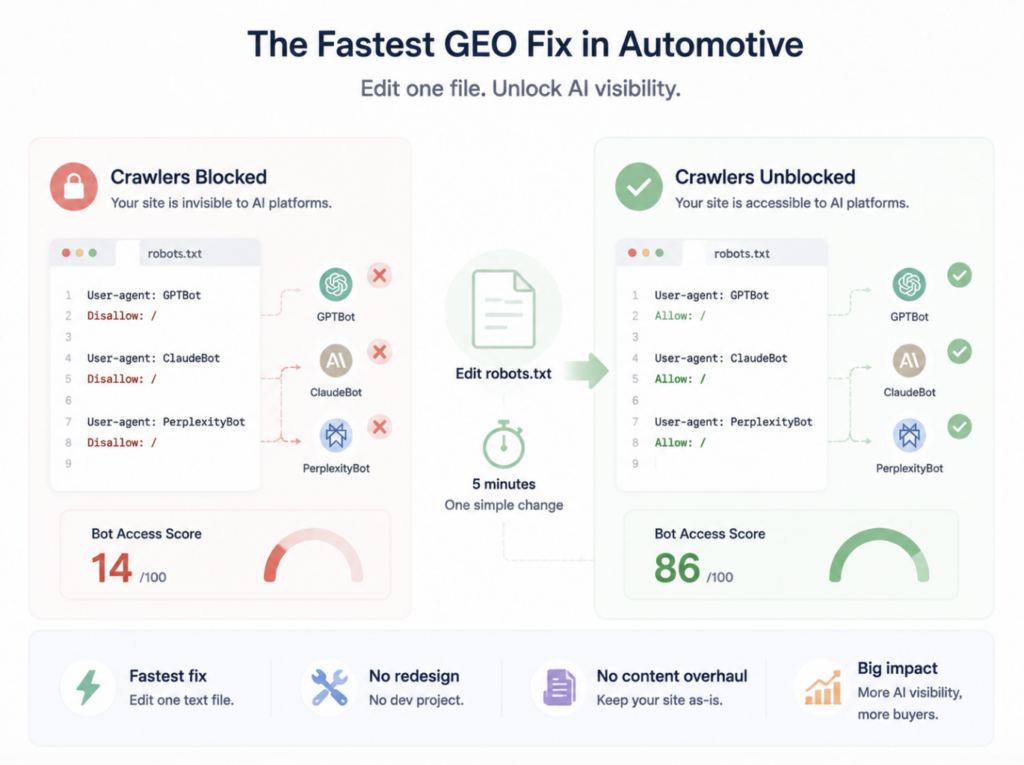
Dealership website platforms often default to blocking AI crawlers. GPTBot, ClaudeBot, PerplexityBot, and others are disallowed in robots.txt without the dealer ever requesting it. The platform vendor set it, and no one revisited the decision.
This is the single fastest GEO fix in automotive. Unblocking these crawlers doesn’t require a website redesign or content overhaul. It requires editing a text file. But most dealers don’t know the file exists, and their Bot Access score reflects that gap.
The problem compounds when inventory pages rely on client-side JavaScript rendering. Even with crawlers unblocked, if your vehicle detail pages only load through JS execution, AI crawlers that don’t render JavaScript will see an empty page. Your 200-unit lot reads as a blank screen.
The Schema Gap That Makes AI Treat Your Dealership Like Any Other Business
Over 60% of dealerships lack proper schema markup. Without AutomotiveBusiness, Vehicle, and FAQPage schema, AI platforms can’t distinguish your dealership from a restaurant or a law office sharing the same strip mall.
Schema tells AI what your business is, what vehicles you carry, what services you offer, and how to verify that information. A dealership with complete Vehicle schema on every listing gives AI structured attributes to match against buyer queries: make, model, year, price, mileage, fuel type, condition. A dealership without it forces AI to guess from unstructured page text, and AI doesn’t guess in your favor.
For parts brands, Product schema with detailed attributes (compatibility, fitment, material, warranty) is equally critical. When a buyer asks AI for “best brake pads for a 2024 F-150,” AI needs structured product data to match your part to that specific vehicle. A product page with only a title and price gives AI nothing to work with.
The OEM Memory Bias That Buries Smaller Parts Brands
AI models carry a built-in advantage for OEM brand names. During training, these models ingested millions of pages where factory-original parts were discussed, reviewed, and recommended. The result: when a buyer asks AI for a replacement part, AI defaults to the brand name it encountered most during training.
Aftermarket and independent parts brands face a structural disadvantage that has nothing to do with product quality. The fix isn’t competing on brand recognition alone. It’s building the technical content and structured data signals that give AI a reason to cite you alongside, or instead of, the OEM option.
One aftermarket retailer proved this is possible: after a focused GEO campaign, their AI visibility grew from under 1% to over 20% of tracked prompts, and AI referral revenue increased 344% in six months.
That gap is measurable. And it starts with knowing your current score.
From a One-Time Score to Continuous Visibility Tracking
The GEO Score Checker gives you a snapshot: here’s where you stand right now across four dimensions. That snapshot is valuable. It tells you whether your robots.txt is blocking crawlers, whether your schema is missing, and whether AI platforms are citing you at all.
But AI visibility isn’t static. Platforms update their retrieval algorithms. Competitors add structured data. New model training runs shift which brands get recommended. A score that reads 55 today could drop to 38 next quarter without any change on your end.
Topify’s Comprehensive GEO Analytics platform turns that one-time check into continuous monitoring across every dimension the checker measures, and several it doesn’t.
| Capability | Free GEO Score Checker | Topify Platform |
|---|---|---|
| Check frequency | One-time snapshot | Continuous monitoring |
| Dimensions tracked | 4 GEO scores | Full GEO analytics + sentiment + citations |
| Historical trends | None | Full trend history with alerts |
| Competitor benchmarking | Not included | Real-time competitor tracking |
| Platform breakdown | Aggregated | Per-platform (ChatGPT, Perplexity, Gemini, AI Overviews) |
| Optimization actions | Directional guidance | Specific, prioritized execution steps |
A single score tells you where you stand. Continuous monitoring tells you which direction you’re moving, and whether your competitors are pulling ahead.
Explore pricing or start a free trial with no credit card required.
Conclusion
AI is already influencing where nearly one in three car buyers shop and which parts brands they trust. The dealerships and parts brands that show up in those AI answers aren’t necessarily the biggest or the best reviewed. They’re the ones whose websites let AI crawlers in, speak AI’s language through structured data, and publish content that AI can cite with confidence.
Start with a free check. Run your domain through the GEO Score Checker and see which of the four dimensions is holding you back. From there, dig deeper with the AI Robots Checker if Bot Access is your weak point, or the Brand Authority Checker to understand how AI perceives your brand’s expertise. If you want a full cross-platform picture before committing to ongoing monitoring, the AI Visibility Report delivers a detailed snapshot across ChatGPT, Perplexity, Gemini, and Google AI Overviews.
Frequently Asked Questions
Why does my dealership rank well on Google but never appear in ChatGPT or Perplexity answers?
Google rankings and AI visibility are driven by different signals. Google uses backlinks and keyword relevance. AI platforms rely on crawler access, structured data, content authority, and cross-platform entity consistency. A dealership can rank first on Google while scoring below 30 on the GEO Score Checker because its robots.txt blocks AI crawlers entirely. The two systems don’t share a ranking pipeline.
Do aftermarket parts brands have a realistic chance of competing with OEM names in AI recommendations?
Yes, but not through brand awareness alone. AI models default to OEM names because training data skews toward factory-original content. Aftermarket brands that invest in structured Product schema, detailed fitment guides, and comparison content create the technical signals AI needs to cite them. One aftermarket retailer grew AI visibility from under 1% to over 20% of tracked prompts in six months by focusing on these signals.
What’s the most common reason dealerships score low on Bot Access in the GEO Score Checker?
The default robots.txt configuration on many dealership website platforms blocks GPTBot, ClaudeBot, and PerplexityBot. This single file prevents every AI crawler from indexing your site. It’s the fastest fix available: editing robots.txt to allow these bots can move your Bot Access score from under 20 to above 70 in one update.
How is a GEO score different from a traditional SEO audit score?
An SEO audit measures how well your site performs in link-based search engines: page speed, backlinks, keyword density, crawl errors. A GEO Score Checker measures how visible and citable your site is to AI answer engines specifically. It evaluates whether AI crawlers can access your pages, whether structured data helps AI understand your content, whether your content carries authority signals, and whether AI platforms actually mention your brand. You can score 90 on an SEO audit and 25 on a GEO check.
Read More:

