

Your keyword research says “best CRM” gets 40,000 searches a month. Clean data. Clear intent. But when a prospect actually opens ChatGPT, they type something closer to “I run a 12-person B2B agency and we need a CRM that integrates with HubSpot, handles deal tracking, and costs under $50 per seat.” That’s 27 words, loaded with constraints your keyword tool never saw. The gap between what traditional search data captures and what users actually type into AI platforms is widening every quarter. And that gap is where brand visibility gets won or lost.
What Separates a Prompt Search from a Keyword Search
The difference isn’t just length. It’s structure.
A Google search is a signal. You type “running shoes flat feet” and the engine infers the rest. An AI prompt is a briefing. You explain your situation, set constraints, and expect a tailored answer. The input changes from a fragment to a paragraph, and the output changes from a list of links to a synthesized recommendation.
The data backs this up. A Semrush study of ChatGPT usage found that the average ChatGPT prompt runs about 23 wordswhen web search isn’t activated. Google’s average query length, by comparison, sits at roughly 3.4 words according to Semrush data. That’s nearly a 7x difference. And when users do activate ChatGPT’s search feature, their prompts drop to about 4.2 words, closer to Google’s norm, but the conversational framing stays.
An analysis of 13,252 publicly shared ChatGPT conversations found that opening messages average 103 words. Users aren’t just asking questions. They’re describing scenarios, listing preferences, and setting context before the first response even loads.
That matters for brands because prompt search isn’t about matching a keyword. It’s about matching a situation.
Three Platforms, Three Prompt Patterns: ChatGPT vs. Perplexity vs. Google AI Mode
Not all prompt search behavior looks the same. Each platform trains users into different querying habits, and those habits shape which brands get surfaced.
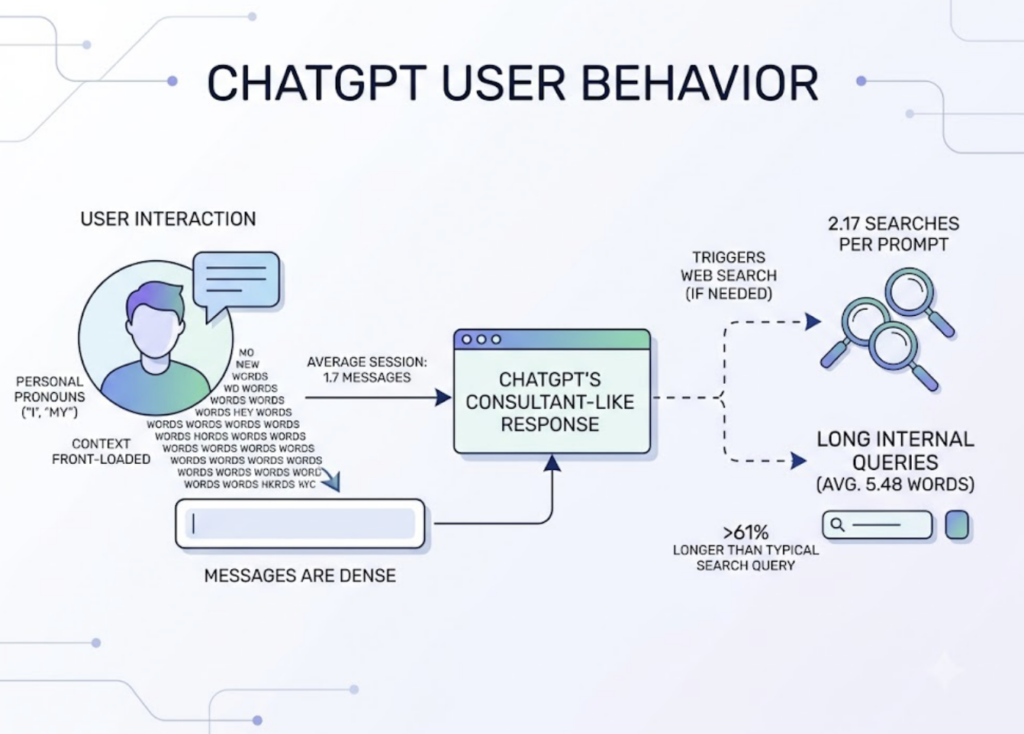
ChatGPT leans conversational and personal. Users treat it like a consultant. Over half of real ChatGPT prompts use personal pronouns like “I,” “my,” or “me.” Sessions average just 1.7 messages, but those messages are dense. The typical user front-loads context rather than asking follow-ups. When ChatGPT does trigger a web search, it averages 2.17 searches per prompt, with internal queries running 5.48 words on average, 61% longer than a typical Google query.
Perplexity attracts a different behavior: iterative research. Users report replacing Google for 70% to 99% of their research and knowledge queries while still defaulting to Google for navigation and shopping. Perplexity’s interface encourages progressive refinement. You start broad, then scope down with follow-ups. The platform transparently shows its sub-searches and cited sources, which trains users to write more structured, research-spec-style prompts.
Google AI Mode is the most revealing shift. After launching in May 2025, it hit 1 billion monthly active users within a year. The average AI Mode query is three times longer than a traditional Google search. Follow-up queries have risen over 40% per month, and planning queries are growing 80% faster than AI Mode usage overall. Similarweb data shows that even in traditional Google Search, average query length has climbed from 3.33 words to 3.51 words since AI Mode launched.
Here’s a side-by-side breakdown:
| Dimension | ChatGPT | Perplexity | Google AI Mode |
|---|---|---|---|
| Avg. prompt length | ~23 words (without search) | Structured research queries | 3x traditional Google search |
| Primary behavior | Single-turn, context-dense | Iterative refinement | Conversational follow-ups |
| Search trigger rate | 31% of prompts | Every query triggers retrieval | Built into every interaction |
| User framing style | Personal (“I need…”) | Analytical (“Compare X vs. Y…”) | Natural language, often voice |
| Follow-up pattern | Low (1.7 msgs avg.) | High (progressive scoping) | Growing 40%+ per month |
The takeaway: a brand that shows up in ChatGPT’s single-turn answers may be invisible in Perplexity’s iterative chains or Google AI Mode’s follow-up conversations. Prompt search visibility is platform-specific.
Why Keyword Research Tools Can’t Track Prompt Search Patterns
Traditional keyword tools were built to index Google’s search bar. They capture short phrases, estimate monthly volumes, and cluster by head terms. That model breaks down when prompts become paragraphs.
The core issue is structural. When someone types “best CRM for small teams” into Google, the engine matches it against its index and returns ranked pages. When the same person types a version of that query into ChatGPT, the model doesn’t just match. It decomposes. This is called query fan-out: the AI breaks one prompt into multiple sub-queries, runs them in parallel, retrieves sources for each, and synthesizes a single answer.
Google described this behavior explicitly when it launched AI Mode, calling it a “query fan-out technique” that issues multiple related searches at once across subtopics and data sources. In practice, one user prompt can generate 8 to 16 sub-queries behind the scenes. ChatGPT averages 2.17 fan-out searches per prompt, with some triggering up to four.
That means the unit of optimization has shifted. It’s no longer one keyword per page. It’s one topic cluster per prompt.
And it gets more complex. SparkToro’s January 2026 research, conducted with Gumshoe.ai across 2,961 prompt runs, found that AI tools produce a different brand recommendation list more than 99% of the time. Even when 142 participants wrote their own prompts for the same underlying intent, the average semantic similarity was only 0.081. In other words, people with identical needs phrase their prompts in vastly different ways, and each variation can surface a different set of brands.
No keyword tool captures that.
What Prompt Search Behavior Means for Brand Visibility
The SparkToro finding sounds alarming at first. If AI recommendations change with every query, what’s the point of tracking them?
Here’s the thing. The brand lists vary, but the brand clusters don’t. SparkToro’s own follow-up analysis noted that despite massive prompt variation, AI tools often returned similar clusters of brands across different phrasings. The wording and order shifted, but the pool of recommended brands overlapped significantly. The question for marketers isn’t “which exact prompt should I optimize for?” It’s “am I showing up reliably across the full semantic neighborhood of this intent?”
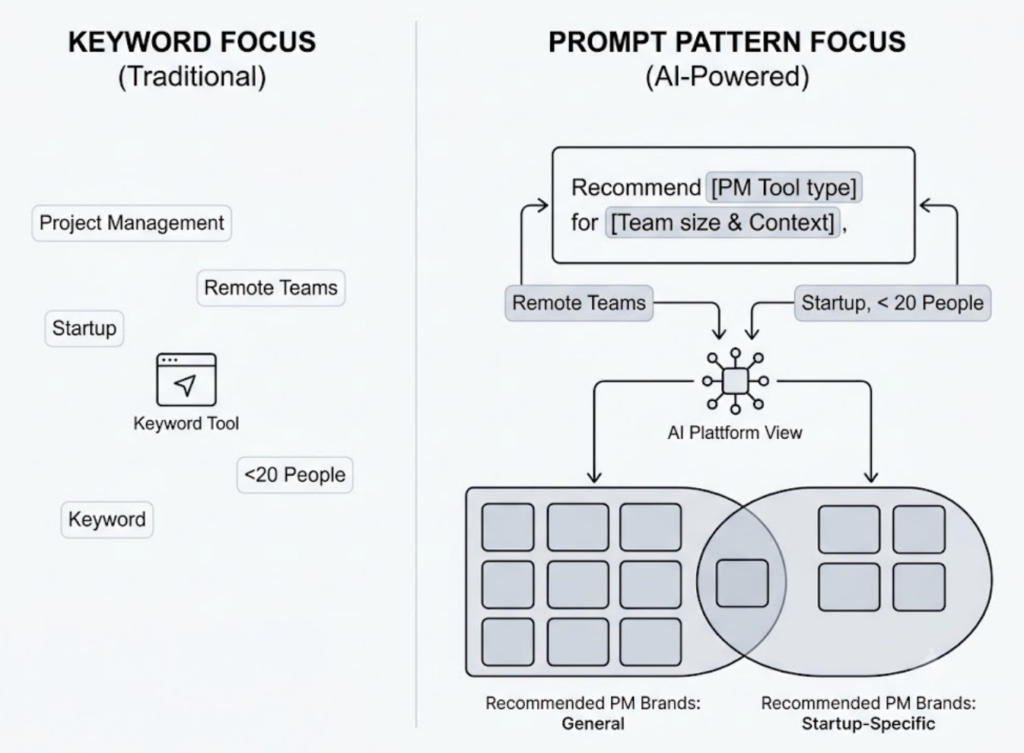
That reframes the visibility challenge. Brands need to understand which prompt patterns, not which exact keywords, drive their inclusion in AI answers. A prompt like “recommend a project management tool for remote teams” and “what’s the best PM software for distributed startups under 20 people” may look different to a keyword tool. To an AI platform, they overlap heavily, but not entirely. The second prompt’s constraints (startup, under 20 people) may pull in a different subset of brands.
This is where prompt-level visibility tracking becomes non-negotiable. Topify‘s High-Value Prompt Discovery surfaces the actual prompts driving AI recommendations in your category, across ChatGPT, Perplexity, Google AI Mode, and other platforms. Instead of guessing which keywords matter, you see which prompt patterns your brand appears in and which ones you’re missing.
In practice, that means a SaaS brand can discover that it’s consistently recommended when users ask about “CRM with email automation” but disappears when the prompt adds “for agencies” or “under $30 per seat.” That’s the kind of prompt-level gap that traditional keyword tools can’t reveal, but that directly impacts pipeline.
How to Track and Adapt to Prompt Search Trends
Knowing that prompt behavior matters is step one. Acting on it requires a system.
Start by mapping your prompt terrain. Use Topify’s Prompt Discovery to identify which AI prompts mention your brand, your competitors, or your product category. This surfaces the actual language users type, not the cleaned-up keyword variants from traditional tools. You’ll often find prompt patterns you never anticipated, like industry-specific use cases or constraint combinations that don’t show up in Google Search Console.
Monitor cross-platform visibility at the prompt level. A brand that ranks well in ChatGPT’s recommendations may be absent from Perplexity or Google AI Mode. Topify’s Comprehensive GEO Analytics tracks seven metrics (visibility, sentiment, position, volume, mentions, intent, and CVR) across major AI platforms. The platform-specific view matters because each engine’s fan-out logic, citation preferences, and retrieval patterns differ.
Analyze what AI cites, not just what it recommends. Topify’s Source Analysis shows which domains and URLs AI platforms reference when generating answers. If a competitor’s blog post is the cited source behind your category’s top prompts, that’s a content gap you can close. If your own product page gets cited for the wrong prompts, that’s a positioning issue to fix.
Iterate based on prompt clusters, not individual keywords. Group the prompts where your brand appears (and where it doesn’t) by intent and constraint patterns. Then map your content to those clusters. The brands that win in prompt search aren’t the ones optimizing for one keyword. They’re the ones that cover the full fan-out surface of their category’s most common prompts.
Conclusion
Prompt search is the new first touchpoint for brand discovery. In 2026, AI Mode alone has a billion monthly users asking queries three times longer than traditional searches, and ChatGPT processes billions of prompts daily with conversational inputs that no keyword tool was designed to capture. The brands that adapt aren’t just optimizing for AI. They’re tracking the actual language their audience uses across platforms, identifying the prompt patterns where they’re visible or invisible, and closing the gaps before competitors do. The shift from keywords to prompts isn’t coming. It’s already here, and it’s measurable.
FAQ
Q: What is prompt search?
A: Prompt search refers to the behavior of querying AI platforms like ChatGPT, Perplexity, and Google AI Mode using natural language prompts instead of short keyword strings. These prompts tend to be longer, more context-rich, and more personal than traditional search queries, often including constraints, preferences, and situational details.
Q: How do prompt search patterns differ between ChatGPT and Google AI Mode?
A: ChatGPT prompts tend to be single-turn and context-dense, averaging 23 words without web search activated. Users often describe personal scenarios upfront. Google AI Mode prompts are three times longer than traditional Google searches, with follow-up queries growing over 40% per month. AI Mode encourages multi-turn conversations, while ChatGPT users typically front-load their context in one message.
Q: Can traditional SEO tools track prompt search behavior?
A: Not effectively. Traditional keyword research tools capture short-phrase queries from Google’s index and estimate search volume. They don’t cover the longer, conversational prompts users type into AI platforms, the query fan-out behavior where one prompt becomes multiple sub-queries, or the cross-platform variation in how AI engines surface brands for similar intents.
Q: How can brands optimize for prompt-based AI search?
A: Focus on three areas. First, discover the actual prompts driving recommendations in your category using prompt-level tracking tools like Topify. Second, build content that covers full topic clusters rather than single keywords, since AI platforms decompose prompts into sub-queries. Third, monitor your visibility across multiple AI platforms, because prompt behavior and citation patterns vary significantly between ChatGPT, Perplexity, and Google AI Mode.

