

Your keyword map has 1,400 terms, each with a monthly volume and a difficulty score. None of them looks like what a VP of Marketing actually typed into ChatGPT last week: a full paragraph naming her team size, her budget, and the tool she’s trying to replace. That’s not just a formatting difference. The constraints inside that paragraph decide which vendors the model recommends, and your keyword data can’t see them.
A prompt research tool is built to close that gap. Done right, prompt research tells you which questions your buyers ask AI, which brands show up in the answers, and why yours doesn’t.
Your Keyword List and Your Buyers’ AI Prompts Are Two Different Lists
Search behavior changes with the interface. In Semrush’s analysis, ChatGPT prompts averaged 23 words, while Google queries sat around four words and Google AI Mode queries landed near 7.2. Similarweb’s numbers are even further apart. Its 2025 report put the average ChatGPT prompt at roughly 60 words, compared with 3.4 for a Google search.
The exact figure depends on who’s measuring. The direction doesn’t.
Length isn’t the real issue, though. What matters is what the extra words carry. A Search Engine Land panel found that about 60% of people phrase their AI queries as questions, while just 9% give direct commands. Those questions come loaded with context: “for a 12-person agency,” “that integrates with HubSpot,” “under $50 a seat.” Each constraint narrows the answer, and each narrowing is a chance for your brand to drop out.
| Approach | Typical input | How intent shows up | What you measure | How stable results are |
|---|---|---|---|---|
| Keyword research | 2 to 5 word phrase | Implied through modifiers | Rank on a results page | Shifts over weeks |
| Prompt research | Full question with context | Stated outright, with constraints | Presence and framing in a generated answer | Varies from run to run |
Bottom line: a keyword list tells you which topics matter. It won’t tell you which questions put a competitor on the shortlist instead of you.
B2B Shortlists Now Form Inside Conversations You Can’t See
Forrester reports that 94% of business buyers now use AI in their buying process, and twice as many buyers as before name generative AI or conversational search as a more meaningful information source than vendor websites, product experts, or sales. Its 2026 survey of nearly 18,000 buyers found that 55% compare vendors inside AI tools before any vendor contact.

The starting point has moved too. G2’s 2026 buyer research shows that 51% of B2B buyers now begin vendor research in AI tools.
Here’s the thing: none of this shows up in your analytics.
There’s no Search Console for ChatGPT. You don’t get a report of which questions mentioned your category, which ones mentioned you, or which ones recommended a rival. Buyers do still verify, since TrustRadius found that 94% of buyers who used AI fact-check the responses at least some of the time. But verification happens after the shortlist exists. If you’re not on it, there’s nothing to verify.
That’s why prompt research has become its own discipline rather than a subtask of keyword research.
How Prompt Research Actually Works, Step by Step
A solid prompt research workflow has five stages. A tool can automate most of them, but the logic is the same whether you run it by hand or through a platform.
Step 1: Start From Buyer Situations, Not Seed Keywords
Keyword research begins with a seed term. Prompt research begins with a situation: who’s asking, what they’re trying to get done, and what constraints they’re working under.
For a project management SaaS, that might be “ops lead at a 40-person agency, moving off spreadsheets, needs client-facing views, budget under $2,000 a year.” Map five to eight of these situations per core persona. They become the backbone of your prompt set.
Step 2: Mine the Language Your Buyers Already Use
You likely have more real prompt data than you think. Similarweb suggests filtering Google Search Console with a custom regex that surfaces queries of ten words or longer, over a date range of at least six months. Those long, question-shaped queries tend to mirror how people talk to AI.
Other sources worth pulling: sales call transcripts, support tickets, onboarding survey answers, Reddit threads in your category, and review site comments. What you’re after is phrasing, especially the constraints and comparisons buyers mention without being asked.
Step 3: Group Prompts by Intent, Not Wording
This is where most manual efforts break down. When SparkToro asked 142 participants to write their own prompts for the same headphone scenario, the semantic similarity score across those prompts was only 0.081. Almost no two prompts looked alike.
The good news is that despite the wildly different phrasing, AI tools still returned similar brand sets for the same underlying intent. So you don’t need to guess every possible wording. You need enough variants per intent cluster, typically 5 to 15, to represent how different buyers ask. Then you measure results at the cluster level.
One caution on synthetic prompts. Search Engine Land’s research notes that real prompts are shaped by conversation history and persistent memory in ways a crafted persona prompt can miss. Treat AI-generated variants as a map of intents, not a mirror of real behavior.
Step 4: Run Every Prompt Many Times and Read the Answers
One run tells you almost nothing.
SparkToro found that ChatGPT and Google’s AI returned the same brand list less than 1% of the time across repeated runs of the same prompt, and the same list in the same order less than 0.1% of the time. What does hold up is frequency. Across the models tested, the three most-mentioned brands appeared in 64% to 73% of responses on average, depending on the platform. That’s why visibility rate, the share of sampled answers that mention you, is a far more reliable metric than position.
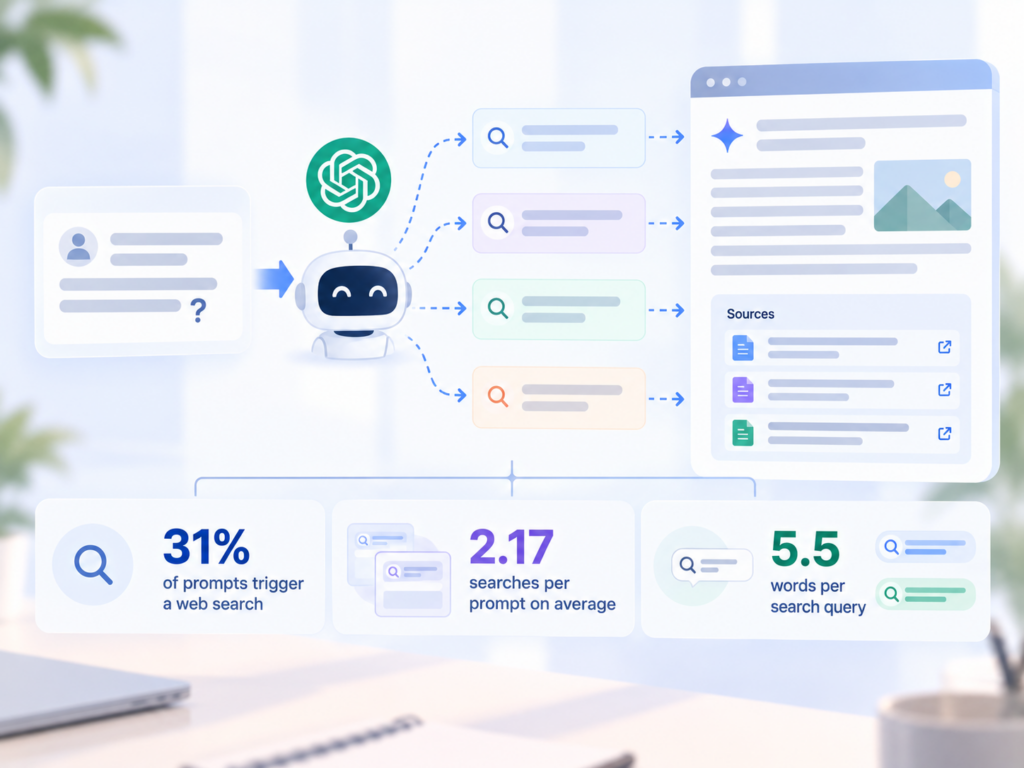
While you’re sampling, capture what the model searched for. Nectiv’s analysis of more than 8,500 prompts found that ChatGPT ran a web search in 31% of prompts, averaging 2.17 searches each at about 5.5 words per query. Those fan-out queries, plus the pages cited in response, show you which content the model leans on.
Step 5: Prioritize by Demand and Gap
Now you’ve got a matrix: intent clusters on one axis, brands and visibility rates on the other. Prioritize clusters that combine real AI search demand with low or zero visibility for your brand, especially where one or two competitors show up again and again.
Those are your content briefs. The cited sources tell you where to publish. The constraints in the prompts tell you what the content has to answer.
What a Prompt Research Tool Should Do That a Spreadsheet Can’t
You can run steps 1 through 3 in a spreadsheet. Steps 4 and 5 are where manual work collapses. Sampling 100 prompts 20 times each across four platforms means 8,000 answers per cycle, and those answers shift every time a model updates.
| Capability | Why it matters |
|---|---|
| Volume signals from real AI search behavior | Shows which intents have demand, not just which ones you can imagine |
| Multi-platform sampling | ChatGPT, Perplexity, Gemini, and AI Overviews often favor different brands |
| Repeated runs with visibility rates | Turns noisy single answers into a stable metric |
| Intent clustering | Measures outcomes by buyer need rather than exact wording |
| Citation and source capture | Reveals which domains shape the answer |
| Continuous prompt discovery | Surfaces new questions as buyer language and models change |
If a tool shows you a single “rank” for a prompt from a single run, treat that number with suspicion. It’s a snapshot of noise.
Where Topify Fits in a Prompt Research Workflow
Topify is built around the loop described above, from finding prompts to acting on what the answers reveal.
Its High-Value Prompt Discovery feature surfaces the high-volume AI prompts relevant to your category and keeps surfacing new ones as AI recommendations evolve, which covers the part of prompt research that goes stale fastest. AI Volume Analytics adds demand data based on real AI search behavior, so you can separate the prompts buyers ask constantly from the ones almost nobody asks. From there, Topify tracks each prompt across ChatGPT, Gemini, Perplexity, and engines like DeepSeek, Doubao, and Qwen. Results are scored on seven metrics: visibility, sentiment, position, volume, mentions, intent, and CVR.
Two features matter most once the research is done. Dynamic Competitor Benchmarking shows which rivals AI recommends for each prompt cluster and flags new ones as they appear. Citation analysis reverse-engineers the exact domains and URLs the models cite, so you can see whether a competitor’s comparison page or a third-party review site is doing the heavy lifting.
In practice, a SaaS marketing team might load 100 prompts across four buyer personas, notice that one competitor owns nearly every “alternative to [legacy tool]” prompt on Perplexity, and trace that to two review sites and a single listicle. That’s a content plan with sources attached. Plus, One-Click Execution turns a goal stated in plain English into a proposed strategy you can review and deploy.
Pricing is usage-based. Basic starts at $99/month for 100 prompts with a 30-day trial, and Pro is $199/month for 250 prompts. Full details are on the pricing page, and you can get started with Topify directly.
Three Prompt Research Mistakes That Skew Everything Downstream
Tracking prompts only you would ask. Branded prompts like “Is [your brand] good for agencies?” feel reassuring because you’ll show up. Buyers early in their research usually don’t know your name yet. Keep branded prompts to a small slice of the set, roughly 10 to 20%.
Chasing position instead of presence. Given how much answers vary, a jump from third to first in one run is usually noise. Watch visibility rate across repeated samples and look for shifts that hold over several weeks.
Front-loading definitional questions. “What is project management software?” gets asked, but it rarely produces a shortlist. Weight your set toward comparison, alternative, and constraint-heavy prompts, since that’s where recommendations happen. SparkToro also found that in tight spaces like niche B2B tools, AI answers clustered around a few familiar names, so in smaller categories a well-chosen prompt set can reveal a lot.
Conclusion
Your buyers aren’t typing four-word keywords into AI. They’re describing their situation and asking for a recommendation, and that answer often decides who makes the shortlist. Prompt research is how you see those questions: start from buyer situations, mine real language, group by intent, sample answers repeatedly, and prioritize where demand meets absence.
A prompt research tool doesn’t replace that thinking. It makes the sampling and monitoring possible at the scale the problem demands. Start with 50 to 100 prompts across your core personas, measure visibility instead of rank, and let the gaps write your next content brief.
FAQ
Q: What is a prompt research tool?
A: It identifies the questions people ask AI assistants like ChatGPT, Perplexity, and Gemini in your category, then samples the answers to show which brands appear, how often, and which sources the models cite. Think of it as the AI search counterpart to a keyword research tool.
Q: How is prompt research different from keyword research?
A: Keyword research targets short phrases and measures ranking positions on a results page. Prompt research targets full, context-rich questions and measures whether your brand appears in generated answers. Most teams need both, since the two lists rarely overlap cleanly.
Q: How many prompts should I track for AI search visibility?
A: Most B2B brands start with 50 to 100 prompts, grouped into 8 to 15 intent clusters with several phrasings each. Expand once you know which clusters drive recommendations in your category.
Q: How do I find the prompts my buyers ask ChatGPT?
A: Combine long, question-style queries from Google Search Console with language from sales calls, support tickets, reviews, and community threads. Then use a prompt discovery tool to add volume data and surface prompts you haven’t considered.

