


Your visibility number dropped from 34% to 21% last week, and your manager wants an explanation. You pull the answers. Same competitors, same citations, nothing obvious changed. So you check the prompt list, and it turns out 40 of your 60 prompts came from a keyword export somebody ran in March. Most of them nobody has ever typed into ChatGPT.
Your GEO rank tracker didn’t fail. It measured exactly what you told it to measure. The problem is that what you told it to measure isn’t your market.
Your Prompt Set Is a Sample, Not a Checklist
Every number a tracker reports is an estimate about a population you can’t enumerate: all the ways real buyers phrase questions in your category, across every engine, every week.
You can’t run that population. You run a sample of it. Which means the prompt set isn’t a to-do list of terms you want to win. It’s a sampling frame, and it determines the accuracy ceiling of every metric downstream.
That distinction has teeth right now, because the population looks nothing like a keyword list. Across Semrush’s ChatGPT prompt dataset, between 65% and 85% of prompts couldn’t be matched to any traditional search keyword. Seer Interactive found that 95% of Gemini’s fan-out queries carry zero monthly search volume by conventional metrics.
No amount of dashboard polish fixes a bad sample.
Three Sampling Biases a GEO Rank Tracker Can’t Correct for You
A tracker reports what it observes. It has no way of knowing that what it observed came from a skewed frame. Three biases account for most of the damage.
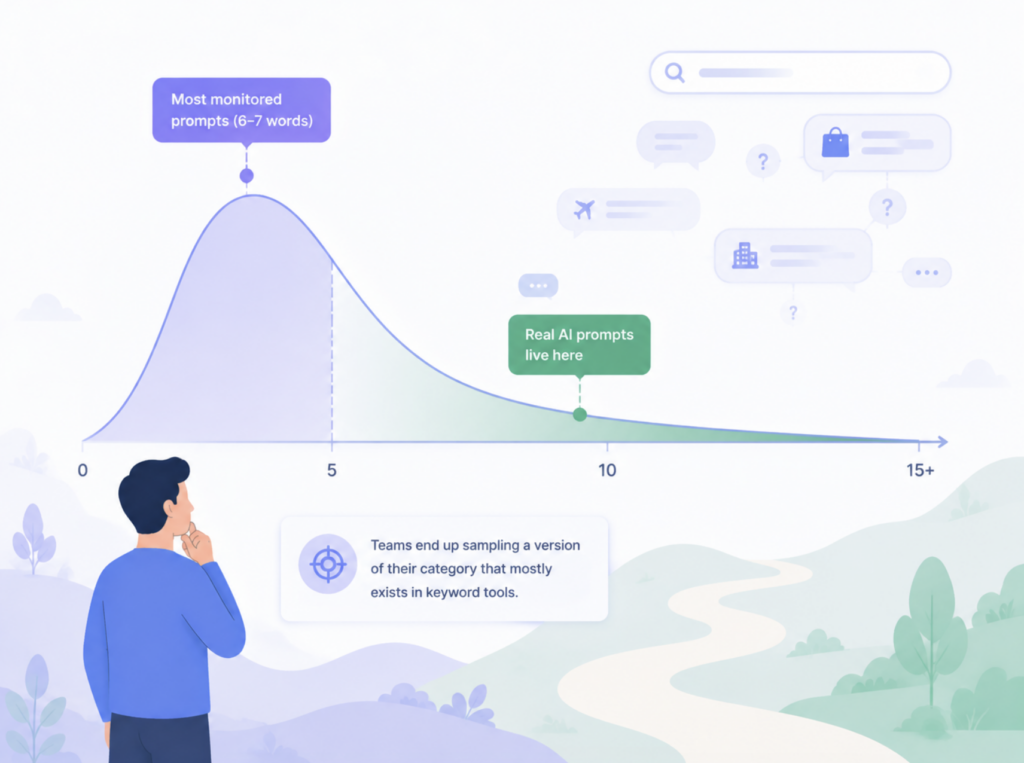
Coverage bias toward the head. AirOps analyzed 245,000-plus prompts that brands were actively monitoring and found they peaked around 6 to 7 words, with almost nothing past 10. Real AI prompts sit much further out on the tail. Teams end up sampling a version of their category that mostly exists in keyword tools.
Branded self-selection. Most brands perform well on their own name, so a set heavy in branded prompts reports a visibility rate that’s structurally inflated. Conductor’s guidance is to keep branded prompts at 25% or less of the total. Anything above that and you’re measuring your own recall, not your category position.
Format skew. How a prompt is shaped changes how many brands appear at all. An analysis of 37,804 AI responses found that ranking-style prompts surfaced roughly 20% more brand mentions than open-ended ones, and concise keyword-style prompts added up to 25%. Load your set with “best X” formats and your visibility looks great. Load it with open questions and the same brand looks weak. Neither number is wrong. Both are unrepresentative.
Stratify First: Five Layers a Representative Prompt Set Needs
Random sampling doesn’t work here, because the strata behave differently and you need to read them separately. Stratified sampling does.
| Layer | Why it moves the number | Suggested share |
|---|---|---|
| Intent stage | TOFU category questions are stable; MOFU commercial queries swing hard on small wording changes | 25% TOFU / 45% MOFU / 30% BOFU |
| Prompt format | Ranking, comparison, and open-question formats return different brand counts | 40% question / 35% comparison or ranking / 25% keyword-style |
| Persona and context | “Best CRM” and “best CRM for a 12-person remote team” resolve to different brand sets | 3+ personas, none below 15% |
| Language and market | A crossed-effects study found brand-by-language accounted for 8.6% of total variance, a measurable bilingual penalty | Proportional to revenue mix, minimum 20 prompts per market |
| Branded vs unbranded | Branded prompts test entity recognition; unbranded prompts test category position | Branded capped at 25% |
The point of stratifying isn’t tidiness. It’s that a stratum you didn’t define is a stratum you can’t diagnose. When visibility drops, you want to be able to say “it fell in MOFU comparison prompts in German” rather than “it fell.”
How Many Prompts Is Enough? Run the Math Before You Run the Tracker
Brand visibility on a single answer is a Bernoulli trial: you’re either mentioned or you’re not. That makes the sample size question answerable with a formula rather than a gut check.
Margin of error on a proportion is z multiplied by the square root of p(1-p)/n. Assuming a realistic visibility rate around 30%, here’s what different precision targets actually cost:
| Target margin of error | Confidence | Independent prompts needed |
|---|---|---|
| ±10 pp | 90% | ~57 |
| ±5 pp | 90% | ~230 |
| ±5 pp | 95% | ~325 |
| ±3 pp | 95% | ~900 |
Two things fall out of that table. Halving your margin of error costs four times the sample, not twice. And a 90% confidence interval is usually the right call for a marketing metric, since you’re deciding whether a topic is trending up or down, not approving a drug.
Here’s the part most teams miss. Those numbers apply per stratum you want to read on its own. Split 100 prompts across five intent-and-format strata and each one lands at 20 prompts, which carries a margin of error near ±17 pp at 90% confidence. At that width, 25% and 40% are the same number.
Decide your reporting granularity first. Then size the set to support it.
Not Every Prompt Deserves an Equal Vote
An unweighted average treats a prompt asked twice a month and a prompt asked four thousand times a month as equally important. That’s a modeling choice, and it’s almost always the wrong one.
Weighting by demand fixes the distortion. It also introduces a new one, because prompt volume estimates are reconstructions. No vendor has access to AI platform query logs. Conductor’s critique is blunt on this: with long, context-laden prompts, exact-match volume approaches one, so keyword-level aggregation breaks down and panel-based estimates carry their own coverage gaps.
The workable middle: use volume data to sort prompts into three demand tiers rather than to assign precise multipliers. Weight them 3, 2, and 1. Then report both the weighted and unweighted visibility rate every cycle. When those two numbers diverge sharply, you’ve learned something real about where your visibility is concentrated.
One Query, Five Answers: Runs Are Not Prompts
Ask the same question twice and the answer moves. The SparkToro and Gumshoe study ran 12 prompts roughly 3,000 times across ChatGPT, Claude, and Google’s AI features, and found the odds of getting the same brand list twice were under 1 in 100. Getting the same list in the same order was closer to 1 in 1,000.
The standard response is to repeat each prompt and average. That’s correct, and it has a sharp ceiling. A 2026 variance-components decomposition found that a repeat past the fifth reduced relative-error variance by only 0.0003, while adding models and languages reduced it far more per unit of query budget. A separate study recommends at least 7 runs per prompt per day for brand monitoring.
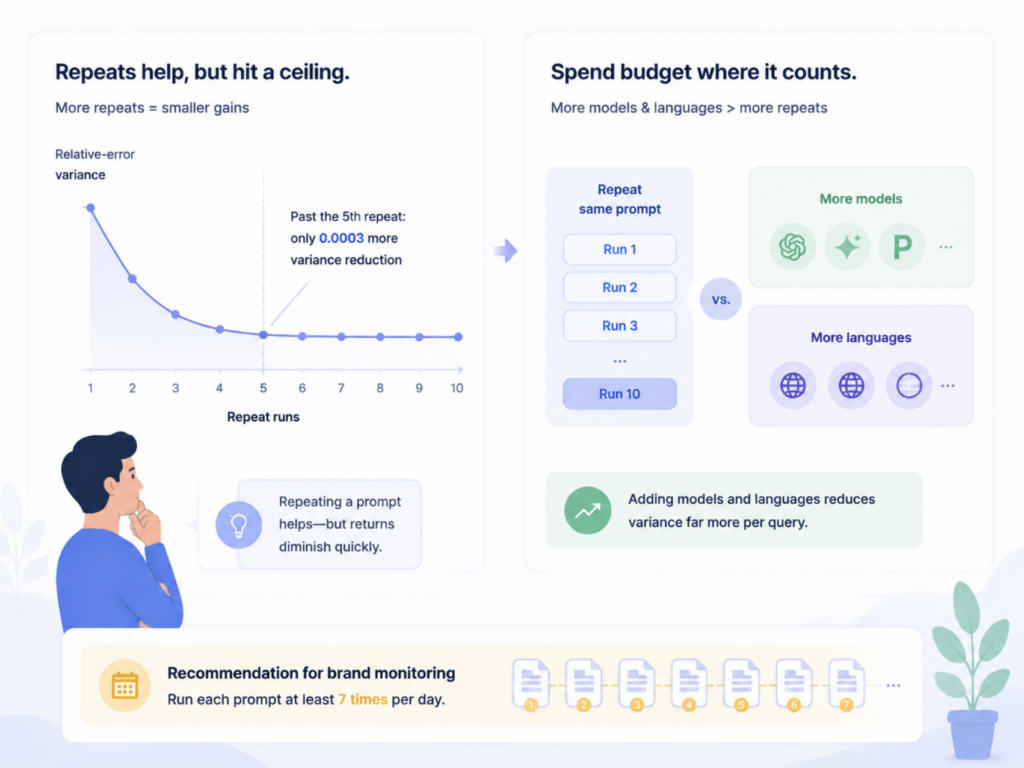
So the practical allocation is: 5 to 7 runs per prompt per engine, then spend everything left on more prompts and more engines.
The reason matters. Repeated runs shrink noise within a prompt. They do nothing for coverage. Thirty prompts run ten times produces 300 answers but still only 30 independent draws from the population of buyer questions, and your confidence interval on category visibility is governed by the 30, not the 300. Teams that report the larger number are quoting a precision they don’t have.
One practical rule falls out of this: never call a week-over-week change real unless it clears the confidence interval you calculated in the previous section.
Building and Validating the Set Inside a GEO Rank Tracker
All of this assumes your tracker can do three things: find the prompts you missed, tell you which ones carry weight, and let you read strata separately.
Coverage is the hardest of the three, because you can’t audit a blind spot from the inside. Topify approaches it through High-Value Prompt Discovery, which surfaces prompts your buyers are actually using rather than the ones your keyword export suggested, and keeps surfacing new ones as recommendation patterns shift. In practice, that’s the difference between a set you wrote from memory and a set drawn from observed demand.
Weighting runs off AI Volume analytics, which gives you the demand tiers described above without hand-waving. Position Tracking and Competitor Benchmarking then let you read those strata as separate series, so a drop in MOFU comparison prompts shows up as a distinct signal instead of getting averaged into a flat category number. Coverage spans ChatGPT, Gemini, Perplexity, DeepSeek, Doubao, Qwen, and others, which is what makes the language and market layer measurable rather than theoretical.
Budget math is worth checking before you commit. The Basic plan covers 100 prompts and 9,000 AI answer analyses per month, and the Pro plan covers 250 prompts and 22,500 analyses. Run 100 prompts at 5 runs across 3 engines and you spend 1,500 analyses per cycle, which leaves room for weekly cadence inside the Basic tier. At 250 prompts you can support ±5 pp overall with enough left to read three or four strata independently.
If you’re rebuilding a set from scratch, the fastest validation is to get started with your existing prompts loaded, then compare them against discovered prompts. The gap between the two is your coverage bias, quantified.
Prompt Sets Decay. Here’s the Refresh Cadence
Sets go stale faster than most reporting calendars assume. The same study that recommended 7 runs per prompt also measured roughly 65% day-to-day turnover in cited sources, and found the standard error of a per-brand detection rate only dropped below 0.05 at around 24 days. A week is not an observation window. A month is the floor.
Rebuild quarterly, not continuously. Replace 20% to 30% of the set each quarter and lock the remaining 70% as your time-series baseline. Swap everything at once and you’ve broken comparability with every prior cycle, which is a more expensive mistake than tracking a few stale prompts.
Then keep three triggers for off-cycle refreshes: a major model release, a new competitor appearing in your answers, and any product or market launch on your side. Those change the population you’re sampling, which means the frame has to change with it. Everything else can wait for the quarter.
Conclusion
The prompt set is the one part of a GEO measurement system that no software can repair after the fact. Size it against a stated margin of error, stratify it so you can diagnose what moves, cap branded prompts, weight by demand tiers rather than false precision, and spend surplus budget on more prompts rather than more repeats.
Start by auditing what you already track. Count the branded share, count the words per prompt, and calculate the margin of error on your current sample. If that last number is wider than the changes you’ve been reporting to leadership, fix the frame before you fix the strategy.
FAQ
Q: How many prompts should I track in a GEO rank tracker?
A: For an overall visibility rate at ±5 percentage points and 90% confidence, plan on roughly 230 independent prompts. If you want to read intent stages or markets as separate series, size each stratum to that target on its own. Fewer than 60 prompts gives you a pilot, not a reportable number.
Q: What share of my prompt set should include my brand name?
A: 25% or less. Branded prompts test whether AI engines recognize and describe you correctly, which is worth monitoring, but they inflate overall visibility because most brands perform well on their own name.
Q: Is it better to run more prompts or repeat the same prompts more often?
A: More prompts, past about 5 runs each. Repeats reduce noise within a single prompt and stop paying off quickly. Coverage across prompts, engines, and languages is what tightens your estimate of category visibility.
Q: How often should I rebuild my prompt set?
A: Quarterly, replacing 20% to 30% while keeping the rest locked as a baseline. Refresh off-cycle when a major model ships, a new competitor enters your answers, or you launch into a new market.

