

Your competitor spreadsheet has the usual five names, pulled from review grids and sales call notes. Then a prospect mentions they shortlisted you after asking ChatGPT, and the other two brands on that shortlist aren’t on your spreadsheet at all.
Most free competitor analysis tools start from your domain and your keywords. That means they tend to report the rivals Google sees. AI engines build their own shortlists, and the brand sitting next to yours in an AI answer is the one shaping the buyer’s decision. Finding out who’s on that list, and why they’re there, is where useful competitor analysis for AI search begins.
Your AI Competitors Probably Aren’t the Ones in Your Slide Deck
AI engines don’t pull your competitors from a market map. They assemble a consideration set on the fly from whatever sources they trust for your category.
When users ask ChatGPT, Gemini, or Perplexity for recommendations, the brands appearing alongside yours can differ from your traditional competitors. A regional player, an adjacent category tool, or a newer startup with strong Reddit presence can all show up where you’d expect your main rival.
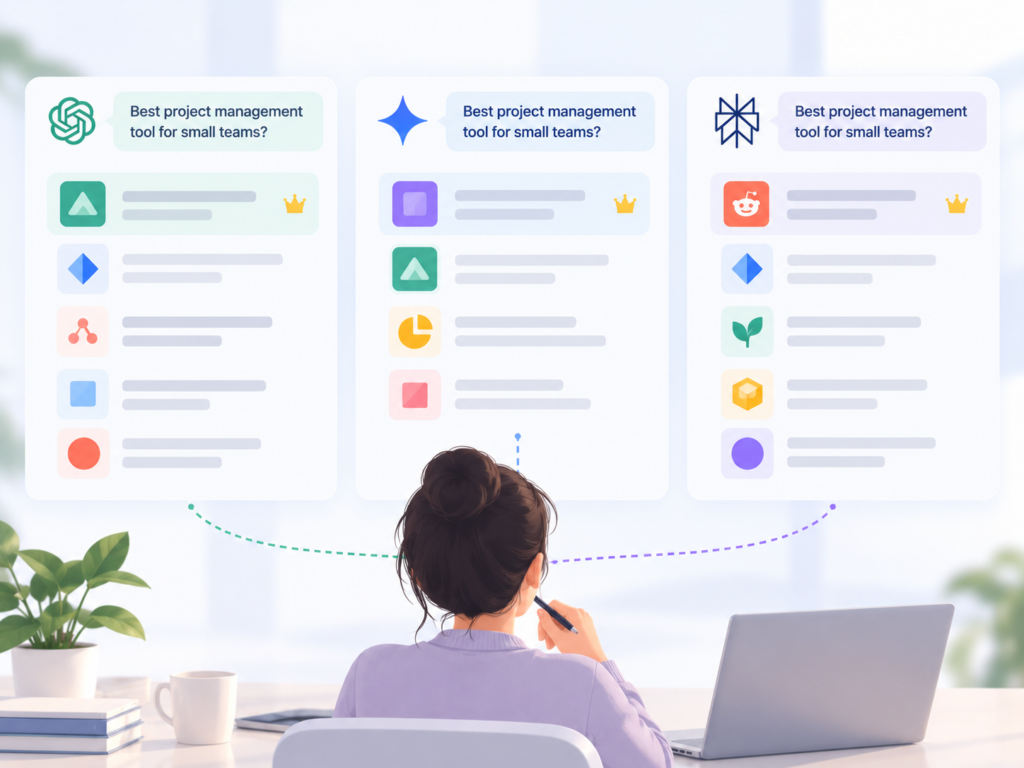
The source layer also shifts between surfaces, even inside Google. According to Ahrefs’ analysis of AI Mode and AI Overviews, the two features shared only 13.7% of their citations for the same queries, and AI Mode responses included 2.5x more people and brand entities. Different sources produce different shortlists.
That’s why a keyword-overlap report can’t tell you who you’re really competing with in AI answers.
One ChatGPT Screenshot Tells You Almost Nothing
The most common form of AI competitor analysis is also the least reliable: someone on the team types a prompt into ChatGPT, screenshots the answer, and drops it in Slack.
Here’s the problem. In a study by SparkToro and Gumshoe.ai, 600 volunteers ran 12 identical prompts through ChatGPT, Claude, and Google’s AI nearly 3,000 times. ChatGPT and Google’s AI returned the same brand list less than 1% of the time, and the same list in the same order came up less than 0.1% of the time.
On the flip side, the pool of brands was far steadier than the order. Across hundreds of runs for the same intent, the top brands in each category showed up in 55% to 77% of responses, regardless of prompt phrasing. The researchers found that visibility percentage across many queries is more consistent than ranking position.
So the useful question isn’t “where do we rank against Competitor X?” It’s “how often does each brand in our category get mentioned, and which ones keep appearing together?” A tool that answers the first question with a single number is handing you noise.
5 Things a Free Competitor Analysis Tool Should Actually Show You
A free tool won’t give you everything a paid platform does. But it should give you enough signal to change what your team works on next week. These five outputs separate a useful free competitor analysis tool from a glorified keyword gap report.
1. The Competitor Set AI Assigns You, With an Overlap Score
A flat list of names isn’t enough. You need to know how directly each brand competes with you in AI answers, so you can separate a true head-to-head rival from a brand that only appears on broad category prompts.
Overlap scoring also flags surprises. If a brand you’ve never tracked scores higher than your “main” competitor, that’s where your attention should go first.
2. How AI Describes Each Rival’s Strengths and Weaknesses
AI answers don’t just name brands. They characterize them: “better for enterprise,” “cheaper but limited,” “easier to set up.”
That framing matters more than rank. If AI describes a competitor as stronger on a dimension your brand actually leads in, the model is misrepresenting the market, and spotting that gap lets you create content that corrects the narrative.
3. How Often Each Brand Appears, Across More Than One Engine
Given the variance data above, frequency is the metric that holds up. A good tool should query several AI platforms, not just ChatGPT, because a competitor that dominates Perplexity might barely register in Gemini.
Platform-level differences also point to the fix. A gap on one engine but not another usually means a source or format problem, not a brand problem.
4. Which Signals Are Feeding Competitor Mentions
This is where competitor analysis turns into strategy. Ahrefs’ study of 75,000 brands found that branded web mentions correlate at 0.664 with AI Overview visibility, versus 0.218 for backlinks. A later report found that YouTube mentions correlated more strongly with AI brand visibility than any other metric.
The gap between leaders and everyone else is steep. Brands in the top quartile for web mentions averaged 169 AI Overview mentions, more than 10x the next quartile’s 14. If a competitor is winning, you want to know whether it’s coming from reviews, forums, video, or editorial coverage. Each one calls for a different response.
5. A Positioning Gap You Can Actually Close
The final output should be a next step, not a score. That might be a comparison page you’re missing, a use case where a rival owns the narrative, or a differentiator AI never attributes to you.
If the report leaves you asking “so what do we do now?”, it’s a diagnosis without a prescription.
Where Free Tools Stop, and Why That’s Not a Dealbreaker
Free tools are snapshots. That’s a real limit, especially when AI answers change from run to run. But a well-built snapshot is still a strong starting hypothesis, as long as you know what it can and can’t tell you.
| Capability | Free one-time analysis | Ongoing competitor monitoring |
|---|---|---|
| Competitor discovery from AI answers | Yes | Yes |
| Overlap scoring and head-to-head summary | Often | Yes |
| Visibility frequency over time | No | Yes, week over week |
| Citation source tracking by domain and URL | Rarely | Yes |
| Alerts when a new rival enters answers | No | Yes |
| Content execution based on findings | No | Depends on platform |
In practice, the free version answers “who are we up against?” Monitoring answers “is it getting better or worse, and why?”
Bottom line: start free, validate the findings, then decide whether the gaps justify tracking.
What Topify’s Free AI Competitor Analysis Returns in Under a Minute
For teams that want the five outputs above without a sales call, Topify‘s free competitor analysis tool is a practical starting point. You enter a brand name and an optional website, the tool queries ChatGPT, Gemini, Perplexity, and more, and the analysis takes 30 to 60 seconds with no signup required.
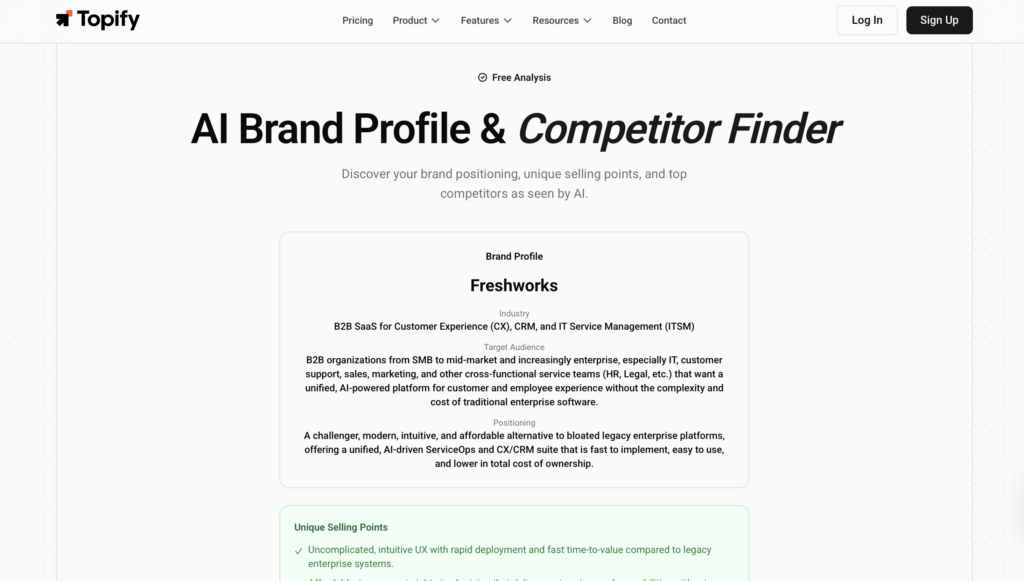
The output is structured rather than a raw chat transcript. According to Topify’s published tool reference, it returns 5 to 8 competitors sorted by an overlap score from 0 to 100, each with its strengths, weaknesses, and a one-line key differentiator, plus a head-to-head summary and 3 to 5 competitive strategy recommendations. That maps directly to outputs one, two, and five from the list above. It also runs on AI-generated answers, so you’re seeing the competitor set the models assign, not the one your SEO tools infer from keyword overlap.
The monitoring layer sits in the paid platform. Topify tracks how competitors’ AI visibility and positioning shift week over week and alerts you when a rival gains ground or a new player enters the conversation. It also pairs competitor data with Visibility, Sentiment, and Position metrics, and its Source Analysis shows which domains and URLs AI engines cite for your category. The Basic plan starts at $99/month with a 30-day trial.
If the competitor report suggests your own pages aren’t getting picked up, the companion GEO Score Checker audits whether AI crawlers can access, parse, and cite your site. You’ll find the rest of the free set on the Topify tools page.
Turning One Free Report Into a 30-Day Plan
A competitor report only pays off if it changes what you publish and where you show up. Here’s a simple cadence that respects how noisy AI answers are.
Week 1: Validate the set. Run 10 to 15 real buyer prompts across two or three AI engines. Note which competitors from the report keep reappearing. Ignore order. Count frequency.
Week 2: Trace the sources. For your top two AI competitors, look at where they get mentioned: review sites, Reddit threads, YouTube comparisons, industry roundups. Muck Rack’s analysis of more than one million AI-cited links found that 82% come from earned media. That’s usually where the gap lives.
Week 3: Close one positioning gap. Pick the single dimension where AI undersells you. Publish a comparison page or use case, then pitch it to one or two sources your competitors already appear in.
Week 4: Re-run and compare. Run the free analysis again. You’re looking for movement in overlap and mention frequency, not a jump to “#1.”
Track it. Fix one thing. Measure again.
Conclusion
The competitors that matter in AI search are the ones the models put next to you, and they’re often not the ones on your internal slide. Screenshots won’t reveal them, and rank positions won’t hold still long enough to be useful.
A good free competitor analysis tool should show you four things fast: who AI pits you against, how closely, how it describes each of you, and what’s feeding their visibility. Start with a free snapshot, confirm it with your own prompts, and fix one positioning gap at a time. When you need to see whether those fixes are moving the numbers, that’s the point to get started with Topify and put the competitive picture on a weekly cadence.
FAQ
Q: What should a free competitor analysis tool for AI search include?
A: At minimum, it should identify the competitors AI engines associate with your brand, score how directly each one overlaps with you, and summarize how AI describes their strengths and weaknesses. The more useful tools also query several AI platforms and suggest concrete next steps.
Q: How do I find out who my competitors are in ChatGPT?
A: Don’t rely on a single prompt, since AI answers vary heavily between runs. Use a tool that queries multiple engines and aggregates the results, or run 10 to 15 real buyer prompts yourself and count which brands keep appearing.
Q: Is there a free AI competitor analysis tool with no signup?
A: Yes. Topify’s AI Competitor Analysis tool takes a brand name, queries ChatGPT, Gemini, Perplexity, and other engines, and returns results in about 30 to 60 seconds without an account.
Q: Why is AI share of voice more useful than AI ranking position?
A: Research from SparkToro shows AI engines almost never return the same recommendation list in the same order twice. How often a brand appears across many runs is far more stable, which makes mention frequency a more reliable way to compare yourself against competitors.

