

Pull the AI search volume data for even a mid-size brand and you’ll get a spreadsheet with hundreds of prompts sorted from high to low. The instinct is to start at the top. That instinct is usually wrong.
Volume tells you how many people are asking. It doesn’t tell you whether those people are ready to buy, or whether your brand has any realistic shot at showing up in the answer. Treat volume as the whole story and you’ll spend a quarter building content for prompts you were never going to win.
Why Volume Alone Breaks Down as a Priority Signal
AI platforms don’t expose true search volume the way Google does. What most tools report as AI search volume is a modeled estimate, built from sampling and inference rather than a real query log. That’s a meaningfully different foundation than the keyword volume data marketers grew up on.
The estimate gets messier once you factor in how prompts actually get processed. Profound ran 10,000 prompts through ChatGPT, Copilot, and Perplexity and found that ChatGPT generated 91% unique search queries, with only 13% word overlap against what the user originally typed. A prompt list built from your existing keyword set won’t reconstruct what AI engines are actually searching for on a user’s behalf.
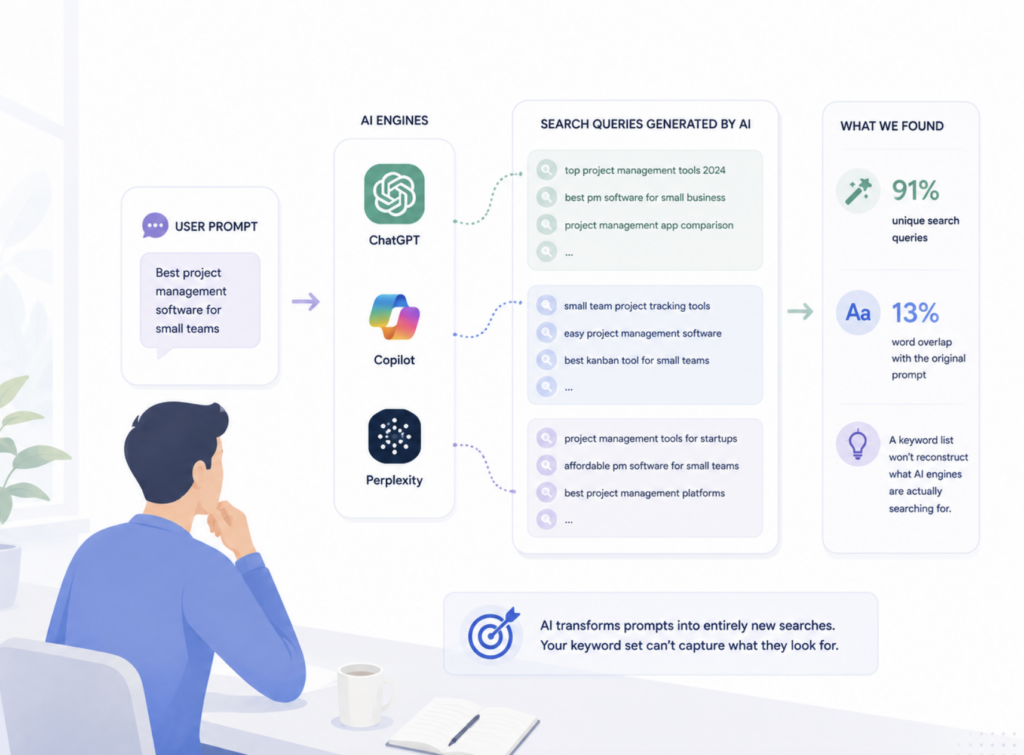
That’s the gap most volume-first strategies miss entirely.
High volume can also mean high competition with zero differentiation. A prompt like “what is generative engine optimization” might get asked constantly and still be a bad target, because every brand in the category is chasing the same broad query with the same generic content. Volume without context just tells you where the crowd is.
The Three Variables: Volume, Intent, Winnability
A workable prioritization model needs three inputs, not one.
Volume answers “how many people are asking this.” It’s a rough proxy for reach, useful for sizing an opportunity but useless on its own for deciding whether to pursue it.
Intent answers “where is this person in their decision, and does that decision touch your product.” Growandconvert’s research on lean GEO teams put it plainly: volume doesn’t move AI citations, focus does. A high-volume, low-intent prompt burns resources without moving revenue.
Winnability answers “can you realistically show up here.” This is the variable most teams skip, and it’s the one recent research makes hardest to ignore.
A joint study from SparkToro and Gumshoe.ai ran 2,961 prompts across ChatGPT, Claude, and Google’s AI systems using 600 volunteers. The finding: repeat the same prompt on ChatGPT or Google AI a hundred times, and the odds of seeing the same brand list twice are under one in a hundred. Citation behavior varies even more by platform. One analysis citing Superlines found that citation volumes for the same brand can differ by up to 615 times across different AI platforms.
That’s a single sentence worth sitting with. If rank and citation behavior are this unstable, “can I win this prompt” is a question about consideration-set inclusion, not position.
Scoring Prompts: A Simple Framework You Can Apply Today
Score each prompt 1 to 5 on all three variables, then multiply.
- Volume (1-5): pull from your AI search volume data, or estimate from adjacent keyword volume if the prompt is new.
- Intent (1-5): 1-2 for pure informational or TOFU curiosity, 3 for comparison-stage MOFU prompts, 4-5 for prompts that signal a near-term buying decision.
- Winnability (1-5): 1 if a handful of entrenched incumbents dominate every response you’ve sampled, 5 if the category is fragmented or your brand already earns occasional mentions.
Multiply the three scores. A prompt scoring 5 on volume, 2 on intent, and 1 on winnability nets 10. A prompt scoring 3, 4, and 4 nets 48. The second prompt loses on raw reach and wins on everything that matters.
This mirrors what Getfluence found when studying how brands should narrow their prompt lists: a reasonable starting point for most brands is 20 to 50 prompts, chosen for where the brand has genuine authority and a competitive edge, not for where the crowd is loudest.
Where Most Teams Get the Weighting Wrong
Volume is the easiest variable to see, so it gets the most weight by default. That’s backwards.
Neil Patel’s team makes the point directly: prompt volume is based on modeled estimates rather than real AI search data, which makes it a shaky foundation for strategic decisions on its own. Chasing a modeled number without checking whether you can actually win the prompt is how a content calendar fills up with pages nobody was ever going to cite.
Intent gets undervalued for a different reason. It’s harder to quantify than volume, so teams skip it and default to whatever the dashboard sorts by default, which is usually volume. But intent is where the commercial payoff sits. Profound’s tracking of roughly 2 million prompts found that open-ended prompts trigger ChatGPT Shopping 12.1% of the time versus 3.1% for brand-direct prompts, a four-times difference that only shows up once you segment by intent rather than treat all prompts as equivalent.
Winnability gets ignored most often, mostly because it requires an honest look at your own competitive position. That’s an uncomfortable exercise. It’s also the one that saves the most wasted effort.
How Topify Surfaces This Data Without Manual Guesswork
Running this model by hand means pulling volume estimates from one tool, intent signals from a spreadsheet of manually tagged prompts, and winnability from screenshots of AI responses. That’s a week of work before you’ve written a single article.
Topify’s AI Search Volume tool gives you the first variable directly, built from real AI prompt behavior rather than a single modeled number. Pair that with Topify’s Position Tracking, which monitors where your brand lands relative to competitors across ChatGPT, Gemini, and Perplexity, and you get a working Winnability signal instead of a guess. Intent still needs a human eye, but scoring 30 prompts against a three-point intent scale is a couple hours of work, not a research project.
AI Search Volume Checker
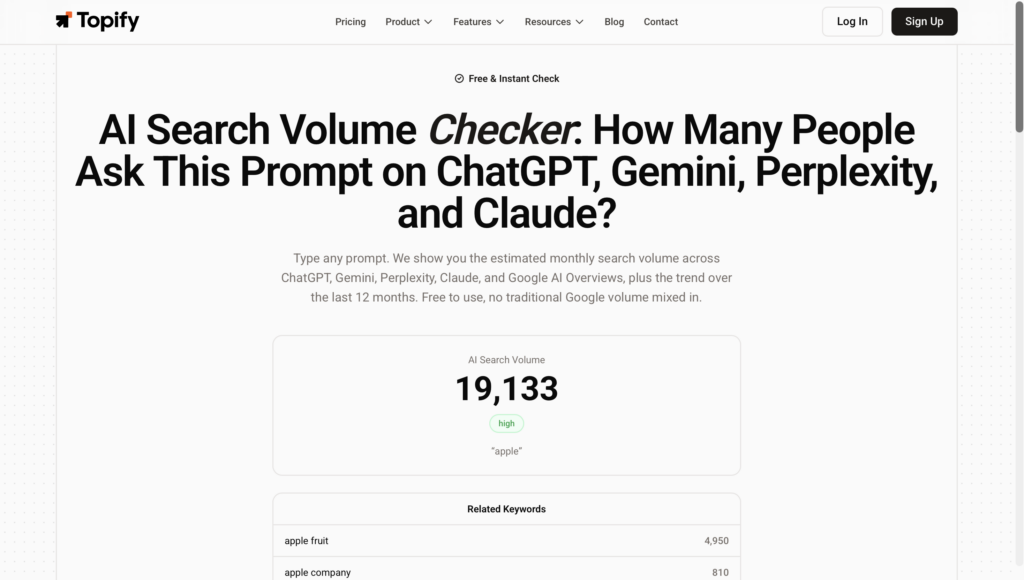
The output isn’t a longer list of prompts to chase. It’s a shorter, ranked one.
Putting the Model into Practice
Go back to that spreadsheet of prompts sorted by volume. Add two columns: intent and winnability, each scored 1 to 5. Multiply all three, re-sort by the combined score, and look at what moved.
The prompts that rise are usually the ones with real commercial intent and a fair shot at inclusion, even if their raw volume looked modest. The prompts that fall are the ones that looked good on a dashboard and would have gone nowhere in practice.
That’s the point of the model. It doesn’t replace judgment. It gives judgment somewhere structured to land.
Conclusion
Volume is easy to measure and easy to over-trust. It answers one question out of three that actually matter. Intent tells you whether the people asking are worth reaching. Winnability tells you whether you have a realistic path to showing up when they ask.
Score all three, multiply them, and the prompt list that comes out the other side looks nothing like the one sorted by volume alone. If you’re still working off a raw volume list, Topify’s AI Search Volume tool is a faster starting point than rebuilding that data by hand.
FAQ
What is AI search volume and how is it different from traditional search volume?
AI search volume estimates how often a prompt or topic comes up across AI platforms like ChatGPT and Perplexity. Unlike Google’s search volume, it’s a modeled figure rather than a direct query count, since AI platforms don’t expose raw search logs the way Google does.
How do you calculate a winnability score for AI search prompts?
Sample how a prompt performs across multiple runs on the AI platforms that matter to your category, then check how often your brand or close competitors appear in the consideration set. A prompt where a handful of incumbents dominate every run scores low. A fragmented category, or one where your brand already surfaces occasionally, scores high.
Should intent or volume matter more when prioritizing prompts?
Neither should stand alone. High volume with weak intent wastes effort on traffic that doesn’t convert. Strong intent on a prompt you can’t win wastes effort on a fight you’ll lose. The combination is what determines priority, not either variable in isolation.

