

Your keyword tool still says everything’s fine. Search volume for your core terms hasn’t dropped much. Rankings are stable. But the content team keeps hearing the same thing from sales: prospects are showing up already knowing things they never read on your site.
Here’s the gap nobody’s dashboard shows. Between 65% and 85% of ChatGPT prompts have no matching keyword in Semrush’s keyword database. Most of what people are actually asking AI systems was never a searchable phrase to begin with. Your keyword research didn’t get worse. It just stopped covering where the questions live.
Keyword Volume Was Never Built to Measure This
Keyword volume answers one question: how many people typed this exact phrase into a search box last month. That’s a clean, countable unit. It assumes search behavior is typing behavior, and for two decades that assumption held.
Fan-out queries generated by ChatGPT and Gemini run 5.5 to 9.1 words on average, against roughly 3.4 words for a classic Google search. People aren’t typing keywords into ChatGPT. They’re describing situations. “Best physiotherapist for running injuries in Toronto” isn’t a keyword, it’s six implicit questions bundled into one sentence.
That’s the gap most brands still can’t see. A tool built to count exact-match phrases has no way to register a sentence that never repeats the same way twice.
A single question to ChatGPT or Gemini routinely triggers 8 to 10 parallel, hyper-specific sub-queries before an answer is returned, and 95% of those fan-out phrases show zero monthly search volume in traditional tools. The AI is doing real research behind the scenes. Your keyword report just can’t see any of it happening.
What Prompt Research Actually Measures
Prompt research treats the AI’s actual input, the full conversational question, as the unit of analysis instead of the keyword string. Where keyword research asks “how many people search this phrase,” prompt research asks “how often does this specific question, or a cluster of its variants, get asked inside an AI conversation.”
This is what ai search volume measures: not typed queries, but the real frequency of prompts and prompt clusters inside ChatGPT, Perplexity, and Gemini conversations. One keyword like “GEO tools” might fan out into a dozen differently worded prompts, each carrying its own volume, its own intent, and its own citation opportunity.
Search-related use of AI now sits at 28% the size of traditional search worldwide, and 17% in the US. That’s not a rounding error. It’s a parallel research channel your content strategy currently has no visibility into.
Where the Old Workflow Breaks Down
The classic keyword research workflow runs four steps: find terms, check volume, check competition, build a content calendar. Every step assumes a Google-shaped world.
Step one, finding terms, still works fine. People still type keywords into keyword tools, and those tools still surface real demand. The break happens at step two. Volume data reflects typed search behavior, not the conversational phrasing an AI model actually processes when it decides what to retrieve and cite.
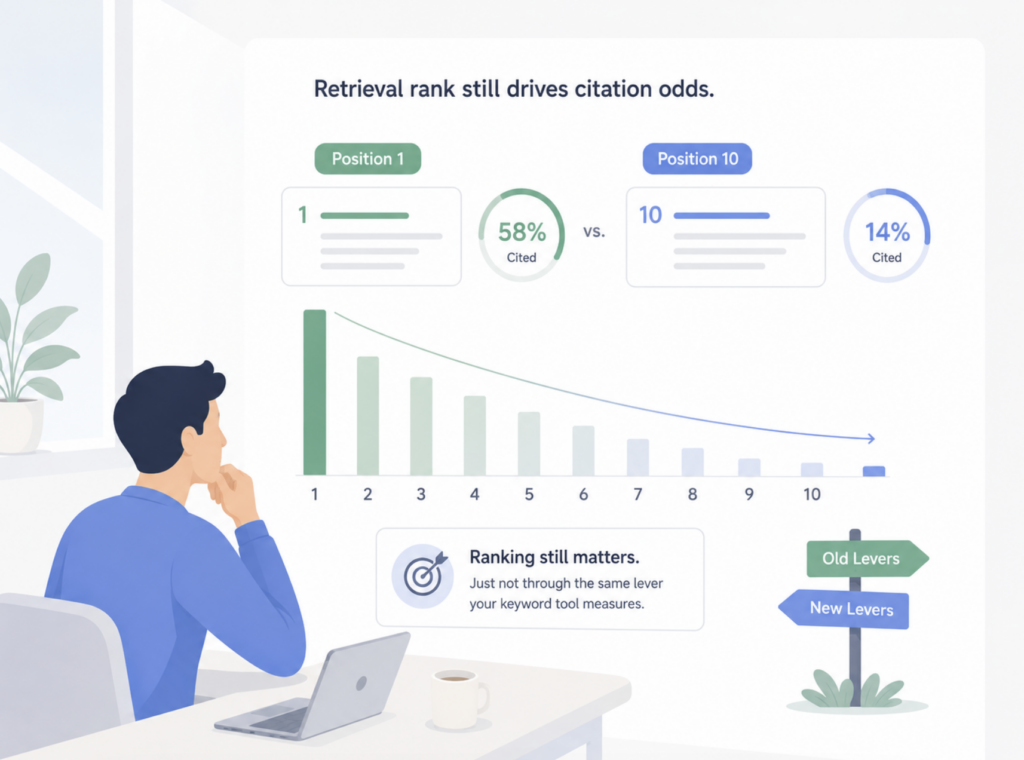
Step three breaks harder. Competition scores are built from SERP rankings, and an April 2026 controlled study across more than 815,000 query-page pairs found retrieval rank still dominates citation odds, with position-one pages cited 58% of the time against 14% for position ten. Ranking still matters, just not through the same lever your keyword tool measures it with.
Step four is where teams feel it most directly. Only 10% to 15% of pages on a typical enterprise site account for 70% to 90% of all AI citations that site earns, and teams publishing 40 or more posts a quarter often find fewer than 20 are ever retrieved. A content calendar built purely off keyword volume keeps producing pages the AI never reads.
Rebuilding the Workflow: From Keyword List to Prompt Map
The fix isn’t throwing out keyword research. It’s adding a layer on top of it. The rebuilt workflow runs four steps of its own: discover high-value prompts, track ai search volume at the prompt level, map the citation gaps that surface, then prioritize the content calendar by prompt cluster instead of keyword string.
This is where Topify’s AI Volume tool earns its place in the stack. It’s built to surface prompt-level ai search volume, showing which conversational questions are actually being asked across ChatGPT, Perplexity, and Google AI Mode, not just which keywords are being typed into a search bar. Pair that with High-Value Prompt Discovery, which continuously surfaces new prompt opportunities as AI recommendations shift, and the content team gets something a keyword tool structurally can’t provide: a ranked list of the exact questions worth answering next.
A content team running this workflow doesn’t scrap its keyword list. It runs the existing terms through prompt discovery, sees which ones fan out into high-volume conversational variants, and reprioritizes the calendar around those clusters. The keyword “GEO tools” might sit at moderate search volume, but if its prompt variants show heavy ai search volume with almost no brand citation coverage, that’s the gap worth closing first.
Reading AI Search Volume Data Without Overreacting to It
Ai search volume isn’t a replacement metric. It’s a second lens layered on top of the first. A term with high traditional search volume and low ai search volume tells you users are still finishing that task inside a search engine. A term with the reverse pattern, low keyword volume but rising ai search volume, is usually the earliest signal that a topic is migrating away from typed search altogether.
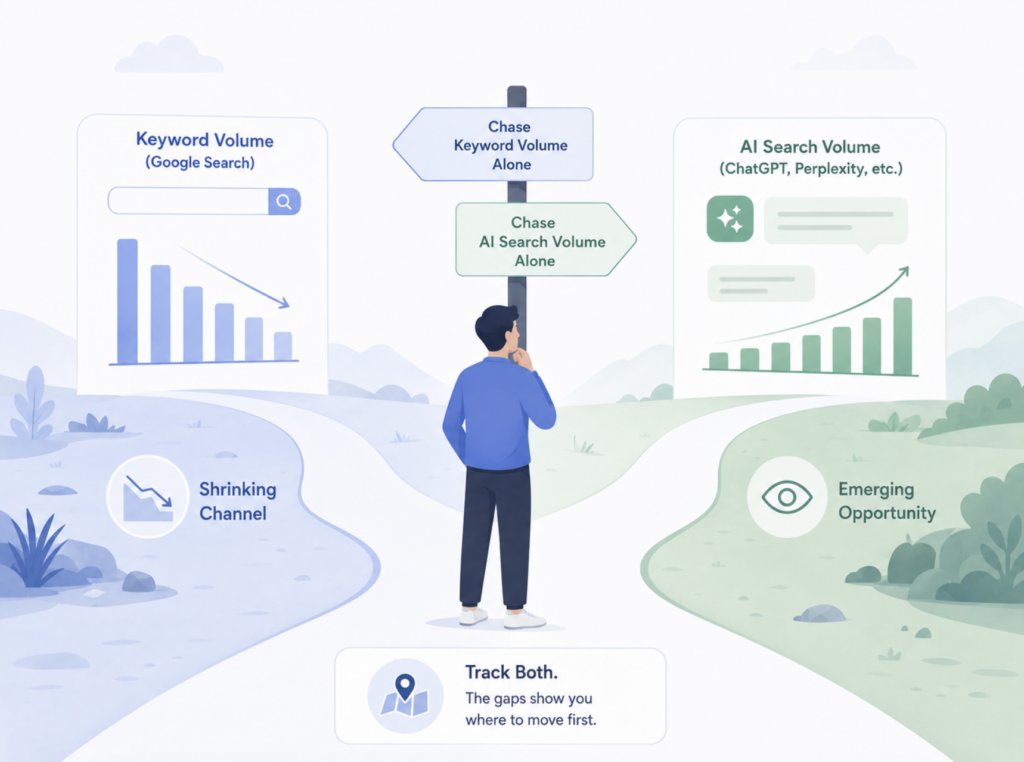
The trade-off is straightforward. Chase keyword volume alone and you’ll keep publishing for a shrinking channel. Chase ai search volume alone and you’ll miss the transactional and navigational queries Google still owns. Track both and the gaps between them tell you exactly where to move first.
What This Means for Your Content Calendar
Nobody needs to rebuild their entire planning process to act on this. Prompt test sets in mature programs typically range from 50 to 400 prompts, refreshed every 4 to 12 weeks, which fits inside a normal monthly or quarterly content review cycle without adding a second full workflow.
In practice, that means keeping the existing keyword research pass, then running the shortlisted terms through a prompt-volume check before anything gets scheduled. Terms that show strong ai search volume and thin citation coverage move up the calendar. Terms with flat ai search volume stay on the traditional SEO track. Enterprise teams that treat AI visibility as a named workstream rather than a side project report two to three times the citation growth for the same spend, which is largely a function of prioritizing correctly rather than publishing more.
Conclusion
Keyword research isn’t obsolete. It’s just no longer the finish line. It tells you what people type. Prompt research tells you what people actually ask once they stop typing and start talking to a model instead. Running both side by side, and letting ai search volume data settle the prioritization calls, is what turns a content calendar built for 2019 search behavior into one that matches how people search now.
FAQ
What is ai search volume?
Ai search volume measures how often a specific prompt or cluster of related prompts gets asked inside AI platforms like ChatGPT, Perplexity, and Google AI Mode. It’s distinct from keyword search volume, which only counts typed queries into traditional search engines.
How is prompt research different from keyword research?
Keyword research analyzes short, typed search phrases and their monthly volume. Prompt research analyzes full conversational questions, the actual sentences people ask AI systems, along with how frequently those questions and their variants get asked.
Can I track ai search volume without replacing my existing keyword tools?
Yes. Ai search volume works best as a layer added on top of existing keyword research, not a replacement for it. Run your current keyword list through a prompt-level volume check to see which terms are fanning out into high-value conversational variants worth prioritizing.
Do I need a huge prompt set to get useful data?
No. Programs typically start with 50 to 400 tracked prompts, refreshed every few weeks, which is enough to reveal prioritization gaps without building a second full research workflow.

