

Most PR teams have already taken the obvious first step: type the brand name into ChatGPT, read whatever comes back, and drop the screenshot into a Slack channel. It feels like due diligence. But ask the same question twice in one week and the tone, the competitors mentioned, and the sources behind the answer can all shift, with nothing in the process explaining why.
That gap is exactly what most AI reputation management efforts miss. It matters more than it used to, since 51 percent of B2B software buyers now start research inside an AI chatbot more often than Google, up sharply from a year earlier. A screenshot doesn’t tell a comms team whether a shift in tone is a blip or the start of a trend.
AI Reputation Management Isn’t Media Monitoring With a New Label
The instinct to treat AI reputation management like traditional media monitoring makes sense on paper. Monitoring used to assume a stable set of channels: Google’s first page, a handful of review sites, maybe a press mentions feed. Set up alerts, check them weekly, move on.
AI search doesn’t hold still that way. Answers get generated fresh each time, pulled from a mix of sources that shifts by the week rather than the year. ChatGPT’s Reddit citation share collapsed from roughly 60% to 10% in mid-September 2025 before stabilizing, and swings like that happen without any change to a brand’s own messaging.
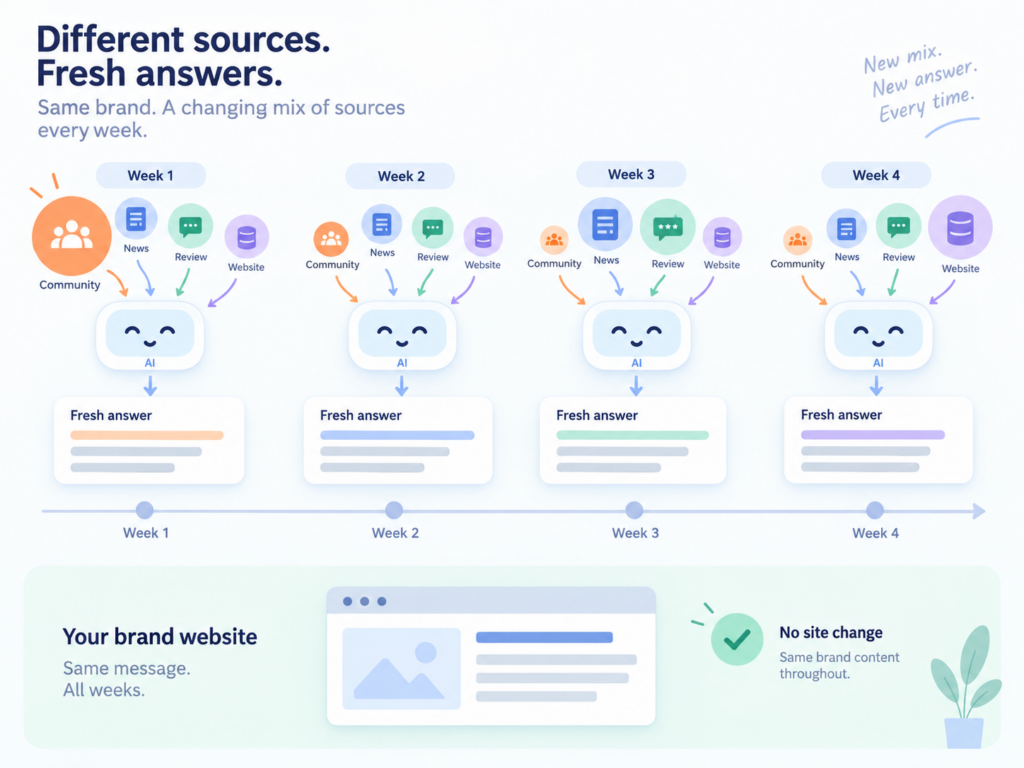
That’s the part most monitoring routines aren’t built to catch.
Cross-platform coverage makes the problem worse before it gets better. Only an estimated 11% of domains are cited by both ChatGPT and Perplexity, which means a single content or monitoring strategy rarely holds up across engines. A brand that looks solid on one platform can be nearly invisible, or badly mischaracterized, on another. One monthly ChatGPT query tells a PR team almost nothing about what Gemini or Perplexity are saying about the same brand right now.
The Sentiment Gap Nobody’s Tracking
Visibility and sentiment are not the same measurement, and most teams only watch one. A brand can show up in nearly every AI response and still come away described as an afterthought.
The baseline is worth knowing before anything else. An analysis of more than 1.8 million AI responses mentioning brands found about 80.6% of mentions read as neutral, 18.4% as positive, and only 1% as clearly negative. That’s useful context on its own: a sudden shift toward flat, neutral language can be as damaging as an outright negative mention, since it usually means the AI has stopped repeating a brand’s actual positioning and started filling gaps with whatever it can find elsewhere.
Mention rates vary sharply by model, too. Claude mentions brands in about 97.3% of relevant responses, while Google’s AI Overviews mention brands in only around 48.5%. A sentiment problem on one platform can hide completely from a team that only checks the other.
Without a sentiment score attached to each mention, a PR team is left guessing whether a spike in mentions is good news or the first sign the AI’s description has drifted off message. Mentions tell you the brand got noticed. They don’t tell you what got said.
Where the Damage Actually Comes From: Source Analysis
A negative or off-message description rarely comes out of nowhere. It comes from somewhere the AI is reading, and most PR teams have no visibility into which sources are actually driving what the model says.

That gap is bigger than most comms teams assume. Muck Rack’s ongoing analysis of more than 25 million AI-cited links found that earned media accounts for 84% of all AI citations, a share that’s held steady across three separate reports since mid-2025. Traditional PR work is still the thing shaping AI’s understanding of a brand, more than a brand’s own website or paid content ever could.
Here’s the problem: the journalists PR teams most frequently pitch overlap with the journalists AI models actually cite only about 2% of the time. Most outreach is aimed at outlets that never make it into an AI answer, while the coverage that does show up came from relationships nobody on the team was actively managing.
That’s the gap most brands still can’t see.
Fixing a sentiment problem without knowing which three or four sources an AI model keeps citing means treating the symptom and leaving the cause untouched. A team can pitch for months and never close a gap it can’t measure.
What a Real AI Reputation Management Workflow Looks Like
Put those three gaps together and the fix looks less like better monitoring and more like a connected system: track where the brand gets mentioned, score the tone of each mention, and trace that tone back to the specific source driving it, all in one place.
That’s the workflow Topify is built around. Its Sentiment Analysis tracks how AI systems talk about a brand on a 0 to 100 scale across ChatGPT, Gemini, Perplexity, and other major platforms, so a drop in tone shows up as a number instead of a hunch. Source Analysis then reverse-engineers the exact domains and URLs each platform is citing, which turns “the AI stopped saying nice things about us” into “the AI stopped citing the three outlets we used to get quoted in.” Competitor Monitoring adds a third layer, showing whether a dip is brand-specific or an entire category’s sentiment shifting at once.
In practice, that means a comms lead can open one dashboard, see sentiment slide on Gemini specifically, and trace it back to a single outlet that stopped citing the brand three weeks earlier. From there it’s a real decision: a pitching gap to fix, or a bigger narrative problem worth a public statement.
Get started with Topify and the manual ChatGPT-and-screenshot routine becomes one recurring check instead of the entire workflow.
Conclusion
Manually checking ChatGPT isn’t wrong. It’s just incomplete. The teams getting this right have stopped treating AI reputation management as a monthly spot check and started treating it as three connected measurements: where the brand shows up, how it’s described, and which sources are driving that description.
Start with sentiment. It’s the fastest way to tell whether the mentions already piling up are working in the brand’s favor, and it’s the number that makes the next two steps, source tracing and competitor comparison, worth doing at all.
FAQ
Q: What is AI reputation management?
A: It’s the practice of tracking how AI platforms like ChatGPT, Gemini, and Perplexity describe a brand, then acting on what drives that description. It’s distinct from traditional reputation management, which mostly focuses on search rankings and review sites.
Q: How do you monitor brand reputation in ChatGPT?
A: Beyond manually asking questions, track mention frequency, a sentiment score for each mention, and the specific sources ChatGPT cites when it talks about the brand, across the prompts customers actually use.
Q: Why does sentiment matter more than mention count?
A: A brand can appear in nearly every relevant AI answer and still lose ground if the tone drifts neutral or negative. Mention count alone doesn’t show whether the description still matches the brand’s actual positioning.
Q: Can PR teams actually influence what AI says about a brand?
A: Yes, largely through earned media. Most of what generative AI cites comes from journalism and third-party coverage rather than owned content, which means traditional media relations work still shapes AI answers more than almost anything else.

