

Your team gets a message from a client: “What does ChatGPT say about us?” Nobody has an answer. You’ve got social listening dashboards, review monitoring, and a Google Alert or two. None of that tells you what an AI model says when someone asks it to recommend a brand in your category.
That gap is the whole problem with how most teams approach AI reputation management. They’ve ported over habits from traditional reputation work, which was built for a world of reviews and search rankings, not synthesized answers. A 2026 shopping behavior roundup from martech.org puts it plainly: 1 in 4 customers already treat AI platforms as their primary source for research and recommendations, ahead of brand websites and reviews. If AI is the first stop, whatever it says about you at that stop matters more than what your dashboard shows.
We looked at where AI reputation management strategies actually break down, and ranked the five most common blind spots by how much damage they can do. The list runs from “annoying gap” to “the thing that quietly erodes your entire funnel.”
Blind Spot #5: You’re Only Watching One AI Platform
Most teams default to ChatGPT because it’s the platform everyone talks about. That’s a mistake with a bigger blind spot behind it.
AI models don’t agree with each other nearly as often as people assume. A Trakkr analysis of over 920,000 pairwise brand comparisons found that models agree on the top brand recommendation only 43.9% of the time. Watch one platform, and you’re wrong about the others more than half the time.
The risk here is moderate on its own, but it’s sneaky. Teams that monitor ChatGPT often assume the picture generalizes. It doesn’t. Perplexity cites sources differently, Gemini pulls from a different index, and Google AI Overviews behave more like a search feature than a chatbot.
Blind Spot #4: You’re Tracking Mentions, Not Sentiment
Being mentioned by an AI model feels like a win. It often isn’t one.
A February 2026 analysis of 1.8 million brand-mentioning AI responses found that 80.6% of brand mentions land in neutral territory, with only 18.4% landing positive. Negative mentions are rare, sitting around 1%. That’s the trap: negative sentiment isn’t the main threat. Getting stuck in the neutral pile is.
A brand that shows up in most category prompts can still look invisible in practice, if every mention hedges, caveats, or quietly points to a competitor instead. Counting mentions tells you that you exist. It says nothing about whether the model is actually recommending you.
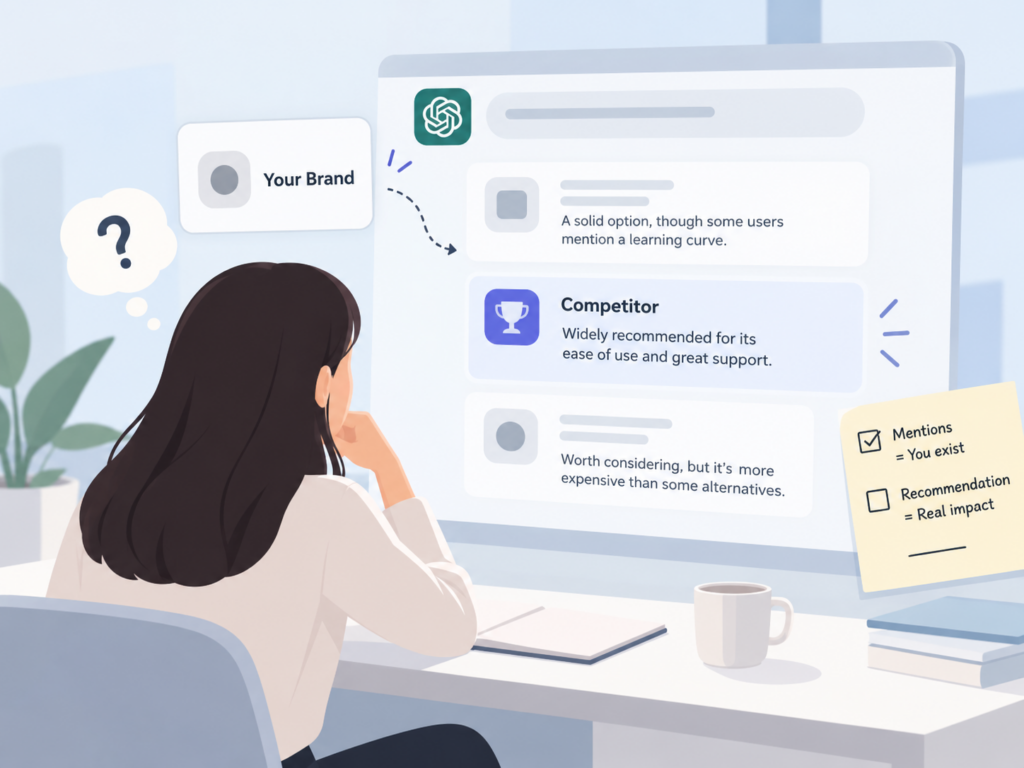
This is a mid-to-high risk blind spot because it creates false confidence. Teams see mention volume go up and assume things are fine.
Blind Spot #3: You Don’t Know Which Sources AI Is Actually Citing
Here’s the thing: AI models don’t invent opinions about your brand from nothing. They pull from sources, and those sources are traceable.
An Ahrefs analysis of the 100 most-cited domains in ChatGPT found Reddit, Wikipedia, Amazon, Forbes, and Business Insider at the top of the list, with citation counts in the hundreds of thousands for the largest sources. If your category’s narrative is being built on a handful of domains you don’t publish on and don’t influence, you’re not managing your reputation. You’re watching it get written by someone else.
This matters more than it sounds like it should. A study cited by Contently, based on Ahrefs’ analysis of 75,000 brands, found that the strongest predictor of appearing in AI-generated answers wasn’t backlinks or content volume. It was branded mentions on platforms you don’t control, correlating at 0.664 with AI Overview visibility.
Not knowing your citation sources is a high-risk blind spot. It’s the root cause behind blind spots #4 and #5. Fix the sources, and sentiment and cross-platform visibility tend to follow.
Blind Spot #2: You Have No Idea Where You Stand vs Competitors
Your sentiment score might look fine in isolation. It might also be losing to a competitor whose score is climbing while yours sits flat.
Reputation in AI answers is relative, not absolute. A Yext analysis of 6.8 million AI citations across Gemini, ChatGPT, and Perplexity found that brand mention rates varied by as much as 3x depending on which model answered the question. That’s not a small variance. That’s the difference between being the default recommendation and being an afterthought, and it changes by platform.
Without a competitor benchmark, you can’t tell the difference between “our sentiment is stable” and “our sentiment is stable while everyone else’s is rising.” Both look identical on your own dashboard. Only one of them is actually a problem.
This blind spot ranks high risk because it hides in plain sight. Nothing on your own numbers tells you it exists.
Blind Spot #1: You Treat This as a One-Time Audit, Not a Loop
This is the blind spot that makes all the others worse over time.
AI models change. Training updates shift, source weighting changes, and the domains a model trusts today aren’t guaranteed to be the ones it trusts in six months. The Everything-PR Citation Source Index documented exactly this kind of shift inside ChatGPT: Wikipedia’s citation share dropped from roughly 55% of prompts to under 20%, Reddit collapsed from about 60% to 10% in six weeks, and LinkedIn climbed from around 11th place to 5th in a matter of months. None of that happened because brands changed. It happened because the model’s source weighting changed underneath them.
A one-time audit captures a snapshot of a system that keeps moving. Run it once, file the report, and you’ll be operating on stale assumptions within a quarter. Teams that treat this as ongoing monitoring, not a one-off project, are the ones that catch shifts before they turn into lost visibility.

This is the highest-risk blind spot on the list. It doesn’t just create a gap. It guarantees every other blind spot resurfaces even after you think you’ve fixed it.
How Topify Closes These AI Reputation Management Gaps
Every blind spot above traces back to the same root issue: fragmented, one-time, single-platform visibility into something that’s continuous and multi-model by nature. Topify was built around that specific problem.
For the single-platform blind spot, Topify’s AI brand monitoring tracks ChatGPT, Gemini, Perplexity, and Google AI Overviews from one dashboard, so you’re not stitching together separate tools per model. For the mentions-versus-sentiment gap, its sentiment tracking scores brand mentions on a 0 to 100 scale, aggregated across platforms, so you can tell the difference between being mentioned and being recommended.
The citation blind spot gets addressed directly through AI citation tracking, which shows the exact URLs each model pulls from when it talks about your brand or your category, then flags where competitor content gets cited and yours doesn’t. That turns a vague “we’re not visible” problem into a specific list of pages to fix. Layered on top, Dynamic Competitor Benchmarking shows sentiment, position, and citation share against named competitors, per model, so relative drift shows up before it becomes a trend you missed for two quarters.
The loop problem is the one most platforms don’t solve well, since most stop at reporting. Topify’s structure runs discovery, tracking, and execution as one continuous cycle rather than a quarterly export. State a goal in plain language, review the suggested strategy, and the system keeps monitoring and re-prioritizing as source weighting and model behavior shift, instead of waiting for someone to remember to re-run an audit.
None of this replaces judgment. It replaces the guesswork of not knowing where to look.
Conclusion
None of these five blind spots is exotic. They’re all versions of the same mistake: treating AI reputation like something you check once and file away, on one platform, using metrics built for a different era of search. The brands catching this early aren’t doing anything more expensive. They’re just watching the right things, on the right cadence, across more than one model.
FAQ
What is AI reputation management?
AI reputation management is the practice of tracking, measuring, and influencing how AI models like ChatGPT, Gemini, and Perplexity describe, rank, and recommend a brand in their generated answers.
How is AI reputation management different from traditional online reputation management?
Traditional reputation management responds to human-generated content: reviews, social posts, news coverage. AI reputation management deals with synthesized answers that change based on model updates and source weighting, not just new posts appearing online. The signal moves differently, and it moves in ways traditional social listening tools can’t detect.
How often should you monitor your brand’s AI reputation?
Continuously, not periodically. Source weighting inside models can shift within weeks, as documented in citation share swings across platforms in 2025 and 2026. A quarterly or annual audit will always be describing a system that has already moved on.
Does a negative AI mention matter more than a neutral one?
Not necessarily. Outright negative sentiment is rare in most categories. The bigger risk is usually getting stuck in neutral, hedged mentions that never turn into a recommendation, since that’s where the bulk of brand mentions actually sit.

