

A prospect opens ChatGPT before your sales call. They type your company name, get a confident paragraph back, and form an opinion in about eight seconds. No one on your team saw it happen.
That paragraph might be right. It might also describe a product you discontinued two years ago, or borrow a competitor’s feature and hand it to you by mistake. Either way, it’s now part of how that prospect thinks about your brand, and you have no record that the moment ever occurred.
This is the new shape of ai reputation management. It’s not about what people say about you. It’s about what a model says on your behalf, to someone you’ll never meet, in a format that looks like fact and disappears the moment the chat window closes.
Why AI Has Become Your Brand’s First Impression
Search used to hand people a list of links and let them decide. Generative search skips that step. It hands people a conclusion.
That shift has moved fast. Roughly 43% of U.S. online shoppers used an AI assistant for product research in the past 90 days, and the share starting their research directly on a standalone AI platform like ChatGPT or Perplexity has nearly doubled since 2024, according to the same report. Traditional search, over that period, gave up ground.
Here’s the part that should worry a brand manager more than the adoption curve. Sixty-six percent of AI users say they trust the accuracy of what these platforms tell them. People aren’t treating AI answers as a rough starting point. They’re treating them as verified.

That’s the gap most brands still can’t see.
What “One Bad Summary” Actually Looks Like
It rarely arrives as a single dramatic lie. It’s usually smaller and stranger than that.
Research tracking AI-generated brand answers found that 72% of brands had at least one factual error somewhere in their AI-generated coverage, ranging from outdated pricing to features credited to the wrong product tier. A separate analysis puts a number on the fallout: 35% of brands report that an inaccurate AI response has already damaged their reputation, a meaningful figure given that ChatGPT alone now serves roughly 800 million people every week.
The errors also aren’t uniform across platforms. One breakdown of AI brand errors found that ChatGPT tends to fabricate plausible-sounding specifics when training data is thin, Perplexity tends to surface outdated information because older pages often outrank newer ones, and Gemini tends to blend two similar companies together when synthesizing comparison articles. A brand that looks clean on ChatGPT can still be quietly wrong on Perplexity.
There’s also a useful way to categorize what’s actually going wrong. One framework separates AI brand errors into three types: outright fabrication with no basis in any source, staleness where a once-true fact never got overwritten, and framing errors where the facts are close but the tone skews negative for reasons no one can point to. That third type is the one social listening tools were never built to catch, because there’s no post to flag and no comment to moderate. There’s just a sentence, generated fresh each time someone asks.
Why Traditional Monitoring Tools Miss This Entirely
Tools like Google Alerts or a standard media monitoring dashboard were built for a web made of indexable pages. Something gets published, it gets crawled, and your alert fires.
An AI answer isn’t published anywhere. It’s generated on demand, phrased slightly differently each time, and gone the moment the session ends. There’s no URL to flag, no page to screenshot, no crawler that will ever find it for you.
That means the first sign of a problem usually isn’t a spike in your dashboard. It’s a confused email from a prospect, or a sales rep mentioning that a deal went quiet right after the buyer said they’d “looked into it more.” By the time you hear about it secondhand, the AI has probably already said the same wrong thing to dozens of other people.
What Actually Catching It Looks Like
Catching a bad AI summary before it spreads means treating your presence inside AI answers as a metric, not a feeling. That starts with a sentiment score.
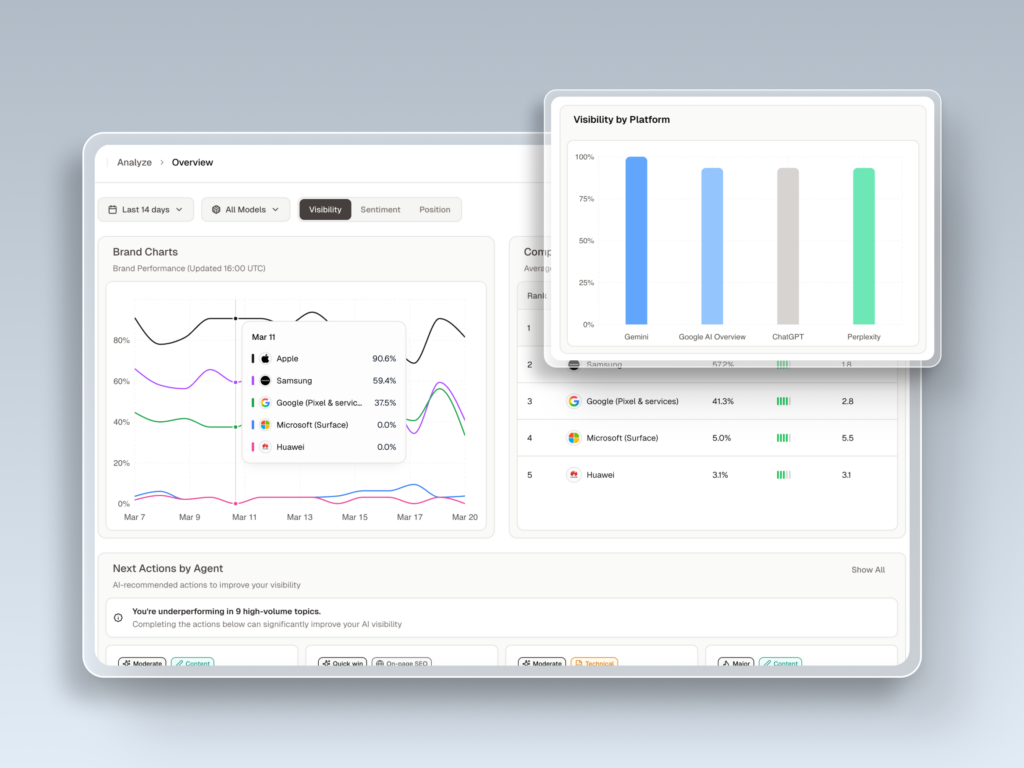
Topify’s Sentiment Analysis scores every AI mention of your brand on a 0 to 100 scale across ChatGPT, Gemini, Perplexity, and other major platforms, pulling from the actual language the model uses rather than a manual spot-check. A score sitting at 78 that slides to 61 over two weeks is a signal, not a coincidence, and it typically shows up well before a support ticket or a lost deal does.
Sentiment on its own tells you the tone is shifting. It doesn’t tell you how far the problem has spread. That’s what Visibility Tracking is for: confirming how many prompts, and which platforms, are actually surfacing the summary in question. A negative framing that shows up once on a niche prompt is an annoyance. The same framing showing up across your five highest-intent category prompts is a fire.
A negative sentiment score without a reason attached is just a number to feel bad about.
Tracing the Summary Back to Where It Came From
Finding out a summary is wrong is only half the job. Finding out why the model believes it is the half that actually lets you fix it.
This is where source-level analysis earns its place in the workflow. Topify’s AI Citation Tracking shows the specific domains and URLs each AI platform is pulling from when it generates an answer about your brand, at both the domain level and the individual page level. If a model keeps repeating a claim from a three-year-old forum thread or a review site that never updated its listing, that’s traceable, and it’s addressable in a way a vague sense of “our AI reputation feels off” never is.
Fixing the source doesn’t guarantee an instant correction inside the model. It does mean the next time that page gets crawled or referenced, the story it’s telling is the current one, not the outdated one the AI has been repeating on autopilot.
Making This a Habit, Not a Fire Drill
None of this works as a once-a-quarter check-in. AI answers shift as models update, as new pages get indexed, and as competitors publish content that reframes the category.
The brands treating this well have folded it into the same rhythm they already use for review monitoring or social listening: a standing view of sentiment, visibility, and source data, checked on a schedule rather than after someone forwards a screenshot. Topify’s GEO platform is built around that rhythm, running daily prompt checks across every major AI provider so shifts in tone or coverage show up as a trend line instead of a surprise.
The cost of setting this up is smaller than most teams assume. A basic monitoring tier typically covers ChatGPT, Perplexity, and Google AI Overviews tracking for well under what a single missed enterprise deal costs, which makes the “we’ll deal with it if it comes up” approach a genuinely expensive bet.
Conclusion
Brand trust took years to build and a few confidently worded sentences to put at risk. The sentences themselves aren’t the real threat. Not knowing they exist is.
Catching a bad AI summary early doesn’t require predicting every way a model might get your brand wrong. It requires a standing view of sentiment, visibility, and sources, so the first person to notice a problem is you, not a prospect who already decided to look elsewhere.
FAQ
How do I know if ChatGPT or another AI is saying something wrong about my brand?
Manually testing a handful of prompts gives you a snapshot, but it misses the fact that answers shift by platform, by prompt phrasing, and over time. Ongoing monitoring tools that score sentiment and track visibility across ChatGPT, Gemini, and Perplexity catch drift that a one-time check never will.
Can damage from a bad AI summary actually be reversed?
Often, yes, though not instantly. Since models retrieve from current sources rather than a fixed record, publishing accurate, well-structured content and earning fresh citations tends to shift what the model repeats over subsequent crawls and updates.
Is this the same thing as traditional online reputation management?
Related, but not identical. Traditional reputation management tracks reviews, articles, and social posts you can find and link to. AI reputation management tracks synthesized answers that are generated fresh each time, which is why it needs its own monitoring layer rather than an add-on to existing tools.
Does every brand actually have an AI reputation problem?
Not every brand has a crisis, but most have blind spots. Given that a large share of brands show at least one factual error somewhere in their AI-generated coverage, the realistic assumption is that something is off; the open question is just how visible and how damaging it currently is.

