

You’ve read three “best rank checker” roundups this week, and they all recommend roughly the same five tools in roughly the same order. The rankings move depending on which affiliate program pays out the most. None of them tell you the one thing you actually need to know in 2026: whether the tool can see your brand in the places people now search. So you’re stuck comparing crawl speeds and keyword limits while the real visibility question goes unanswered.
That gap exists because most reviews still treat ranking as a number between 1 and 100 on a Google results page. The job has changed. Here’s the checklist that decides whether a tool is worth paying for.
Why “Best Rank Checker” Lists Keep Steering You Wrong
Most best-of lists rank tools on the wrong axis. They compare keyword volume limits, crawl frequency, and dashboard polish, then sort by price. Those things matter, but they describe a 2018 problem.
The deeper issue is that affiliate-driven roundups measure what’s easy to measure. SERP position is a clean, sortable metric. It fits a comparison table. So that’s what gets compared, even though SERP position now explains less of your actual traffic than it used to.
That’s the gap most reviews refuse to name.
A rank checker’s value in 2026 isn’t how precisely it tracks position 7 versus position 9. It’s whether it can tell you where your brand stands when a buyer asks ChatGPT instead of typing into Google. Judge tools on that, and most “best” lists fall apart.
What “Rank” Actually Means in 2026
Search has shifted from a list of links to a synthesized answer. AI platforms like ChatGPT, Perplexity, and Google AI Overviews increasingly resolve a query inside the chat window, so the user never clicks through to a ranked page at all.
The numbers behind this are hard to argue with. Google’s average zero-click rate has climbed to roughly 64.82% in 2026, and on Perplexity it reaches about 93%. When an AI Overview appears, the top organic result loses an average of 37.5% of its click-through rate. Ranking first still happens. It just buys you less.
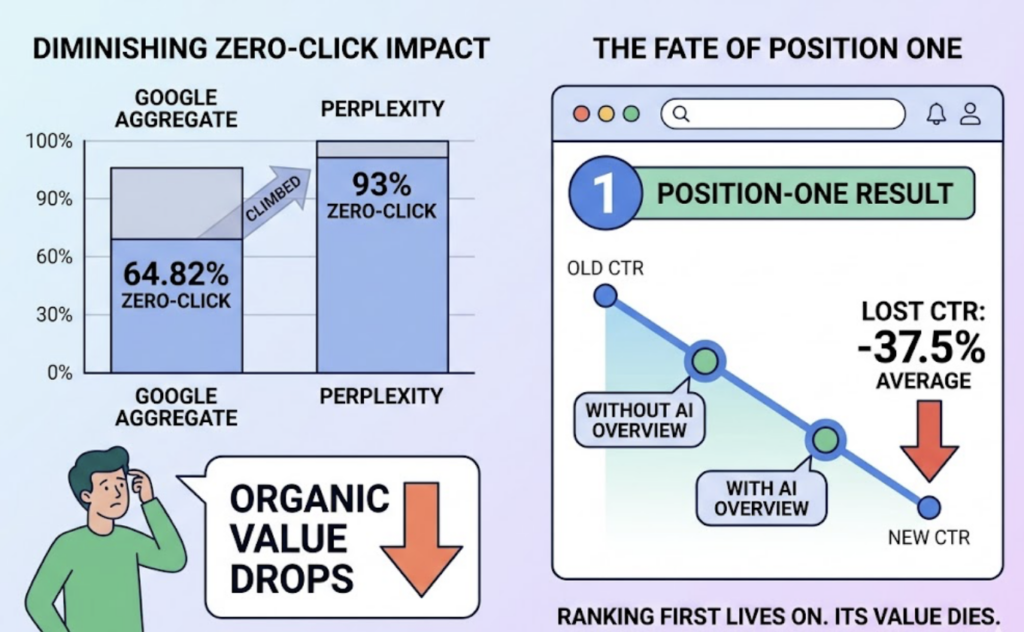
Here’s the part that breaks traditional tracking. High Google rankings no longer guarantee AI visibility. Only about 38% of the URLs cited inside AI Overviews rank in the top 10 organic results, which means citations and rankings have decoupled. A tool watching only the blue links is watching the wrong scoreboard.
The reason is structural. Traditional tools crawl and index static pages. AI models perform query fan-out, pull from multiple sources in real time, and decide what to cite based on entity clarity, semantic trust, and citation confidence rather than keyword density or raw backlink counts. A rank checker built for the old logic can’t see the new one.
The Best Rank Checker Checklist Most Reviews Skip
These are the five criteria that separate a tool that measures presence from one that just measures position. Run any shortlist against them before you commit.
It Has to Cover AI Answers, Not Just Blue Links
Start here, because it’s the line most reviews skip entirely. Ask whether the tool tracks brand mentions and citations across ChatGPT, Gemini, Perplexity, and Google AI Overviews, or whether it stops at SERP position.
If it only reports blue-link rankings, you’re paying to monitor a shrinking share of how people actually find you. Coverage across multiple AI models is the baseline, not a premium add-on.
Being Mentioned Isn’t the Same as Being Cited
A mention is cheap. A citation is authority. The tool should tell you whether the AI treats your brand as a primary source or a passing afterthought, and it should report the exact URL and the specific content the model is pulling from.
In practice this is the difference between knowing you showed up and knowing why. Without source mapping, you can see a visibility drop but you can’t fix it, because you don’t know which page stopped earning the citation.
It Should Tell You Why a Ranking Moved
A dashboard that flags a drop without explaining it is a liability, not an asset. You’ll spend hours guessing at causes that the data already contains.
The better tools now run diagnosis, not just detection. They connect a visibility loss to a competitor’s content shift, a sentiment change, or entity ambiguity, and some pair that with AI agents that suggest the fix. If a tool only hands you a falling line on a chart, you’re doing the analyst’s job yourself.
Tone Counts: Leader, Alternative, or Afterthought
AI doesn’t just rank you. It describes you. The tool should measure how the model frames your brand, whether it positions you as the category leader, a secondary alternative, or something worse.
This is reputation management, not vanity tracking. If Perplexity keeps calling your premium product a “budget option,” that framing shapes every buyer who reads it, and you can’t correct what you don’t measure.
It Maps Where Competitors Earn Their Citations
The last criterion is the one that turns monitoring into strategy. A strong rank checker identifies which domains your competitors are using to win citations, so you can find the content gaps and fill them.
That’s how you move from watching your position to changing it. Competitor citation benchmarking tells you exactly where the authority is being captured and where there’s still room to take it.
Matching the Right Rank Checker to Your Use Case
No single tool covers every angle well, and pretending otherwise is how people end up disappointed. The realistic 2026 setup is a dual stack: keep a traditional SEO suite for transactional, high-intent queries where blue-link traffic still converts, and add an AI-native platform for the informational and research-intent queries that now resolve inside AI answers.
Here’s how the two categories actually differ:
| Dimension | Traditional SEO Suite | AI-Native Visibility Platform |
|---|---|---|
| Primary metric | SERP ranking, 1 to 100 | Visibility index / citation rate |
| Platform scope | Google Search | Multi-model: ChatGPT, Gemini, Perplexity |
| Focus | Keyword density, backlinks | Content extractability, entity authority |
| Actionability | Manual interpretation | AI-driven optimization suggestions |
| Best for | Transactional keywords | Informational and research-intent queries |
What you prioritize depends on who you are. A solo SEO consultant tracking a handful of money keywords can lean on a traditional tracker and add a lightweight AI check. An agency reporting to clients needs the AI-answer coverage, because that’s the question clients now ask in quarterly reviews. An in-house marketing team protecting brand positioning should weight sentiment and competitor citation mapping heavily, since that’s where reputation actually forms now.
Where an AI Rank Checker Fits: Tracking the Half SERP Tools Miss
This is the side of the checklist a traditional rank checker can’t cover, and it’s where a purpose-built platform earns its place in the stack. Topify is built specifically to measure the AI-answer layer, which maps onto the five criteria above almost line for line.
It tracks recommendation position and visibility across ChatGPT, Gemini, Perplexity, and other major models, so the “AI answer coverage” box is the default rather than an upgrade. Its source analysis reverse-engineers the exact domains and URLs the models cite, which is the citation-health and competitor-benchmarking layer in one. And rather than stopping at a dashboard, its analytics span AI volume, citation frequency, sentiment, and recommendation position, then feed into one-click GEO execution that turns a visibility gap into a content update without a manual, multi-step workflow.
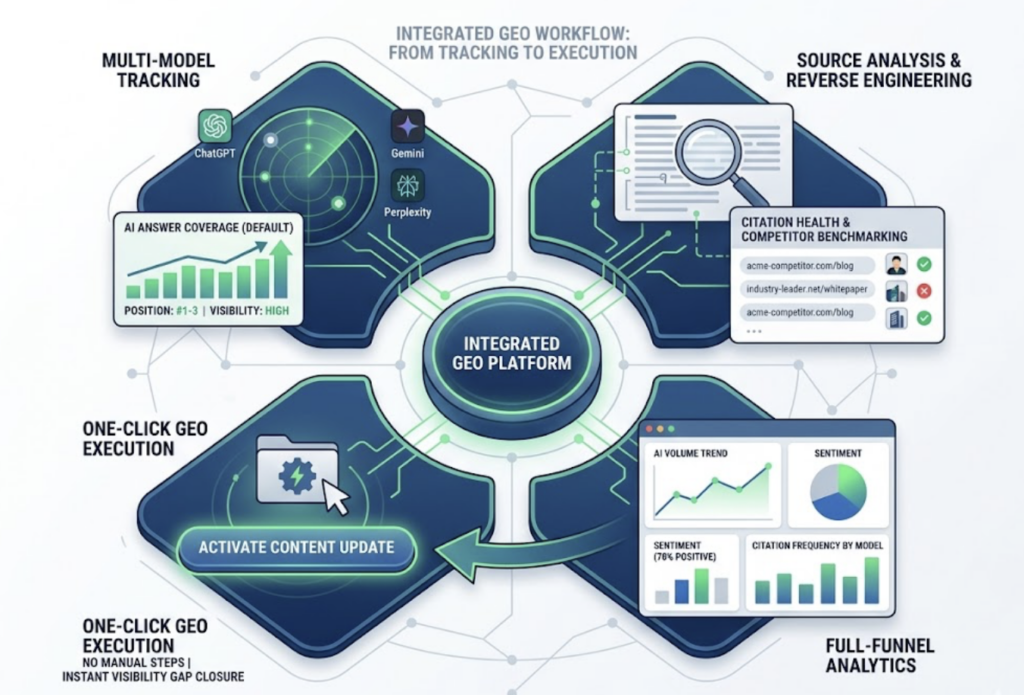
For a team that already runs a traditional tracker, this is the missing half of the picture. You can spot a slide in ChatGPT mentions, trace it to a source that stopped citing you, and act on it in the same place. If you want a no-commitment starting point, a free GEO tools reference is a reasonable way to baseline where you stand before you get started with full tracking.
Conclusion
The best rank checker in 2026 isn’t the one with the most keyword slots or the cheapest annual plan. It’s the one that can see your brand where buyers actually look, which now means AI answers as much as Google results. Run any shortlist against the five criteria: AI-answer coverage, citation health, a real explanation of why rankings move, sentiment, and competitor citation mapping.
Start by auditing your baseline. Pick the top 50 prompts that represent your category, measure where you stand across the major AI platforms, and decide whether your current tool can even show you that. If it can’t, you don’t need a better keyword tracker. You need to cover the half of search it was never built to see.
FAQ
Q: How do I choose a rank checker in 2026?
A: Score each option against five criteria rather than price alone: does it cover AI answers across multiple models, does it map citation sources, does it explain why a ranking moved, does it measure sentiment, and does it benchmark competitor citations. A tool that only reports SERP position fails most of that list.
Q: Is an AI rank checker different from a traditional keyword rank checker?
A: Yes. A keyword rank checker tells you your position on a Google results page. An AI rank checker measures whether models like ChatGPT and Perplexity mention, cite, and recommend your brand, and how they describe it. With zero-click rates above 64% in 2026, the second question often matters more.
Q: Can I replace my SEO tool with an AI visibility platform?
A: For most teams, no. The practical approach is a dual stack: keep a traditional suite for transactional keywords where blue-link traffic still converts, and add an AI-native platform for the informational queries that now resolve inside AI answers. They measure different things.
Q: How often should rank data update?
A: AI models shift their citation patterns frequently, so monthly snapshots go stale fast. Look for tracking that refreshes often enough to catch a competitor’s content shift before it costs you a quarter of visibility, and that flags the change rather than making you hunt for it.

