


Your rank tracker shows green across the board. Position one for your money keyword, top three for a dozen others, not a red arrow in sight. Then you open Search Console and clicks are down 30% over the same window. Nothing in the ranking report explains the drop, because it’s measuring a page that fewer people ever reach. The number is accurate. What it used to predict isn’t anymore, and even the best rank checker on your stack still can’t tell you why.
Your Rankings Are Fine. So Where Did the Clicks Go?
The gap between ranking and traffic isn’t a tracking bug. It’s structural.
For most of search history, position one meant the lion’s share of clicks. That math has broken down. In 2026, roughly 64.82% of Google searches end without a single click to any website, according to zero-click data compiled by Digital Applied. SparkToro’s analysis puts it bluntly: less than one third of Google searches still send a click anywhere.
So a #1 ranking now competes for a shrinking pool of clicks that may never leave the results page. Your position didn’t fall. The traffic behind it did.
What a Rank Checker Measures, and What It Misses
A traditional rank checker is, at its core, a SERP scraper. It measures positional rank from 1 to 100 on a static results page and reports where your URL sits. That was the right metric when the results page was the destination.
The problem is what it can’t see. It doesn’t register whether an AI Overview summarized the answer above your link. It has no view into whether ChatGPT or Perplexity recommended a competitor when someone asked for options in your category. It measures a location on a page that generative summaries increasingly bypass.
Here’s the split in plain terms:
| Dimension | Traditional Rank Tracker | AI Visibility Platform |
|---|---|---|
| Primary focus | Blue-link SERP position | Citation frequency and answer presence |
| Data logic | Keyword-to-URL matching | Semantic intent and query fan-out |
| What it measures | Click-through rate | Answer authority, sentiment, citations |
| Platform scope | Google Search | ChatGPT, Perplexity, Gemini, and more |
A rank checker tells you where you stand. It says nothing about whether you were mentioned, recommended, or quietly left out of the answer a user actually read.
The Real Reason Rank #1 No Longer Means Traffic
Two shifts explain the decoupling, and both happen above your link.
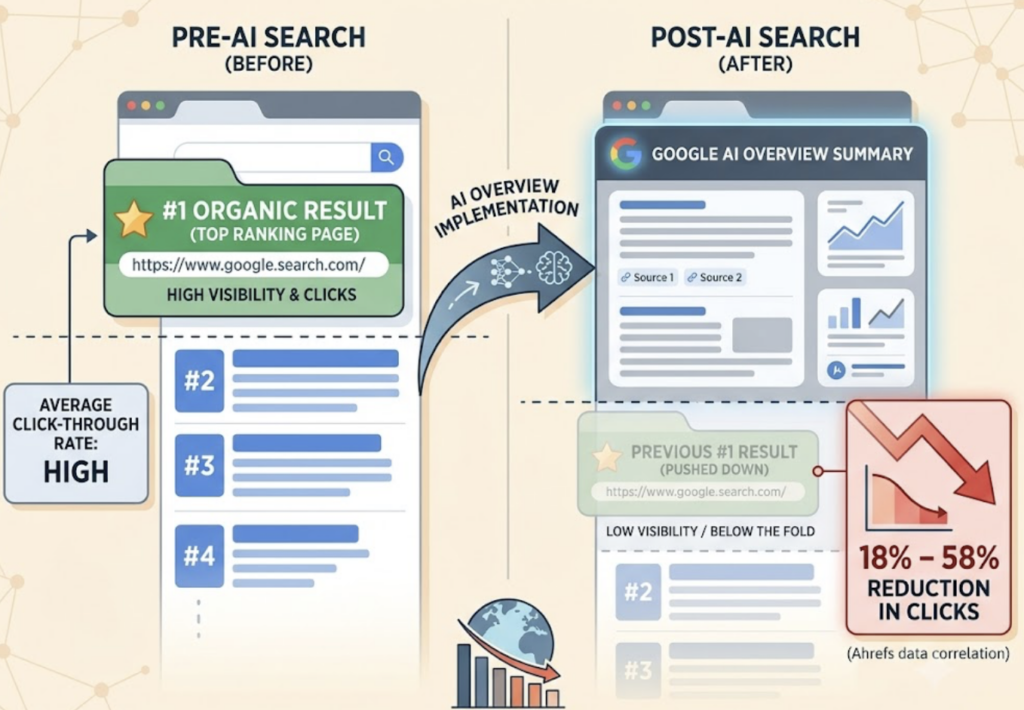
First, AI Overviews push the classic blue links down. When Google generates a summary at the top, the #1 organic result moves below it, often below the fold. Ahrefs measured this directly: the presence of AI Overviews correlates with up to a 58% reduction in clicks to the top-ranking page, with the broader range landing somewhere between 18% and 58% depending on query type.
Second, ranking and being cited have come apart. Only around 38% of the URLs cited inside AI Overviews actually rank in the top 10 organic results, per analysis from Seer Interactive and Goodfirms. AI systems pull from sources based on how cleanly they answer a sub-question, not on where they sit in the rankings.
Ranking first and getting cited are now two different games.
That’s the part a rank checker structurally can’t surface. It’s scoring you on the first game while your traffic is being decided by the second.
What the Best Rank Checker Should Track in 2026
If the results page is no longer the finish line, the criteria for evaluating a tracking tool have to change too. The best rank checker for this environment isn’t the one with the most granular blue-link positions. It’s the one that can tell you whether you exist inside the answer.
Four questions separate a tool built for 2020 from one built for now:
- Does it cover AI platforms, not just Google Search? If it can’t see ChatGPT, Perplexity, or Gemini, it’s blind to where a growing share of queries resolve.
- Does it measure mention and position inside AI answers, not just page rank? Being recommended third in a ChatGPT answer is a real position your SERP tracker never captures.
- Does it show you the sources AI cites? Without that, you can’t tell why a competitor got picked and you didn’t.
- Can it tie visibility to downstream intent? Presence in an answer matters more when it’s the kind of answer that sends a buyer your way.
A tool that only reports SERP position answers one of these. The rest stay dark.
From Rank Position to AI Visibility
The metric shift here is the whole story. Traditional SEO optimizes for rankings. Generative Engine Optimization, or GEO, optimizes for reusability, getting your content lifted directly into an AI’s answer.
That works differently than ranking. When an AI receives a complex prompt, it fans the prompt out into smaller sub-queries and assembles an answer from multiple sources. Winning means being the cited source for those sub-queries, which rewards content that’s structurally extractable: clear question-style headers, concise factual paragraphs, and lists an AI can lift without guessing. Entity authority compounds it, since editorial mentions and consistent presence across the web feed the model’s trust in your brand. None of that shows up as a number on a SERP rank report. For a fuller breakdown of how the two metrics diverge, this comparison of AI search visibility versus Google rankings is a useful starting point.
How to See the Layer Your Rank Checker Can’t
Closing the gap starts with measuring the thing your current tool can’t: presence inside AI answers. That means tracking, prompt by prompt, whether your brand shows up when someone asks an AI for a recommendation, and where you land relative to competitors when it does.
This is the layer Topify is built to monitor. Instead of scoring blue-link position, it tracks Visibility and Position across ChatGPT, Perplexity, and Google AI Overview, so you can see whether your brand is mentioned in a given answer and how it ranks against rivals in that same answer.
From there, the diagnostic gets concrete. Source Analysis shows the exact domains an AI cites for your core prompts, which turns “we’re not getting picked” into “here’s the citation gap and who’s filling it.” Its conversion-oriented metric estimates how likely a given AI answer is to push a user toward your brand, so you’re not just counting mentions but weighting the ones that matter.
The practical move is to start with the prompts that drive your category, not your keyword list. You can pressure-test the basics with a set of free GEO tools first, then get started with continuous monitoring once you’ve confirmed the gap is real.
GEO Score Checker
Conclusion
A rank checker still has a job. It just answers a narrower question than it used to, and treating its green dashboard as a traffic forecast is what’s catching teams off guard. Position one is real. The clicks it once guaranteed are now split with AI summaries, zero-click answers, and citations that don’t track ranking at all.
The fix isn’t a better SERP scraper. It’s adding the layer underneath: confirming whether AI engines mention, recommend, or ignore your brand before you spend another quarter optimizing for a page fewer people open. Check that first. The ranking report can wait.
FAQ
Q: Why is my traffic dropping even though my rankings are stable?
A: Because ranking and traffic have decoupled. With zero-click searches near 64.82% and AI Overviews cutting top-page clicks by as much as 58%, a #1 position now competes for far fewer clicks than it used to. Your rank report can’t show that erosion, because it only measures position, not whether the answer was resolved before anyone clicked.
Q: Can a traditional rank checker track AI search visibility?
A: Generally no. Standard rank trackers scrape SERP positions and don’t see whether you’re cited in ChatGPT, Perplexity, or AI Overviews. Measuring AI visibility requires a tool that tracks mentions and position inside AI answers, not blue-link rank.
Q: What’s the difference between rank position and AI visibility?
A: Rank position is where your URL sits on a results page. AI visibility is whether your brand appears inside an AI-generated answer, how it’s positioned against competitors, and which sources the AI cites. Only about 38% of URLs cited in AI Overviews even rank in the top 10, so the two rarely move together.
Q: What should the best rank tracker for AI search include?
A: Coverage across multiple AI platforms, measurement of brand mention and position inside AI answers, visibility into the sources AI cites, and a way to connect that presence to conversion intent. A tool covering only Google SERP position misses where a large share of queries now resolve.

