

Your weekly rank report is all green. Position one for your head terms, healthy keyword movement, a backlink profile that keeps climbing. Then a prospect asks ChatGPT for the best tool in your category, gets five recommendations back, and your brand isn’t one of them. Your rank checker never flagged it, because it was never built to look there. The ranking it tracks and the ranking that’s quietly deciding your traffic have drifted apart, and most SEO teams won’t notice until the AI-driven decline shows up in their analytics.
The Ranking You’re Tracking Isn’t the Only One That Matters
Semrush and Ahrefs measure one thing extremely well: where your URL sits on a Google results page, from position one to one hundred. For two decades, that number was a dependable proxy for traffic. In 2026, the proxy is breaking down.
Search has moved to an answer-first model, where ChatGPT, Perplexity, and Google AI Overviews synthesize a response instead of returning a list of links. Google’s aggregate zero-click rate has reached 64.82% according to 2026 data from Digital Applied, and on Perplexity it runs as high as 93%. The user reads the answer and never scrolls down to your position-one result.
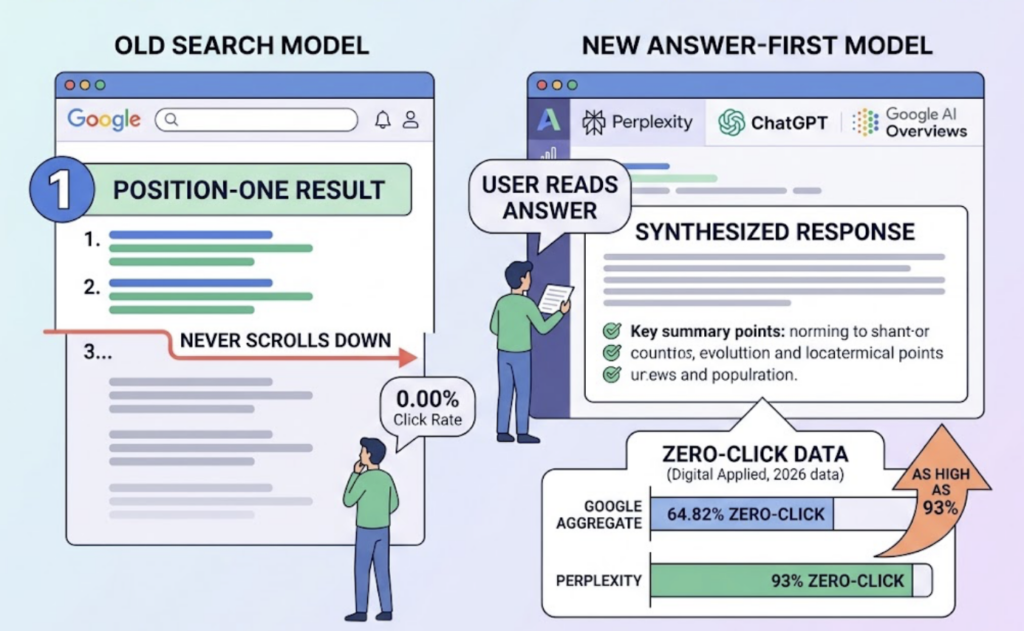
It gets worse for the clicks that do happen. When an AI Overview shows up above the organic results, average click-through rate for the number-one ranking drops by 37.5%. Your rank didn’t move. Your traffic did.
That’s the rank no traditional checker is built to see.
Why Semrush and Ahrefs Can’t Cover the AI Rank Checker Gap
This isn’t a knock on Semrush or Ahrefs. They’re still the standard for traditional SEO, and the gap comes from architecture, not effort.
Traditional rank trackers send crawlers to scrape a static SERP, then map one keyword to one URL at one position. AI models work nothing like that. They run query fan-out: a single prompt gets split into multiple sub-queries, sources get synthesized on the fly, and a fresh response gets generated every time. There’s no fixed “position one” to scrape. There’s a citation list that reshuffles with each query.
The data backs this up. Ahrefs found in 2026 that only 38% of pages cited in AI Overviews also rank in Google’s top 10. Topping the SERP no longer predicts whether AI will cite you. The models are weighing topical authority and answer-readiness, not just backlinks and keyword density.
Both suites have bolted on “AI visibility” modules, but the core logic still runs on Google search signals like E-E-A-T and backlink profiles. They can tell you a mention happened. They struggle to tell you whether the AI recommended you, named you in passing, or cited a competitor’s teardown of your product.
What the Best Rank Checker Now Has to Measure
If the old definition of rank was “position on a page,” the new one is “placement in an answer.” A rank checker fit for 2026 has to measure four things the old model never accounted for.
Visibility Index: the share of AI answers where your brand appears at all. Citation Frequency: how often a model attributes a specific claim to your exact URL. Recommendation Rank: whether you’re the primary suggestion or the afterthought buried in the fourth sentence. Platform Coverage: presence across ChatGPT, Gemini, Perplexity, and Claude, since each model grounds its answers differently and a strong showing on one says nothing about the rest.
None of these map cleanly onto a keyword-to-position spreadsheet. That’s the gap. And it’s why “the best rank checker” now means something different than it did even a year ago.
How a Rank Checker for AI Search Closes the Gap
Closing the gap means tracking rank where the answers actually form. That’s the niche a new class of AI-native platforms fills, and Topify is built specifically for it.
Instead of scraping a SERP, Topify monitors brand performance at the prompt level across major AI platforms, scoring seven metrics: visibility, sentiment, position, volume, mentions, intent, and CVR. The Position metric is the closest analog to a traditional rank checker, except it measures where your brand lands relative to competitors inside an AI answer, not on a Google page.
Here’s what that looks like in practice. You notice your mention rate on ChatGPT dropped for a high-value prompt. Topify lets you trace it to a specific source that stopped citing you, or to a competitor that started showing up ahead of you, all in the same view. Reverse-engineering those citations tells you which domains the model trusts, so you know exactly which content gap to close.
For teams already running Semrush or Ahrefs, this isn’t a rip-and-replace. It’s the layer that answers the question your current report can’t: are we showing up in AI search, and where?
Semrush, Ahrefs, and the Layer They Don’t Replace
Stacked side by side, the split is clear. Traditional suites own the SERP. AI-native platforms own the answer. The mistake is treating them as rivals.
| Tool | SERP Blue-Link Rank | AI Answer Rank | Cross-Platform AI Coverage | Citation Source Tracking |
|---|---|---|---|---|
| Semrush | Yes | Limited, Google-rooted module | Primarily Google | No |
| Ahrefs | Yes | Limited, Google-rooted module | Primarily Google | No |
| Topify | Not the focus | Yes, prompt-level | ChatGPT, Perplexity, Gemini, Claude | Yes |
Semrush and Ahrefs still win for navigational and transactional queries, where someone already knows what they want and types it into Google. Topify covers the informational and research-stage queries that now happen entirely inside an AI model. The smart stack in 2026 runs both.
Where to Start Checking Your AI Rankings
You don’t need to overhaul your whole stack to find out where you stand. Start with the prompts that matter most to your business.
Pull 5 to 10 questions a real buyer would ask an AI in your category, the ones where a recommendation directly shapes a purchase. Run them across ChatGPT and Perplexity, and note two things: does your brand appear, and if so, where in the answer. That single exercise usually surfaces the gap faster than any dashboard.
From there, an AI-native platform turns the spot-check into continuous monitoring. You can get started with Topify and watch how your AI rankings move week over week, the same way you’ve always watched your keyword positions.
Conclusion
An all-green rank report feels like proof you’re winning. In 2026, it’s only proof you’re winning the part of search that’s shrinking. The zero-click majority is forming its opinion inside AI answers, and your traditional rank checker was never built to look there.
The fix isn’t to abandon the tools you trust. It’s to add the layer they don’t cover, so the next time someone asks ChatGPT for the best option in your category, you already know whether your brand makes the list. Track the rank that’s actually deciding your traffic.
FAQ
Q: What is an AI rank checker?
A: It’s a tool that tracks where your brand appears inside AI-generated answers, across engines like ChatGPT, Perplexity, and Google AI Overviews. Instead of measuring your URL’s position on a Google results page, it measures whether and where you show up when a model synthesizes a direct response.
Q: Can Semrush or Ahrefs track ChatGPT rankings?
A: Only partially. Both have added AI visibility modules, but their core logic stays rooted in Google search signals, so they tend to flag whether a mention happened rather than your recommendation rank or which source the model cited. For prompt-level tracking across multiple AI engines, a purpose-built rank checker for AI search fills that gap.
Q: Is an AI search ranking tool worth it if my Google rankings are strong?
A: Strong Google rankings no longer guarantee AI visibility. In 2026, only 38% of pages cited in AI Overviews also ranked in Google’s top 10, so the two systems can diverge sharply. If your buyers research inside AI tools, you want eyes on both.
Q: Which AI platforms should a ChatGPT rank checker cover?
A: At minimum ChatGPT, Perplexity, and Google AI Overviews, with Gemini and Claude close behind. Each model grounds its answers using different logic, so coverage on one platform tells you little about the others.

