

Adobe had been running paid campaigns for Firefly and Acrobat Studio inside ChatGPT for months, treating it like any other channel. Then OpenAI quietly told Adobe those campaigns would no longer get approved. No public announcement, no warning window, just a rejected order. If your product sits anywhere near a category OpenAI wants to own, the same call could land on your desk next.
What Actually Changed in OpenAI’s Ad Policy
OpenAI updated its advertising rules to stop approving campaigns for standalone image and audio generation tools inside ChatGPT, and it did so without a public announcement. The shift only surfaced after advertising partners were notified directly, and Adobe was one of the first to confirm it, after previously promoting Firefly and Acrobat Studio through OpenAI’s initial ad pilot.
The restriction is narrow for now. Video generation ads are still being approved, which suggests OpenAI is drawing the line around the specific categories where it’s actively competing rather than banning AI tool advertising outright. The timing lines up with OpenAI’s own push into the same territory: ChatGPT Images 2.5 and ChatGPT Live voice both shipped around the same window as the policy change.
That’s less a coincidence than a pattern. Platforms tend to close the door on rivals right after launching a competing feature, not before.
The Platform Is Also the Competitor
Media companies and streaming platforms have rejected competitor advertising for decades, so the move itself isn’t new. What’s different here is that OpenAI controls both the paid channel and a big share of organic discovery for the same categories it just restricted.
ChatGPT has also stopped returning outbound citations and links for action-oriented image queries, including searches for photo editors and image generators. Paid and organic paths are narrowing at the same time, for the same set of competitors.
That’s the part brand teams tend to miss. A platform that owns both the ad auction and the answer engine doesn’t need to ban you outright. It just needs to stop mentioning you.
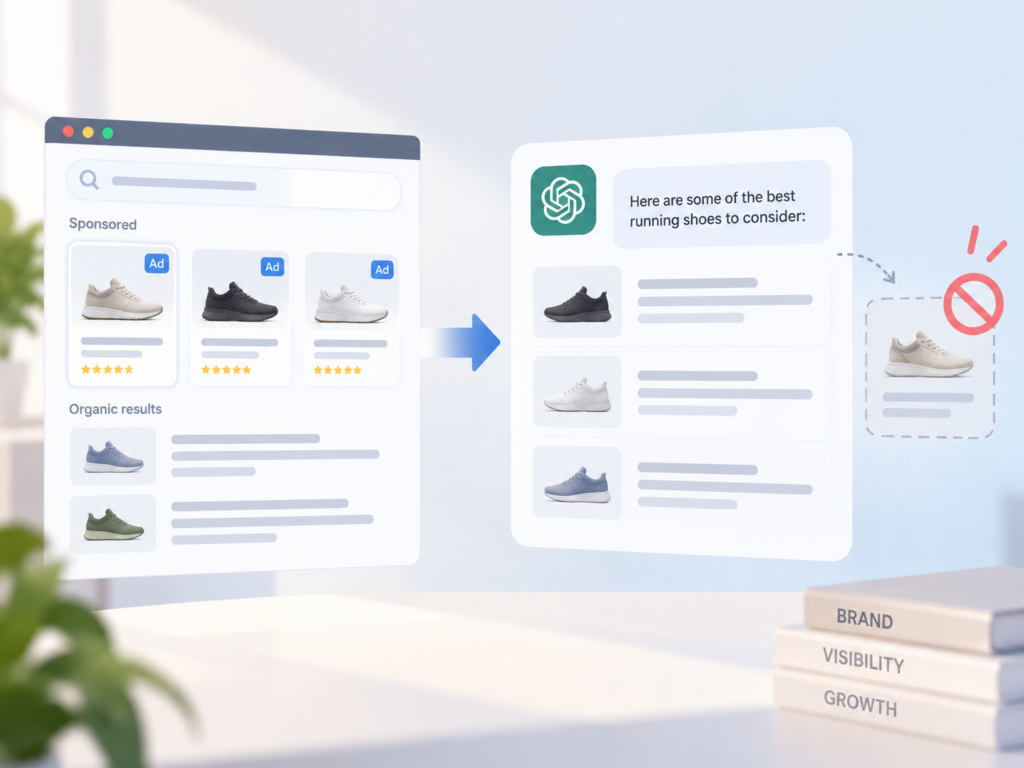
According to reporting on OpenAI’s updated advertiser terms, the company now has explicit discretion to decline or remove ad content that conflicts with its business interests or competitive position. That’s a policy written to flex whenever OpenAI decides a category matters enough to protect.
Why This Should Change How Brands Think About ChatGPT
If your acquisition plan for ChatGPT depends on paid placement, you’re building on a channel the platform owner can close whenever your product starts looking like competition. That’s not a hypothetical. It already happened to Adobe, a company with far more leverage than most brands running ads on this platform.
Here’s the part worth sitting with: a paid channel you don’t control isn’t a channel, it’s a favor.
The teams least exposed to this shift are the ones who were never counting on ChatGPT ads to begin with. They built visibility into how ChatGPT answers questions about their category, not into how much they spend on placement. That distinction is becoming the difference between a durable channel and a rented one.
OpenAI’s own ad ambitions make this more urgent, not less. The company is reportedly targeting roughly $2.4 billion in annual ad revenue, and reaching that number means favoring advertisers who don’t compete with its native tools. Expect the list of restricted categories to grow as OpenAI ships more first-party features.
What Brands Can Still Control When Paid Access Narrows
This is where generative engine optimization, or GEO, stops being a nice-to-have and starts being the more stable half of your AI search strategy. GEO focuses on whether AI systems mention, describe, and recommend your brand in their answers, independent of whether you’re allowed to buy a placement there.
Topify tracks that side of the equation across ChatGPT, Gemini, Perplexity, and other major AI platforms, using seven metrics: visibility, sentiment, position, volume, mentions, intent, and CVR. In practice, that means you can see whether your brand still shows up in category recommendations even after a platform tightens its ad rules, and trace a drop back to a specific source that stopped citing you.
For marketing teams in categories adjacent to what OpenAI builds, that visibility is worth watching closely. If ChatGPT ads for your category ever get restricted the way image and audio tools were, your organic presence in AI answers becomes the only lever left. Competitor monitoring matters just as much here: seeing which rivals keep getting recommended after a policy shift tells you whether the drop is platform-wide or specific to you.
Source analysis rounds this out. Understanding which domains ChatGPT actually cites for your category helps you close the gap the ad restriction just opened, by earning the kind of organic mentions no policy change can revoke.
A Practical Starting Point
Three moves make sense regardless of what OpenAI does next:
- Check whether your product category overlaps with anything OpenAI has launched or hinted at launching. Overlap is the strongest predictor of future ad restrictions.
- Audit how often your brand currently shows up in ChatGPT’s answers for your core category, not just your paid campaign performance.
- Track which sources ChatGPT cites when it recommends competitors, so you know exactly where the content gap sits.
None of these require you to stop advertising where you still can. They just stop your visibility from depending entirely on a channel someone else controls.
Conclusion
OpenAI’s ad restriction isn’t really a story about Adobe or image generators. It’s a preview of how any AI platform will treat advertisers once it decides a category is worth owning outright. Brands that treat GEO as a parallel investment, not a backup plan, are the ones least exposed the next time a policy update lands without warning.
FAQ
Q: Can any AI company advertise on ChatGPT?
A: Not anymore in every category. OpenAI still approves most advertising, but it now declines campaigns for standalone image and audio generation tools that compete directly with its own features. Video generation ads remain permitted for now.
Q: What tools are banned from ChatGPT ads?
A: Reporting points to standalone image generation and audio or voice generation products, with Adobe’s Firefly cited as an affected example. The restriction hasn’t been formalized as a public policy list, which makes it harder for brands to predict in advance.
Q: How do brands get recommended by ChatGPT without ads?
A: By focusing on generative engine optimization: tracking how often ChatGPT mentions your brand, understanding which sources it cites for your category, and closing content gaps competitors are filling instead of you.
Q: Will OpenAI expand these ad restrictions to other categories?
A: It’s likely, given OpenAI’s own product roadmap keeps expanding into new categories and its stated ad revenue targets create pressure to prioritize non-competing advertisers.

