


On February 16, 2026, ChatGPT quietly became a storefront. OpenAI’s Instant Checkout, built on the Agentic Commerce Protocol and rolled out to ChatGPT’s 800 to 900 million weekly users generating an estimated 50 million shopping queries a day, let US shoppers buy directly inside a chat window for the first time. A few weeks earlier, Google had made its own move: Sundar Pichai announced the Universal Commerce Protocol at NRF 2026 with backing from more than 20 retailers, payment networks, and processors.
Two of the biggest platforms on the internet just agreed, independently, that agents need a standard way to read your products. That’s the part most brands are missing. Standardization isn’t a future trend to watch. It’s infrastructure that’s already routing purchases.
What Agentic Commerce Protocol Actually Means for Your Brand
An agentic commerce protocol is a shared language that lets an AI agent discover, evaluate, and transact with a business without a human clicking through pages one at a time. The Agentic Commerce Protocol, maintained by OpenAI and Stripe, defines how buyers, their AI agents, and businesses connect to complete purchases. Google’s answer, the Universal Commerce Protocol, works alongside the Agent Payments Protocol, which secures agent-to-agent transactions by verifying a user’s authority, the agent’s authenticity, and providing a cryptographic audit trail.
You don’t need to pick a side. Most retailers won’t. Shopify already abstracts both ACP and UCP through what it calls Agentic Storefronts, letting merchants toggle AI channels on or off while Shopify handles the protocol work in the background.
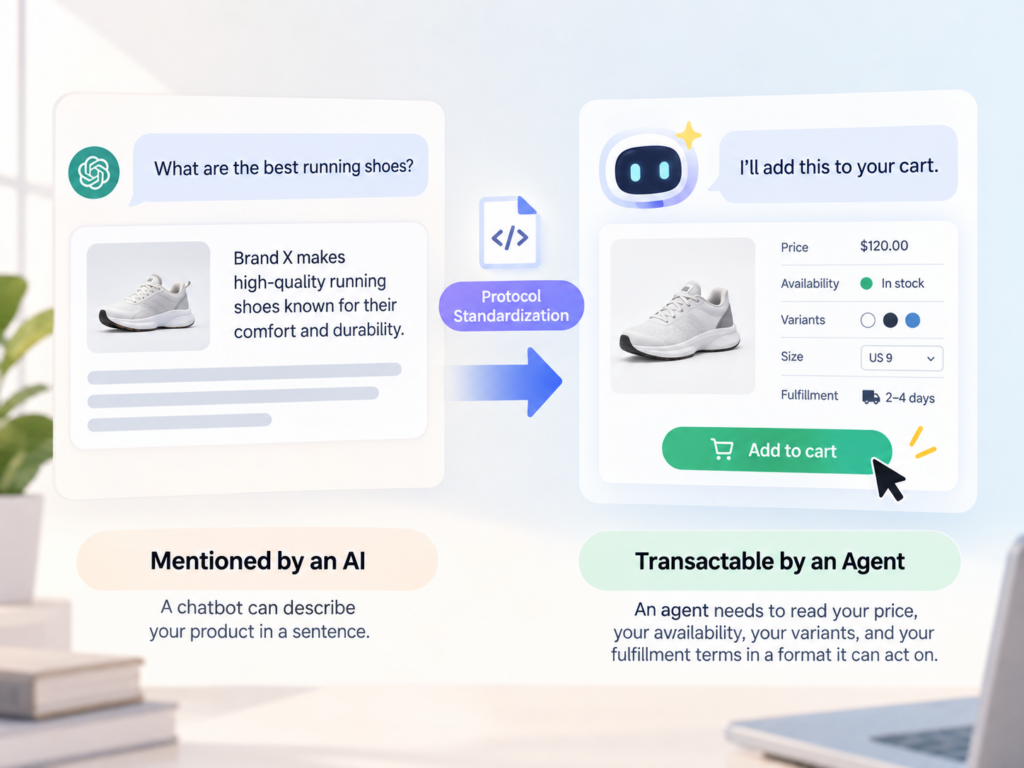
Here’s the distinction that actually matters for you. Being mentioned by an AI is not the same as being transactable by an agent. A chatbot can describe your product in a sentence. An agent needs to read your price, your availability, your variants, and your fulfillment terms in a format it can act on. Protocol standardization is what turns “the AI knows you exist” into “the AI can put you in a cart.”
Why Standardization Changes the Rules of Visibility
Traditional SEO rewarded content built for people: persuasive copy, backlinks, keyword density. Agentic commerce protocol standardization rewards something narrower: structured, verifiable, machine-parseable facts.
Under UCP, agents extract Schema.org markup and compare factual specifications against a shopper’s query, and precise attributes like “100% GOTS certified organic cotton, 200 GSM” consistently outperform marketing copy like “luxuriously soft premium cotton”. That’s not a stylistic preference. It’s how the retrieval mechanism works.
This is the part that should worry more brands than it does. A protocol doesn’t rank you lower for weak data. It skips you. If your product feed is missing the fields an agent needs to compare, negotiate, or verify a transaction, you’re not competing for the third spot on a results page. You’re not in the query at all.
Google’s Shopping Graph now holds over 50 billion product listings and processes more than 2 billion product updates per hour, which gives a sense of the scale agents are already querying against. Your listing either fits into that machine-readable layer or it doesn’t show up.
The Data Gap Most Product Feeds Have Right Now
Most catalogs aren’t close to ready, and the gap is well documented. Early 2026 research found that 40% of ecommerce businesses were still standardizing their product pages for agentic AI, while 33% hadn’t started at all. Separately, nShift’s early 2026 survey found that 58% of consumers had already replaced traditional search with AI for product discovery, even as 33% of ecommerce businesses had not begun structured data preparation.
The gap isn’t only about missing tags. It’s also about staleness. Ahrefs data cited by Passionfruit Labs found that GPT-5.3 retrieves only 6% of pages older than 30 days, down from 33% under GPT-5.2. Agents are weighting recency harder every model cycle. A product page that hasn’t been touched since last quarter is effectively invisible to the newest retrieval behavior, regardless of how good the content is.
Partner surveys back this up from the retailer side too. Tech partners in Mirakl’s 2026 commerce survey rated retailer AI readiness at just 4.4 out of 10, with the lowest scores going to monitoring brand presence in AI-driven search. Most brands genuinely don’t know which queries surface their products in an agent’s response, or whether they show up at all.
How This Differs from Traditional SEO Data Requirements
| Requirement | Traditional SEO | Agent-Ready Data |
|---|---|---|
| Core asset | Page content, backlinks | Structured attributes, schema markup |
| Update cadence | Weekly or monthly | Real-time pricing and availability |
| Success signal | Ranking position | Successful agent read and transaction |
| Format | Human-readable copy | Machine-parseable JSON-LD, feeds, APIs |
| Failure mode | Lower ranking | Excluded from the agent’s result set entirely |
How to Check If Your Product Data Is Agent-Ready
You can’t fix a gap you can’t see, and most teams are flying blind here. This is exactly where Source Analysis inside Topify’s GEO analytics platform becomes useful. It tracks the specific domains and URLs that AI platforms cite when answering product-related queries, so you can see whether agents are actually pulling from your product pages or defaulting to a competitor’s listing, a marketplace page, or a review site instead.
That distinction matters more than a generic visibility score. A brand might show up in general brand mentions across ChatGPT or Perplexity while its actual product pages never get cited in the moments that lead to a transaction. Source Analysis surfaces that content gap directly, which is the same gap the protocol standards above are built to expose.
Structured data correlates directly with citation rates: 71% of pages cited by ChatGPT and 65% of pages cited by Google AI Mode contain schema markup, most commonly in JSON-LD format. If your product pages lack that markup, the data says you’re statistically less likely to be the source an agent reaches for.
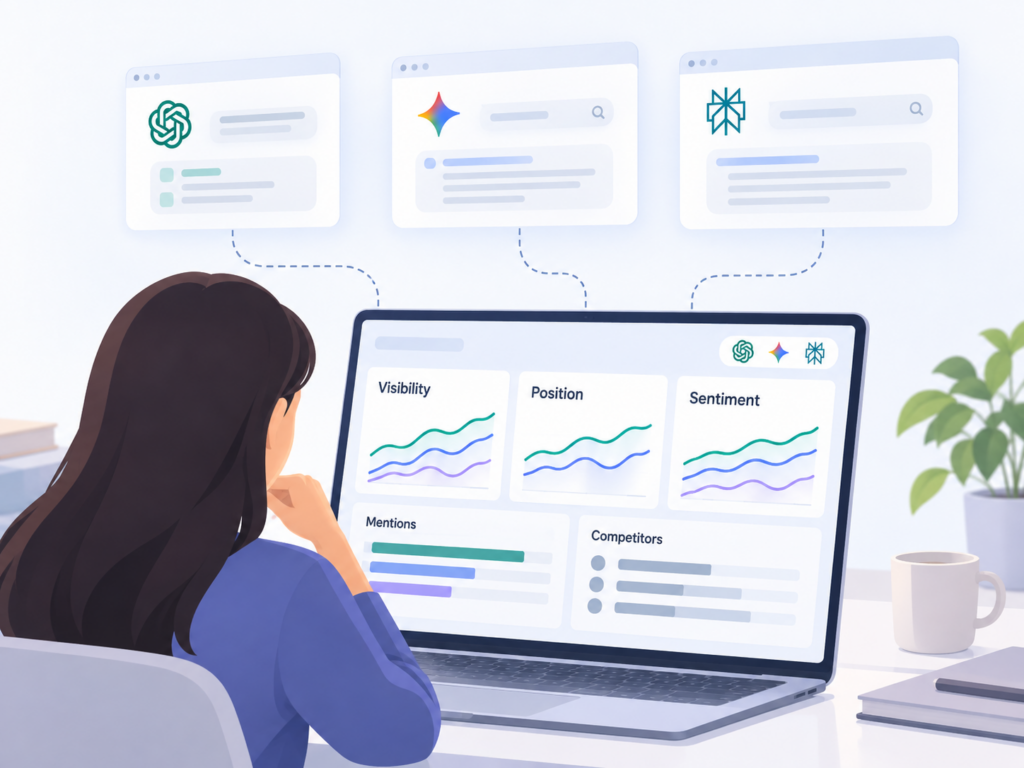
Pairing that source-level view with Comprehensive GEO Analytics gives you the other half of the picture: how your visibility, position, and sentiment compare to competitors across ChatGPT, Gemini, and Perplexity over time, not just a one-time snapshot.
Getting Ahead of the Standardization Curve
The pace of adoption isn’t waiting for anyone to catch up. McKinsey’s 2026 AI Commerce Index found that 34% of online shoppers in the US had already used an AI agent to assist with a purchase decision, up from 9% in 2024. That’s a fourfold jump in two years, and the protocol layer underneath it is still being finalized.
Fixing your data now is cheaper than fixing it after standardization fully locks in. Once ACP, UCP, and AP2 mature into the default rails for agentic transactions, brands with clean structured data will have a running head start, and brands without it will be doing emergency catalog audits under competitive pressure instead of on their own timeline.
Start with what’s actually blocking agents today: incomplete attributes, stale pricing, missing schema markup. Then use visibility and source tracking to confirm the fix worked, not just that you shipped it. That verification step is where most teams stop, and it’s the one that actually tells you whether agents can see you.
Conclusion
Agentic commerce protocols aren’t a distant standard to plan for someday. ACP is already routing purchases inside ChatGPT, UCP is live in Google’s AI Mode and Gemini, and the coalition behind both keeps growing. What decides whether your brand participates in that layer isn’t your marketing copy. It’s whether your product data is structured, current, and verifiable enough for an agent to act on.
FAQ
What is an agentic commerce protocol?
It’s an open standard, like ACP or UCP, that defines how AI agents discover product information, complete checkout, and transact with a business on a shopper’s behalf, without a human browsing the page directly.
How do AI agents actually read product data?
Agents pull from two main sources: structured feeds submitted directly to a platform, and Schema.org markup embedded in your product pages that crawlers like GPTBot or PerplexityBot can parse during a live query.
How do I know if my product data is ready for AI agents?
Check whether your product pages are actually being cited when AI platforms answer shopping-related queries in your category. That visibility, not your page’s traditional SEO ranking, is the signal that reflects agent readiness.
Searched the web

