An old NoArchive or NoCache directive may look harmless because it has survived several platform migrations. Microsoft’s new policy makes that assumption risky. Beginning in 2027, those older signals stop serving as the training and grounding choice publishers may have expected, while newly documented controls take over at different scopes.
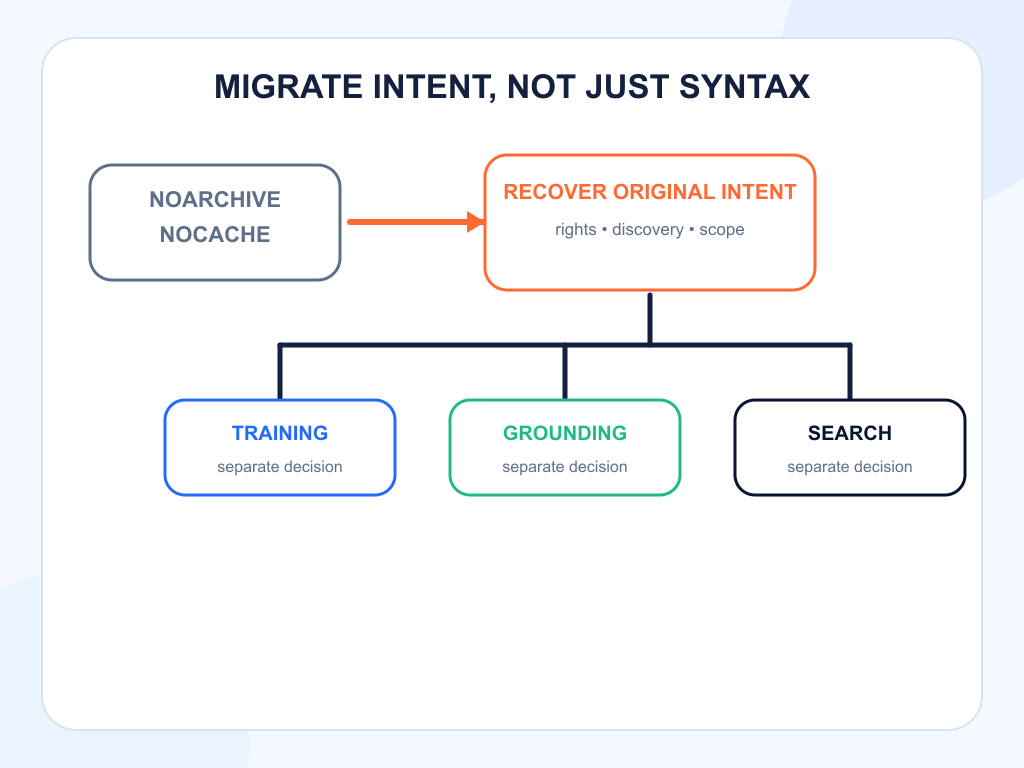
The migration is not a search-and-replace exercise. Teams need to recover the original intent, separate training from grounding, publish the new values, and preserve a temporary setting while Microsoft recrawls affected pages. Missing one layer can silently broaden use or remove desired AI visibility.
Start with an inventory of old directives
Search HTML templates, HTTP headers, CDN rules, server configuration, CMS plugins, and edge functions for NoArchive and NoCache. Include capitalization variants and rules generated only for Bingbot. A page-source scan alone will miss directives delivered through X-Robots-Tag.
For every match, record the URL pattern, delivery layer, current owner, original business reason, and last verification date. Mark whether the directive protects licensed material, prevents stale copies, limits snippets, or was added as a general AI precaution.
Do not assume the name explains the purpose. Old directives may have accumulated several meanings over time.
| Inventory field | Why it matters | Common failure |
|---|---|---|
| Delivery layer | Shows where the replacement must be deployed | Editing HTML while a CDN header still wins |
| URL scope | Prevents accidental site-wide application | Applying one policy to public and licensed pages |
| Intended use | Separates training, grounding, and search concerns | Replacing every rule with the strictest option |
| Owner | Creates an approval path | Technical teams guessing at contractual intent |
| Last crawl evidence | Supports transition planning | Assuming Microsoft has discovered the new value |
Translate intent before translating syntax
Microsoft’s new preference framework separates two questions. AI Training controls whether content may help modify generative model parameters. AI Grounding controls whether content may inform a generated response at answer time.
A publisher can disallow training while allowing grounding. That combination keeps content eligible to support citations without granting the same preference for future model training. A publisher can also allow training but restrict extended grounding, although the business case should be explicit.
Map each old directive to a policy outcome, not directly to a new token. Legal and editorial owners should approve the intended use; engineering should implement the approved state.
Publish the new training preference at the right scope
Microsoft supports the shared __usage_ai-training policy token in robots.txt for site or path rules. The IETF Internet-Draft uses ordinary robots path matching, including longest-match precedence, rather than inventing a new directive grammar.
Microsoft also documents page-level training values through a Bingbot meta tag or X-Robots-Tag. A page-level value can override a broader robots policy. That is useful for exceptions, but it also creates an audit challenge when teams forget that the override exists.
Use the broadest scope that accurately reflects policy, then document every exception. Avoid generating thousands of page-level overrides when one stable path rule would express the same decision.
Publish grounding separately on each page class
AI Grounding is page-level in Microsoft’s implementation. Allow is the default, DisallowExtended limits use to Microsoft-operated experiences, and Disallow prevents grounding use. There is no site-wide robots.txt grounding preference in the announcement.
Choose one delivery method per content system when possible. HTML meta tags work well for templated pages. HTTP headers are useful for PDFs, feeds, and responses that do not expose editable markup. Check that canonical and localized variants receive the intended value.
Conflicting headers and tags should block the release. A policy that depends on undocumented precedence is not ready for production.
Use the transition window instead of waiting for recrawl
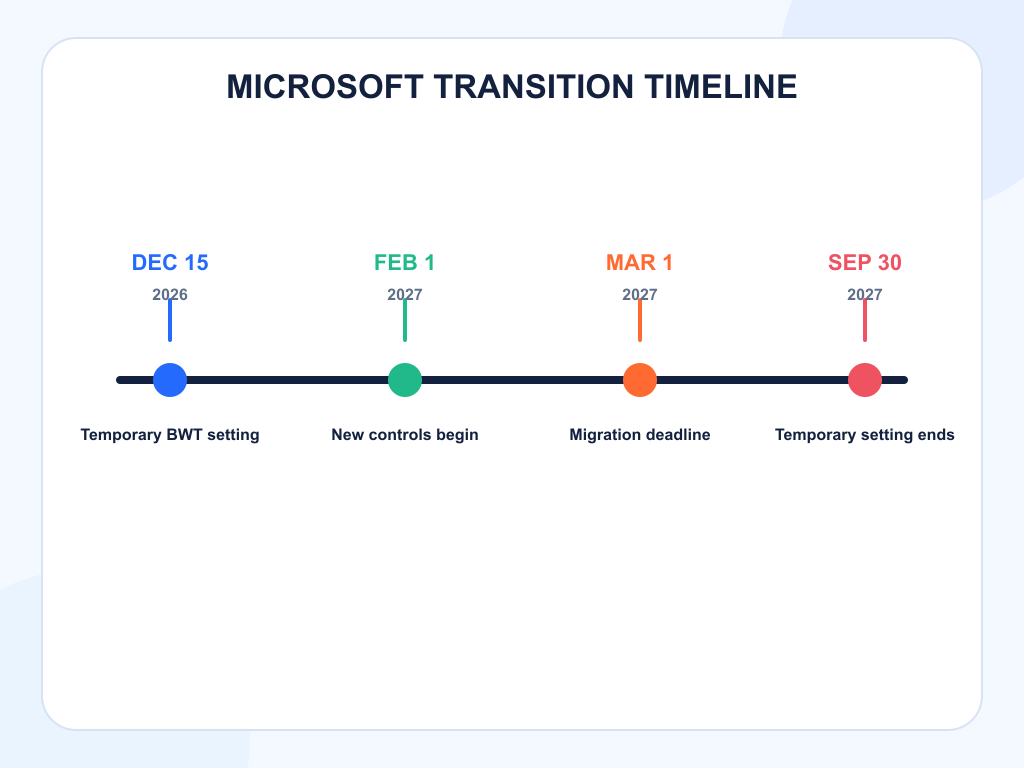
The announced schedule has four important points:
- December 15, 2026: temporary grounding transition preferences open in Bing Webmaster Tools for qualifying sites already using
NoArchiveorNoCache. - February 1, 2027: Microsoft begins honoring the new preferences as pages are crawled.
- March 1, 2027: publishers using the old signals must complete the documented transition steps to maintain restrictions.
- September 30, 2027: remaining temporary grounding preferences expire.
The temporary setting exists because recrawl timing is not guaranteed. Publishers that need continuity should not rely on Microsoft discovering every replacement directive before the deadline.
Record screenshots or exports of the temporary setting, the production directives, and the date each page class was verified. This evidence matters when a policy review occurs months later.
Validate responses at the edge and origin
Run automated checks against representative URLs from every policy class. Capture the status code, canonical URL, robots rules, page meta tags, X-Robots-Tag, cache state, and rendered response. Repeat from more than one region if the CDN varies responses geographically.
Also test failure states. A 404 template, soft 404, redirect target, or authentication wall can expose a different header set. A rule applied only to successful HTML responses leaves other assets outside the intended boundary.
After deployment, use IndexNow when appropriate to signal changed URLs, but treat it as a recrawl hint rather than proof. Microsoft states that publishing a setting is not the same as activating it; the crawler must discover the new value.
Monitor search and AI visibility as separate outcomes
Traditional Bing eligibility should remain distinct from grounding visibility. Track indexed pages, impressions, clicks, and crawl behavior in the search layer. Track citations, mentions, recommendation position, and source selection in the answer layer.
Topify can organize the second layer around a fixed set of prompts. Tag prompts by the page class they are most likely to retrieve, then use citation and competitor intelligence to observe whether affected sources disappear, persist, or shift after recrawl. Pair those observations with deployment timestamps and Bing Webmaster Tools evidence. The related workflow in Measure the Lag From AI Discovery to Citation explains why one early answer should not be treated as the final effect.
The limitation is causal certainty. A model update or competitor page can change the same metrics. Use control prompts and repeated observations.
Build a rollback and review plan
Every content-control migration needs a rollback owner. Preserve the previous configuration, the approved policy map, and the mechanism for reversing a mistaken rule. Set a review after the first verified recrawl and another before the temporary preference expires.
Monitor for three failure patterns: unexpected loss of Microsoft citations, pages still behaving under an old directive, and content classes receiving the wrong new value. A successful syntax check does not prove the business outcome matches the intended policy.
Coordinate the migration across teams
The technical owner should not carry this change alone. Legal or rights teams define which uses are permitted, editorial teams classify content, product teams identify discovery value, and infrastructure teams control the delivery layer. Assign one accountable migration lead who can resolve conflicts rather than allowing each group to publish its own override.
Create a change ticket for every policy class, not every URL. The ticket should include the current state, approved training value, approved grounding value, implementation location, sample URLs, test output, temporary Bing Webmaster Tools state, and rollback instruction. Attach the final production response after deployment.
Communicate the difference between a deadline and a recrawl. Completing the code by March 1 does not prove every page has been processed. Continue monitoring until representative pages show the new response, old directives are removed where required, and the temporary bridge is no longer the only protection.
Retire duplicate legacy rules after verification. Leaving obsolete controls in place makes later debugging harder and can cause a future migration tool to infer the wrong intent.
Conclusion
Migrating from NoArchive and NoCache requires more than swapping strings. Recover the original intent, separate training from grounding, select the right scope, publish the new directives, and use Microsoft’s temporary transition setting while recrawl catches up.
Complete the inventory before the March 1, 2027 deadline becomes an emergency. Then keep search reporting and answer-level visibility in separate dashboards. Topify’s source monitoring workflow can help document the AI visibility side of the migration while server and Bing data verify implementation.
FAQ
When do NoArchive and NoCache stop serving as AI preferences?
Microsoft says the new controls begin taking effect on February 1, 2027 and publishers using the old signals should complete transition steps by March 1, 2027.
Can one setting control both training and grounding?
No. Microsoft treats them as independent preferences, so the publisher should make and implement each decision separately.
Is the temporary Bing Webmaster Tools preference permanent?
No. It ends when Microsoft recrawls the page and discovers the new value, or on September 30, 2027, whichever comes first.
Does IndexNow guarantee that Microsoft activates the new rule?
No. It can signal a changed URL, but it does not guarantee a particular recrawl date.