A content team updates a page on Monday, sees an AI crawler in its logs on Tuesday, and checks ChatGPT on Wednesday. The answer still cites a competitor, so the team calls the update a failure. That conclusion may be correct, but the timing evidence is not strong enough to support it. A crawler visit, a retrieved passage, a changed answer, and a visible citation are separate events.
The lag from AI discovery to citation is best treated as an observed distribution, not a promised turnaround time. Measuring it requires controlled releases, stable prompts, and a timeline that preserves uncertainty. The result will not tell you exactly why a model selected a source. It will tell you when to keep waiting, when to investigate access, and when the content itself needs improvement.
Discovery, retrieval, citation, and mention are different events
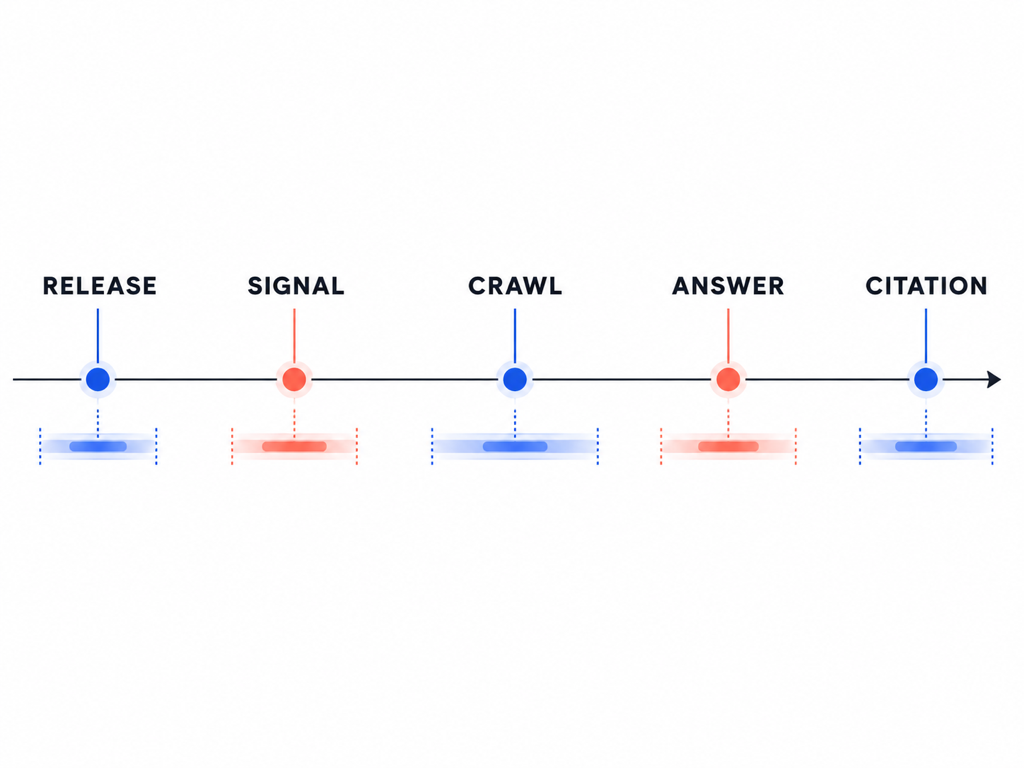
Discovery means a system becomes aware that a URL exists or changed. Crawling means an automated agent requests the resource. Retrieval means the page or passage is selected as potentially relevant to a prompt. Citation means the final answer exposes the source to the user. A mention may include the brand without linking to any owned page.
Teams often collapse all five into “indexing.” That shortcut makes diagnosis impossible. A verified crawl followed by no citation can be caused by weak topical relevance, insufficient evidence, conflicting facts, answer variability, or a stronger competing source. A citation can also appear without a referral click, so analytics traffic is not a dependable timestamp for citation.
Use a separate event model:
| Event | Observable evidence | Main limitation |
|---|---|---|
| Page release | Deployment or CMS log | Proves availability, not discovery |
| Change signal | Infrastructure or sitemap event | Proves notification, not fetch |
| Verified crawl | Edge or origin request with validated identity | Proves access, not retrieval |
| Answer change | Repeated prompt capture | May occur without a citation |
| Citation | Visible source URL in an answer | Varies by platform, prompt, and run |
| Referral | Session with an AI referrer | Captures only users who click |
The lag you calculate depends on which pair of events you compare. “Release to first citation” is a business-facing measure. “Verified crawl to first changed answer” is a narrower technical measure. Keep both when possible.
Define timestamps before the release goes live
Retrospective measurement is fragile because teams rarely preserve the exact old page, prompt wording, model surface, or answer. Define the experiment before publishing the change.
Record the canonical URL, release timestamp in UTC, changed claim, old value, new value, source that supports the correction, and the audience decision affected. Save a rendered copy or content hash of both versions. The hash helps prove the page changed, while the rendered copy shows what a crawler and user could actually read.
Choose prompt clusters that directly test the changed claim. A new compatibility statement might require prompts about supported devices, setup requirements, alternatives, and purchase suitability. One broad brand prompt may never retrieve the affected page.
Keep the platform, region, language, account state, and prompt wording stable for the primary series. Exploratory variations can run separately, but mixing them into the core timeline introduces more variability than insight.
Establish a baseline that captures answer volatility
Run the test prompts several times before release, not once. AI responses can change even when your page does not, so the baseline must show normal variation in mentions, positions, and sources.
For each run, capture the full answer, timestamp, linked citations, unlinked brand mentions, recommendation position, and important factual phrasing. Record whether the changed claim appears at all. A source may remain cited while the answer stops using its outdated passage.
You do not need to pretend the baseline is a controlled laboratory study. Label account, personalization, and product-version details that you cannot hold constant. The goal is to distinguish a durable post-release shift from ordinary output churn.
A practical minimum is a pre-release window plus several post-release checkpoints. Faster cadence is appropriate for a material correction; slower cadence is sufficient for an evergreen explainer. Avoid publishing a universal “24-hour indexing” expectation when the underlying systems do not offer that guarantee.
Mark releases and control for unrelated changes
Content teams often change titles, internal links, schema, copy, images, and redirects in the same deployment. That may improve the page, but it weakens causal interpretation. When the objective is to learn about discovery-to-citation lag, isolate one material change or at least document every concurrent change.
Also record external events. A competitor may publish new research, an official source may change its documentation, or the AI product may update its retrieval system. These events can alter citations independently of your release.
Use a control set of prompts unrelated to the edited page. If citations change widely across control and test prompts at the same time, the effect may reflect platform-level volatility rather than your update.
Calculate median lag and confidence bands
The first observed citation is useful, but it can be an outlier. A stronger metric reports the distribution across prompts and repeated runs.
For each prompt, calculate:
- release-to-first-verified-crawl time;
- crawl-to-first-answer-change time;
- release-to-first-citation time;
- share of post-release runs citing the updated page;
- share of answers that reflect the corrected claim.
Report the median rather than only the fastest case. Add an interquartile range when you have enough observations. With a small sample, show every observation and call it descriptive rather than statistically conclusive.
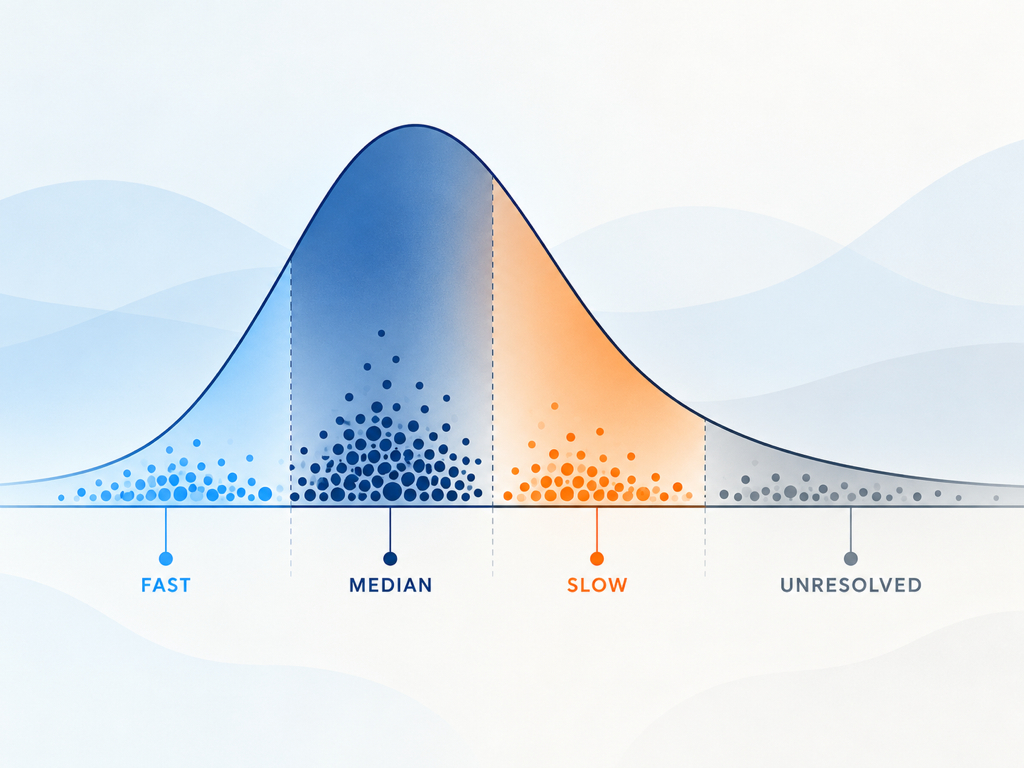
Do not assign a zero-day lag to pages that never receive a citation. Treat them as censored or unresolved observations. That preserves the difference between “not yet observed” and “will never happen.”
Interpret zero-citation and partial-change outcomes
A page can be crawled and still fail to appear in answers. That outcome directs the next investigation toward relevance and evidence rather than access. Check whether the page answers the test question directly, exposes the updated fact in readable text, cites a primary source, and uses a canonical URL that resolves consistently.
A changed answer without a visible citation is more ambiguous. The new fact may come from another source, from an uncited retrieval step, or from a model behavior unrelated to your page. Report it as an answer change, not as an owned-source citation win.
A citation without the corrected claim also deserves caution. The model may use a different passage from the page. Passage-level comparison matters more than a binary cited/not-cited field when the experiment targets a specific fact.
Here is the decision rule:
- No verified crawl: investigate discovery, access, rendering, or bot controls.
- Crawl but no answer change: improve relevance, extractability, evidence, or corroboration.
- Answer change but no owned citation: look for alternate sources and avoid causal claims.
- Citation appears inconsistently: increase repetitions before declaring a stable gain.
- Citation and corrected claim persist: record the lag and keep monitoring for durability.
Use Topify to observe the citation side of the timeline
Topify can serve as the repeated answer-observation layer while your CDN, server, or crawler-verification system supplies the access timestamps. Create a prompt group that maps directly to the changed claim, capture a pre-release baseline, annotate the release date outside the platform if needed, and compare visibility, position, sentiment, and cited sources after the release.
Topify's documented Sources Analytics supports date ranges, provider filters, citation counts, top domains, and source-performance trends. Those outputs can show whether the edited URL or domain appears more often in the observed source set. They cannot prove that one crawler visit caused one answer, and the underlying responses remain sampled observations. The related article Why AI Stops Citing Your Brand is useful when access succeeds but citation share later declines.
Keep the raw captures. A dashboard trend is easier to defend when an analyst can inspect the answer and citation that produced it.
Conclusion
Discovery-to-citation lag is not one timer. It is a chain of events with different evidence: release, signal, crawl, retrieval, answer change, citation, and click. Measure each event you can observe, keep prompt conditions stable, and report a distribution rather than the fastest success. A missing stage should narrow the diagnosis instead of triggering a generic “indexing issue” label.
Begin with one material page update and five tightly matched prompts. Preserve the old page, log the release, verify crawler access, and monitor repeated answers for at least the decision window your business can tolerate. Topify's source and visibility monitoring can document the downstream answer layer while infrastructure data anchors the technical timeline.
FAQ
What is discovery-to-citation lag?
It is the observed time between a page release or discovery event and the first verified AI answer that visibly cites the page. Teams should specify the exact start and end events.
Can server logs show when a page was cited?
No. Logs can show requests to your server. Citation requires inspecting the AI answer and its displayed sources.
How many prompts should a lag test include?
Use enough prompts to cover the changed claim and its main user intents. Five to ten focused prompts can support an initial descriptive test, but repeated runs matter as much as prompt count.
Why might a crawler revisit a page without citing it?
Access does not guarantee relevance or selection. The page may be weaker than competing evidence, poorly structured for the prompt, or simply not chosen in a variable answer run.