A policy meeting reaches agreement that “AI use” should be limited, then stalls when engineering asks what that means. One stakeholder wants models not to learn from the archive. Another still wants Copilot and ChatGPT to cite current reporting. A third wants ordinary search traffic protected. The phrase sounds unified, but the systems are not.
AI training vs AI grounding is a governance choice between future model development and answer-time retrieval. Publishers can make different decisions for each use. The practical task is to match those decisions to content rights, discovery value, and platform-specific controls without pretending one directive governs the entire AI stack.
Training and grounding happen at different times
AI training uses content to modify a model’s learned parameters. Grounding uses content at inference time to help answer a current request. Traditional search indexing builds a retrievable catalog, while crawling obtains the content needed for one or more of those purposes.
Those layers can share infrastructure, but they remain different uses. OpenAI, for example, documents GPTBot for potential training and OAI-SearchBot for ChatGPT search. Microsoft now documents independent training and grounding preferences. Google’s Google-Extended controls selected Gemini training and grounding uses without controlling Google Search.
| Layer | Main question | Typical evidence | Business effect |
|---|---|---|---|
| Crawl access | May this agent fetch the URL? | Server logs and robots rules | Technical availability |
| Search indexing | May the page appear in search results? | Search platform reporting | Link discovery and traffic |
| AI grounding | May the page inform a generated answer now? | Citations and answer captures | Answer visibility and referral opportunity |
| AI training | May the content help modify future model parameters? | Published preference and platform policy | Long-term model-development permission |
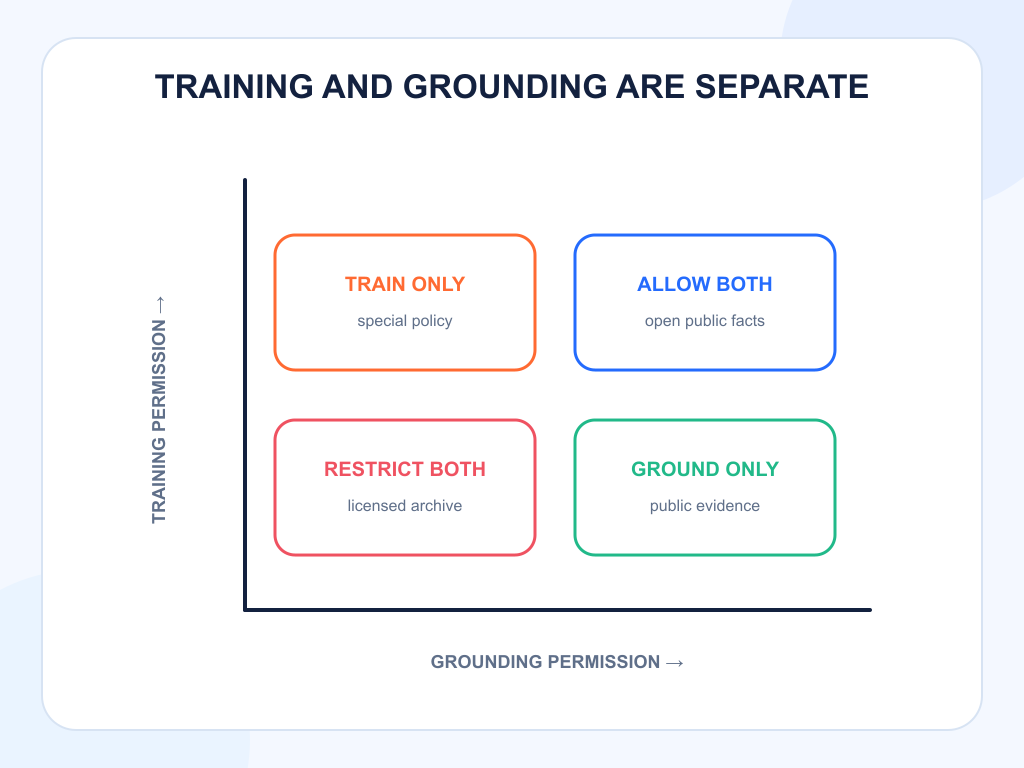
Allowing grounding does not require allowing training
A publisher may want current public facts cited while withholding a preference for model training. OpenAI explicitly presents OAI-SearchBot and GPTBot as independent controls. Microsoft similarly allows a publisher to disallow training and keep grounding at Allow.
That combination is often the starting point for public documentation, product specifications, press releases, and evergreen explainers. The material benefits from being discoverable at answer time, while the organization keeps a separate position on model development.
The reverse combination may be harder to justify for many publishers, but it is still conceptually possible. The important point is that policy owners must choose each use deliberately.
Rights and business value should drive the content map
Do not begin with platform syntax. Begin with content classes and the rights attached to them. Public corporate facts, licensed wire copy, subscriber analysis, user submissions, personal data, product manuals, and government records have different risk and discovery profiles.
For each class, record:
- who owns the material and which contracts limit reuse;
- whether answer-time citation provides audience or public-interest value;
- whether the content remains accurate without live context;
- whether the page contains sections that need narrower treatment;
- who can approve a change and how often the policy should be reviewed.
This is not a substitute for legal advice. It is an operating map that lets legal, editorial, product, and engineering teams discuss the same assets and outcomes.
Platform controls do not line up perfectly
The web still lacks one universally deployed AI-use switch. The IETF’s AI Preferences vocabulary remains an Internet-Draft, and the newer machine-readable training signal is also a draft. Microsoft has announced support for __usage_ai-training, while Google says it intends to support the shared token in early 2027.
OpenAI currently uses crawler-specific robots groups. Apple documents Applebot controls for crawling and model training. Google-Extended is a product token rather than a separate request user agent. Microsoft adds page-level grounding choices that do not have a direct equivalent on every other platform.
Build a platform matrix rather than forcing one label across incompatible mechanisms. Mark each control as current, announced, experimental, or draft.
Use the narrowest control that matches the concern
A global crawl block is usually broader than a training objection. It can prevent search or answer-time retrieval and remove the opportunity for a citation. A training-specific token is narrower when the concern is model development. A page-level grounding restriction is narrower when only selected material should stay out of generated answers.
Section-level controls may be appropriate when a page mixes public commentary with licensed excerpts, though platform support varies. Authentication and paywalls are access controls, not simply preference signals. They should be governed by the content product, not added as a last-minute SEO tactic.
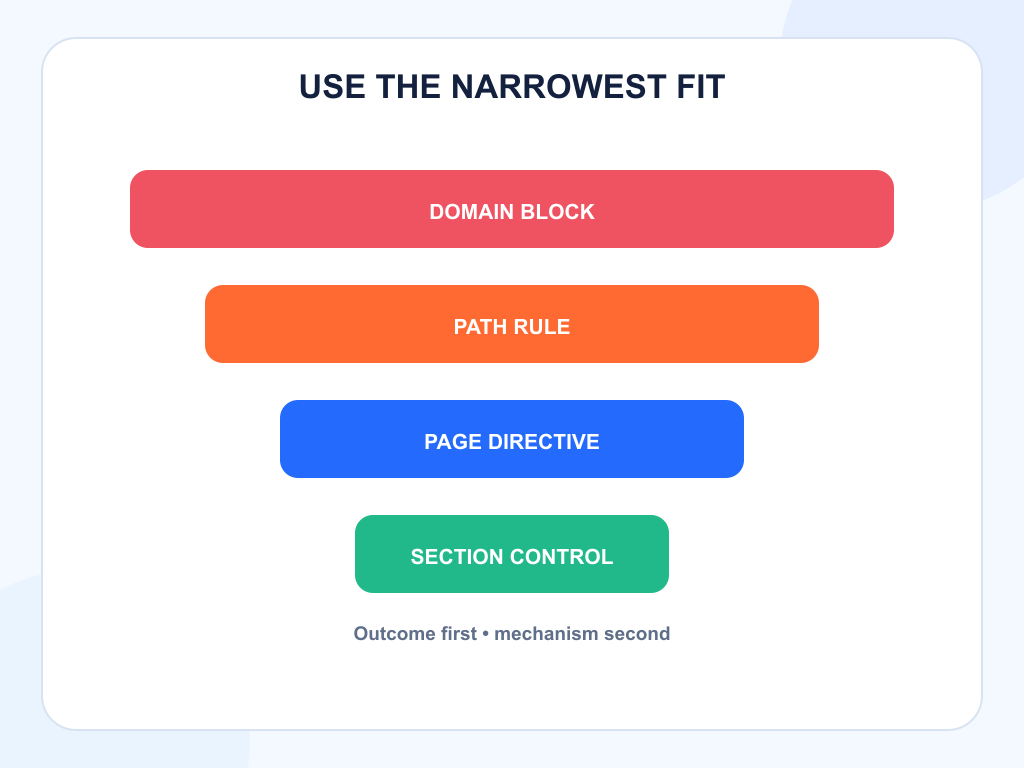
The safest rule is outcome first, mechanism second. Define the use you want to permit or restrict before selecting syntax.
Measure what a restrictive choice removes
Before a policy change, capture a baseline for crawl activity, indexed pages, citations, brand mentions, referral sessions, and business outcomes. Segment by content class and platform. A global average can hide that one documentation section supplies most valuable AI citations.
After the change, wait for recrawl and collect repeated answer observations. A citation decline may be an intended consequence, but stakeholders should see its size and location. Traditional search can remain stable while AI grounding visibility falls.
Topify can support the answer-level baseline with fixed prompt sets and cross-model visibility tracking. Compare mentions, positions, and cited sources before and after a directive is discovered. Use the related guide AI Crawl Budget: Reduce Waste Without Hiding Useful Pages to keep role-specific access from becoming a blanket bot policy. Topify observations do not replace server logs or platform controls, but they reveal the user-facing surface that infrastructure data cannot show.
Create a registry instead of relying on robots.txt memory
Maintain a policy registry with the content class, platform, control, scope, value, owner, approval record, deployment date, crawl status, and review date. Link to the exact current documentation used for the decision.
Review it after platform announcements and at least quarterly for high-value content. A directive can become technical debt when the product changes, a contract expires, or a shared standard replaces a vendor-specific control.
Include a rollback plan. When a restrictive rule causes an unintended visibility loss, the team should know who can reverse it and how to verify that the change has been recrawled.
Avoid policy language that promises enforcement
Preference signals communicate an instruction or request within a platform’s documented framework. They are not access-control systems, encryption, or universal contracts. Do not describe a robots rule as proof that content can never be copied, retained, or used by an unidentified system. Sensitive material should not be published openly merely because a training preference is present.
Use precise internal language. “We publish a disallow preference for this platform and content class” is supportable. “No AI can train on this page” is not. The first statement describes the organization’s action; the second claims knowledge about every external actor.
The same precision should appear in public policies. Explain the scope, affected services, and effective date without implying that a draft standard has universal adoption. When a vendor changes documentation, update the register and the public explanation together. This reduces the gap between what policy owners believe, what engineers deployed, and what readers were told.
Finally, keep confidential or regulated material behind appropriate authentication and authorization. AI preferences can complement those controls, but they cannot replace them.
This hierarchy also clarifies incident response. An access-control failure is a security event; an incorrect preference is a governance and distribution event. The owners and remedies are different.
Conclusion
AI training vs AI grounding is not a semantic distinction. Training concerns future model parameters; grounding concerns the sources available to a current answer. Publishers can allow one and restrict the other while preserving separate choices about crawling and ordinary search.
Map rights and discovery value by content class, choose the narrowest supported mechanism, and measure the result after recrawl. Topify’s cross-model analytics can show the citation and mention consequences of a grounding decision, while your registry and technical checks preserve the policy evidence behind it.
FAQ
Is AI grounding the same as search indexing?
No. Grounding uses content to inform a generated answer, while indexing makes content retrievable for a search system. A platform may connect the systems, but the uses remain distinct.
Can a publisher block training and allow AI citations?
Yes, when the platform offers separate controls. OpenAI and Microsoft both document ways to distinguish training from search or grounding.
Does robots.txt legally enforce an AI preference?
Robots.txt communicates a machine-readable preference or crawl rule. Legal enforceability depends on jurisdiction, contracts, and facts, so publishers should obtain appropriate counsel.
Why is a platform matrix necessary?
Vendor controls differ in scope, syntax, and deployment status. A matrix prevents a rule for one system from being mistaken for a universal standard.