

Your domain authority is solid. Your keyword rankings haven’t moved in months. By every metric in your SEO dashboard, things look fine. Then someone asks Perplexity for the top tools in your category, and your brand isn’t in the answer.
None of your existing metrics can explain why, because none of them were built to measure what an AI chooses to say. There’s no position eleven in an AI answer. You’re either cited or you’re invisible, and most SEO stacks can’t tell you which one you are right now.
What AI Search Visibility Actually Measures
AI search visibility measures how often, and how prominently, your brand appears in AI-generated answers across engines like ChatGPT, Google AI Overviews, Gemini, and Perplexity. It’s a fundamentally different quantity from a Google ranking.
Traditional search is a list. Position 3 still gets clicks, position 8 still gets scraps, and you can trade positions week to week without falling off the map. AI search is a synthesis. The engine reads its sources, composes one answer, and cites a handful of brands. Everyone else gets nothing.
That’s the core mechanical difference: rankings measure position, AI visibility measures the probability of being mentioned at all.
The two don’t move together as much as most SEO teams assume. Research on ranking and mention behavior shows that traditional SEO signals predict where you appear inside an AI answer better than whether you appear in it. Strong domain authority helps you rank higher once you’re cited. It doesn’t guarantee the citation happens.
Here’s how the pipeline works in practice. A user types a prompt. The engine retrieves candidate sources, weighs them by topical fit, entity consistency, and extractability, then synthesizes an answer that cites a small subset. Your visibility is decided at that retrieval-and-citation step, not on a results page.
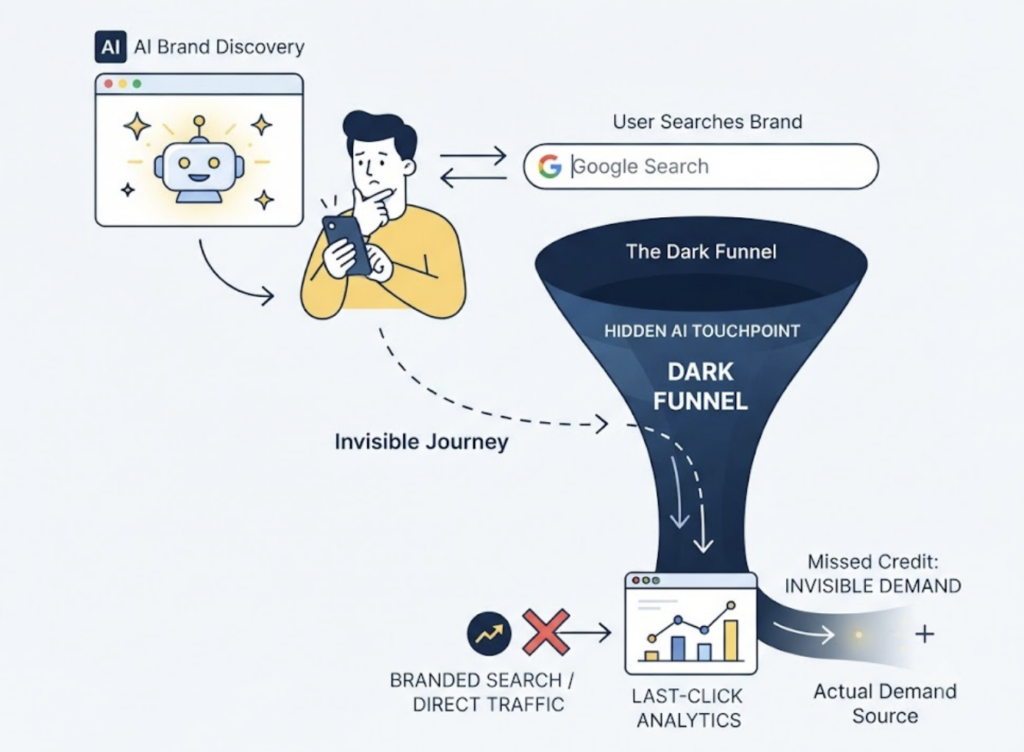
There’s also an attribution problem hiding underneath. Users often encounter a brand inside an AI answer first, then Google the brand by name later. Last-click analytics logs that as branded search or direct traffic. The AI touchpoint that actually created the demand never shows up in your reports. Industry researchers call this the dark funnel, and it’s the reason AI visibility rarely gets credit inside standard dashboards.
How to Measure AI Search Visibility
The first instinct most teams have is to open ChatGPT, type their category keyword, and see if they show up. That single check is close to meaningless.
AI outputs are stochastic. The same prompt can return different brands on different days, because large language models compose answers probabilistically rather than pulling from a fixed index. Citation volatility studies from Passionfruit found that roughly 68% of queries generating citations in one month fail to generate them the next. One spot-check tells you about one roll of the dice.
Measuring AI search visibility properly requires three things: a fixed prompt set, multi-engine coverage, and time-series data. In concrete terms, that looks like tracking 100 buyer-relevant prompts across four AI engines over 30 days, then reading the trend rather than the snapshot.
Once the methodology is in place, these are the metrics that matter:
| Metric | What it tells you |
|---|---|
| Mention rate | How often your brand appears across your prompt set |
| Position | Whether you’re in the answer body or buried in a citation list |
| Sentiment | Whether the AI recommends you, qualifies you, or stays neutral |
| Citation share | The percentage of category answers citing your domain |
| Prompt coverage | Whether you show up across the full buyer journey, not just one query type |
| Source authority | Which third-party domains the AI trusts when discussing your category |
| Competitor gap | How you perform against rivals on identical prompts |
Mention rate alone is a vanity number. A brand mentioned frequently but described as “a budget option” in a premium category has a sentiment problem that raw counts will never surface. The framework only works when the dimensions are read together.
Why Teams Monitor AI Search Without Otterly
Otterly.AI was one of the earlier entrants in this category, and plenty of teams started their AI monitoring journey there. A meaningful number of them are now searching for how to monitor AI search without Otterly, and the reasons tend to cluster around three gaps rather than any single failure.
The first is engine coverage. Answer engines differ significantly in citation logic. A brand can dominate Perplexity answers while being absent from Gemini, so a tool that skews toward a subset of engines produces a partial picture. With ChatGPT alone serving over 900 million weekly active users and Google AI Mode crossing 1 billion monthly users according to Similarweb data, partial coverage means missing where most of the volume actually lives.
The second is depth past the mention count. Knowing your score dropped is diagnosis-free data. Teams increasingly want source-level analysis: which specific domain the AI pulled from when it cited a competitor, and which of their own pages stopped earning citations.
The third is the gap between data and action. A dashboard that reports a visibility decline but suggests nothing is a reporting tool, not an optimization tool.
None of this makes any single platform a bad product. It does define the evaluation checklist for whatever you monitor AI search with instead: simultaneous coverage of ChatGPT, Gemini, Perplexity, and Google AI Overviews, citation-source analysis, longitudinal tracking built for volatile outputs, and a feedback loop that turns findings into content moves.
A Full-Stack Way to Track AI Search Visibility
For teams that want all four criteria in one place, Topify tends to be the strongest fit, largely because it was built around the measurement framework above rather than a single metric.
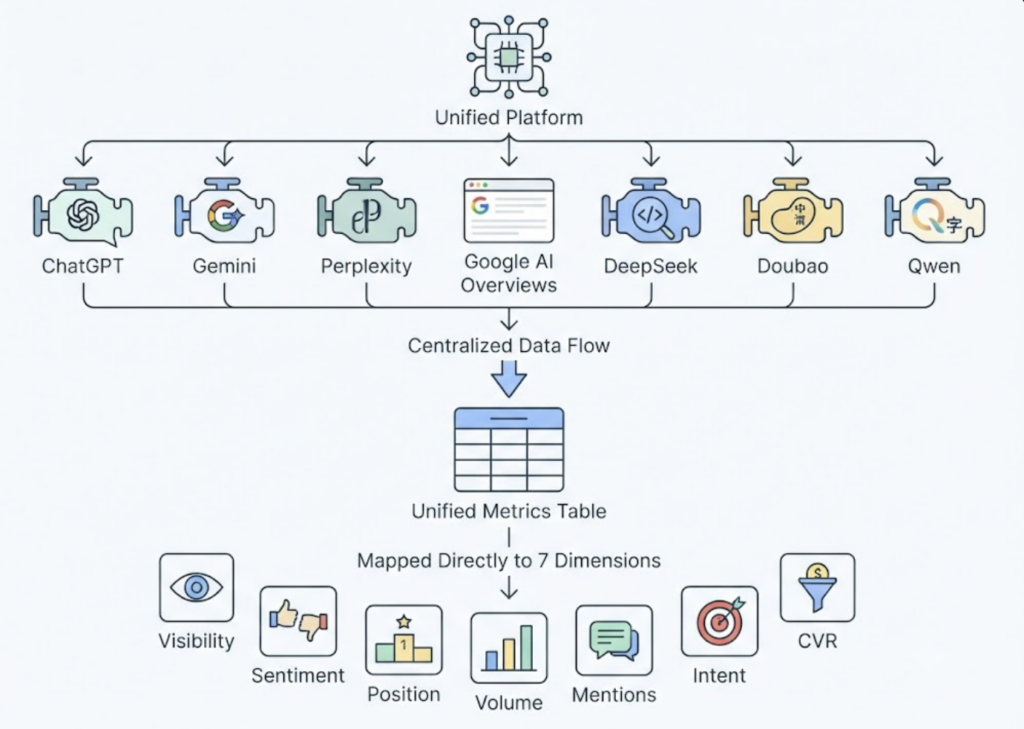
The platform tracks brands across ChatGPT, Gemini, Perplexity, Google AI Overviews, and DeepSeek, plus regional engines like Doubao and Qwen for brands with international audiences. Every prompt in your set is scored across seven dimensions: visibility, sentiment, position, volume, mentions, intent, and CVR, a conversion-oriented estimate of how likely an AI answer is to route users toward your brand. That maps one-to-one onto the metrics table from the measurement section, which means you’re not stitching together partial views from multiple tools.
The source layer is where diagnosis happens. Topify’s citation analysis reverse-engineers the exact domains and URLs each AI engine pulled from. In practice, that means you can watch your ChatGPT mention rate dip, trace it to a specific review site that stopped citing your product, and know precisely which third-party relationship to repair. Without that layer, a visibility drop is just a number that went down.
Competitor benchmarking runs on the same prompt set, so you see who the engines recommend instead of you and which sources earned them that slot.
The execution side closes the loop. You state a goal in plain English, review the proposed strategy, and deploy it in one click. Monitoring that ends in a PDF report is where most tools stop. Plans start at $99/month with a 30-day trial covering 100 tracked prompts and 9,000 AI answer analyses, with full details on the pricing page.
How to Improve AI Search Visibility: A Working Checklist
Monitoring tells you where you stand. Improving the number requires changing what AI engines can find, extract, and trust. This checklist covers the moves with the strongest evidence behind them.
Structure content for extraction. AI models favor atomic content blocks: clear headings, declarative answers, FAQ formatting. Conductor’s benchmarks found that around 44% of AI citations are drawn from the first 30% of a page. Bury your answer in paragraph twelve and you’ve functionally opted out.
Invest in third-party presence. This is the single biggest lever most teams underweight. Brands are 6.5x more likely to be cited in AI responses through third-party media, review sites, directories, and industry publications, than through their own content. Your G2 profile and your press coverage are now retrieval surfaces.
Build comparison content. AI engines lean heavily on “vs.” and “alternative” style sources when synthesizing high-intent answers. Objective comparison pages that evaluate your brand against competitors are among the most reliably cited formats in the category.
Keep entity signals consistent. If your site says enterprise-grade and a directory says budget-friendly, the AI resolves that conflict for you, and not always in your favor. Audit how your brand is described everywhere it appears.
Track prompts, not keywords. Discover the actual questions buyers ask AI engines and cover them directly. Topify’s prompt discovery surfaces high-volume AI prompts in your category as they emerge, and this curated set of free GEO tools covers lighter-weight ways to start.
Avoid the common mistakes. The recurring failure patterns are checking one engine and generalizing, treating a single spot-check as data, using Google rankings as a proxy for AI visibility, and optimizing owned content while ignoring the third-party sources engines actually cite.
Re-measure on a cycle. Given 68% month-over-month citation volatility, a strategy set once and left alone decays quietly. Monthly baseline comparisons are the minimum viable cadence.
Conclusion
The metrics that defined a decade of SEO reporting weren’t built to answer the question your leadership is now asking: what does AI say about us? Rankings measure position on a page. AI search visibility measures whether you exist in the answer at all, and the gap between those two numbers is where competitors quietly win category recommendations.
The starting move is unglamorous but concrete: define a fixed set of high-intent prompts, measure your baseline across every major engine, and only then decide what to optimize. You can get started with Topify and have that baseline within a day, or build a manual version first. Either way, measure before you guess.
FAQ
Q: What are examples of AI search visibility?
A: A project management tool appearing in ChatGPT’s answer to “best project management software for remote teams” is AI visibility. So is a skincare brand cited in a Google AI Overview for “how to treat dry skin,” or a fintech company named in Perplexity’s response to “Stripe alternatives.” In each case, the brand earned a slot inside a synthesized answer rather than a ranked link.
Q: How much do AI search visibility tools cost?
A: Most platforms in this category run between roughly $99 and $500+ per month depending on prompt volume and engine coverage. Topify’s Basic plan starts at $99/month with 100 tracked prompts, 9,000 AI answer analyses, and a 30-day trial, with Pro at $199/month and Enterprise tiers from $499/month.
Q: Can I monitor AI search without Otterly?
A: Yes. The capability that matters isn’t any specific vendor, it’s the framework: multi-engine coverage, a fixed prompt set, source-level citation analysis, and time-series tracking. Any platform that delivers those four, Topify included, gives you a complete monitoring setup.
Q: How often should I measure AI search visibility?
A: Continuously, with monthly baseline reviews at minimum. Since roughly 68% of citing queries change month to month, quarterly checks miss most of the movement. Daily or weekly automated tracking with a monthly strategic review is the cadence most teams settle into.

