

Your CMO asks a simple question in the quarterly review: what’s our AI visibility score? You have screenshots of ChatGPT answers. You have a spreadsheet of Perplexity spot-checks from three weeks ago. What you don’t have is a number.
That gap isn’t a reporting problem. It’s a measurement problem. AI answers change between sessions, engines, and even phrasings of the same question, so a handful of manual checks can’t be turned into a metric anyone should trust. And traditional rank trackers won’t save you, because ranking in Google and getting mentioned by AI turn out to be two different things. Getting to a defensible score starts with understanding what goes into one.
A Single Score Sounds Simple. The Math Behind It Isn’t.
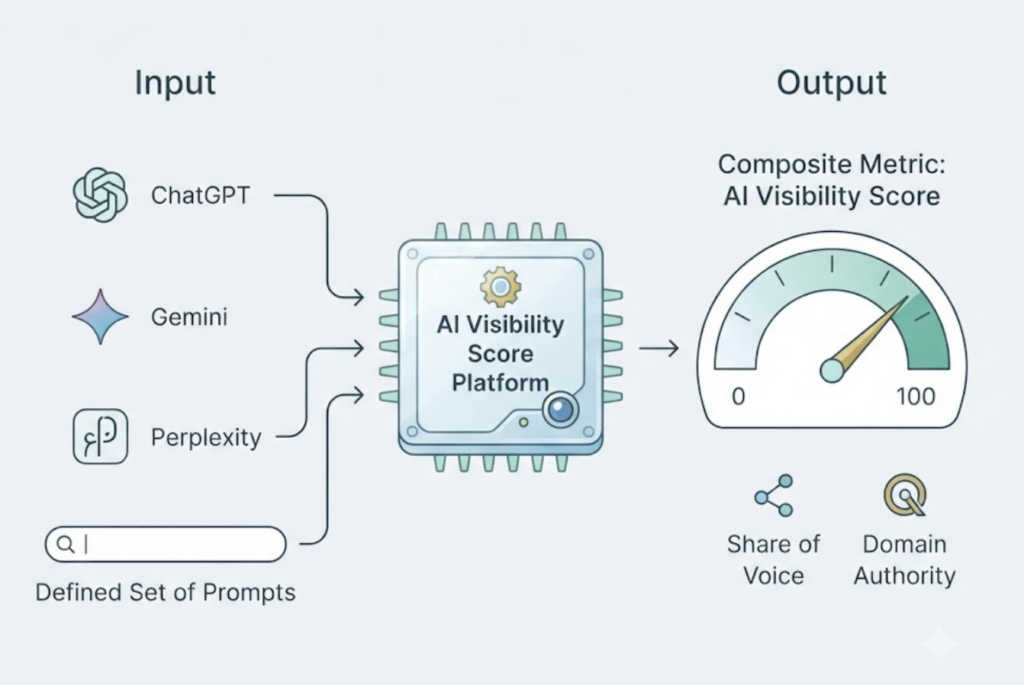
An AI visibility score platform is software that converts scattered AI answer data into one trackable, composite metric: how frequently and how prominently AI engines mention your brand across a defined set of prompts. Most platforms normalize it on a 0 to 100 scale so teams can report it the way they’d report share of voice or domain authority.
The hard part is that AI search is probabilistic. Ask ChatGPT the same question twice and you can get two different brand lists. A 2026 statistical framework on arXiv makes the point directly: a single spot-check of an AI answer is a sample of one, and it fails to account for the stochastic nature of LLM outputs.
One prompt, on one engine, on one day, is not a score. It’s an anecdote.
A credible AI visibility score tool solves this with volume: repeated sampling across a fixed prompt universe, multiple engines, and time. The score becomes a distribution with confidence intervals, not a snapshot. That’s the difference between a metric your leadership can track quarter over quarter and a screenshot that’s stale by Friday.
How an AI Visibility Score Platform Works, Input by Input
Under the hood, most AI visibility score systems follow the same pipeline: define a prompt set, sample answers across engines at high frequency, detect brand mentions, weight each signal, and roll everything into a composite. The formula typically looks like a weighted sum, where each signal gets a weight and a score, summed into the final number.
What varies between platforms is which signals feed the score. The research consensus points to five core components:
Mention frequency. The percentage of prompts in your universe where the brand appears at all. This is the reach layer.
Prominence. Not all mentions are equal. A brand named as the primary recommendation in the answer’s main narrative carries more weight than one buried in a “see also” list.
Citation support. Whether the AI backs the mention with an attributable source link. Cited mentions signal that the engine treats your brand as evidence-backed, not incidental.
Entity resolution accuracy. How reliably the AI identifies your brand, its category, and its value propositions. A mention that miscategorizes your product counts against you in practice, even if it counts toward raw visibility.
Cross-engine consistency. Stability of presence across GPT-4o, Gemini, Perplexity, DeepSeek, and other models. A brand that only surfaces in one engine has a fragile position.
A score you can’t take apart is a score you can’t act on.
That’s the black-box test for any AI visibility score analytics layer. If the platform shows you a 62 but can’t tell you whether the drag comes from low mention rate, weak positioning, or missing citations, the number is a vanity metric. Topify structures its scoring around seven decomposable metrics for exactly this reason: visibility, sentiment, position, volume, mentions, intent, and CVR, each traceable on its own.
What Separates a Real AI Visibility Score Tool from a Repackaged Rank Tracker
Several legacy SEO vendors have bolted an “AI visibility” tab onto their rank trackers. The problem is that SERP data is a lagging indicator for AI answers, and the research shows why.
Studies on ranking–mention separation confirm that a page can rank #1 on Google as a blue link and remain completely invisible in the AI-synthesized answer above it. AI systems weight entity authority and structured extraction, things like tables, definitions, and explicit comparisons, over the backlink counts that drive traditional rankings. Brands with modest domain authority routinely earn “trusted default” status in AI answers because their content is answer-first and schema-backed.
So if a vendor’s AI visibility score software is just re-scoring your existing keyword data, it’s measuring the wrong layer. Here’s what to check instead:
| Evaluation dimension | Repackaged rank tracker | Purpose-built AI visibility score platform |
|---|---|---|
| Engine coverage | Google AI Overviews only | ChatGPT, Gemini, Perplexity, DeepSeek, and more |
| Sampling model | Daily SERP snapshot | Repeated probabilistic sampling with confidence intervals |
| Score decomposition | Single opaque number | Mention rate, position, sentiment, citation share broken out |
| Competitor scoring | Keyword overlap | Same prompt universe, head-to-head, auto-detected rivals |
| Citation attribution | Backlink data | The actual domains AI engines cite when mentioning you |
| Actionability | “Rankings dropped” | “This source stopped citing you on these 14 prompts” |
The citation attribution row deserves emphasis. Knowing which third-party domains trigger your mentions is often more valuable than the score itself, because it tells you where to invest next. That’s a data layer rank trackers were never built to capture.
Where Topify Fits: A Score You Can Take Apart
For teams that need a reportable number backed by decomposable data, Topify’s Comprehensive GEO Analytics is built as a scoring engine first. It monitors brand performance across ChatGPT, Gemini, Perplexity, DeepSeek, Doubao, Qwen, and other major engines, then rolls seven metrics into a view you can drill into: visibility, sentiment, position, volume, mentions, intent, and CVR.
In practice, the workflow looks like this. Your AI visibility score dashboard shows a 12-point drop this month. You open the citation layer and see that a comparison article on a high-authority review site stopped mentioning your brand after an update. You trace exactly which prompts lost coverage, and you know precisely what to fix. Diagnosis to root cause, inside one dashboard, without exporting anything to a spreadsheet.
Competitor context comes standard. Because an AI visibility score is only meaningful relative to your category, Topify auto-detects rivals and scores them against the same prompt universe, so a 58 stops being abstract and becomes “6 points behind the category leader, driven by their Perplexity citation share.”
Then there’s execution. Most tools stop at the diagnosis. Topify’s agent layer takes a plain-English goal, proposes a strategy, and deploys it with one click, closing the loop between the score and the actions that move it. If you want to test the measurement side before committing, Topify also maintains a set of free GEO tools for quick checks.
How to Improve Your AI Visibility Score Without Gaming It
Once you can measure the score, the next question is how to move it. The research points to four levers, and none of them involve keyword density.
Rebuild content answer-first. AI models lift concise, declarative statements. Rewriting page intros so the direct answer comes before the context measurably increases the odds of being synthesized into a response.
Structure your comparisons. LLMs handle “vs” and “alternative” queries constantly, and they favor content with explicit comparison tables and spec breakdowns. Give the model structured evidence and it can recommend you with confidence.
Close third-party source gaps. AI engines synthesize heavily from authoritative external domains: G2, Reddit, niche forums, specialized industry publications. Monitoring which of these domains cite your competitors but not you tends to be higher-leverage than another post on your own blog.
Ship machine-readable signals. Implementing LLMs.txt files and Organization, Product, and Person schema markup significantly raises the probability that AI crawlers resolve your entity correctly, which feeds directly into the entity-accuracy component of your score.
One warning: don’t optimize for a single engine’s quirks. Model updates reshuffle citation behavior every few weeks, so tactics tuned to one engine’s current pattern tend to decay. Optimize the inputs, not the number.
Common Mistakes That Make Your Score Meaningless
Even teams with a real AI visibility score solution in place undermine it with measurement errors. Four patterns show up repeatedly.
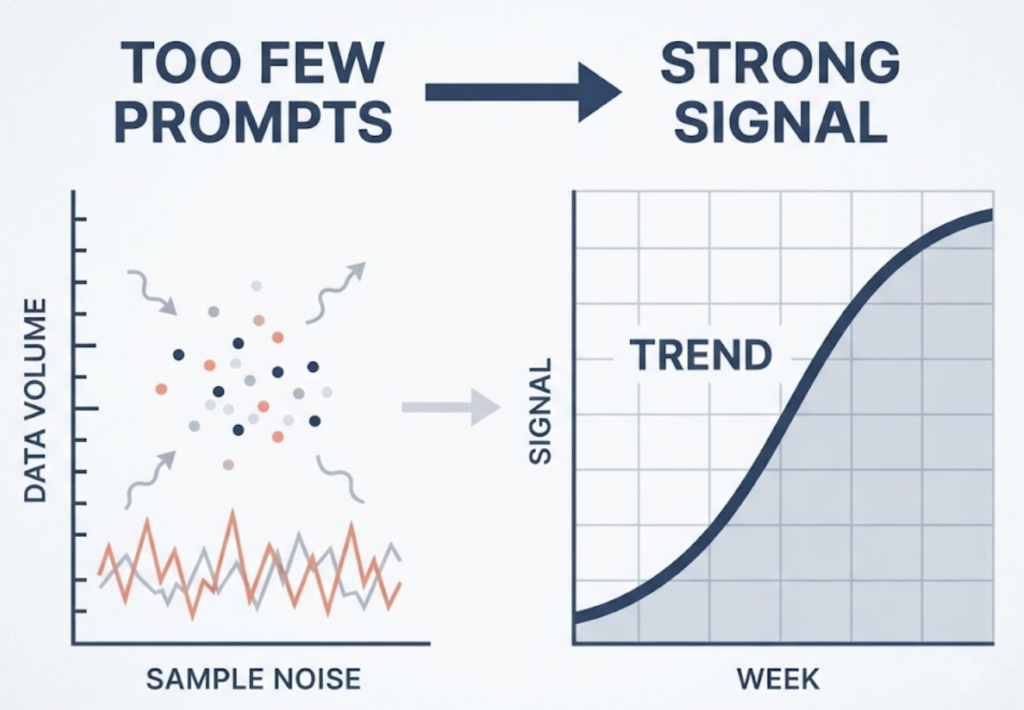
Sample noise read as trend. Too few prompts creates the illusion of movement where there’s only variance. The emerging standard is a prompt universe of at least 100 category-relevant queries before treating week-over-week changes as signal.
Single-engine bias. Tracking only ChatGPT misses how differently other engines behave. Perplexity, for instance, leans heavily on real-time search and cites different source types, so a ChatGPT-only score tells you nothing about a third of your buyers’ AI touchpoints.
Ignoring sentiment. A mention inside a comparison that favors your competitor still counts toward raw visibility. Without a sentiment layer, your score can rise while your actual authority falls.
Cadence errors. Citation patterns shift with every model update. Monthly checks can’t capture that volatility. Bi-weekly sampling is the floor, and high-frequency sampling is becoming the standard for teams that report the score as a KPI.
Each of these is a solved problem at the platform level. Which is the honest argument for buying software instead of building a spreadsheet.
What an AI Visibility Score Platform Costs in 2026
Pricing for AI visibility score platforms generally scales on three variables: prompt volume, engine coverage, and seats. Entry tiers across the category tend to run from double digits to a few hundred dollars per month, with enterprise plans climbing well past that once agencies or multi-brand teams need volume.
Topify’s tiers map cleanly to team size. The Basic plan at $99/month includes 100 tracked prompts, 9,000 AI answer analyses, and coverage across ChatGPT, Perplexity, and AI Overviews, with a 30-day trial. Pro at $199/month raises that to 250 prompts and 22,500 analyses across 8 projects. Enterprise starts at $499/month with a dedicated account manager.
The buying advice is the same regardless of vendor: start with a prompt set that matches the questions your actual buyers ask, not a generic keyword export. A 100-prompt universe built from real buyer questions produces a more decision-ready score than 500 prompts of keyword filler. Expand once the score starts driving decisions.
Conclusion
The next time leadership asks for your AI visibility score, the goal isn’t just to have a number. It’s to have a number you can defend: sampled across engines, decomposed into mention rate, position, sentiment, and citations, and benchmarked against the competitors AI actually recommends in your category.
The test for any platform is decomposition. If you can’t peel the score back to the specific prompts, engines, and sources driving it, keep looking. If you want to see what a decomposable score looks like on your own brand, you can start with Topify’s trial and have a baseline within the first sampling cycle.
FAQ
Q: What is an AI visibility score platform?
A: It’s software that measures how often and how prominently AI engines like ChatGPT, Gemini, and Perplexity mention your brand across a defined set of prompts, then converts that data into a composite 0 to 100 score you can track over time and benchmark against competitors.
Q: How does an AI visibility score platform work?
A: The platform samples AI answers repeatedly across a fixed prompt universe and multiple engines, detects brand mentions, and weights signals like mention frequency, position, sentiment, and citation support into a composite score. Because AI outputs are probabilistic, credible platforms calculate the score as a distribution rather than a single snapshot.
Q: Can you calculate an AI visibility score manually?
A: You can approximate one with a spreadsheet, but the statistics work against you. Stable measurement requires 100+ prompts sampled repeatedly across several engines at bi-weekly or faster cadence, which quickly becomes thousands of answer analyses per cycle. Manual tracking can’t sustain that volume or catch citation shifts between checks.
Q: What’s a good AI visibility score?
A: There’s no universal benchmark, because the score is relative to your category. A 55 in a crowded SaaS niche where the leader sits at 60 is a strong position; a 55 where the leader holds 85 is a visibility gap. Competitor-relative scoring matters more than the absolute number.

