

Your team can pull a Google ranking for any keyword in seconds and tell exactly where you sit. Then someone asks ChatGPT to recommend a product in your category, and you have no idea whether your brand came up at all. Most of the tools that promise to answer that question measure it differently, so the numbers don’t even agree with each other. The gap isn’t accepting that AI matters. It’s knowing what “being mentioned” actually looks like, and how an AI mention tracking solution measures it without guesswork.
What an AI Mention Tracking Solution Actually Is
An AI mention tracking solution is an automated system that monitors how often, where, and in what context your brand shows up inside the answers generated by AI engines like ChatGPT, Perplexity, Gemini, and Google AI Overviews.
The distinction that matters: traditional rank trackers measure your position on a list of links. A mention tracking solution measures entity-level presence. It asks whether the AI named your brand at all, not where your domain landed on page one.
That’s a different question than SEO has ever answered.
Here’s why it’s become urgent. As more buyers consume an AI’s summary without clicking through to any site, the AI’s description of your brand often becomes the final touchpoint before a decision. If you’re not in the answer, you’re not in the consideration set. And no amount of domain authority tells you whether that happened.
How an AI Mention Tracking Solution Works
These solutions don’t crawl the web the way a search engine does. They simulate the way your customers actually query AI.
The mechanism runs in four stages. First, you define a prompt set: the high-intent questions a buyer would ask an AI when researching your category. Second, the solution sends those prompts to multiple AI engines at once. Third, it parses each response to find your brand entity, noting the position, the surrounding context, and whether a citation links back to a source. Fourth, it repeats the sampling on a schedule.
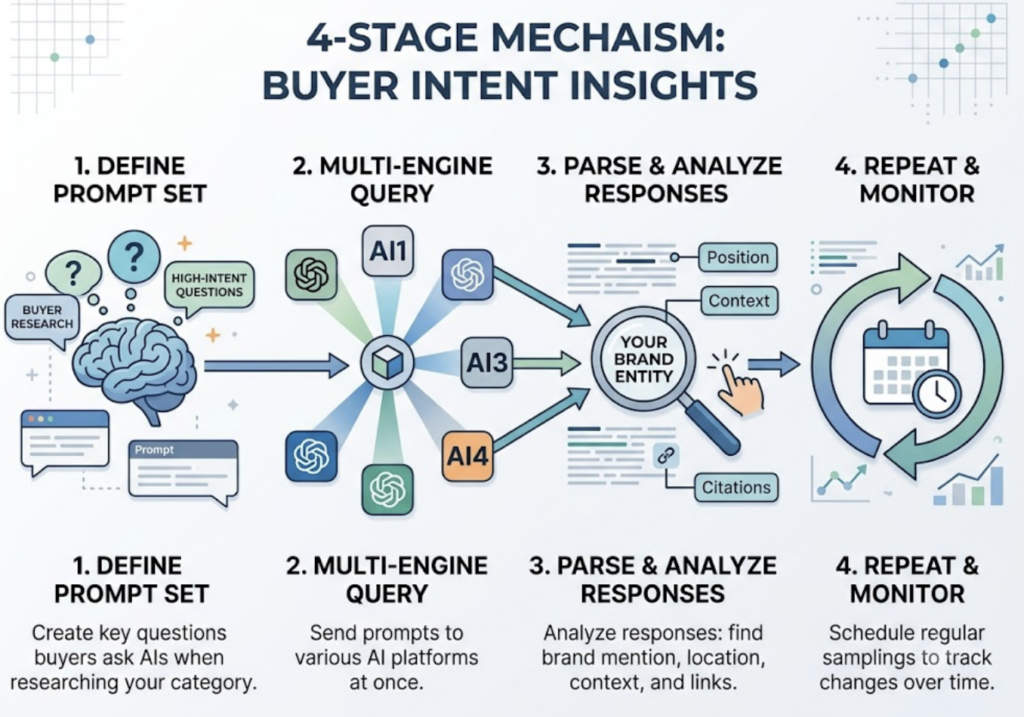
That last step is the one teams underestimate.
AI answers are unstable. Your brand can appear in a response today and vanish tomorrow after a model update or a shift in how the engine weights its sources. A single check is a snapshot, and snapshots lie. Running recurring samples is what turns scattered observations into a statistically meaningful visibility score instead of a misleading one-off reading.
How to Measure AI Mentions: The Metrics That Matter
Counting mentions is the easy part. Turning them into something a marketing team can act on takes a framework.
Most serious platforms track a handful of signals together, because any one of them in isolation misleads.
| Metric | What It Tells You |
|---|---|
| Mention Rate | The share of relevant prompts where your brand shows up |
| Share of Voice | Your prominence relative to direct competitors |
| Sentiment | The tone the AI uses when it describes you |
| Citation Attribution | Which external pages are feeding the AI’s trust in you |
| Positioning | Whether you’re top-of-answer or buried near the end |
A high mention rate paired with negative sentiment isn’t a win. Top positioning that traces back to a competitor’s review page tells you where your real vulnerability sits.
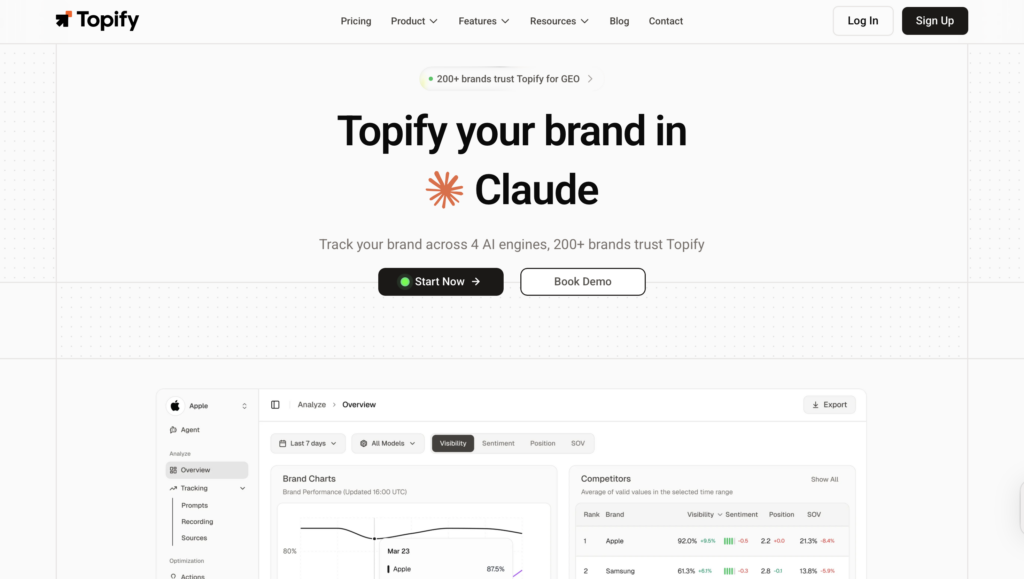
This is where consolidation helps. Topify folds these signals into Comprehensive GEO Analytics, a single dashboard built around seven core metrics: visibility, sentiment, position, volume, mentions, intent, and CVR. The point isn’t more numbers. It’s being able to spot a drop in ChatGPT mentions and trace it to the source that stopped citing you, all without switching tools.
Improving Mentions Through GEO Content Structure and Formatting
Tracking tells you you’re invisible. The next question is why. More often than not, the answer is that your content isn’t built for an AI to extract.
This is the part most teams miss. Generative engines pull from content that’s structured for extraction: declarative headings, answer-first paragraphs, FAQ schema, and clearly bounded claims they can lift into a synthesized response. Get your geo content structure and formatting wrong, and even authoritative content stays buried.
A few structural shifts tend to move the needle:
- Lead each section with the answer, then explain. AI engines favor passages where the conclusion comes first.
- Use headings that state a claim, not a topic. “How mention tracking works” gives the engine something to quote. “Overview” gives it nothing.
- Add structured data and FAQ markup so machines can map your content to specific questions.
There’s a second lever: reverse-engineering citations. When a tracking solution shows a competitor getting cited, it can surface the source. Often the AI isn’t citing the competitor’s homepage at all. It’s citing a third-party review or an industry forum. That insight redirects your PR and link efforts toward the domains the AI actually trusts, rather than the ones you assume it does.
Choosing the Right AI Mention Tracking Solution
The tools in this category look similar on a feature list and behave very differently in practice. A few criteria separate them.
Engine coverage comes first. A solution that only watches Google AI Overviews misses the conversational volume sitting in Perplexity and ChatGPT. If your buyers live in those interfaces, partial coverage is a blind spot, not a discount.
Then there’s the depth question. Does the dashboard stop at “you were mentioned 40% of the time,” or does it show the source attribution you need to fix the gap? Mentions without explanation are a vanity metric.
Competitor benchmarking matters too. You want to see your mention rate next to your top three to five rivals, tracked on the same prompts, over the same window.
For teams weighing the options, Topify covers the major engines including ChatGPT, Gemini, Perplexity, and DeepSeek, and pairs that coverage with competitor benchmarking and citation analysis in one place. Its one-click execution layer also closes the loop, letting teams push content and structured-data updates right after a gap shows up, instead of handing the work off to a separate workflow.
Other tools in the space each have their niche. The deciding factor is usually whether a platform explains the “why” behind a mention or just reports the “what.”
AI Mention Tracking Solution Pricing: What You’re Paying For
Pricing in this category rarely tracks features. It tracks scale.
Most platforms price on three variables: how many prompts you monitor, how many engines you cover, and how often you sample. A bigger prompt set and a faster cadence cost more because they consume more analysis. That’s the real unit of value, not a bundle of dashboard widgets.
As a rough benchmark, focused category monitoring tends to start around $99 a month, while multi-seat plans with deeper analysis and historical trends run from roughly $199 to $499 and up.
Topify follows that logic. Its Basic plan runs $99 a month with tracking across ChatGPT, Perplexity, and AI Overviews, 100 prompts, and a 30-day trial. Pro steps up to $199 a month with 250 prompts and more seats, and Enterprise starts from $499 with a dedicated account manager. You can see the full breakdown on Topify’s pricing page, or get started with Topify on the trial.
The takeaway: don’t pay for prompts you won’t use. Start with the prompt set that maps to your real buyer questions, then expand once the data earns it.
Conclusion
The hard part of AI search was never accepting that it matters. It’s knowing what “being mentioned” looks like and tracking it without guessing. An AI mention tracking solution closes that gap by turning scattered AI answers into a measurable signal, then pointing you at the content and citation fixes that move it.
Start small. Run a baseline audit across your top buyer-intent prompts, find the questions where you’re already a close runner-up, and work those first. Visibility in AI search compounds. The brands tracking it now are the ones AI will keep recommending later.
FAQ
Q: What’s an example of an AI mention tracking solution in action?
A: A SaaS brand notices it’s rarely named when users ask ChatGPT for the best CRM for startups. The tracker reveals ChatGPT keeps citing a competitor’s comparison article. The team updates its own site with comparable data and refreshes its third-party review profile to reclaim the citation, then watches the mention rate recover on the next sampling cycle.
Q: What should a basic mention tracking checklist include?
A: Four things. Define your core buyer prompts, choose at least three major AI platforms to monitor, set a monthly cadence for data collection, and assign one person to bridge the gap between citation findings and content updates.
Q: What are the most common mistakes when tracking AI mentions?
A: Three show up repeatedly. Tracking too few prompts, which leaves you with low statistical power. Monitoring only one AI platform. And fixating on mention count while ignoring the sentiment and context around each mention.
Q: What’s a good starting strategy for AI mention tracking?
A: Run a one-time visibility audit across your top 50 buyer-intent queries to set a baseline. Use it to spot the low-hanging fruit, the prompts where your brand is already a close runner-up, and prioritize those before chasing the harder wins.

