

You ran the AI visibility report. Your brand shows up in maybe two out of ten answers for the queries that matter, while a competitor you rarely think about gets cited in seven. The report gave you the number. It didn’t tell you why, or what to fix first.
That’s the frustrating part of citation share work. The gap is easy to measure and painful to close, because the levers that move it aren’t the ones traditional SEO trained you to pull. The good news: citation behavior follows patterns. Once you can see which sources AI reaches for and why, raising your share stops being guesswork.
What AI Citation Share Actually Measures (and Why Rankings Don’t)
AI citation share is the percentage of AI-generated answers that cite your domain as a source, measured across a defined set of category-relevant queries. It’s a share, not a rank. If a topic generates 100 citations across ChatGPT, Perplexity, and Google AI Overviews, and your domain accounts for 12 of them, your citation share is 12%.
This is a different metric from the two most teams already track. Share of Voice counts how often your brand gets mentioned across media. Search rankings track your position in a list of blue links. Neither one tells you whether an AI engine treats your page as evidence worth quoting.
Here’s the distinction that matters most. A brand mention inside AI-generated narrative is often a residue of training data. A citation is a receipt: the engine retrieved your page in real time and attributed a specific claim to it. Being mentioned is not the same as being cited.
| Metric | What it tracks | What moves it |
|---|---|---|
| Search Rankings | Position in the results list | Backlinks, domain authority, on-page SEO |
| Share of Voice | Brand mention volume across media | PR, social reach, ad spend |
| AI Citation Share | Share of AI answers that cite your domain | Extractability, semantic relevance, entity coherence |
The reason rankings don’t predict citations is structural. Up to 80% of the sources AI platforms cite don’t appear in the top 10 of traditional search for the same query. Different pipeline, different winners.
Tactic 1: Find Out Which Sources AI Already Cites in Your Category
Don’t start by producing more content. Start by reverse-engineering the current citation landscape.
LLMs don’t rank pages the way Google does. They run a retrieval pipeline: analyze the query, pull semantically close content using vector embeddings, re-rank candidates on structural and authority signals, then attribute claims to the sources they kept. If you want to understand how LLMs choose which sources to cite, you have to look at the sources they’re already citing in your space.
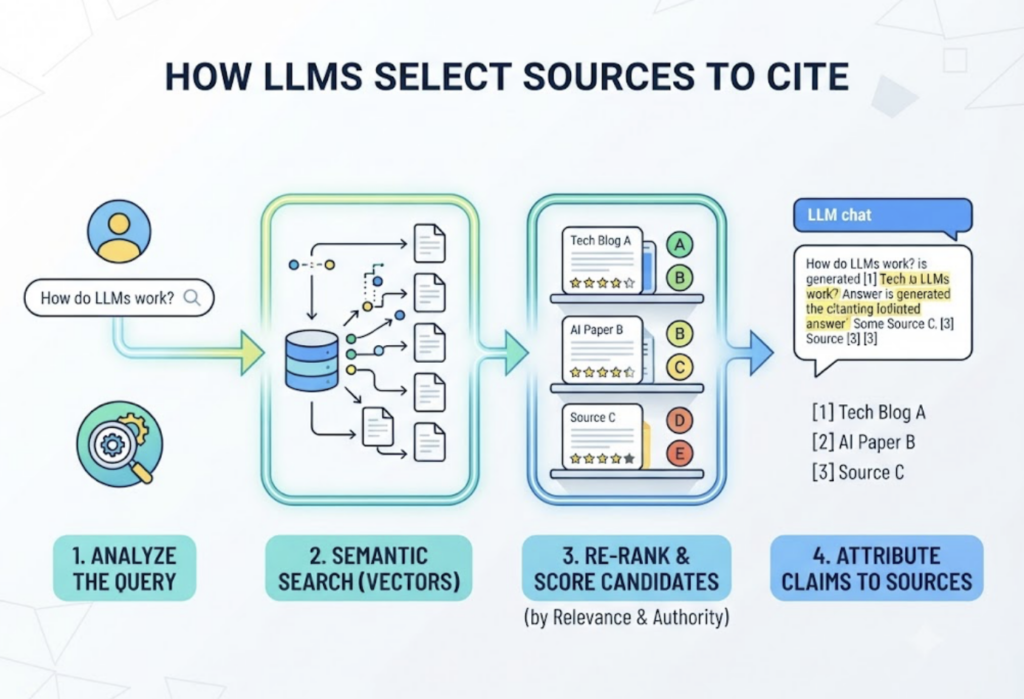
Pull the domains and URLs that AI engines reference for your top category prompts. Look for concentration. In most categories, a small set of pages absorbs the majority of citations, and they usually share a structure worth copying.
This is where a citation-source view earns its keep. Topify includes a Source Analysis function that reverse-engineers the exact domains and URLs AI platforms cite, so you can see whether you or your competitors dominate those references before you write a single new sentence. Map the landscape first. Everything after this tactic is a response to what you find.
Tactic 2: Structure Content the Way LLMs Extract It
Extractability is the single biggest lever most teams ignore. An engine can only cite what it can pull cleanly out of your page without losing the meaning.
Lead with the answer. Put the core response in the first 40 to 75 words of a section, using a simple pattern: define the entity, answer the question directly, then add supporting evidence. Burying the answer under three paragraphs of setup is how good content goes uncited.
Then break the body into small, self-contained blocks. Two to four lines each, written so a model can quote the block without needing the surrounding context to make sense.
Format for machines as well as people. Comparison tables, numbered lists, and clear bullet points give engines discrete, quotable units. Structured formats like tables can lift citation rates by up to 2.5x over the same information delivered as prose. Same facts, very different pickup.
Tactic 3: Earn Citations From Sources AI Already Trusts
LLMs build evidence graphs to resolve contradictions between sources. When two pages disagree, the engine leans toward the one that’s corroborated elsewhere and broadly recognized.
That produces a systematic bias toward third-party, earned media. Industry publications, well-cited research, and active community forums tend to get pulled more often than a brand’s own marketing pages making the same claim. The engine reads independent corroboration as a trust signal.
So a real citation strategy isn’t only about your own site. It’s about getting your data, definitions, and point of view embedded in the sources AI already reaches for. A single stat cited in a respected industry report can do more for your citation share than ten blog posts on your own domain.
Tactic 4: Write for the Prompt, Not Just the Keyword
Keywords are how people searched Google. Prompts are how people talk to AI, and they carry more intent, more context, and usually a follow-up.
Match that. Use question-style headings that mirror the exact phrasing a user would type, and answer each one as a clean, standalone unit. Applying FAQPage schema to genuine question-and-answer pairs helps here, because engines frequently pull from structured segments that offer a clear, extractable factual unit.
Then anticipate the second question. Someone asking how to increase AI citation share will almost certainly wonder how citation share differs from share of voice, or how long improvements take to show up. Cover the chain, not just the entry point, and you become the source that answers the whole conversation.
Tactic 5: Keep Your Facts Fresh and Consistent Everywhere
Contradictory or stale information gets down-weighted. If your homepage says one thing, a directory listing says another, and a two-year-old post says a third, the engine has no stable version of your brand to trust.
Entity coherence fixes this. Define your brand, your category, and your key facts the same way across every platform you appear on: your site, press releases, industry profiles, and social. Consistency lets the model validate your authority instead of hedging around it.
Freshness compounds the effect. Update your highest-priority pages on a regular cadence so the numbers, product details, and claims stay current. Facts drift, and so does model behavior.
Tactic 6: Measure Your AI Citation Share Before and After Every Change
You can’t improve what you don’t baseline. And manual spot-checks won’t cut it, because AI responses are probabilistic: ask the same question twice and you may get two different source sets.
A credible tracking setup does three things. It uses a defined prompt perimeter of 30 to 50 high-intent queries rather than one broad term. It monitors ChatGPT, Perplexity, and Google AI Overviews at once, since each engine sources differently. And it normalizes the data by dividing your citations by the total pool of citations in the set, so the number holds up across platforms.
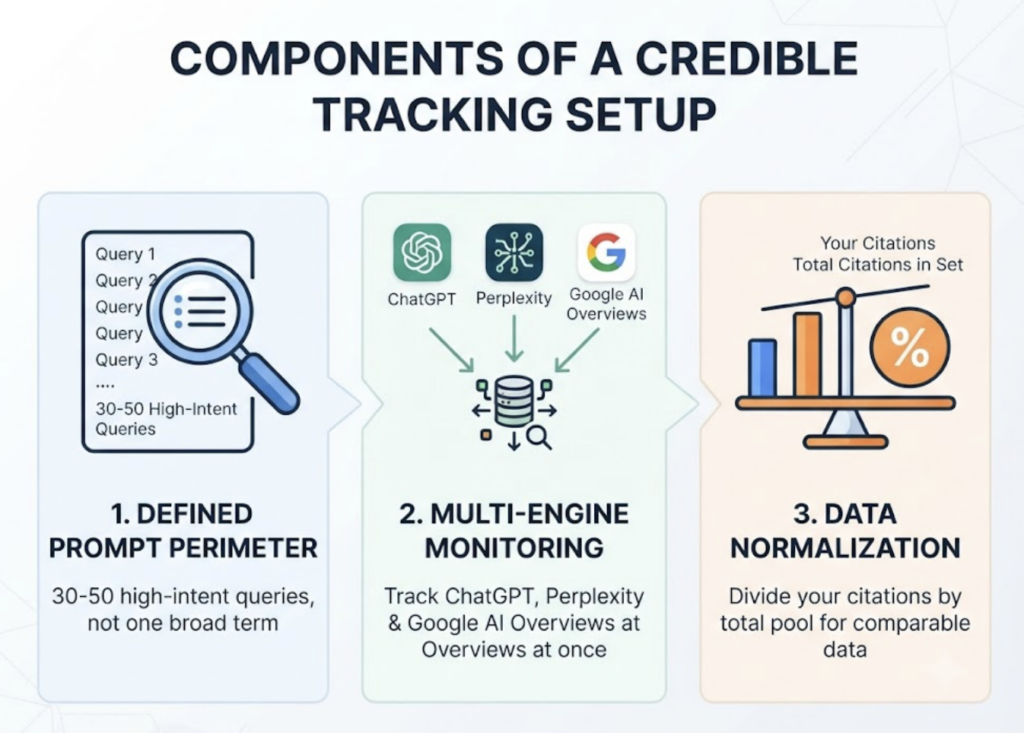
This is measurement work, not intuition. Topify’s Visibility Tracking quantifies your citation share across major AI platforms, and its Competitor Benchmarking shows how much of the pool each rival is taking. Run the baseline, ship a change, then re-measure so you can attribute movement to the specific tactic that caused it. Ship. Measure. Attribute.
Tactic 7: Take the Gaps Your Competitors Left Open
Not every prompt in your category is contested. Some high-intent questions get thin, generic AI answers because nobody has published a genuinely citable source yet.
Those gaps are the fastest wins. Find the prompts where the current citations are weak, off-topic, or dominated by a single aging page, and build the answer-first, well-structured resource that engine has been waiting for. You’re not fighting an entrenched competitor there. You’re filling a vacuum.
Prioritize by data, not by hunch. The prompts with high intent and weak incumbent citations should sit at the top of your content queue, ahead of the ones where a strong competitor already owns the reference.
Conclusion
Low citation share is rarely a content-volume problem. It’s a signal that you’re not showing up at the citation layer, where extractability, corroboration, and consistency decide who gets quoted. The teams that win treat their content as a source to be reused, not a page to be ranked.
Start narrow and sequence it. Baseline your share against your top three competitors, reverse-engineer the pages AI already cites, fix structure and consistency on your highest-intent pages, then re-measure every couple of weeks to account for model drift. If you want the tracking and source analysis in one place, you can get started with Topify and see where your share stands before you change anything.
FAQ
Q: What’s the difference between AI citation share and share of voice?
A: Share of voice measures how often your brand is mentioned across media. AI citation share measures how often AI engines cite your domain as a source in their answers. A mention is often a byproduct of training data, while a citation is a real-time retrieval that treats your page as evidence.
Q: How long does it take to improve AI citation share?
A: It varies by category and how competitive the citation landscape is. Structural fixes like answer-first formatting and tables tend to show up faster than authority-based gains, which depend on earning references from trusted third-party sources. Because models update frequently, treat improvement as an ongoing cadence rather than a one-time project.
Q: Do I need to track every AI platform separately?
A: Yes, at least the major ones. ChatGPT, Perplexity, and Google AI Overviews use different sourcing logic, so a source that dominates one may barely appear in another. Tracking them together and normalizing by the total citation pool gives you a share number you can compare across platforms.
Q: Is low citation share a content problem or an authority problem?
A: Usually both, in that order. Extractability and structure are the first fixes because engines can’t cite what they can’t cleanly parse. Once your pages are citable, corroboration and entity consistency across trusted external sources determine how often you actually get chosen.

